MONA LISA WITH ROCKET LAUNCHER
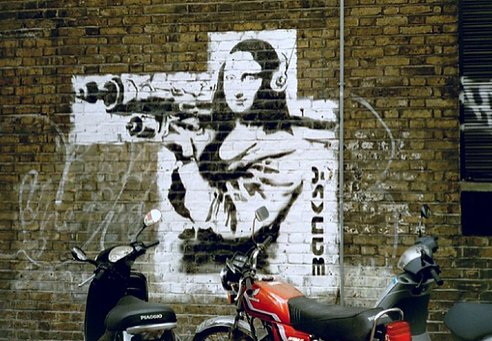
Mona Lisa Goes to War
Leonardo da Vinci's Mona Lisa sits with her familiar composure, her expression apparently unchanged after five centuries. Banksy, however, has removed her from the landscape of Renaissance Florence and equipped her with a rocket launcher and military communications headset.
The juxtaposition is characteristically economical. One of the most recognizable images of Western culture is combined with one of the most recognizable instruments of modern warfare. Banksy does not distort Mona Lisa's face or turn her into a caricature. Her serenity is essential to the work: she handles the weapon with the same enigmatic calm with which Leonardo's sitter originally folded her hands.
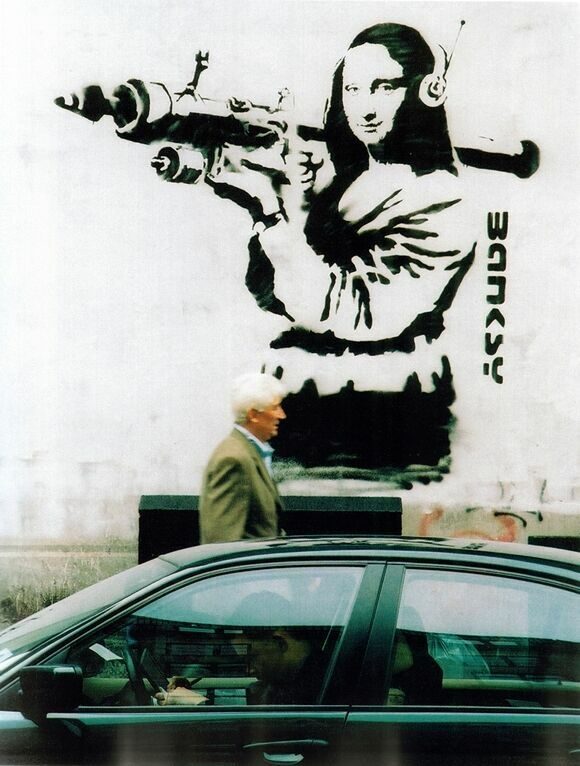
The mural has frequently been dated to 2007, including on the existing Banksy Explained catalogue page, but the documentary record establishes a significantly earlier date. A contemporary online discussion from February 2002 identifies the work on Poland Street in Soho, while later scholarship drawing upon Banksy's Wall and Piece dates the mural to 2001. Stephen Gough's research likewise identifies the Soho work as 2001 and records that the enormous stencil reportedly took only around fifteen minutes to execute.
The World's Most Famous Face
Banksy's choice of the Mona Lisa is significant precisely because the original painting requires almost no introduction. By the beginning of the twenty-first century, Leonardo's portrait had long escaped the confines of the Louvre to become a universal cultural image, endlessly reproduced, advertised, parodied and appropriated.
Banksy enters an equally long history of artists interfering with her. Marcel Duchamp famously added a moustache and goatee to a postcard reproduction in L.H.O.O.Q. in 1919, while subsequent generations repeatedly appropriated Leonardo's portrait through Pop Art, advertising and mass culture. Banksy's intervention belongs to this tradition but introduces something more threatening. He does not merely ridicule an icon of high culture; he arms her.
The collision is particularly effective because the rocket launcher belongs to an entirely different visual vocabulary. Leonardo's portrait has come to represent artistic refinement, historical continuity and cultural prestige. The weapon represents technological violence and contemporary conflict. Banksy compresses those two worlds into a single instantly comprehensible image.
The Headset and the Rocket Launcher
The military headset is a small but important detail. Mona Lisa is not simply carrying a weapon she has accidentally acquired. She appears equipped for combat, connected to some unseen command structure and prepared to use it. Banksy employed similar communications equipment on the protagonist of Monkey Detonator, another image in which an apparently incongruous figure is given control over potentially catastrophic violence.
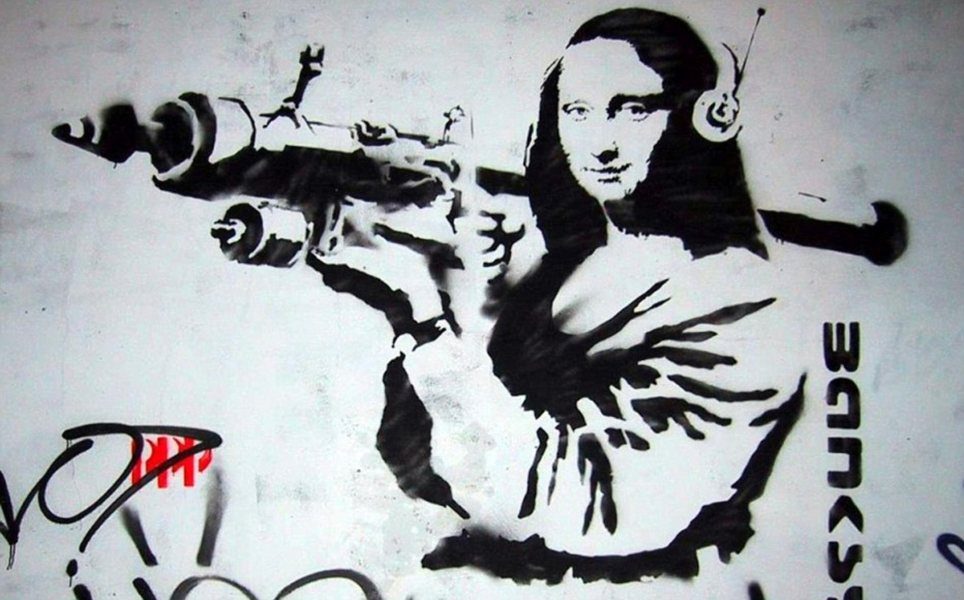
The rocket launcher also connects Mona Lisa with Banksy's rapidly developing anti-war vocabulary of the early 2000s. In Bomb Hugger, a young girl embraces an aerial bomb; in Happy Choppers, attack helicopters acquire decorative bows; in Bombing Middle England, pensioners play bowls with explosives. The mechanism is consistent: objects or figures associated with innocence, familiarity or cultural respectability are brought into direct contact with military hardware.
What makes Mona Lisa with Rocket Launcher especially unsettling is the absence of visible alarm. She does not appear frightened, angry or even particularly interested in the weapon she carries. Banksy preserves the emotional ambiguity of Leonardo's sitter and allows it to acquire a new meaning. Her famous composure begins to resemble indifference.
That makes the image less an illustration of war than a comment on its normalization. Modern conflict can coexist with ordinary life at a comfortable distance, transmitted through television and newspapers while daily routines continue elsewhere almost undisturbed. Banksy's Mona Lisa embodies that contradiction: civilization's most celebrated smile and the machinery capable of destroying civilization occupy the same figure.
An Early Banksy Mona Lisa
The Soho mural was not Banksy's only engagement with Leonardo's image. Significantly, an authenticated unique Mona Lisa on board was already executed in 2000. Christie's records that work as having been acquired directly from Banksy and describes the figure as similarly equipped with a rocket launcher. The motif therefore belongs to a particularly early phase of Banksy's practice, rather than the later 2007 period to which the street mural has sometimes been assigned.
This places Mona Lisa with Rocket Launcher alongside Banksy's earliest experiments in appropriating the canon of art history. The strategy would become central to his work, culminating particularly in the Crude Oils and vandalised paintings, where Monet, Van Gogh, Edward Hopper and other familiar images are invaded by shopping trolleys, abandoned vehicles, surveillance devices and the debris of contemporary life.
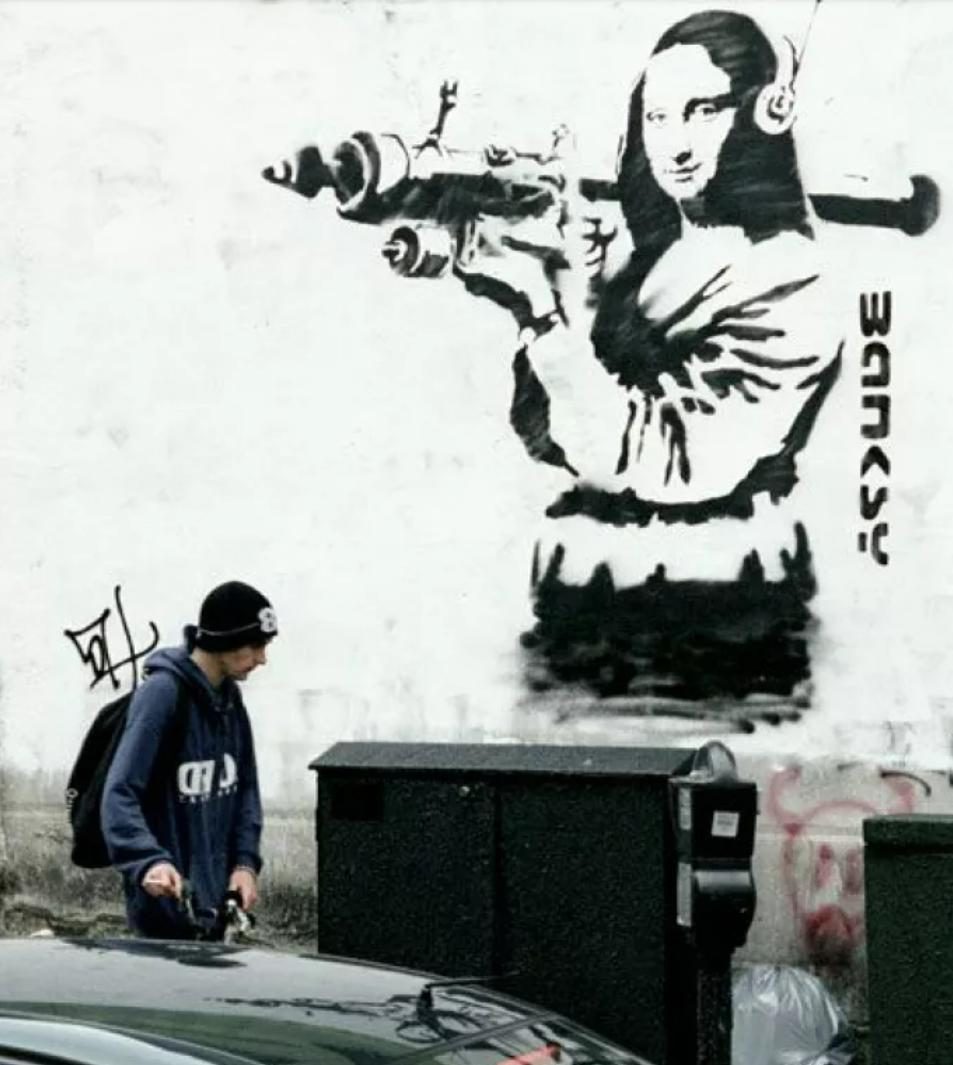
Banksy's relationship with art history is rarely one of simple parody. He generally preserves enough of the original image for its cultural authority to remain intact and then introduces a contemporary contaminant. The joke depends upon recognition, but the collision allows the old image to speak about a world its original artist could never have imagined.
A Mural That Lasted Days
Like many of Banksy's early London works, Mona Lisa with Rocket Launcher had an extremely short physical existence. The historical record preserved in Wall and Piece states that the work was converted into Osama bin Laden by an unknown artist and then removed after only two days. A February 2002 discussion provides unusually valuable contemporary corroboration: a contributor who knew the work on Poland Street reported that someone had already transformed it into bin Laden and that it had subsequently been completely blacked out.
That brief afterlife is characteristic of the collaborative and unstable nature of early street art. Banksy appropriated Leonardo; another anonymous street artist immediately appropriated Banksy; somebody else erased the result. The wall therefore accumulated several authors in a matter of days.
The original mural survives principally through photographs, one of which shows the figure beneath the decidedly un-museum-like architecture of the Soho wall and its barbed wire. That context matters. The world's most famous museum portrait had temporarily escaped the Louvre only to reappear armed with a rocket launcher on a London street.
Mona Lisa with Rocket Launcher contains in embryonic form several ideas that would become fundamental to Banksy's work: appropriation, anti-war imagery, the corruption of cultural icons and the collision between beauty and violence. Its early date is particularly revealing. By 2001, Banksy was already discovering that he could communicate complex contradictions simply by combining two images that apparently had no business occupying the same space.
The work also anticipates his later vandalised paintings. Banksy does not destroy Leonardo's icon; he needs its familiarity intact. Mona Lisa remains Mona Lisa, complete with the expression that has fascinated viewers for centuries. The rocket launcher merely forces that expression into a completely different moral landscape.
Her smile has not changed. What has changed is what she is smiling beside.
STAY INFORMED
Receive the latest news, exhibitions, artworks and market updates on Banksy.