MONKEY DETONATOR
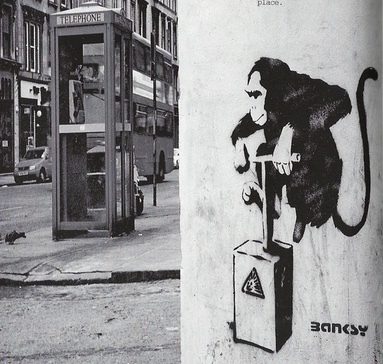
The Monkey at the Detonator
Monkey Detonator belongs to Banksy's earliest and most enduring group of monkey stencils. In this documented London execution, photographed beside a British Telecom telephone box, a crouching chimpanzee operates a traditional plunger detonator. The precise location and date of this particular intervention have not been conclusively established; surviving photographic documentation nevertheless places it within the group of early London street works through which Banksy repeatedly adapted the image during the first half of the 2000s. The approximate dating should therefore be understood as provisional rather than definitive.
The composition is characteristic of Banksy's early use of animals as substitutes for human behavior. A monkey, conventionally associated with the supposedly primitive, has been given control of a device designed to trigger an explosion. The reversal is simple but effective: while the animal appears to threaten destruction, the technology it operates is entirely a human invention. Banksy's monkeys would repeatedly perform this function, holding up an uncomfortable mirror to ideas of intelligence, civilization and authority that would later be developed more explicitly in works such as Laugh Now and Devolved Parliament.
A Recurring Street Image
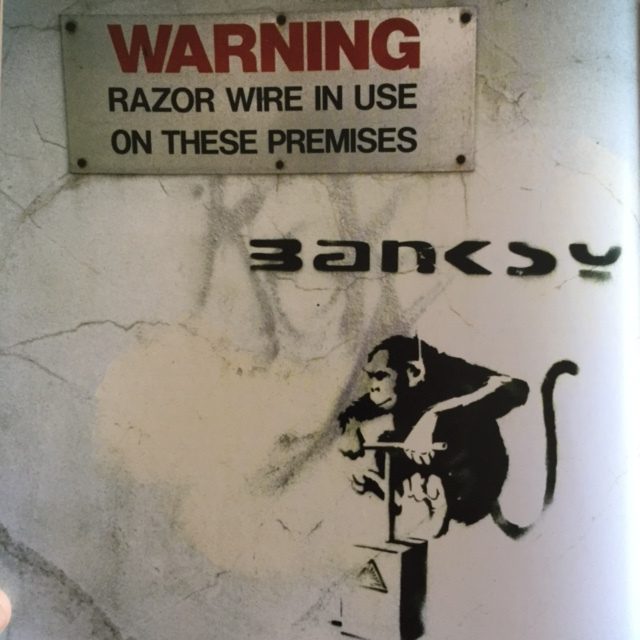
Monkey Detonator was not conceived as an image attached permanently to a single location. Banksy reused and modified the stencil on several walls, allowing the surrounding architecture to alter the composition. Photographs survive of versions positioned around electrical installations, security notices and other pieces of street infrastructure. Existing warning signs—including references to high voltage and razor wire—could consequently become part of the work without being painted by Banksy himself. These variations demonstrate one of the principal advantages of the stencil in Banksy's early practice: a recognizable image could migrate rapidly through the city while acquiring a different meaning at each site.
The origins of the motif appear to extend back to Banksy's Bristol period. An early composition generally known as Slick on Brick has been associated with Easton, Bristol, around 1999, where the monkey reportedly operated a detonator in relation to a safe or industrial doorway. Documentation surrounding these earliest executions is fragmentary, however, and distinctions between dates, locations and individual versions are not always secure. Rather than treating every surviving photograph as evidence of the same mural, they are better understood as records of a stencil Banksy repeatedly deployed and developed during this formative period.
Waterloo, 2006
A considerably better documented version appeared in 2006 beneath Waterloo Station in London. Here Banksy expanded the basic composition into a more elaborate visual narrative, connecting the monkey's detonator to a bunch of bananas transformed into an explosive device. The absurd substitution gives the image an unmistakably comic quality while sharpening its central inversion: the monkey's natural object of desire has become something potentially lethal.
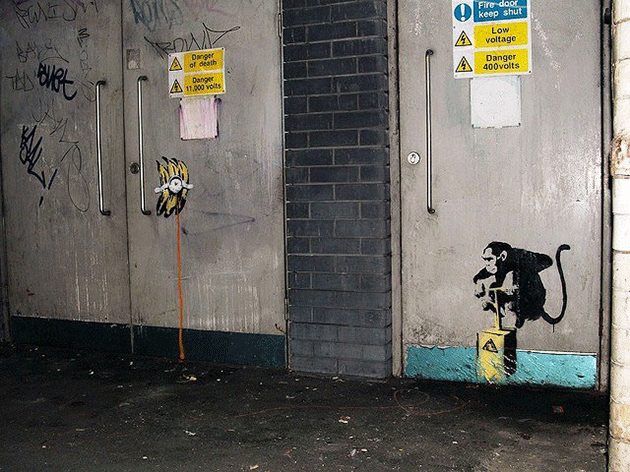
The Waterloo execution is particularly useful in understanding how Banksy continued to revisit an image that had originated several years earlier. Rather than simply reproducing the original stencil, he could introduce new objects and exploit different architectural settings, allowing an established motif to evolve. The area beneath Waterloo Station would itself later acquire considerable significance in Banksy's history when the nearby Leake Street tunnel became the setting for the Cans Festival in 2008.
From the Street to the Studio
The movement of Monkey Detonator between different street locations was accompanied by its almost immediate migration into Banksy's studio practice. Two important 2000 originals already documented in the Banksy Explained catalogue demonstrate that the motif had become an established part of his visual vocabulary at a remarkably early stage.
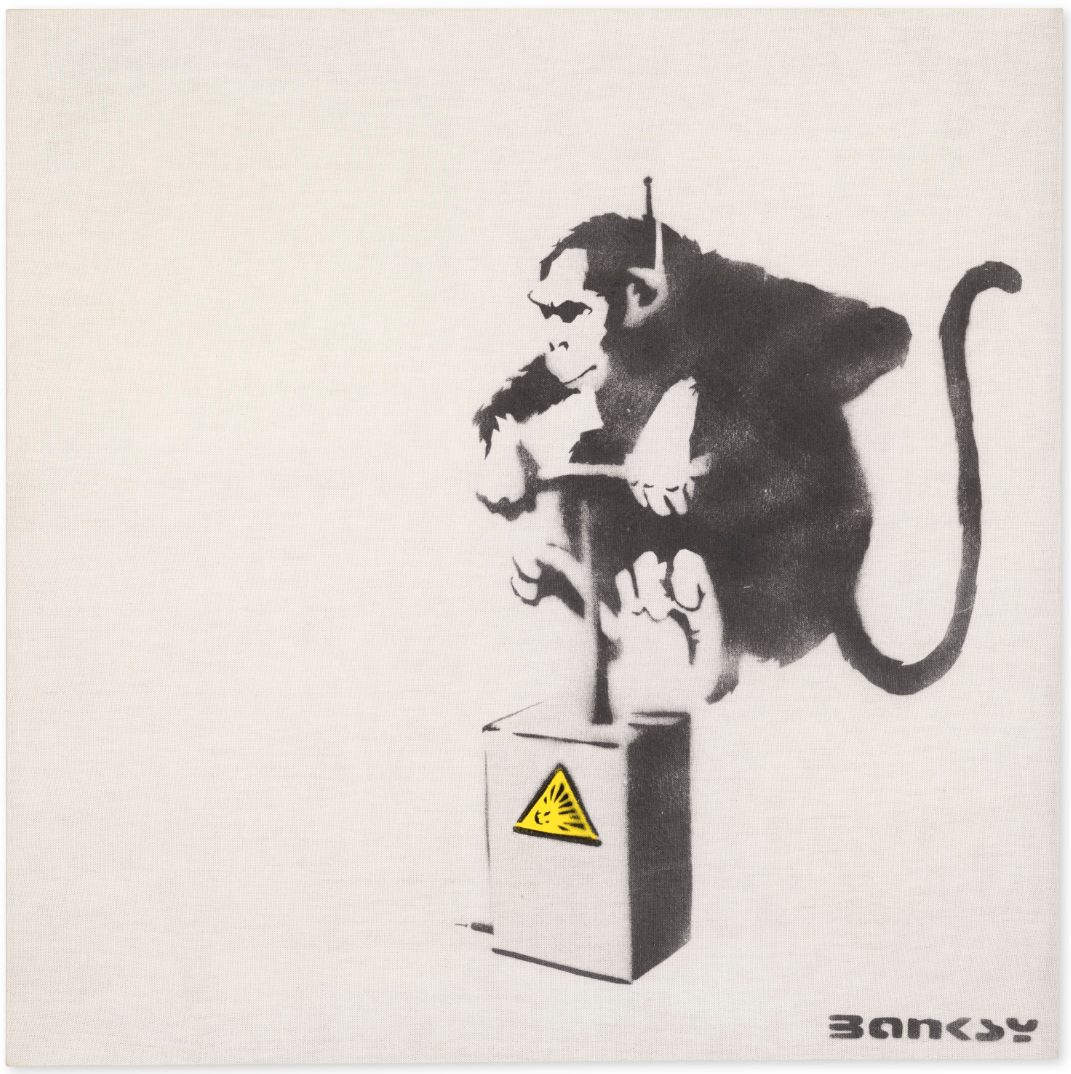
One Monkey Detonator from 2000, executed in spray paint on canvas and acquired directly from Banksy that year, retains the crouching monkey and detonating mechanism while removing the figure from the architecture of the street. The work subsequently sold at Christie's New York on 9 November 2021 for $2,190,000. Christie's described the composition as deriving from a motif originally spray-painted on an industrial wall, providing important documentary evidence for the relationship between Banksy's early street interventions and the studio versions that followed. Monkey Detonator, 2000 — Banksy Explained
A second Monkey Detonator from 2000, executed in acrylic and stencil and unique in its format, provides another early variation on the subject. Stencil-signed BANKSY, the work was later offered at Dreweatts in London in October 2008. Together, these surviving originals demonstrate that Monkey Detonator was never exclusively a street image: from an early stage, Banksy was moving the same visual vocabulary between public walls and unique studio works. Monkey Detonator, 2000 — Banksy Explained
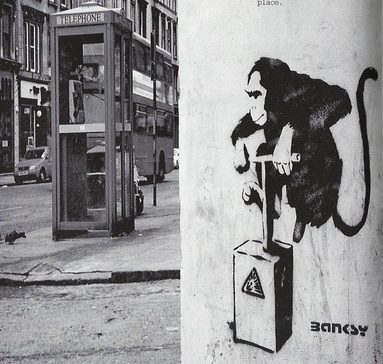
The photograph beside the BT telephone box therefore provides a useful physical anchor for a motif whose complete early chronology remains difficult to reconstruct. Rather than assigning an unsupported precise date or address to this particular execution, the broader evidence allows us to follow the image with greater confidence across Banksy's formative practice: from its probable Bristol origins around 1999, through early London street versions and the documented 2000 originals, to the more elaborate Waterloo composition of 2006. In doing so, Monkey Detonator offers an unusually clear example of the fluid relationship between street intervention, repeated stencil and unique studio work that characterized Banksy's early development.
STAY INFORMED
Receive the latest news, exhibitions, artworks and market updates on Banksy.