NO BALL GAMES
No Ball Games
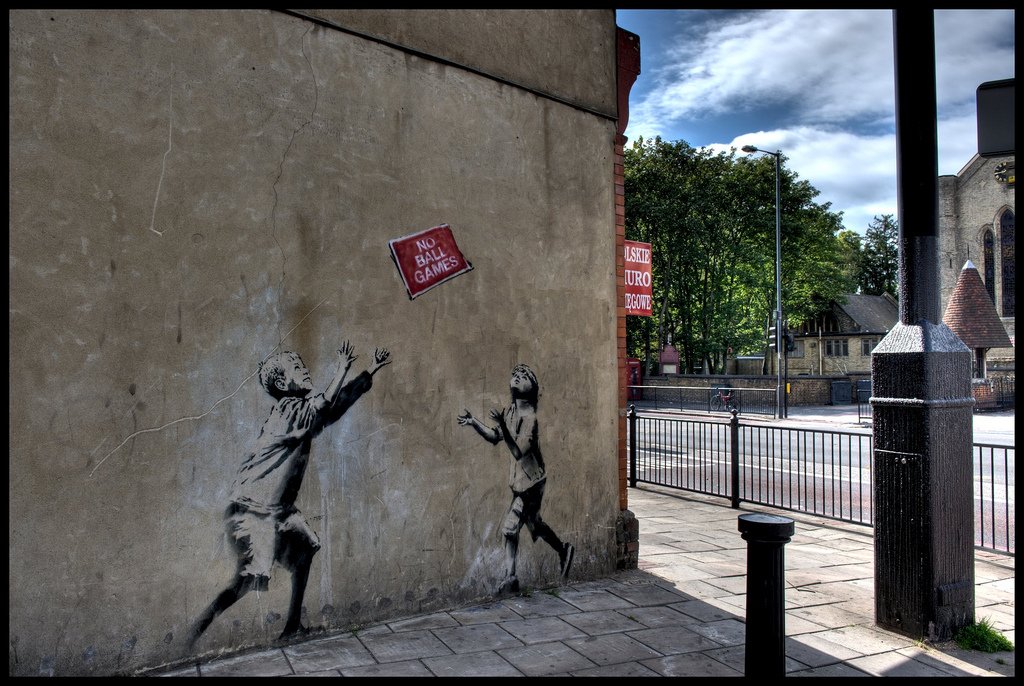
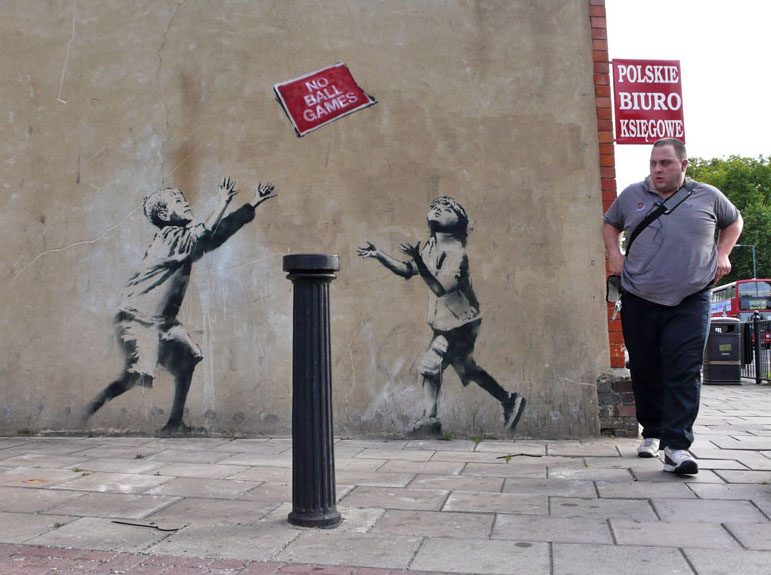
Painted on the side of a convenience store in Tottenham in September 2009, No Ball Games depicts two children playing catch with an object that should, quite literally, prevent them from doing so. Suspended between the figures is a red municipal-style sign bearing the instruction NO BALL GAMES, transformed by the children into the very object of play that it seeks to prohibit. Contemporary photographs taken on 29 September document the mural shortly after its appearance and confirm its location on Tottenham High Road.
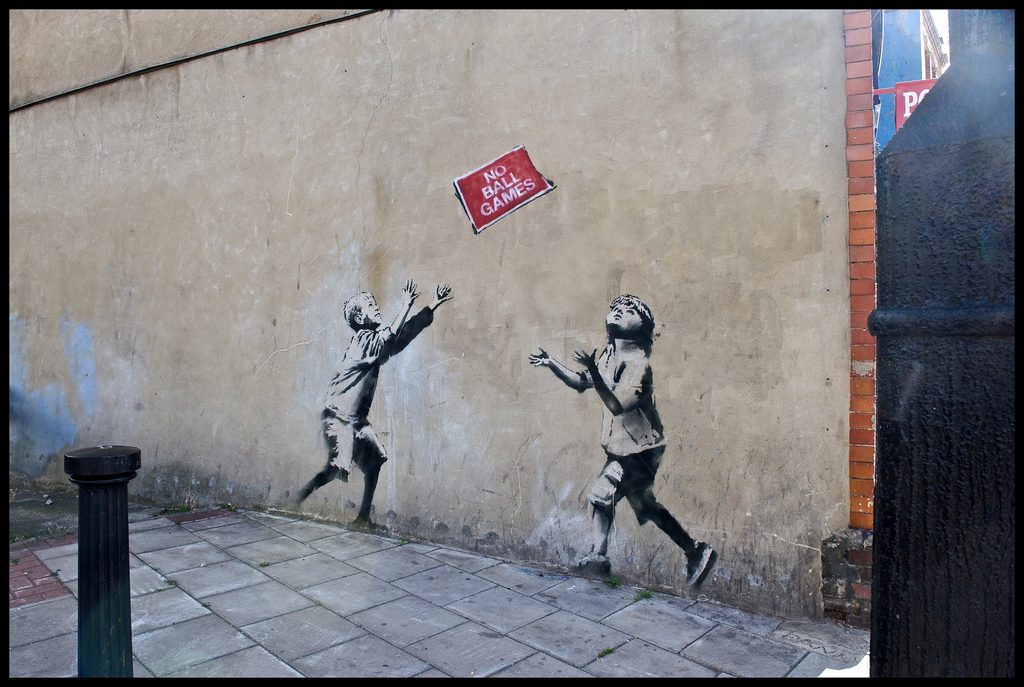
The composition is characteristic of Banksy's ability to construct a political argument through a simple visual reversal. The prohibition remains perfectly legible, yet the children neither obey it nor openly confront it. Instead, they appropriate the sign and give it another function. Authority is not attacked or destroyed; it is rendered ineffective through imagination.
The contrast between the children and the sign reinforces the idea formally. Their bodies are rendered in Banksy's familiar monochrome stencil technique, while the prohibition sign is emphatically red. It should therefore constitute the most authoritative element of the composition, but its meaning is undermined by its position. Once airborne between the two children, it ceases to operate convincingly as an instruction and becomes part of their game.
From Barely Legal to Tottenham
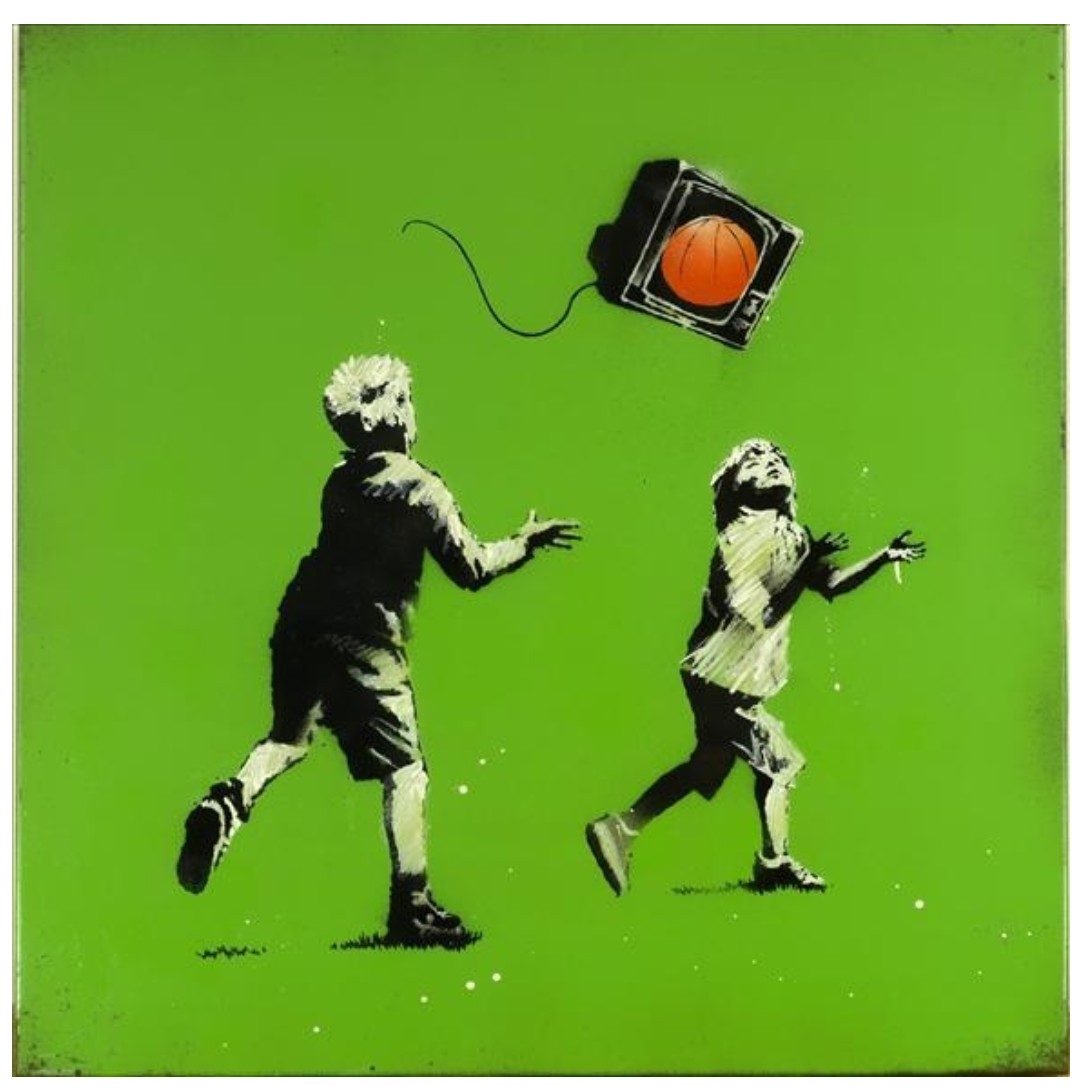
The origins of the composition predate the Tottenham mural. An important earlier version appeared in 2006 at Barely Legal, Banksy's major Los Angeles exhibition. The two children are already present, but instead of playing with a prohibition sign they throw a television set displaying the image of a ball. Your print catalogue also preserves a working sheet showing the two figures and television before the later substitution of the sign.
The transformation between 2006 and 2009 is significant. In the earlier composition, the television introduces a critique of mediated experience: the children appear to play with a representation of a ball rather than the real object itself. Childhood activity has been displaced from physical space onto the screen. When Banksy revisited the composition three years later, he replaced the television with an instrument of regulation. The subject consequently shifted from the mediation of experience to the restriction of public behavior.
The Tottenham version is arguably more concise. The words NO BALL GAMES immediately establish a rule, while the children's response invalidates it without requiring any explanatory text. Banksy has taken an object whose sole function is to prohibit play and converted it into a plaything.
Childhood and the Regulated City
Children occupy a particularly important place within Banksy's imagery because they allow him to examine authority from the perspective of those who possess very little of it. From Girl with Balloon and Bomb Hugger to the children painted along the West Bank barrier, childhood frequently represents imagination, vulnerability and freedom confronted by systems constructed by adults.
In No Ball Games, however, the children are neither victims nor explicit rebels. Their response is considerably more subtle. They do not remove the sign, vandalize it or stage a protest against it; they simply refuse to recognize the purpose assigned to it. The work is therefore less about disobedience in the conventional sense than about the capacity of play to transform imposed structures.
The Tottenham setting gives this idea an important social dimension. Signs restricting ball games became familiar features of British housing estates and urban residential areas, usually justified by concerns over noise, nuisance or damage. Banksy's image addresses the broader tension between the regulation of shared space and the freedom of children to inhabit it. The work need not be reduced to an attack on a vaguely defined “nanny state,” as the present Banksy Explained text suggests. Its argument is more interesting when understood as a question about who controls public space and what forms of behavior that space is designed to accommodate.
The children provide Banksy's answer through their actions. Regulation may determine the intended purpose of an object, but imagination can assign it another.
The 2009 Editions
The same year as the Tottenham mural, Banksy developed No Ball Games as a screenprint published by Pictures on Walls. Two principal versions were produced, generally known as Grey and Green, each in a signed edition of 250.
The transition from mural to edition is worth mentioning without allowing the print history to dominate the street-work entry. The essential composition remains unchanged, but the controlled format of the print inevitably alters its relationship with the original subject. In Tottenham, the image addressed regulation while occupying an urban wall without conventional authorization; as an edition, the same image entered the controlled structures of publishing, collecting and eventually the secondary market.
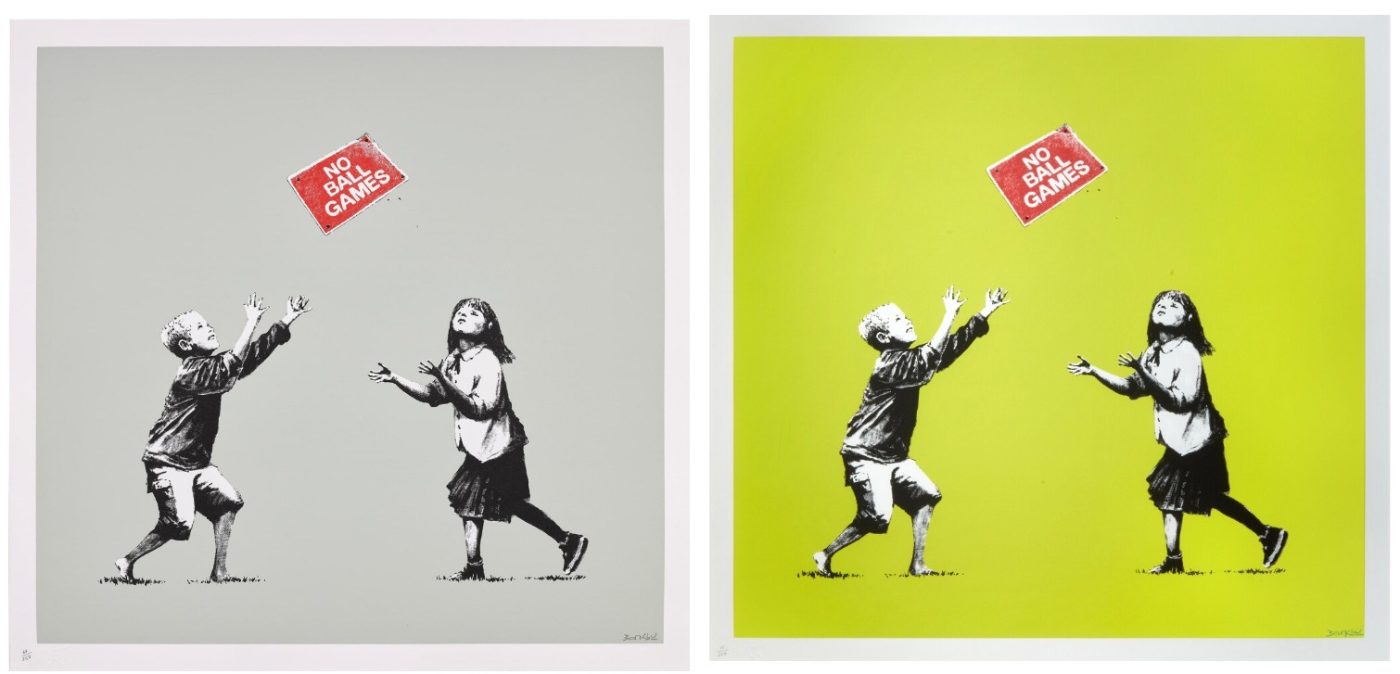
It has since become one of Banksy's recognizable editioned images, with both colorways developing substantial auction markets. The full print history and market data are better treated separately in the dedicated Banksy Explained print and auction-results entries.
Removal from Tottenham
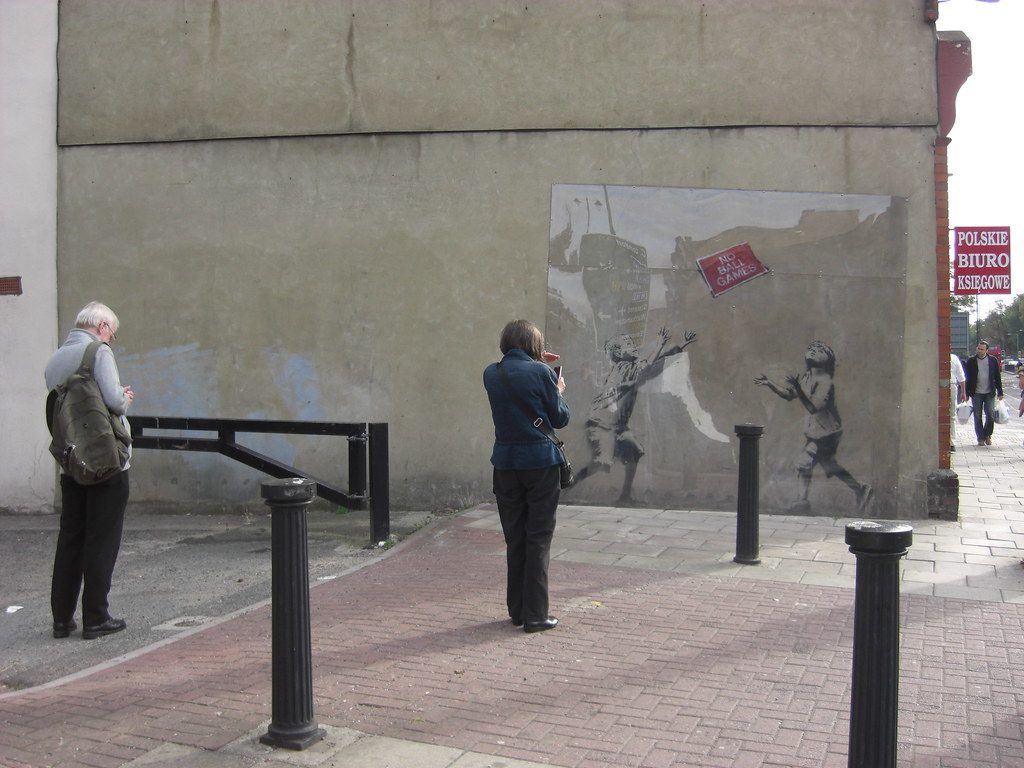
The history of the mural changed dramatically in July 2013. Residents noticed scaffolding and wooden hoardings surrounding the wall, and the work subsequently disappeared. The mural had been divided into three sections and physically removed from the building. Contemporary reporting identified the Sincura Group as the organization overseeing the process.
The timing was particularly sensitive. Only months earlier, another Banksy mural in the same London borough, Slave Labour, had been removed from a Poundland building in Wood Green, provoking substantial local opposition and a dispute over whether an artwork created for public view should be treated as an asset belonging exclusively to the owner of the wall.
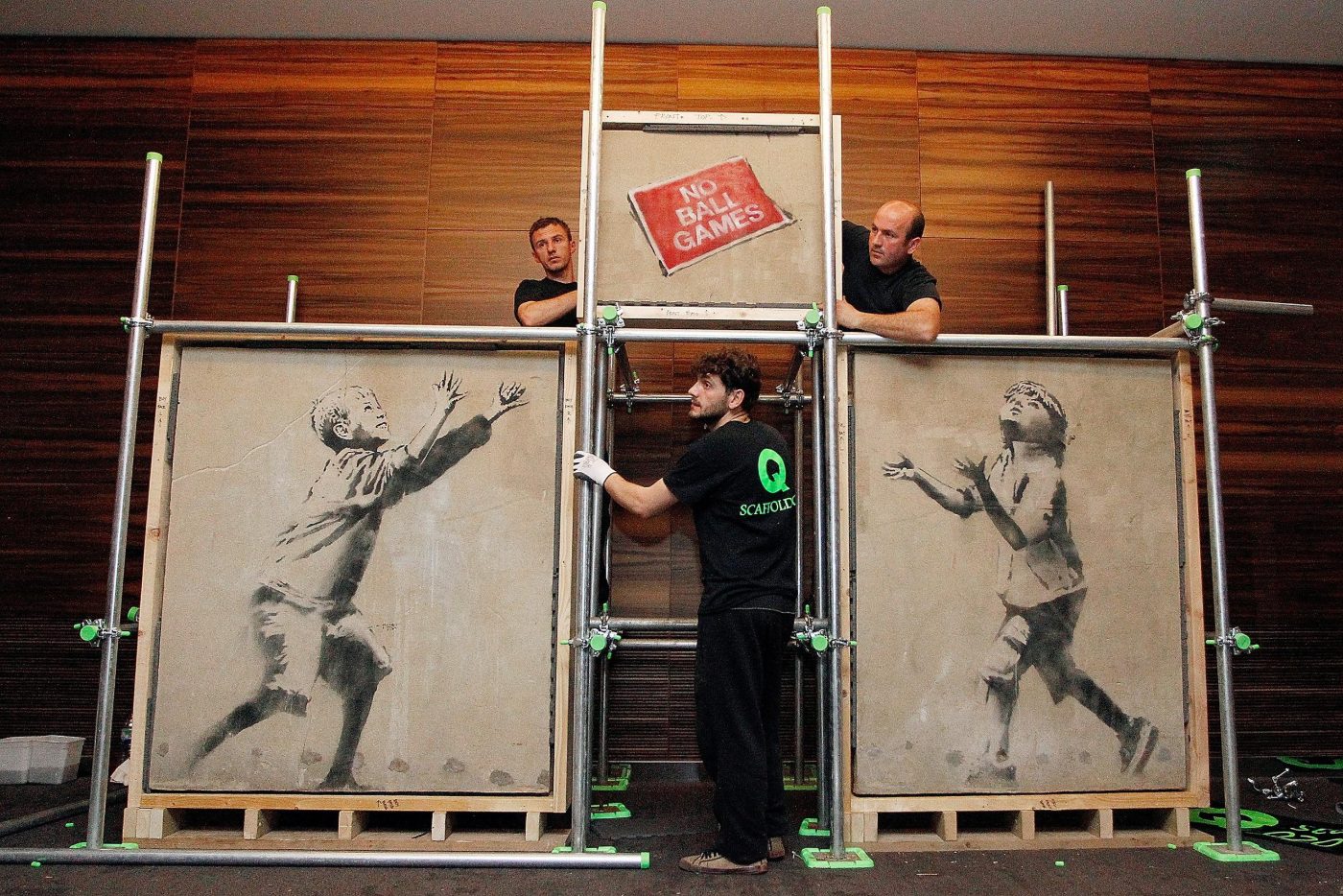
No Ball Games reopened precisely the same debate. Local residents expressed disappointment at the disappearance of a work that had become a recognizable feature of Tottenham High Road, while Sincura argued that removal would allow the mural to be restored and that the sale would benefit disadvantaged children in the area. Contemporary reporting records plans for the work to be restored and subsequently offered for sale.
The mural was subsequently restored and presented as part of The Stealing Banksy? exhibition in London in 2014 before being offered for sale. This afterlife raises a question increasingly central to Banksy's street work: whether removing a mural preserves an artwork or fundamentally changes it. The painted image may survive, but the relationship between image, architecture, neighborhood and public accessibility does not.
Takeaways
No Ball Games is one of Banksy's clearest examinations of the relationship between childhood and authority, but its effectiveness derives from avoiding a conventional scene of confrontation. The children do not appear angry, oppressed or politically conscious. They are simply playing, and their imaginative use of the prohibition sign makes the rule momentarily irrelevant.
The development from the 2006 Barely Legal composition is particularly revealing. In Los Angeles, the children play with a television containing an image of a ball, suggesting the replacement of physical experience by its representation. In Tottenham three years later, the television disappears and is replaced by a prohibition sign. Banksy preserves the children's gestures while changing the object between them, allowing essentially the same composition to address a different form of restriction.
The subsequent removal of the mural adds an unintended final dimension to these questions of control and public space. An image concerned with who determines how shared urban space may be used was itself eventually removed from that space and converted into a transportable object. The children remained, as did their red sign, but the Tottenham wall and the public environment against which Banksy had originally staged their game were lost.
STAY INFORMED
Receive the latest news, exhibitions, artworks and market updates on Banksy.