NO FUTURE
Description
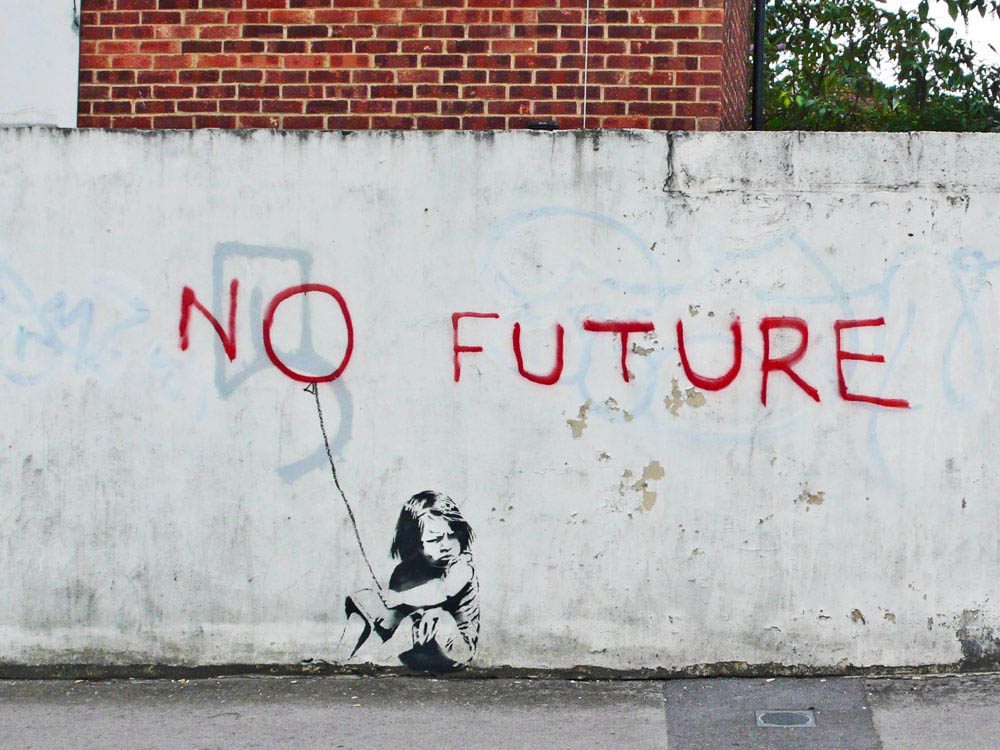
A young girl sits alone at the foot of a wall, holding the string of a balloon above her head. The balloon itself is not conventionally drawn: its circular outline forms the letter O in the large red inscription NO FUTURE stretching across the wall.
The visual economy is remarkable. Banksy combines one of his most familiar symbols of childhood—the balloon—with a phrase associated with hopelessness and rebellion. Unlike Girl with Balloon, where the balloon escapes and leaves open the possibility of hope, here the child still holds the string. What should represent play, aspiration and possibility has literally become part of the words denying her a future.
No Future
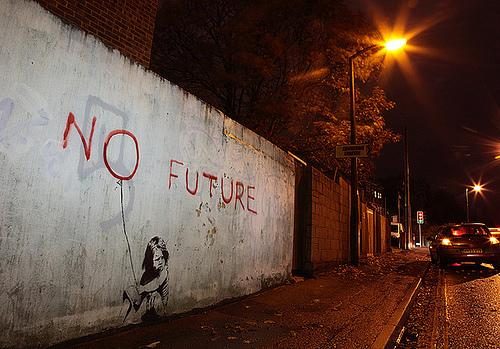
The mural appeared in Bevois Valley, Southampton, in November 2010. Contemporary photographs securely document it by 12 November, while another surviving photograph was taken on 20 November. It was painted on the wall of a private property on Mount Pleasant Road, in an area where student development bordered one of Southampton's less affluent neighborhoods.
The words No Future inevitably evoke the language of British punk, most famously the refrain associated with the Sex Pistols' God Save the Queen. Banksy couples that nihilistic slogan with a child, turning an expression of youthful rebellion into something more unsettling. The girl is not rejecting her future; she appears to have been told that she does not have one.
As with many of Banksy's children, the image can accommodate several readings—economic exclusion, social inequality or anxiety about the world inherited by the next generation—without resolving itself into a single political message. Its power comes precisely from the simplicity of the contradiction: a child, the conventional embodiment of the future, sits beneath the words NO FUTURE.
A Future of Only a Few Days
The mural's own existence proved appropriately brief. After local media drew attention to it, the work was attacked and largely painted over in November 2010, only days after its public discovery. Contemporary local discussion records that Banksy's image had already appeared on his website before the press caught up with it.
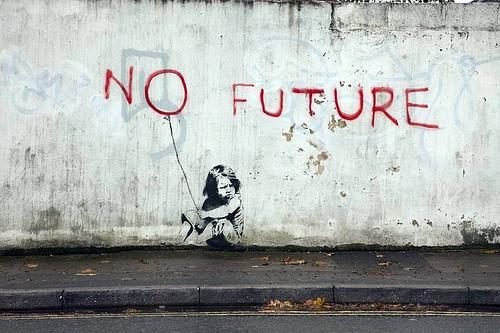
The destruction created one of the recurring paradoxes surrounding Banksy's street work. An unauthorized image was suddenly regarded as something worthy of preservation once its author was recognized, while the person who subsequently painted over it was condemned for doing essentially what urban walls continually invite: adding another layer.
The title ultimately became unexpectedly literal. No Future was created as an image about a future apparently denied to a child; within days, the mural itself had none.
STAY INFORMED
Receive the latest news, exhibitions, artworks and market updates on Banksy.