NO TRESPASSING
No Trespassing
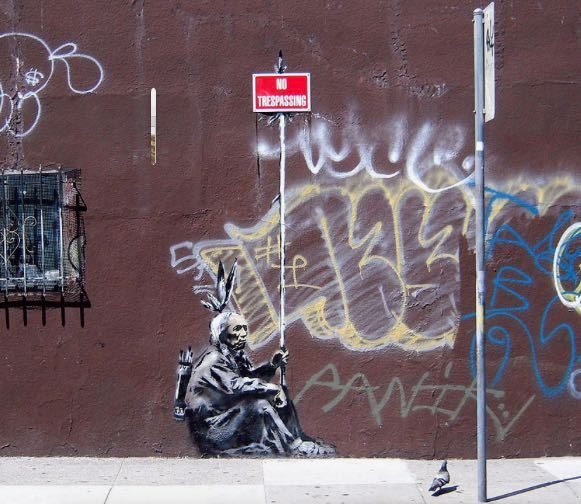
Created during Banksy's visit to San Francisco in April 2010, No Trespassing depicts a seated Native American figure holding the pole of an existing red-and-white NO TRESPASSING sign. The stencil appeared on the side of the former Café Prague at 2140 Mission Street, at Sycamore Street, in San Francisco's Mission District. Contemporary photographs document the work by 24 April 2010 and identify it as one of six Banksy interventions discovered around the city during this period.
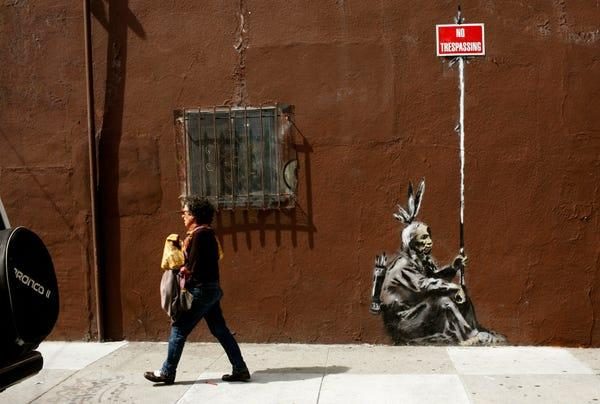
As in Hammer Boy three years later, Banksy uses an existing piece of street infrastructure as an integral component of the composition. The sign is real; only the seated figure beneath it is Banksy's addition. His hand appears to grasp the metal pole, visually transforming an ordinary property warning into the placard of a protester. The intervention is remarkably economical: without altering the words themselves, Banksy changes entirely who appears to be saying them.
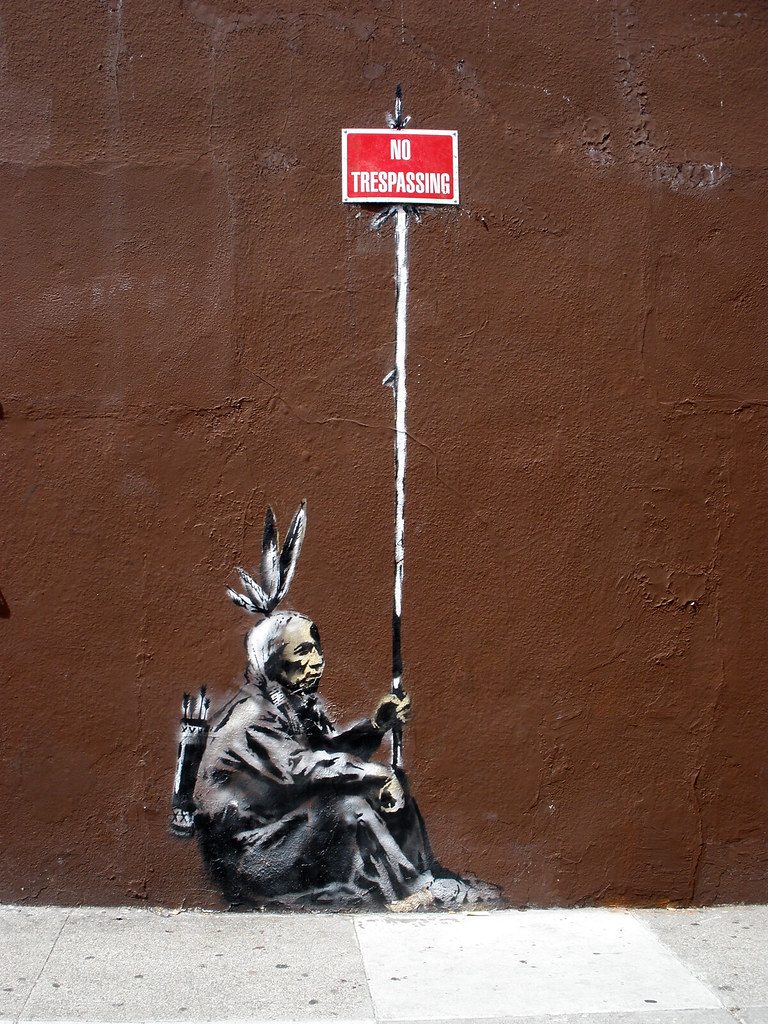
The choice of a Native American figure gives the instruction NO TRESPASSING an unmistakable historical irony. A sign designed to exclude unauthorized people from privately controlled property is placed in the hands of a representative of the Indigenous population whose lands were progressively occupied and appropriated during European colonization and the territorial expansion of the United States. The contemporary language of property ownership is therefore made to collide with a much longer history of dispossession. Art-historical scholarship has similarly interpreted the work through the displacement of Native American populations and, more broadly, questions of exclusion within the modern city.
The Street as Medium
The effectiveness of No Trespassing depends upon its location and upon Banksy's decision to leave the existing sign untouched. Painted independently on a conventional canvas, the figure would lose much of its meaning. Here, an object belonging to the regulated city—one intended precisely to establish a boundary between permitted and forbidden space—is appropriated by an artist whose own unauthorized presence on the wall constitutes an act of trespassing.
That contradiction introduces a second reading. Banksy himself is occupying a surface without permission while creating an image concerned with the authority to occupy land. The work therefore operates simultaneously across different scales: the immediate question of private property and unauthorized graffiti; the social experience of exclusion from urban space; and the historical question of who possessed the authority to declare territory private in the first place. The stencil does not attempt to resolve these different histories but compresses them into the relationship between a figure, a pole and two words.
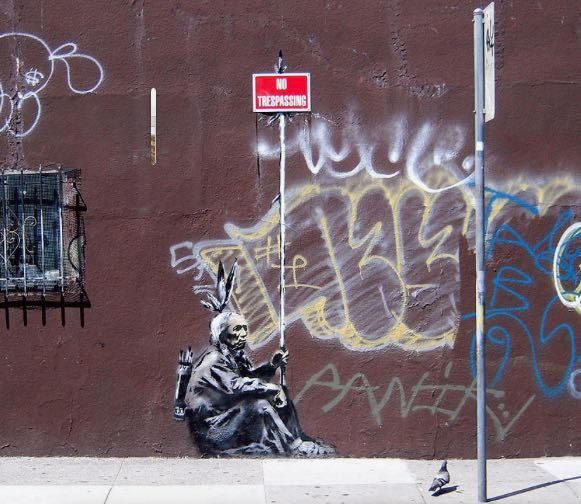
The surrounding wall is equally important. Contemporary photographs show Banksy's carefully shaded monochrome figure surrounded by existing tags and graffiti on a dark red façade. Rather than isolating the image from that environment, the visual disorder reinforces its status as a street intervention. Banksy's contribution occupies the same contested urban surface whose access the sign above it attempts to regulate.
Banksy in San Francisco
No Trespassing appeared during a brief but productive period in which Banksy left a group of works across San Francisco. Six interventions were documented around the city, including Peaceful Hearts Doctor in Chinatown, This'll Look Good When It's Framed on Valencia Street, two rat works, and a bird incorporated into a tree, alongside No Trespassing in the Mission District. Contemporary observers were already mapping and photographing the works almost immediately after their appearance.
The timing was significant. Banksy's first feature film, Exit Through the Gift Shop, had premiered at the Sundance Film Festival in January 2010 and was beginning its American theatrical release that spring. The San Francisco interventions formed part of a broader period of activity by Banksy in the United States surrounding the film's release, during which new street works appeared in several American cities.
The San Francisco group also demonstrates the range of Banksy's approach to site specificity. Rather than simply placing predetermined images on available walls, several works respond directly to objects or characteristics already present at their locations. No Trespassing is perhaps the most concise example: the pre-existing sign supplies both the title and the conceptual structure of the intervention.
A Lost Mural
Like many unauthorized street works, No Trespassing proved temporary. Contemporary photographs already show it existing within a heavily graffitied environment, and the mural was subsequently marked by additional tags before eventually being painted over. San Francisco's FoundSF archive now records it among the city's lost murals and identifies its former location in Sycamore Alley, just west of Mission Street.
Its disappearance makes the photographs taken immediately after its discovery particularly important. They preserve not merely Banksy's stencil but the relationship between the figure and the actual No Trespassing sign from which the work derived its meaning. What survives photographically is therefore the complete intervention: Banksy's painted figure, the municipal and commercial environment around it, and an ordinary warning sign transformed through one carefully positioned stencil into a commentary on property, possession and the right to occupy land.
STAY INFORMED
Receive the latest news, exhibitions, artworks and market updates on Banksy.