PEACEFUL HEARTS DOCTOR
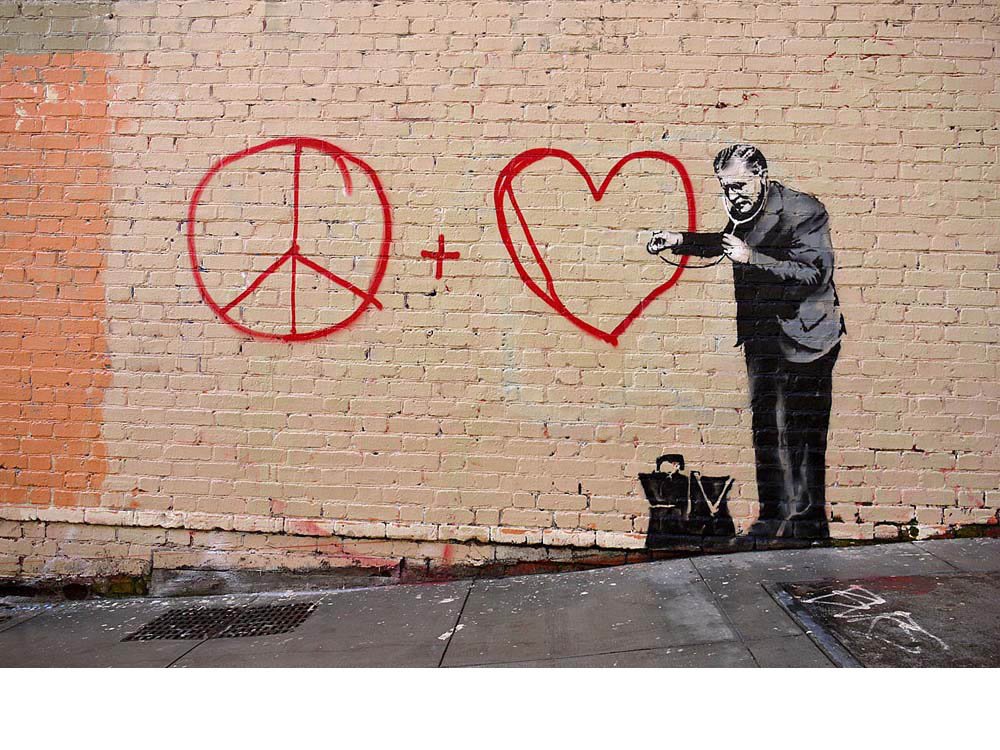
Peaceful Hearts
In April 2010, during a prolific visit to San Francisco, Banksy painted an unlikely physician on the side of a building at 720 Grant Avenue in Chinatown. Dressed in a white coat and wearing a stethoscope, the doctor kneels beside a large red heart and carefully examines the peace symbol at its centre.
The composition is almost entirely monochrome except for the heart, whose brilliant red immediately dominates the image. Banksy's doctor treats peace as though it were a patient: something alive, potentially fragile and apparently in need of medical attention. The stethoscope completes the joke. Rather than simply displaying the familiar peace-and-love symbols of the 1960s, Banksy asks us to imagine checking whether they still have a pulse.
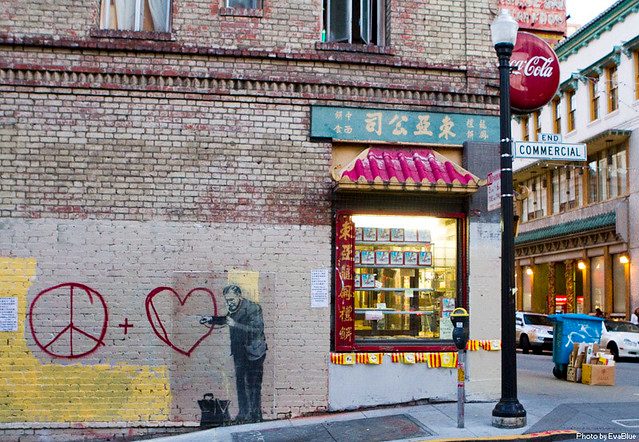
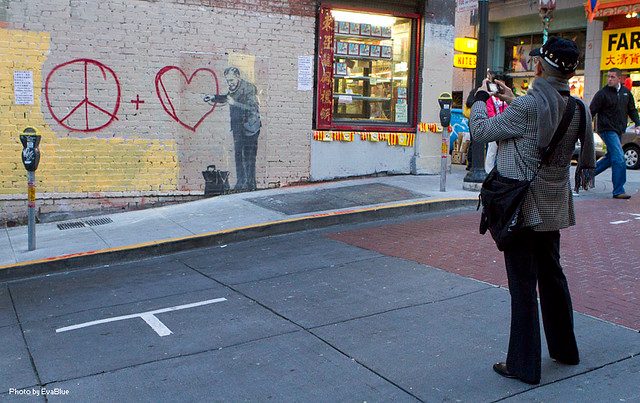
Contemporary photographs establish the location precisely as 720 Grant Avenue, between Commercial Street and Sacramento Street. Photographers were already documenting the work by 22–26 April 2010, placing it firmly among the group of San Francisco interventions Banksy produced that spring.
Is Peace Still Alive?
The imagery is unusually gentle for Banksy. There are no policemen, bombs, surveillance cameras or soldiers. Instead, the work takes two of the most familiar symbols in popular visual culture—the heart and the peace sign—and treats them almost literally.
The doctor's concentration introduces a subtle ambiguity. Is he confirming that peace is healthy, or checking whether it is dying?
That uncertainty gives the image more depth than its initially sentimental appearance suggests. The heart is enormous compared with the kneeling physician, yet it seems to require his attention. Peace may be universally recognizable as an ideal, Banksy suggests, but recognition alone does not guarantee its survival.
The medical metaphor also works particularly well because a doctor normally treats individuals, while Banksy's patient is an idea. The image quietly shifts from personal health to the health of society itself.
Banksy in San Francisco
Peaceful Hearts Doctor belonged to a concentrated burst of Banksy activity across San Francisco in April and May 2010, around the American release of Exit Through the Gift Shop. At least six works were documented across Chinatown, the Mission, Haight-Ashbury and other parts of the city, including No Trespassing, This'll Look Nice When It's Framed, several rats and If At First You Don't Succeed – Call An Airstrike. Contemporary reporting on 25 April was already mapping the works and recording their exact addresses.
The San Francisco works reveal Banksy's extraordinary range during this period. Only a short distance separates the tenderness of Peaceful Hearts Doctor from the militarized child of Call An Airstrike. One asks whether peace still has a heartbeat; the other imagines a world in which children already need gas masks.
Together they offer two sides of Banksy's recurring preoccupation with peace: not as an abstract slogan, but as something precarious that has to survive in a world organized around conflict.
Attacked Almost Immediately
The mural's subsequent history is particularly striking because the deterioration began almost as soon as the work appeared.
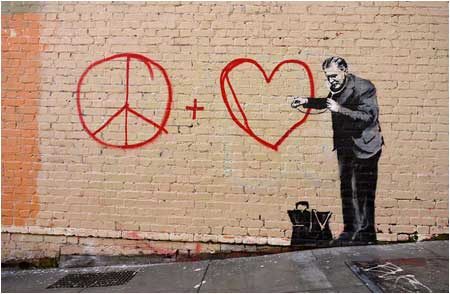
The building's owners valued the Banksy and attempted to protect it behind Plexiglas. Yet contemporary photographs taken by Eva Blue on 5 May 2010, only weeks after its appearance, already show yellow paint running across the wall and protective covering installed over the composition. Her captions specifically document both the vandalism and the attempt to preserve the work.
Further attacks proved more destructive. Black paint was eventually introduced behind or around the protective covering, heavily obscuring the doctor's face and body. The current Banksy Explained page records a worker at the Eastern Bakery, which occupies the building, describing the work as essentially destroyed.
The irony is difficult to miss. A mural depicting a doctor attempting to preserve the health of a heart became an artwork that its owners repeatedly attempted—and ultimately struggled—to keep alive.
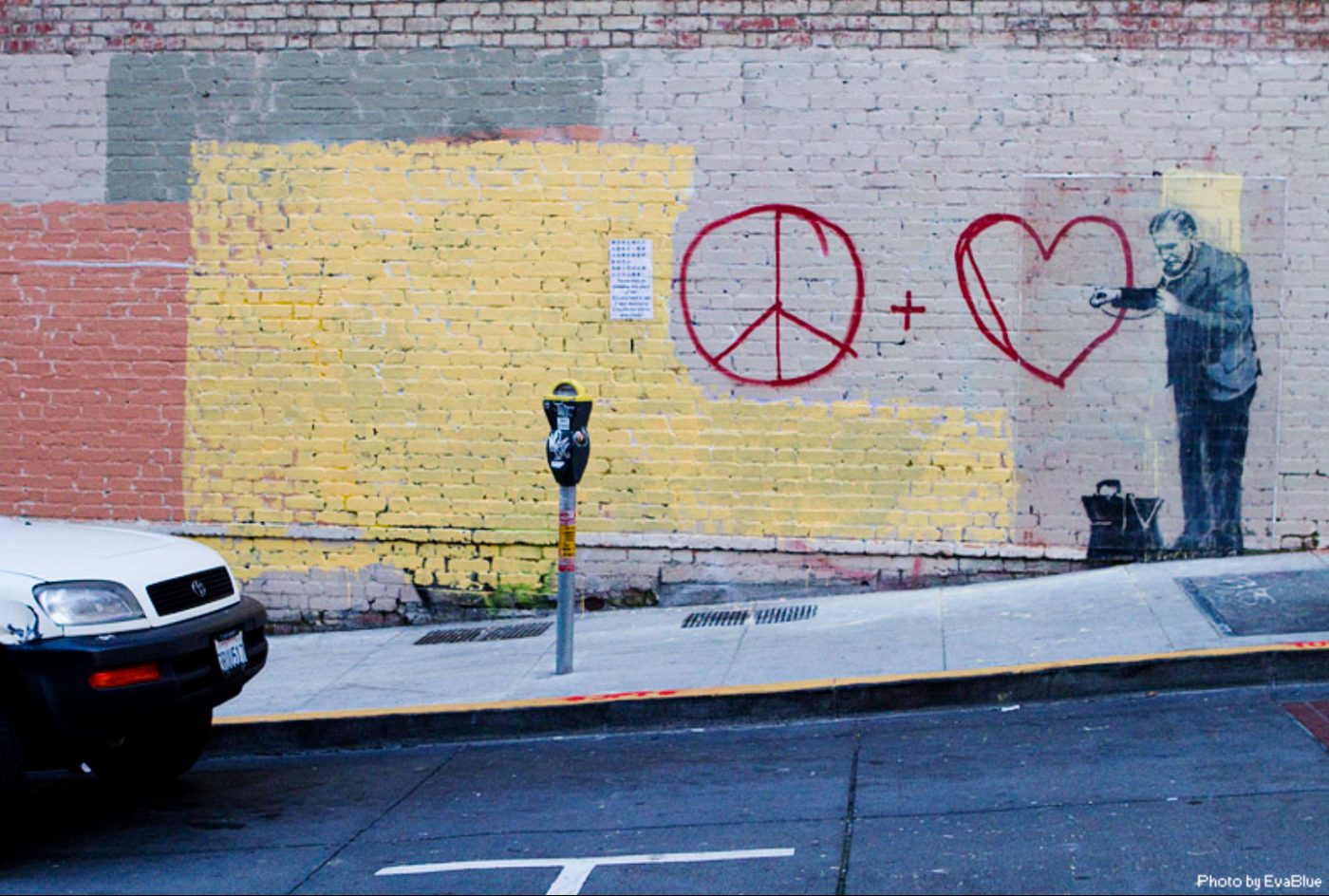
Peaceful Hearts Doctor demonstrates how little Banksy sometimes needs to construct an effective image. A doctor, a stethoscope, a red heart and a peace sign are enough. There is no written slogan telling us how to interpret them and no complicated political narrative.
Instead, Banksy turns a cliché into a question. Hearts symbolize love; the peace sign symbolizes peace. Both have been reproduced so endlessly that they can become almost meaningless. By placing one inside the other and having a physician actually examine them, Banksy briefly restores their urgency.
The work's deterioration subsequently gave that metaphor an unintended second life. The patient painted on the wall needed care; before long, so did the mural itself. The doctor is listening carefully. Banksy leaves us to decide whether peace still has a heartbeat.
STAY INFORMED
Receive the latest news, exhibitions, artworks and market updates on Banksy.