PEEPING BOYS
Behind the Curtain
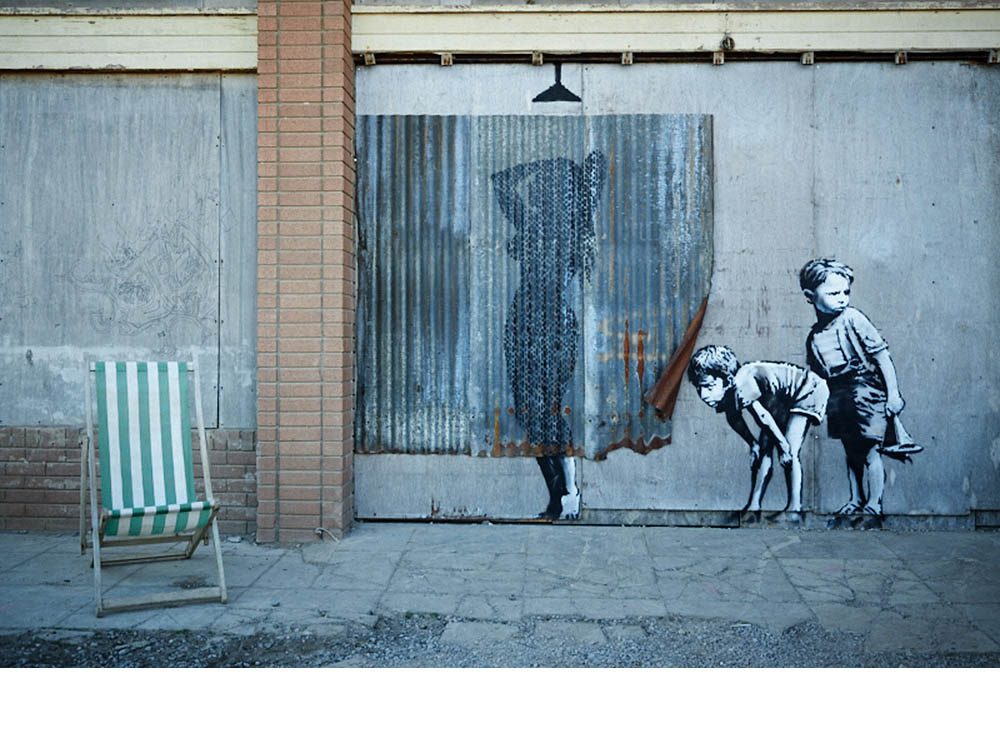
Created for Dismaland in August 2015, this mural depicts two young boys beside a makeshift outdoor shower. One bends forward and peers through a gap in a corrugated metal screen, while the second stands behind him holding what appears to be a small spade. Behind the metal, the silhouette of a naked woman can just be discerned beneath a shower head.
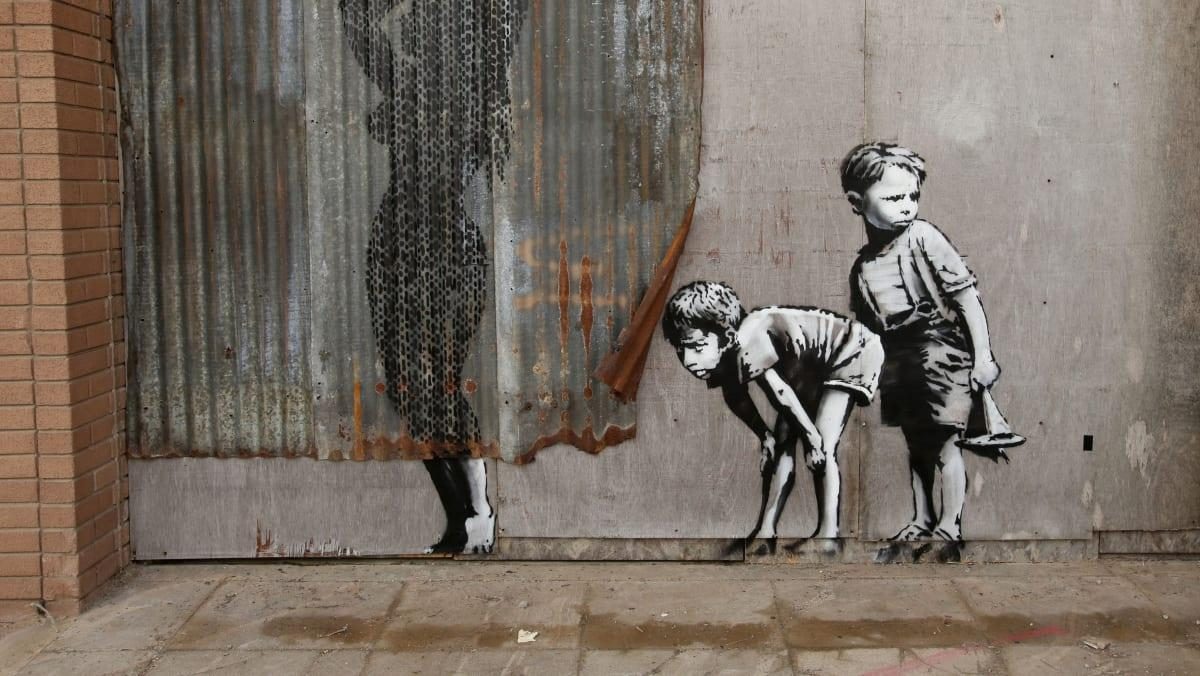
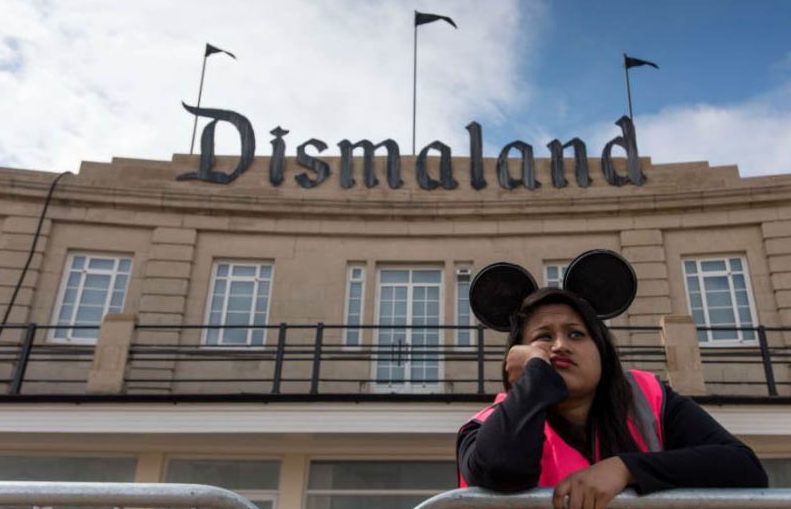
The work was painted directly onto one of the weathered buildings of the former Tropicana lido in Weston-super-Mare, the derelict seaside complex Banksy transformed into his temporary “bemusement park.” Dismaland opened in August 2015 and brought together work by 58 invited artists alongside a group of new works by Banksy. He described the project as a “family theme park unsuitable for children.”
The mural is particularly dependent upon its physical setting. Banksy incorporated a pre-existing sheet of rusting corrugated metal into the composition as the shower screen, painting the woman partly behind it while placing the boys on the exposed wall beside her. Contemporary observers noted how precisely the figures and existing materials had been arranged, with the real metal creating both the visual barrier and the reason for the boys' curiosity.
Looking at What You Shouldn't See
The joke is immediately recognizable: childhood curiosity collides with adult sexuality. The boy at the front has discovered something forbidden and cannot resist looking, while his companion appears more hesitant or distracted. Banksy leaves their relationship deliberately unresolved. One may be acting as lookout; alternatively, the second child may simply not yet share the first boy's fascination.
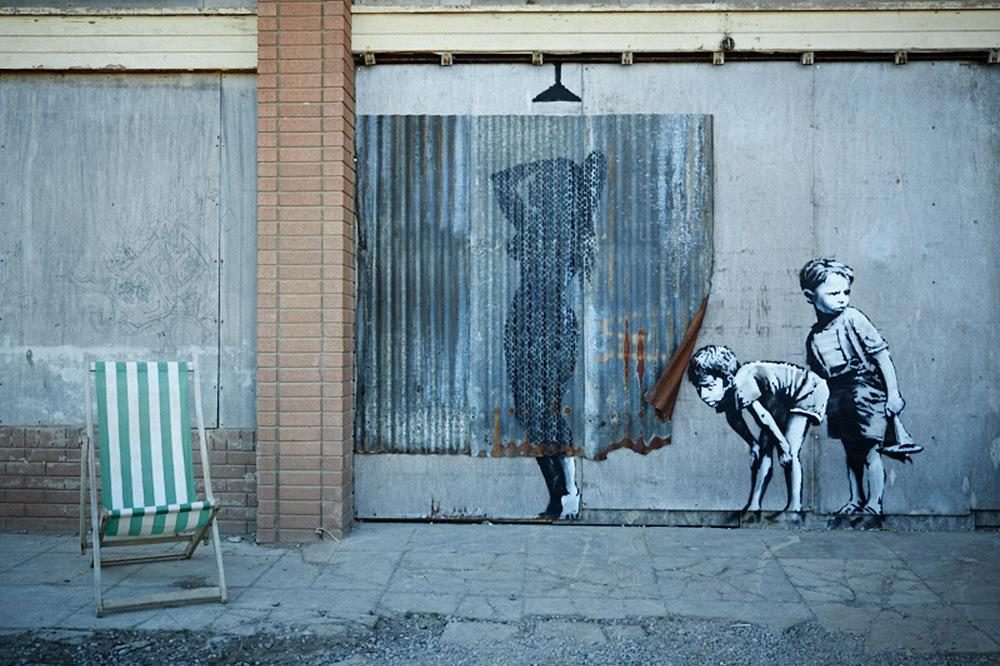
More importantly, the corrugated sheet allows Banksy to construct the image around visibility and concealment. The woman is simultaneously present and hidden. Her body can be reconstructed from the fragment visible beneath and through the perforated metal, but the viewer is denied a complete image. To understand what the boy is trying to see, the spectator is encouraged to look more closely as well. The audience is therefore drawn into the same act of curiosity represented in the mural. Contemporary accounts even noted that visitors could crouch beside the children and attempt to peer around the screen themselves.
The use of the existing material also demonstrates one of Banksy's most effective street-art strategies. The corrugated sheet is not merely a surface onto which an image has been applied; it performs a role that paint alone could not accomplish. Remove the metal and much of the joke disappears.
Dismaland and the British Seaside
The setting adds another layer. The Tropicana had opened as an outdoor swimming complex in the 1930s and had stood derelict for years before Banksy occupied it. Its decaying concrete, rusting fixtures and abandoned leisure architecture became fundamental to the atmosphere of Dismaland, a deliberately bleak inversion of the conventional amusement park.
Against that dystopian background, Peeping Boys is comparatively light-hearted. Rather than addressing migration, policing, surveillance or consumer culture directly, it draws on the slightly disreputable humor traditionally associated with the British seaside: changing rooms, bathing, voyeurism and the mischievous curiosity of children. The real deckchair positioned nearby reinforced the impression that the scene belonged naturally to an ageing coastal resort rather than to a conventional exhibition.
Yet it also fitted Dismaland's larger rejection of sanitized entertainment. The park repeatedly replaced the reassuring conventions of family attractions with discomfort, inappropriate humor and situations in which spectators became implicated in what they were watching. Here, Banksy constructed an image about looking at something one is not supposed to see, then positioned the spectator alongside the boys doing exactly that.
The mural disappeared with the temporary world for which it had been created. Dismaland closed on 27 September 2015 after five weeks, and the Tropicana was dismantled as an exhibition site. What survives in photographs is therefore particularly dependent upon the original architecture: two curious children, a hidden woman, a rusting sheet of metal and a derelict seaside resort briefly transformed into Banksy's playground.
STAY INFORMED
Receive the latest news, exhibitions, artworks and market updates on Banksy.