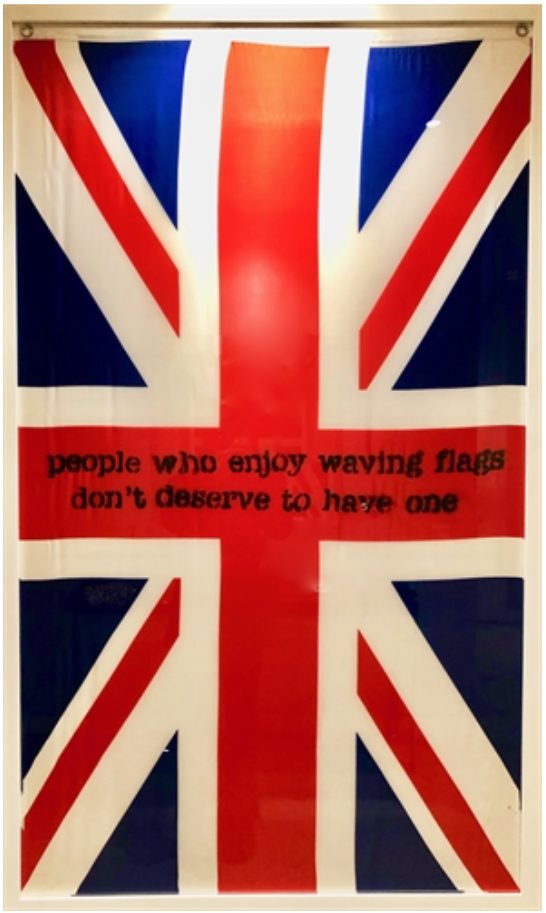
PEOPLE WHO ENJOY WAVING FLAGS DON'T DESERVE TO HAVE ONE, 2003
Provenance
- The artist
- Steve Lazarides, London
- Private Collection, London
Auction History
Prices are inclusive of buyer’s premium unless stated otherwise, as reported by the auction houses.
Catalogue Note
Created in 2003, People Who Enjoy Waving Flags Don’t Deserve to Have One belongs to Banksy’s early body of works in which familiar symbols of British identity are appropriated and turned against themselves. Here, the Union Jack is not represented through paint or stencil but used as the physical support of the work. Rotated vertically and overlaid with the statement “people who enjoy waving flags don’t deserve to have one,” the flag is transformed from an emblem intended to express collective allegiance into the object of Banksy’s characteristically sardonic critique.
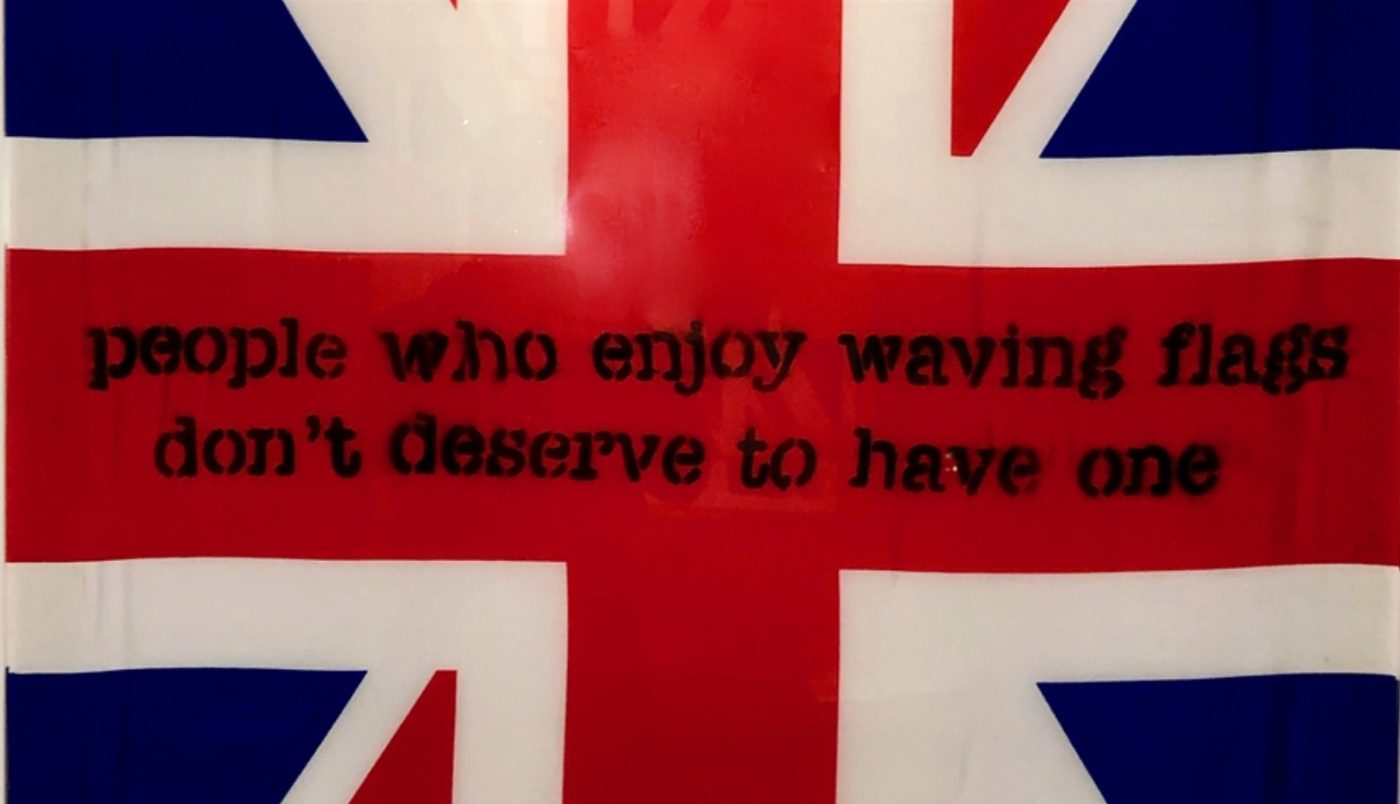
The economy of the intervention is central to its effectiveness. Banksy leaves the flag almost entirely intact, allowing its powerful geometry and immediately recognizable red, white and blue pattern to dominate the composition. Across its center, however, the roughly sprayed black lettering interrupts the polished authority of the national symbol. The contrast between the mass-produced flag and the deliberately irregular stencil typography creates a tension between official identity and unauthorized speech: the object proclaims the nation while Banksy’s intervention questions the behavior associated with proclaiming it.
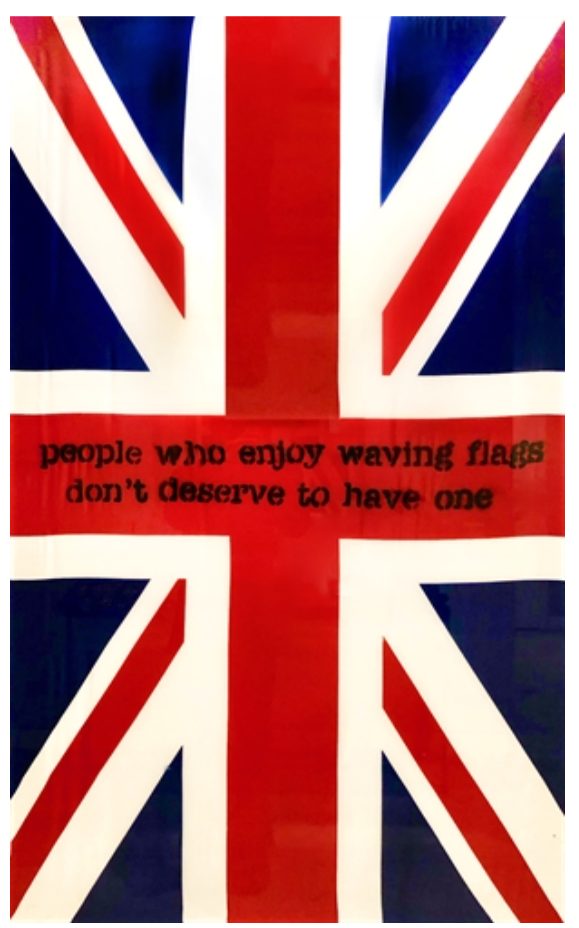
Rather than rejecting British identity itself, the work is more convincingly understood as a criticism of performative and unquestioning nationalism. The distinction is important. Banksy does not destroy the Union Jack; he uses it as both image and material, turning the flag into the surface upon which the culture of flag-waving is challenged. The paradox of placing an anti-flag-waving statement directly onto a flag gives the work much of its humor, while also reflecting a recurrent strategy in Banksy’s practice: appropriating the visual language of authority in order to undermine the assumptions it carries.
The work dates from a particularly significant moment in Banksy’s development. In 2003, against the background of the Iraq War and the enormous anti-war demonstrations in Britain, questions of patriotism, political obedience and national identity were especially charged. These concerns recur throughout Banksy’s work of the period, from the placards produced for the anti-war protests to images such as Bomb Hugger and Happy Choppers. People Who Enjoy Waving Flags Don’t Deserve to Have One approaches the same political atmosphere without depicting war at all. Instead, Banksy focuses on one of nationalism’s simplest and most powerful objects—the flag itself—and converts it into a vehicle for dissent.
STAY INFORMED
Receive the latest news, exhibitions, artworks and market updates on Banksy.