Provenance
- Carmichael Gallery, Los Angeles
- Acquired from the above in 2020 by the present owner
Auction History
Prices are inclusive of buyer’s premium unless stated otherwise, as reported by the auction houses.
Catalogue Note
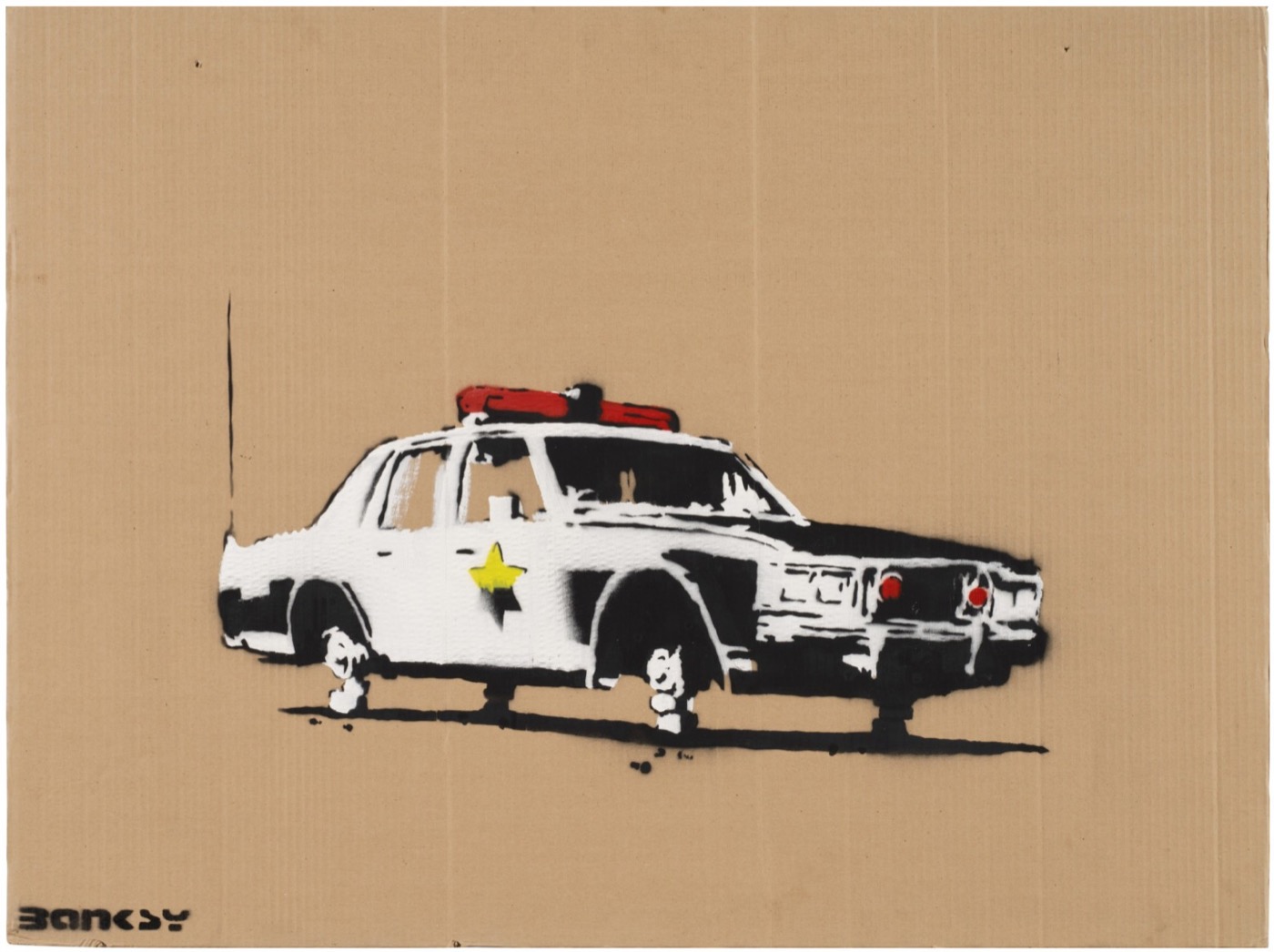
Executed in 2003, Police Car belongs to the important body of works created around Turf War, the landmark exhibition that marked a decisive moment in Banksy’s early career. While introducing his imagery into the gallery setting, Banksy deliberately preserved the immediacy, irreverence and material vocabulary of the street, producing works that remained visually inseparable from their urban origins.
The composition depicts an abandoned police car resting awkwardly on bricks after all four wheels have been stolen. Rendered in Banksy’s characteristic black-and-white stencil technique, the scene is immediately recognizable yet quietly absurd. The vehicle itself bears no visible signs of violence beyond its immobilization, transforming what might otherwise be an act of vandalism into an image of unexpected humor. Authority has not been destroyed; it has simply been rendered powerless.
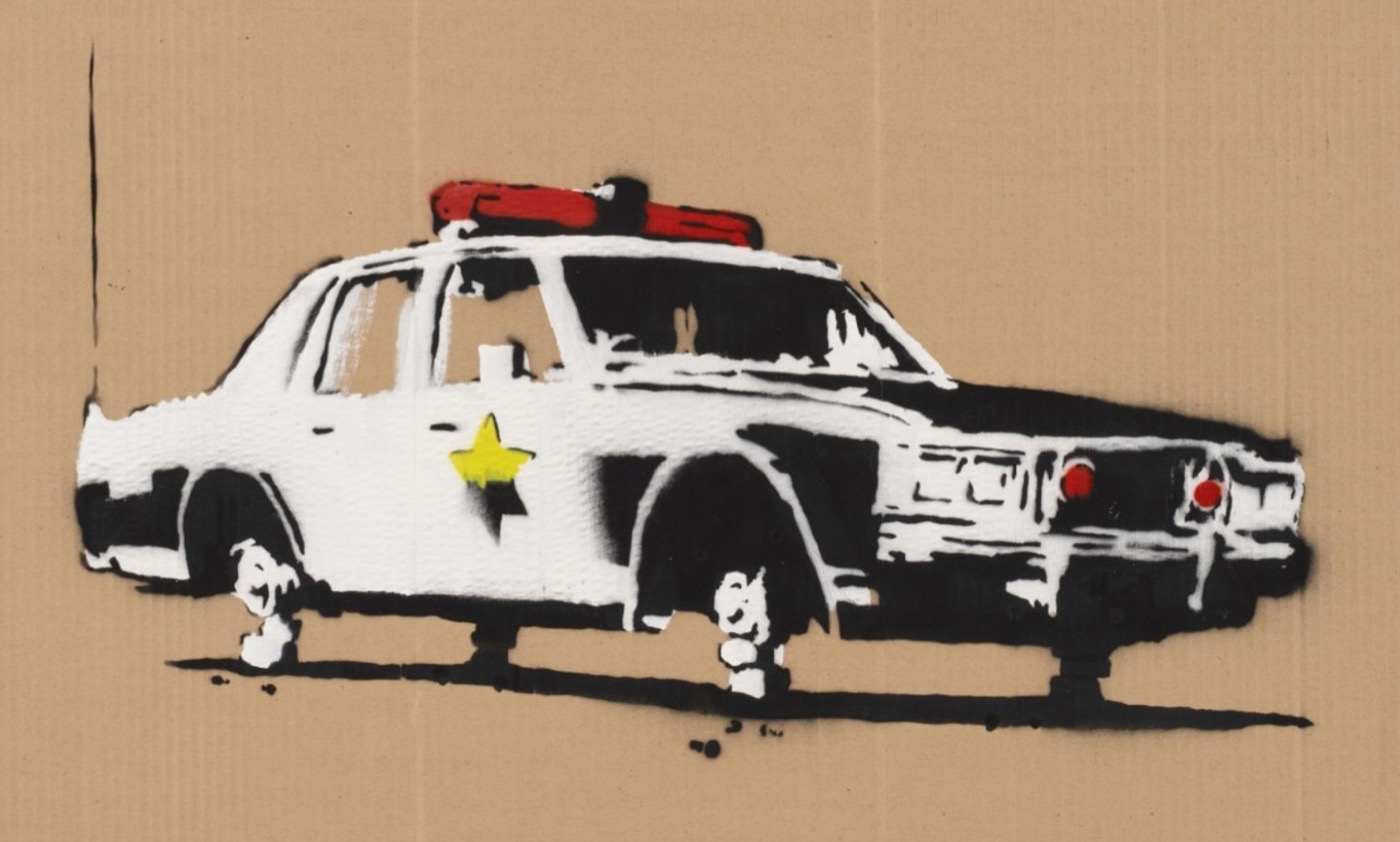
The work perfectly illustrates Banksy’s remarkable ability to undermine established symbols through minimal intervention. Throughout his career, police officers frequently appear as embodiments of institutional authority, yet they are rarely portrayed as overtly threatening. Instead, Banksy prefers irony to confrontation. Here, the police car remains intact, but its removal from action subtly inverts the traditional balance of power. The image suggests that even the most imposing institutions ultimately depend upon fragile foundations and can be disarmed through surprisingly ordinary means.
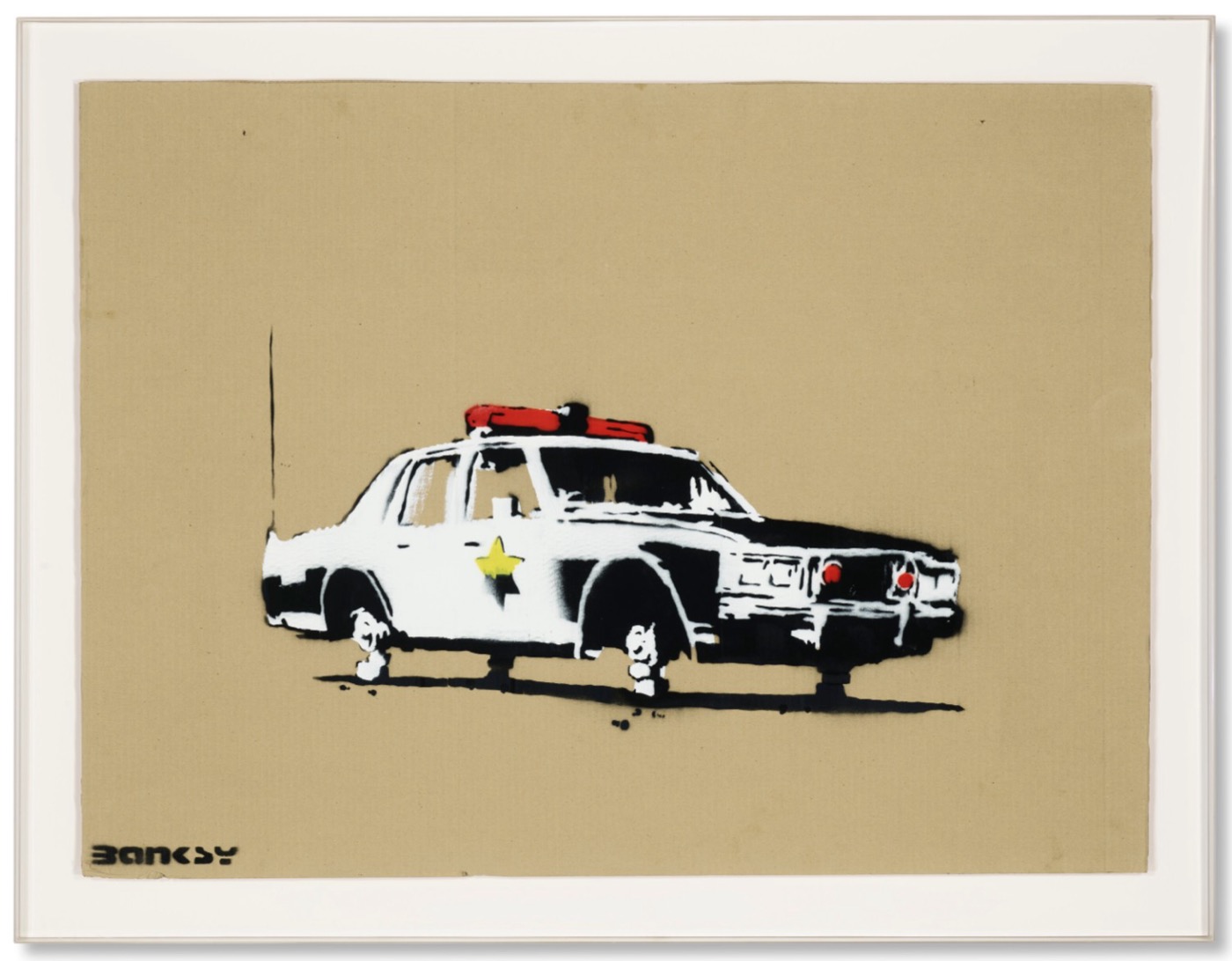
This version is particularly distinguished by its execution on corrugated cardboard, one of Banksy’s most evocative early supports. Far from being a simple substitute for canvas, the cardboard is integral to the work’s meaning. Associated with discarded packaging, temporary shelters and the everyday materiality of the street, it preserves the raw aesthetic of graffiti while deliberately challenging conventional ideas of artistic value. The visible folds, corrugations and imperfections of the surface become active elements of the composition, reinforcing the impression that the work itself has been salvaged directly from the urban environment.
The restrained use of color further enhances the composition. Against the warm tones of the cardboard, the crisp black-and-white stencil assumes an almost graphic clarity, while the small red light bar and yellow police insignia provide the only chromatic accents. These subtle touches are sufficient to identify the vehicle instantly, demonstrating Banksy’s remarkable ability to communicate through visual economy rather than complexity.
Variation Sold at Auction
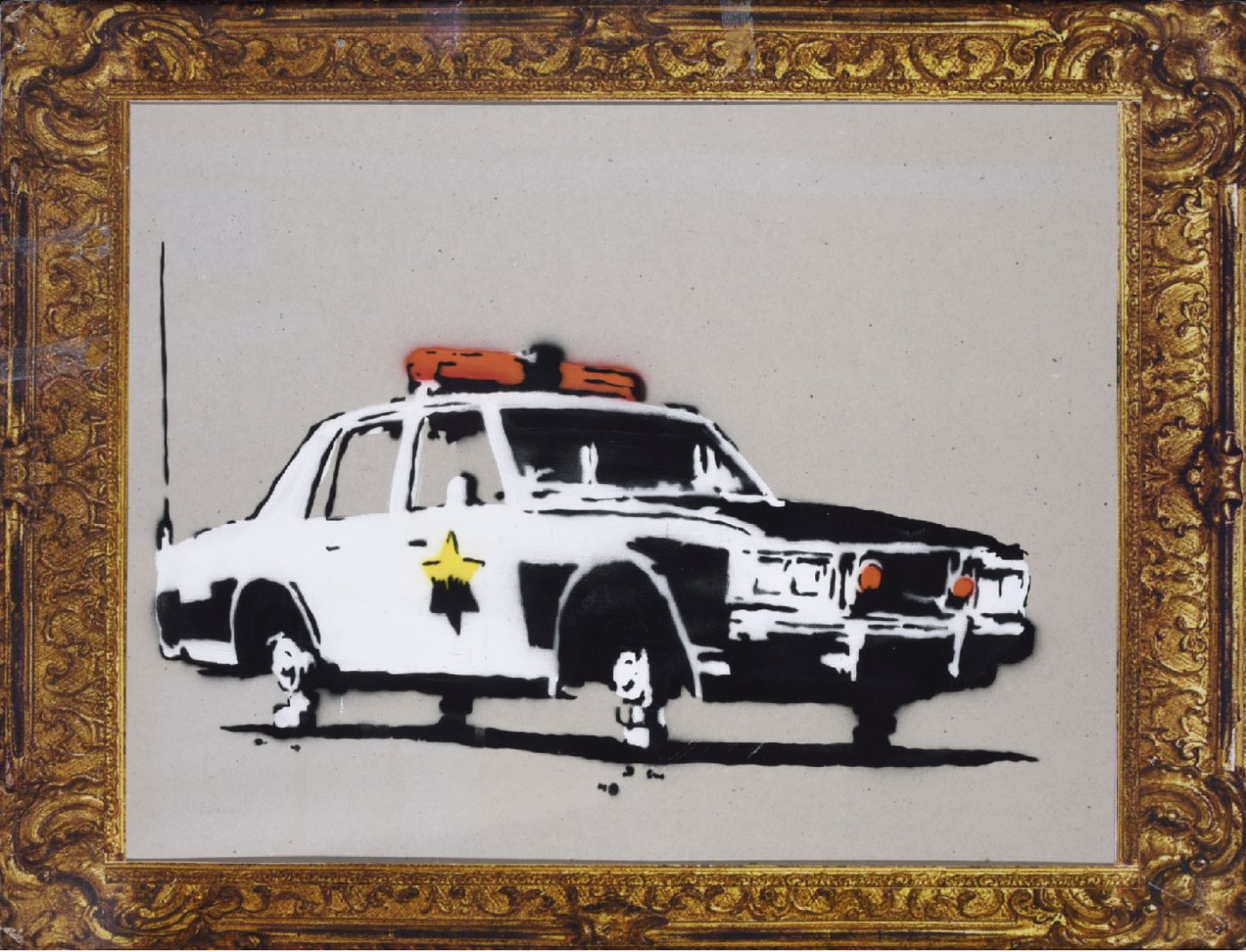
Another variation, slightly smaller in size, unique in its format sold at Digard Auctions in France, on 12 December 2023.
Description
- BANKSY
- Police Car, 2003
- Spray paint and mixed media on cardboard
- 73×105 cm (28.7 x 41.3 inches)
- Unique in this format
Prices are inclusive of buyer’s premium unless stated otherwise, as reported by the auction houses.
STAY INFORMED
Receive the latest news, exhibitions, artworks and market updates on Banksy.