PORTRAIT OF BASQUIAT BEING WELCOMED BY THE METROPOLITAN POLICE
An Unofficial Collaboration
On Sunday, 17 September 2017, four days before the opening of Basquiat: Boom for Real at the Barbican Centre, Banksy created two works on the institution's exterior walls. The exhibition was the first large-scale presentation of Jean-Michel Basquiat's work in the United Kingdom, bringing together more than one hundred works and extensive archival material.
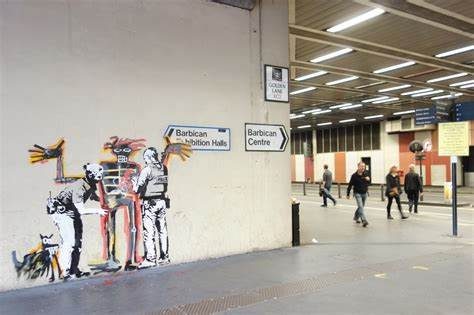
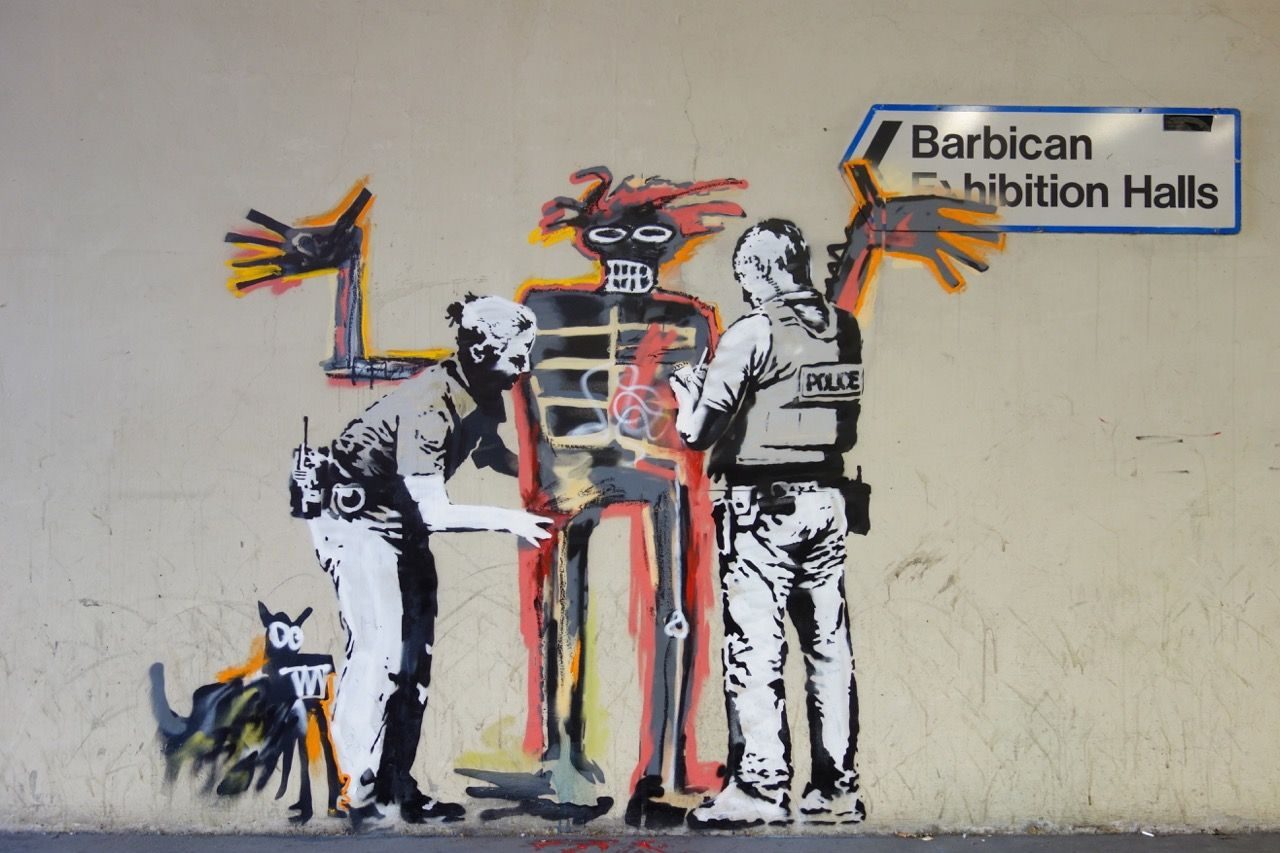
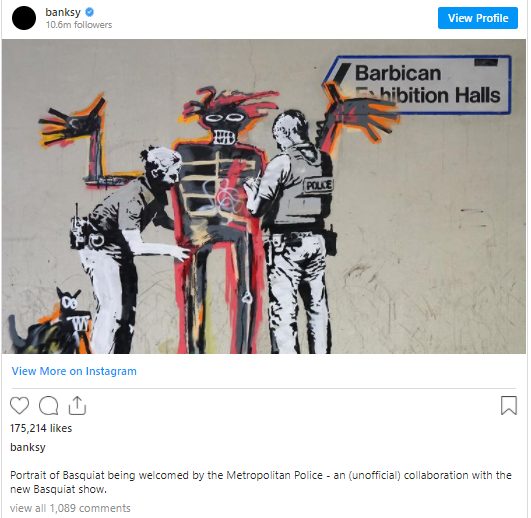
The larger of Banksy's two interventions appropriated the central figures from Basquiat's celebrated 1982 painting Boy and Dog in a Johnnypump. Banksy removed the boy and dog from the explosive field of color of Basquiat's original and transported them onto the pale concrete wall of the Barbican. On either side, he added two Metropolitan Police officers. One bends towards the figure while the other searches him, as the dog looks on.
Banksy announced the work with a characteristically dry caption:
“Portrait of Basquiat being welcomed by the Metropolitan police – an (unofficial) collaboration with the new Basquiat show.”
The word “welcomed” transforms the entire scene. Basquiat is being celebrated inside the institution while his painted alter ego is being stopped and searched outside it.
Boy and Dog in a Johnnypump
Banksy's source was carefully chosen. In Basquiat's Boy and Dog in a Johnnypump, the figures occupy a blazing, almost incandescent field of color. A “johnny pump” is New York slang for a fire hydrant opened during the summer, and the original painting evokes both the heat and energy of the city.
Banksy strips that environment away. Basquiat's loose, skeletal figure remains recognizably his, but the surrounding colour and movement have disappeared. The boy has been displaced from New York into London and from the freedom of Basquiat's painted world into an encounter with authority.
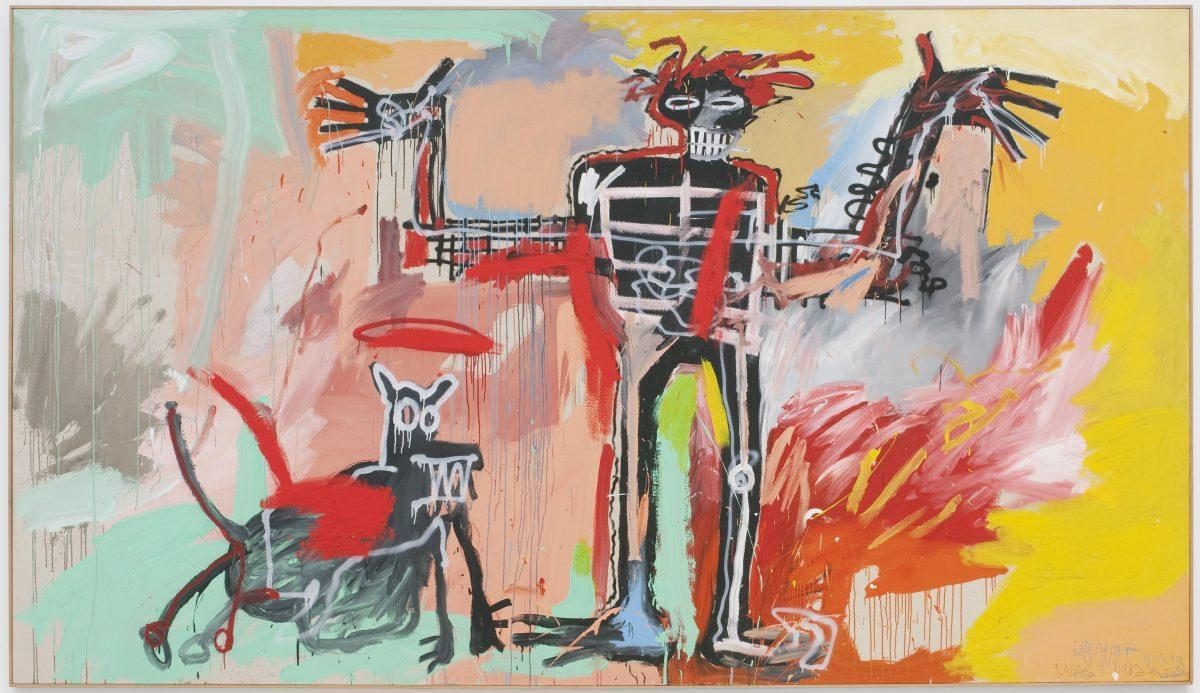
The contrast in artistic languages is equally effective. Basquiat's figure remains nervous, gestural and apparently spontaneous; Banksy's police officers are controlled, monochrome and mechanically precise. The encounter between the figures becomes an encounter between two visual languages: Basquiat's expressive disorder confronted by Banksy's regimented agents of order.
The City of London's own subsequent study of the murals described this transformation explicitly: the figure who plays freely within the spray of the hydrant in Basquiat's original is placed by Banksy under the direct physical control of the state.
Basquiat, Race and the Police
The intervention cannot be separated from Basquiat's identity as a Black artist. Contemporary reporting immediately connected Banksy's image with the disproportionate use of stop-and-search powers against Black people in Britain.
That makes the imaginary encounter deliberately uncomfortable. London is preparing to celebrate Basquiat as a cultural giant, yet Banksy asks how the same young Black man might have been treated before the museum, the international exhibitions and the extraordinary market values transformed him into an institutionally approved artist.
There is another layer. Basquiat's own work repeatedly engaged with racism, policing and violence against Black bodies. Most notably, Defacement (The Death of Michael Stewart), 1983, responded to the death of the young Black artist Michael Stewart following his arrest by New York transit police after allegedly writing graffiti in a subway station.
Banksy's policemen therefore do more than introduce an external political message into Basquiat's imagery. They return Basquiat's figure to concerns already embedded within his own life, environment and work.
Inside the Museum, Outside on the Wall
The location completes the intervention. Banksy accompanied the two Barbican murals with another message:
“Major new Basquiat show opens at the Barbican – a place that is normally very keen to clean any graffiti from its walls.”
The contradiction was irresistible. Inside, the Barbican was preparing a major exhibition celebrating an artist whose career emerged partly from the illicit SAMO inscriptions he and Al Diaz placed across Lower Manhattan. Outside, unauthorized graffiti remained something the institution and surrounding authorities routinely removed. Art of the State even documented an earlier Banksy rat on the Barbican complex that had itself disappeared under the area's graffiti-removal regime.
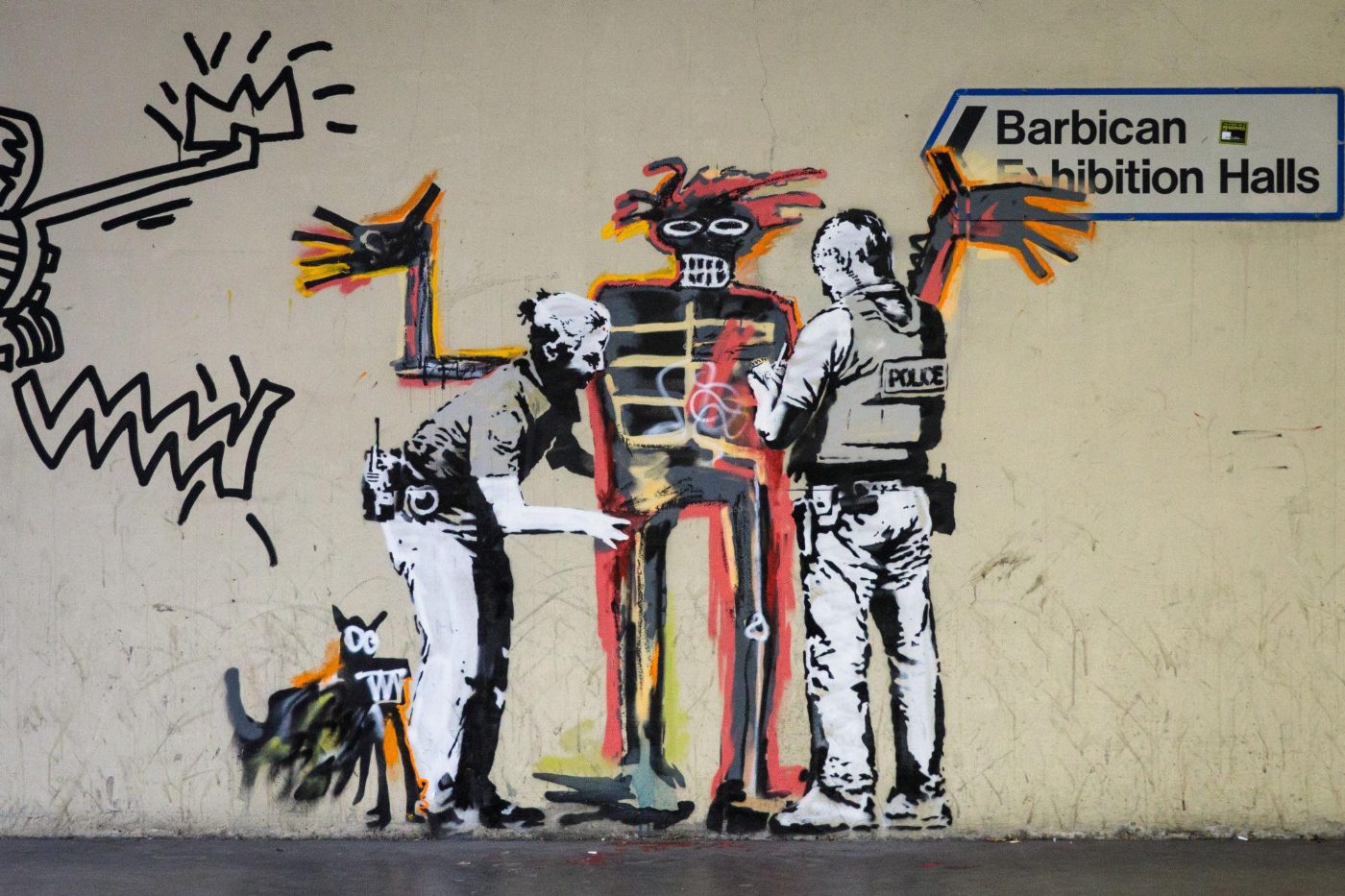
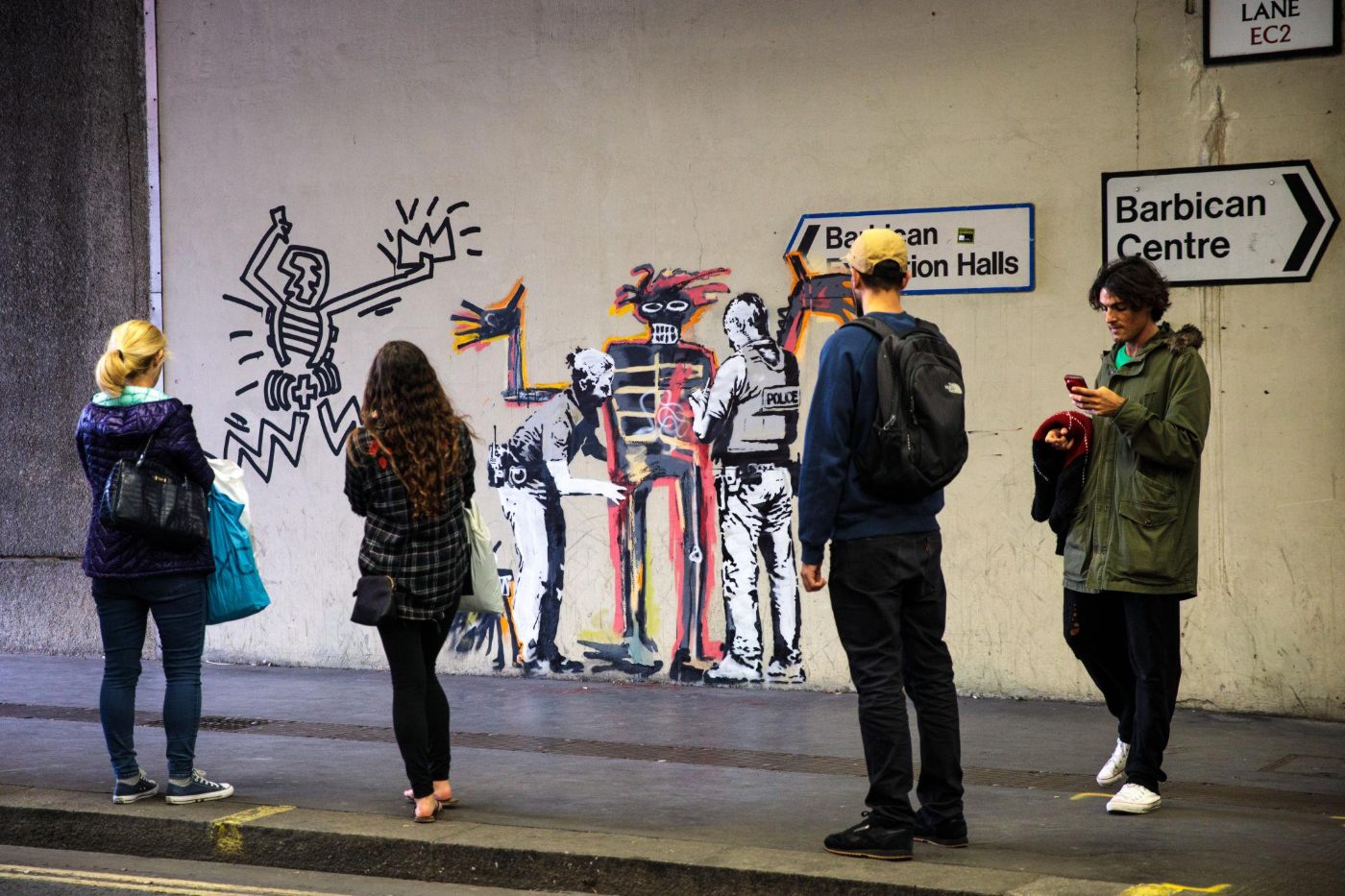
Banksy effectively turned the exterior wall into an unofficial first room of Boom for Real. The official exhibition began on the other side of the institution; Banksy's unauthorized exhibition began before visitors entered it.
This is what makes the work considerably more than a tribute to Basquiat. It questions the process through which an illicit mark becomes cultural heritage. Graffiti can be removed when it appears without permission, celebrated when attributed to a sufficiently important artist, and eventually protected by the very institutions that once regarded it as vandalism.
From Graffiti to Protected Artwork
The Barbican immediately recognized the dilemma Banksy had created. Within two days, the institution confirmed that it was discussing with the City of London Corporation how the two murals might be preserved.
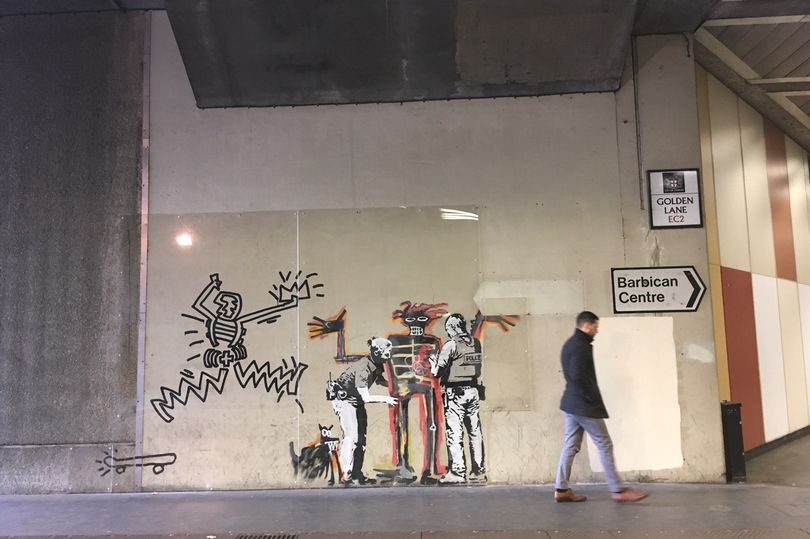
They were subsequently protected and remain at the junction of Beech Street and Golden Lane, where the larger mural continues to attract visitors. The Barbican itself was still directing visitors to the protected Banksy works years later.
The preservation completes Banksy's joke almost perfectly. The Barbican mounted an exhibition celebrating an artist who emerged from New York's graffiti culture. Banksy responded by placing unauthorized art on its exterior. The institution that was, in Banksy's words, normally eager to clean graffiti from its walls then took measures to ensure that this particular graffiti could not be removed.
Inside the Barbican, Basquiat had become art history. Outside, Banksy demonstrated how that transformation happens.
STAY INFORMED
Receive the latest news, exhibitions, artworks and market updates on Banksy.