PROTESTING BIRDS
Migrants Not Welcome
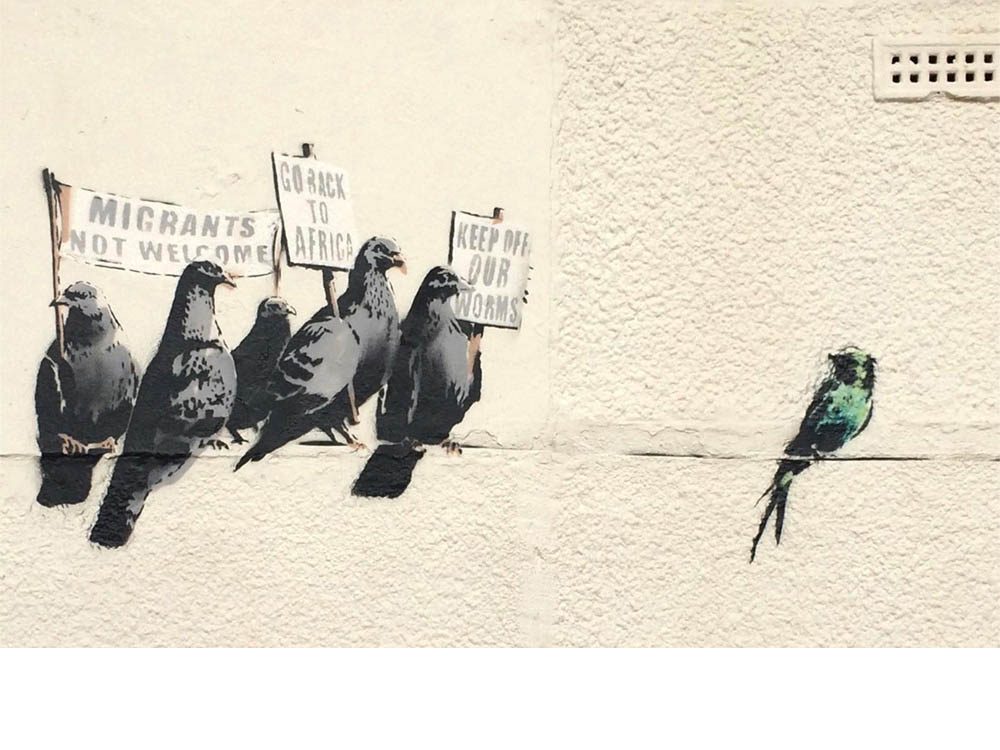
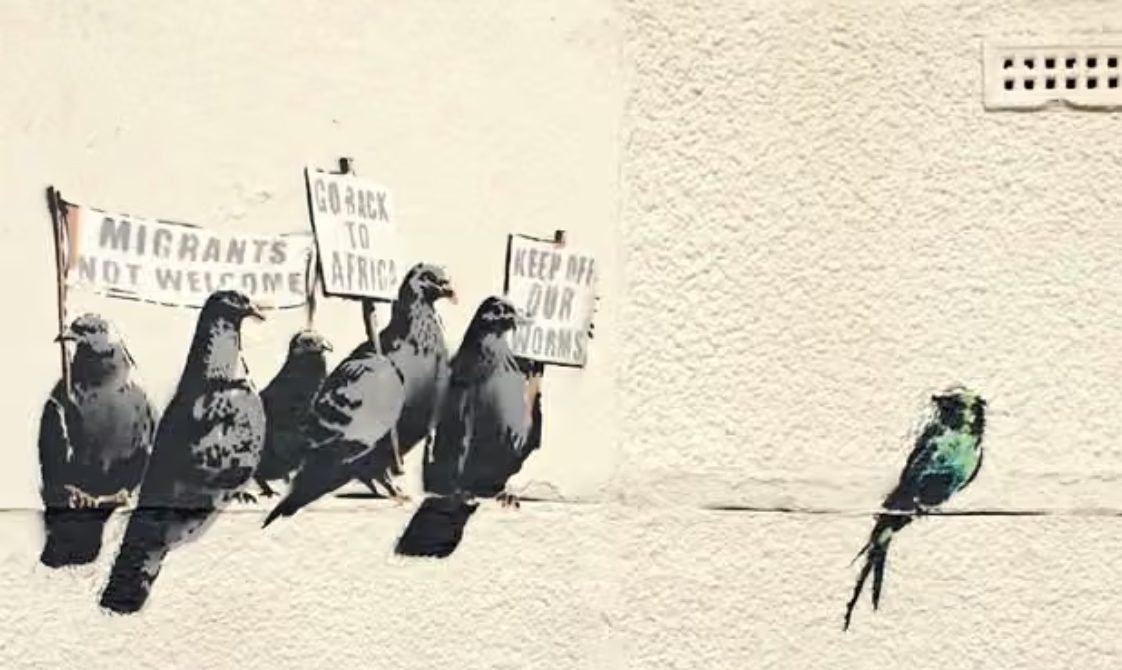
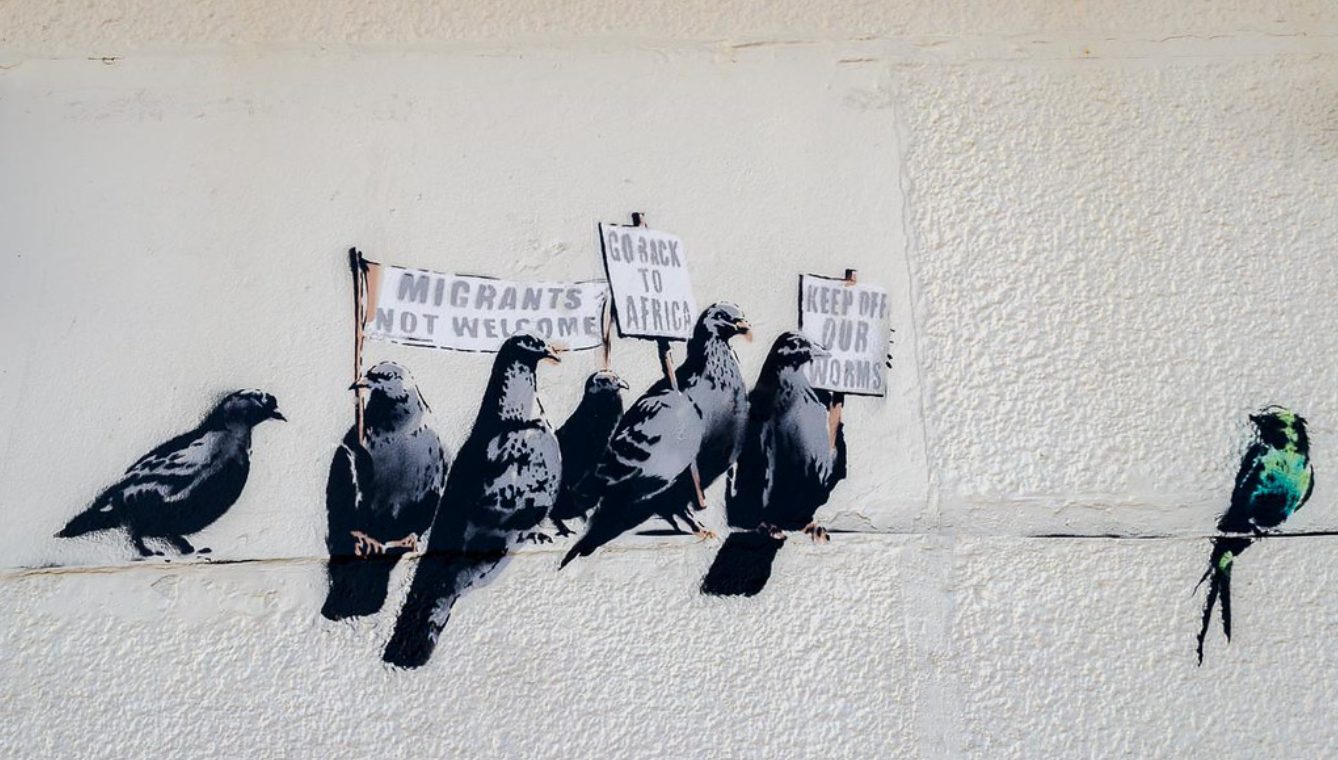
Appearing on a seafront building in Clacton-on-Sea in late September 2014, Protesting Birds depicts five grey pigeons confronting a single brightly colored migratory bird. Three of the pigeons carry miniature placards reading “MIGRANTS NOT WELCOME,” “GO BACK TO AFRICA” and “KEEP OFF OUR WORMS.” The small green-and-blue bird stands apart from them, facing the hostile group without any corresponding slogan of its own.
The composition is deceptively simple. Banksy turns the familiar sight of birds gathered on a wall into a miniature political demonstration, using differences of species and color to make human prejudices immediately legible. The pigeons are larger, monochrome and visually repetitive; the solitary newcomer is smaller but conspicuously more colorful. Even before the placards are read, the image establishes a confrontation between a uniform majority and an individual perceived as different.
The humor depends upon an obvious biological contradiction. Birds migrate naturally across territories and borders, making the pigeons' demand that another bird should “go back to Africa” inherently absurd. The phrase “keep off our worms” pushes the analogy further, reducing familiar arguments about competition for jobs and resources to an animal struggle over food. Banksy transforms xenophobic rhetoric into a fable in which its underlying logic becomes ridiculous precisely because it has been transferred from humans to birds.
Clacton, Immigration and the 2014 By-Election
The location and timing gave the mural considerably greater political force. It appeared approximately a week before the Clacton parliamentary by-election of 9 October 2014, triggered when the constituency's Conservative MP Douglas Carswell defected to UKIP and resigned his seat in order to contest it under his new party. Immigration was one of the central issues surrounding UKIP's political rise, and Carswell would go on to win the election, becoming the party's first elected MP.
Banksy's birds therefore operated simultaneously as a universal satire of xenophobia and as an intervention in a very specific political environment. The pigeons' slogans mimic the language of human exclusion while exposing its contradictions. The native birds claim ownership over territory and resources that no bird could meaningfully possess, while the migratory bird's movement is presented simply as part of its nature.
The work belongs to Banksy's broader use of animals as proxies through which human behavior can be made strange enough to reconsider. Rats become marginalized urban populations, monkeys assume positions of political and social authority, and here birds reproduce the territorial anxieties of humans. By removing the rhetoric from its normal setting, Banksy allows its absurdity to become visible.
Removed for Being “Racist”
The mural survived for only a matter of days. Tendring District Council received a complaint that “offensive and racist remarks” had appeared on the seafront building. Council staff inspected the work and, apparently unaware that it was by Banksy, concluded that it could be considered offensive. On the morning of 1 October 2014, the mural was removed in accordance with the council's policy on offensive graffiti.
The destruction immediately became part of the work's history. The racist language on the placards was not Banksy's position but the object of the satire: the hostility belongs to the grey pigeons, while the isolated migratory bird is its obvious target. Yet the work was removed because the language it was criticizing was interpreted literally.
Once Banksy's authorship became known, the council said it would have welcomed an appropriate Banksy work on its seafront and would be delighted if he returned. Banksy himself declined to comment publicly on the council's action.
When Satire Becomes Indistinguishable from Reality
The accidental destruction gives Protesting Birds an unusually powerful afterlife. Banksy constructed an image about the rejection of an outsider, placed it in a town where immigration was at the center of an imminent election, and watched the image itself become unwelcome and disappear.
There is an additional irony in the speed with which this occurred. Street art is frequently removed because its message challenges authority, but here the mechanism was more complicated: an anti-xenophobic image was destroyed through an institutional attempt to protect the public from xenophobic language. The satire was sufficiently close to contemporary political rhetoric that, stripped momentarily of its visual context, it could be mistaken for the thing it opposed.
Protesting Birds lasted only a few days, but its destruction completed the work in a way Banksy could scarcely have anticipated. A mural about intolerance towards an unwelcome visitor was itself declared unwelcome and removed.
STAY INFORMED
Receive the latest news, exhibitions, artworks and market updates on Banksy.