PULP FICTION
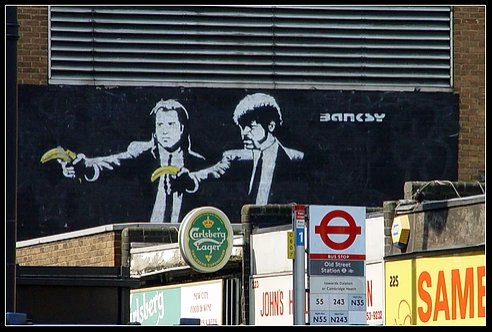
Bananas Instead of Bullets
Appearing near Old Street station in 2002, Pulp Fiction is one of the defining images of Banksy's early London period. Banksy appropriates the instantly recognizable figures of Vincent Vega and Jules Winnfield from Quentin Tarantino's 1994 film, preserving their suits, confrontational poses and outstretched arms while making one wonderfully ridiculous substitution: their pistols become bright yellow bananas.
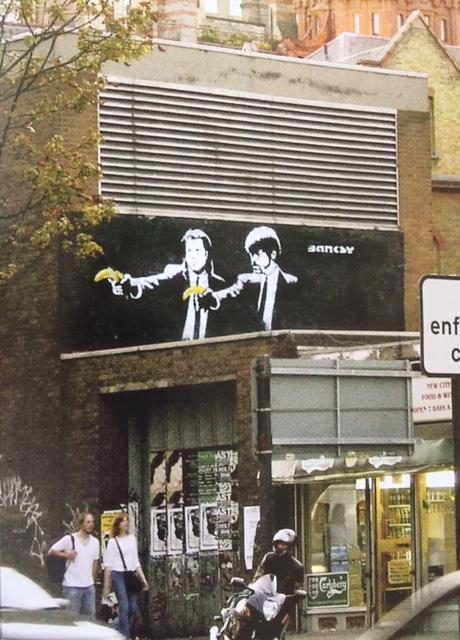
The transformation works because Banksy changes almost nothing. The aggressive choreography remains intact; only the weapons disappear. The result sits somewhere between menace and slapstick. Two cinematic killers continue to behave exactly like cinematic killers, but the objects responsible for the danger have become pieces of fruit. Banksy doesn't need to lecture the viewer about violence—he simply removes the gun and lets the absurdity of the pose reveal itself.
Formally, the mural is exceptionally strong. Travolta and Jackson are rendered almost entirely in black and white against a large black rectangular field, while the bananas provide the only substantial color. Their yellow immediately attracts the eye, making the joke legible from the street before the viewer has even identified the film reference. The work demonstrates something Banksy was becoming particularly good at around this period: taking an image already embedded in popular culture and altering one decisive element so that its meaning changes completely.
Banksy, Tarantino and Pop Culture
Pulp Fiction also shows how naturally Banksy's practice could absorb popular culture. Rather than inventing a new character, he borrows an image millions already know and uses that familiarity as visual shorthand. Tarantino supplies the tension, Hollywood supplies the characters, and Banksy supplies the banana.
There are tempting connections to Warhol's famous banana for The Velvet Underground & Nico and to Monty Python's Self-Defence Against Fresh Fruit, and both have frequently been suggested. They are enjoyable associations, but I would not present either as Banksy's documented source. The Tarantino appropriation is certain; the other connections remain interpretation.
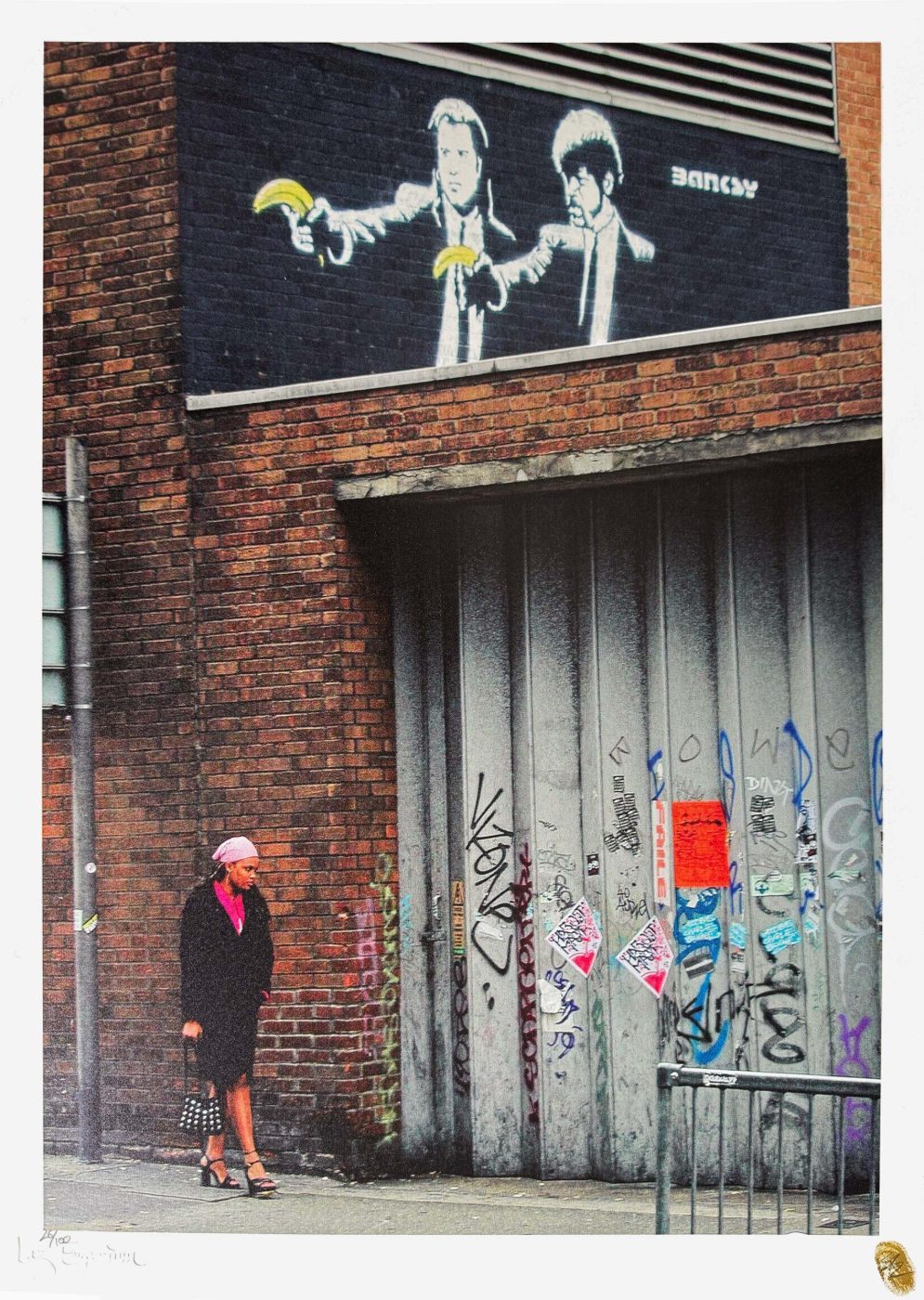
What is more significant within Banksy's own development is the method. Pulp Fiction belongs beside works such as HMV and later Napalm: existing cultural imagery is treated almost as public property, available to be sampled, edited and returned to the street with an entirely different message. Banksy increasingly behaves less like a traditional image-maker than a visual editor of contemporary culture.
Painted Over
The mural survived for approximately five years and had become a well-known local landmark when Transport for London painted it over in April 2007 as part of its graffiti-removal policy. TfL defended the decision on the basis that graffiti contributed to an atmosphere of neglect and social decay. A spokesman produced an inadvertently perfect line: its cleaners were professional cleaners, not professional art critics.
The irony was difficult to miss. An unauthorized image that had become sufficiently famous to attract visitors was erased because the institution responsible for the wall continued to classify it as graffiti. The episode captures the strange transitional moment Banksy had reached by 2007: his work could simultaneously be considered vandalism by public authorities and valuable contemporary art by the market.
But the story became considerably better. After its removal, someone painted “COME BACK” on the empty wall. Banksy did.
He returned with a deliberately inverted version: Vincent and Jules now wore banana costumes while carrying real guns. A young graffiti writer named Ozone subsequently tagged over the work with the challenge that if Banksy did something better next time, he would leave it alone. Shortly afterwards, Ozone was killed by an Underground train. Banksy then replaced the image with a memorial to Ozone, depicting an angel in a bulletproof vest holding a skull.
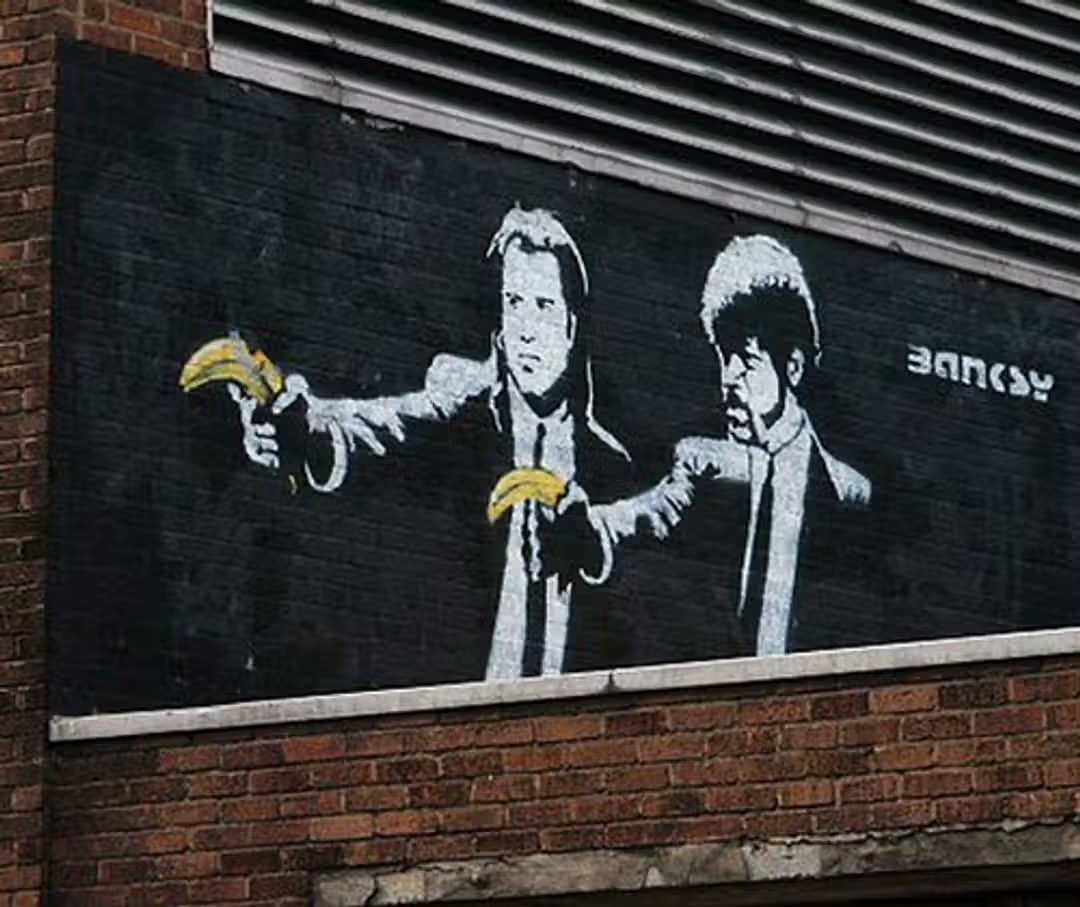
That entire sequence deserves to be included on Banksy Explained because it transforms Pulp Fiction from a famous stencil into a genuine piece of street-art history. The wall became a conversation: Banksy, the authorities, another graffiti writer and Banksy again, each responding to what the previous person had left behind.
Pulp Fiction captures Banksy at a particularly fertile moment. The stencil is technically simple, the cultural reference immediate and the intervention almost absurdly economical. Replace two guns with two bananas and an image of cinematic violence becomes a joke about cinematic violence.
But its subsequent destruction and repainting reveal something even more important about street art. Unlike a painting hanging safely in a museum, a mural remains vulnerable to everything around it—to councils, cleaners, other writers, weather and history. The work can answer back, and somebody else can answer again. Banksy changed the guns into bananas. The street took care of the rest.
STAY INFORMED
Receive the latest news, exhibitions, artworks and market updates on Banksy.