QUEEN VIC
THE QUEEN AFTER NINE O’CLOCK
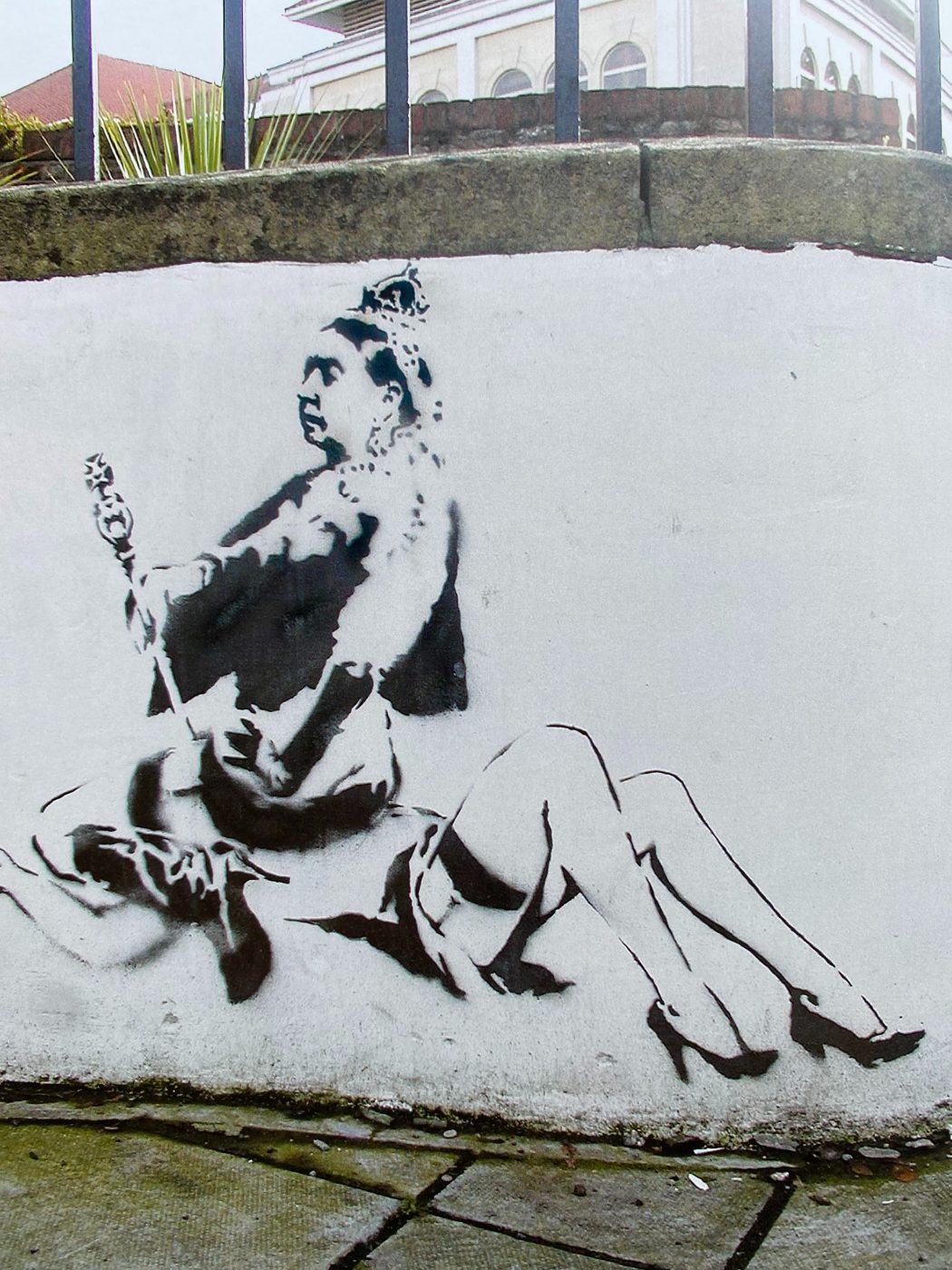
Queen Vic belongs to Banksy's earliest appropriations of British national and royal iconography. The stencil depicts Queen Victoria in crown, ceremonial jewellery and royal sash, seated across the body of another woman in an overtly sexual pose while retaining the sceptre that identifies her authority. The confrontation between the instantly recognizable monarch and an image of lesbian sexuality deliberately overturns the sobriety, restraint and moral respectability traditionally associated with both Victoria and the age that bears her name.
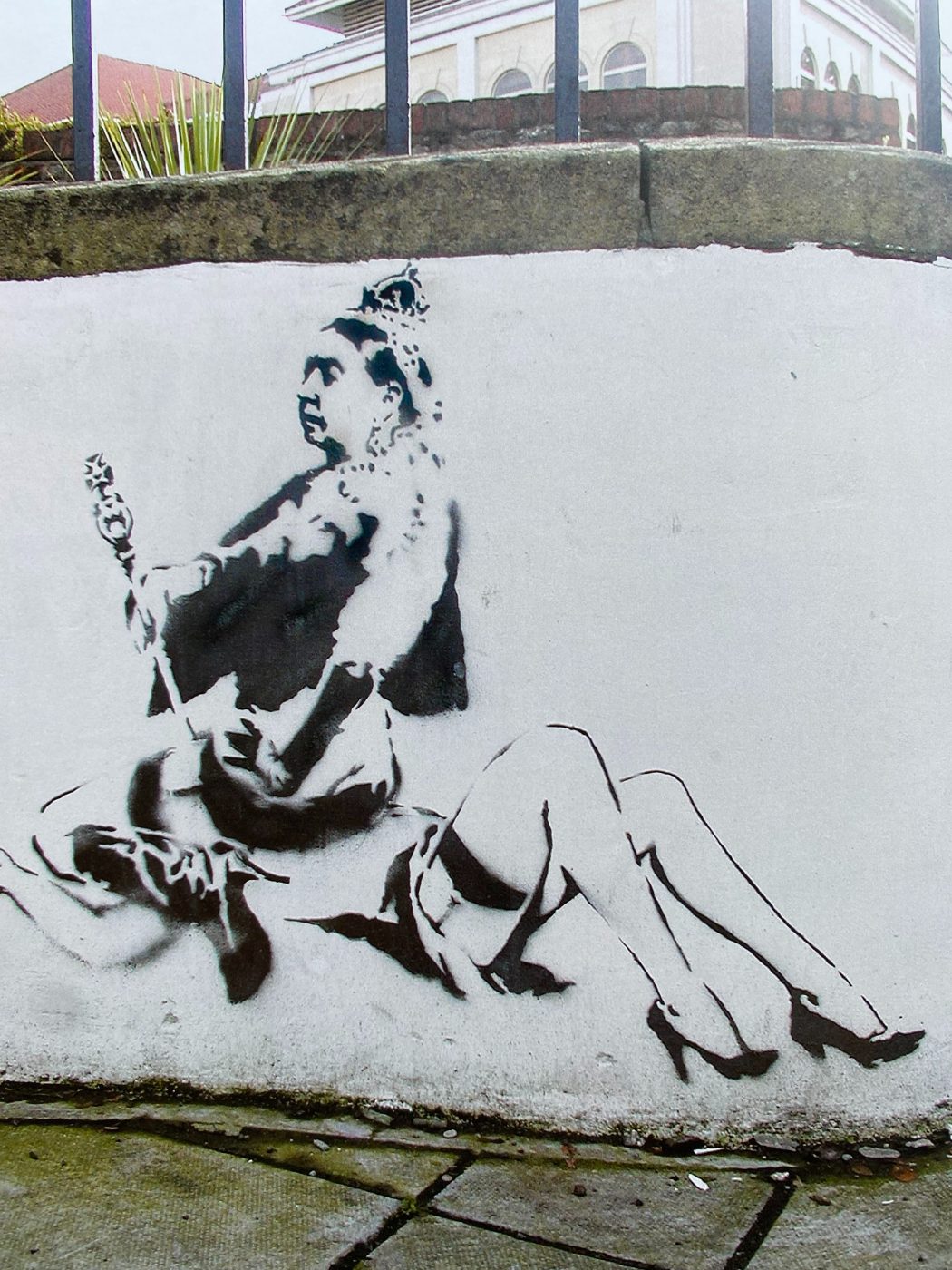
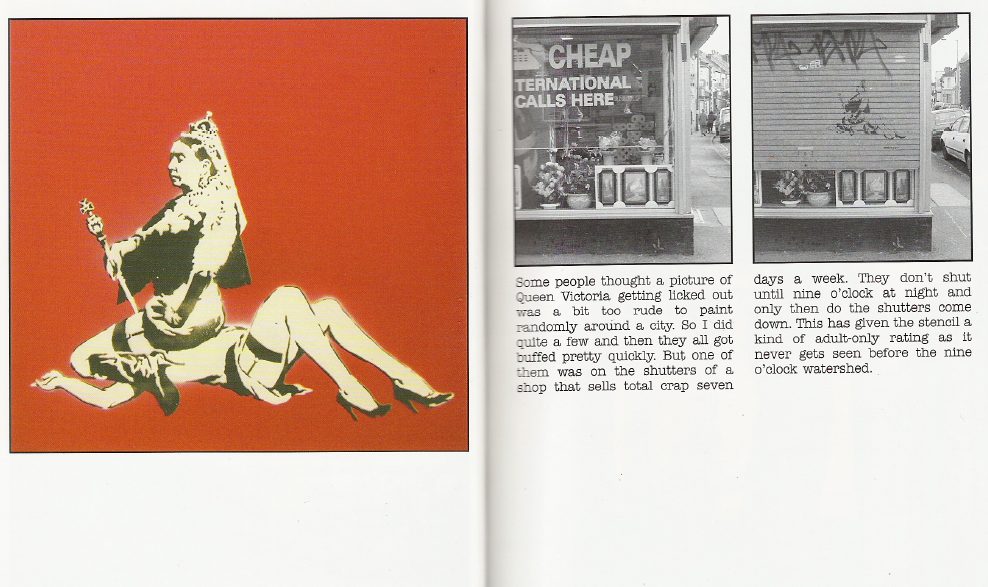
The image was already appearing on the streets of London around 2001. One early version was painted on the shutters of a shop that closed in the evening, an architectural circumstance Banksy incorporated into the joke. In Existencilism (2002), he observed that because the shutter could only be seen once the shop had closed, the work effectively acquired an “adults-only” character and could not be seen before the nine-o'clock watershed. The anecdote is important because it shows Banksy exploiting not merely the wall but the daily functioning of the building itself: during business hours the image disappeared, while after dark the respectable commercial façade revealed an altogether less respectable Queen Victoria.
VICTORIAN MORALITY TURNED UPSIDE DOWN
The satire depends upon Victoria's extraordinary symbolic status. Her reign, from 1837 to 1901, coincided with Britain's emergence as the dominant imperial power of the nineteenth century, while the term “Victorian” subsequently became shorthand for a culture associated—sometimes rather simplistically—with propriety, sexual restraint and rigid social conventions. Banksy takes one of the principal embodiments of that mythology and places her within an image that contradicts almost every expectation attached to it.
The work has frequently been connected to the popular story that Queen Victoria refused to believe that sexual relationships between women existed. That anecdote is often invoked to explain why lesbian acts were not explicitly included when male homosexual acts were criminalized in nineteenth-century British legislation. The historical claim itself is not supported by reliable documentary evidence, however, and should not be repeated as established fact. Banksy's image works perfectly well without it: its central mechanism is the collision between the cultural mythology of Victorian respectability and a deliberately transgressive representation of the monarch herself.
There is also a broader characteristic of Banksy's treatment of authority at work. Rather than depicting Victoria as cruel or oppressive, he removes the protective solemnity surrounding the royal image. Crown, sceptre and ceremonial dress remain recognizable, but their conventional meaning is destabilized by the situation in which they appear. Banksy's attack is therefore directed as much at reverence as at monarchy itself—the assumption that certain historical figures and national symbols should remain beyond irreverent reinterpretation.
FROM THE STREET TO THE CANVAS
Queen Vic quickly migrated from the street into Banksy's studio practice. By 2002, Banksy had produced a substantial unique version in oil on canvas, presented in an ornate gilt artist's frame and exhibited at Santa's Ghetto at the Dragon Bar in Shoreditch. The elaborate framing deliberately evokes the conventions of official royal portraiture, creating a further contradiction between the ceremonial presentation of the work and the irreverence of its subject.
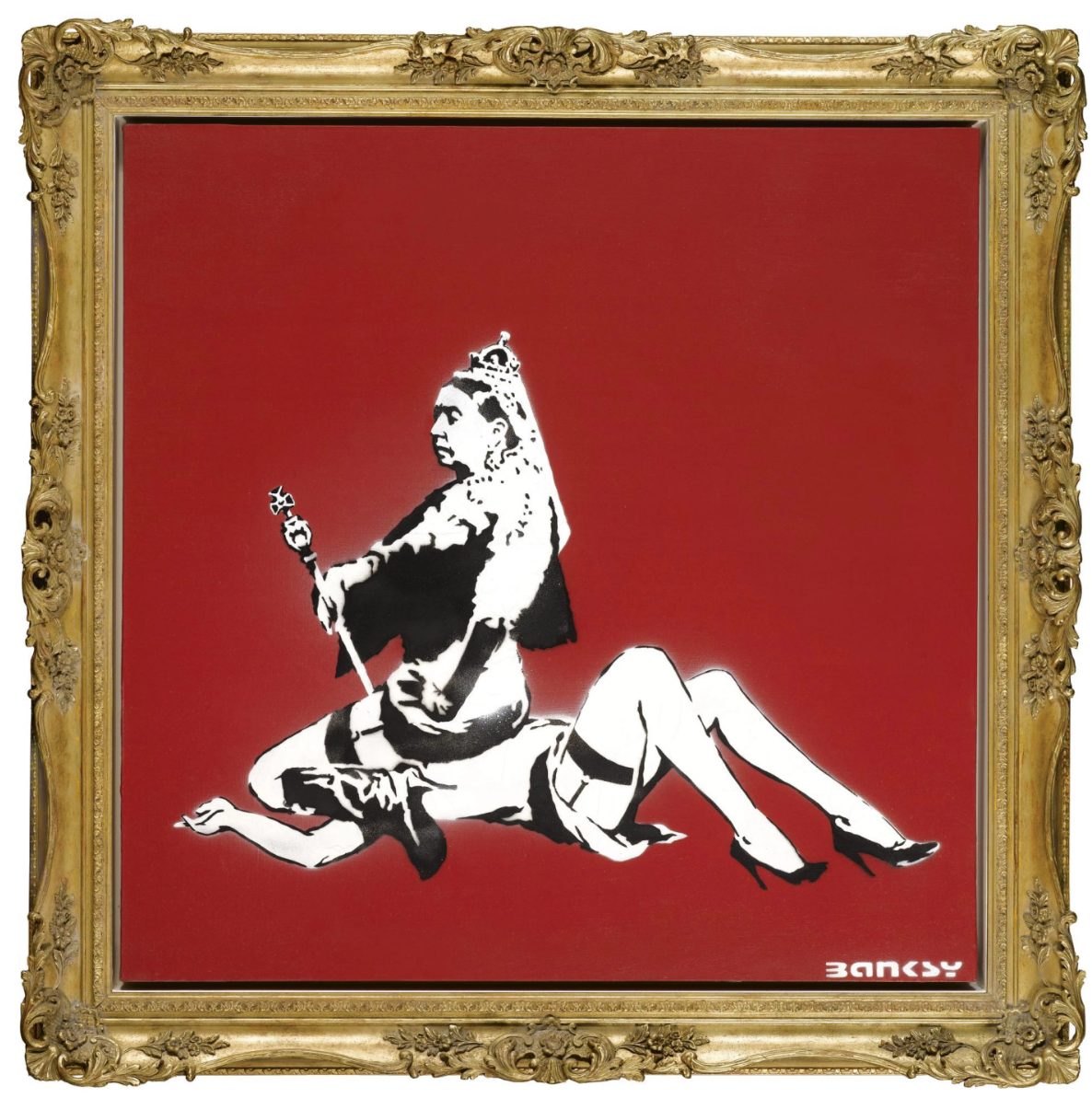
That 2002 painting is particularly important to the history of the image. Against a saturated crimson background, the monochrome figures acquire the graphic clarity that would characterize the subsequent edition, while the gilt frame effectively converts Banksy's illicit street stencil into a parody of an institutional portrait. The work later sold at Sotheby's London on 17 October 2008 for £277,250, demonstrating how rapidly an image developed through Banksy's early street practice had entered the established secondary market.
QUEEN VIC, 2003
In 2003, Banksy developed the image again as a screenprint published by Pictures on Walls. The edition comprised 500 impressions, including 50 signed examples, and retained the striking combination of monochrome figures against a crimson field. The print belongs to the remarkable group of early editions through which images initially encountered in Banksy's street and exhibition practice became available to a much broader audience.
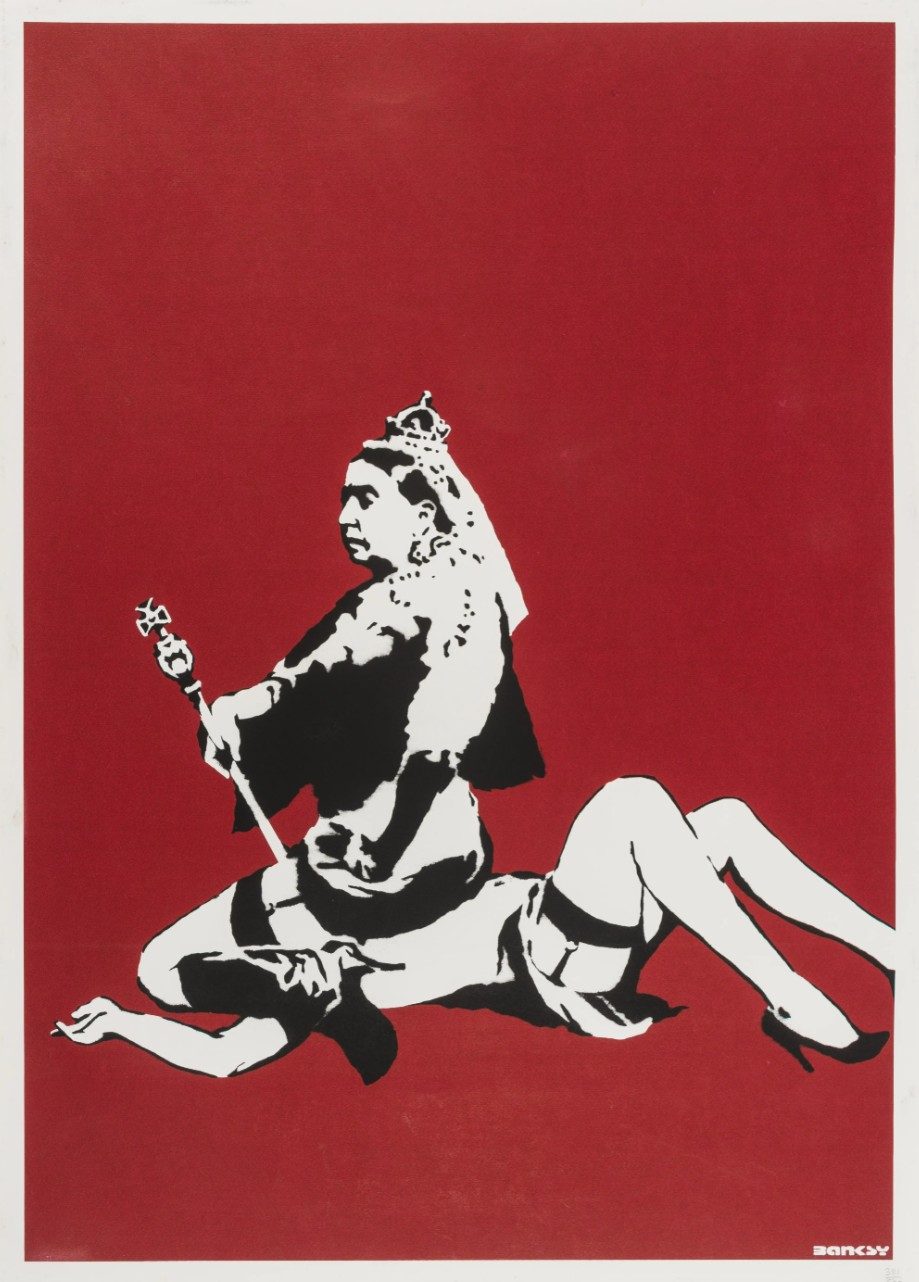
The chronology is therefore especially useful for understanding Banksy's practice at the beginning of the 2000s: street stencil around 2001, unique framed painting in 2002, published screenprint in 2003. Rather than treating these as unrelated objects, they reveal the movement of a single image between the street, exhibition space and editioned work—a pattern that would become fundamental to Banksy's early career.
IRREVERENCE AS A FORM OF CRITICISM
Queen Vic remains one of Banksy's clearest early demonstrations of his ability to undermine authority through visual contradiction rather than elaborate political argument. The image requires almost no explanation to function: one of the most solemn figures in British history has been placed in a situation radically incompatible with the cultural mythology constructed around her.
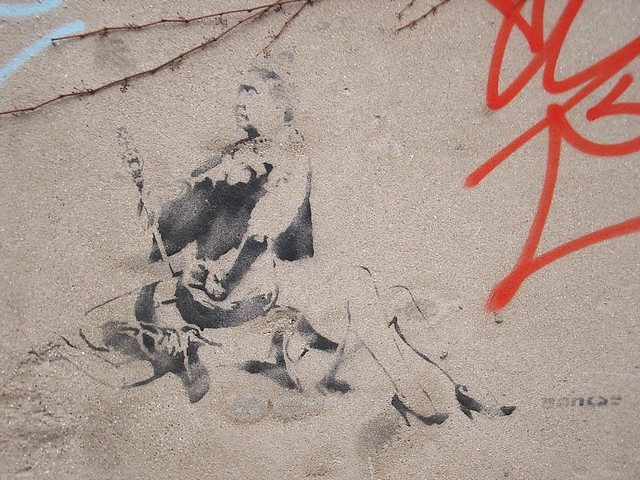
At the same time, its development across several media makes it historically significant within Banksy's catalogue. The early shutter version exploited the rhythms and architecture of the street; the 2002 canvas transformed the image into a mock royal portrait; and the 2003 edition allowed it to circulate internationally as a collectible artwork. Across each iteration, the underlying strategy remains consistent: Banksy appropriates a familiar symbol of institutional authority and preserves just enough of its original dignity for the act of subversion to remain immediately recognizable.
STAY INFORMED
Receive the latest news, exhibitions, artworks and market updates on Banksy.