RIOT ON THE MOVE, 1998
Exhibited
- Easton, Bristol, 1998
Catalogue Note
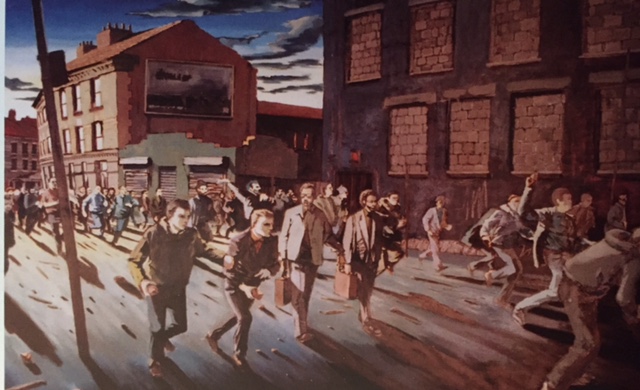
Painted in 1998, Riot on the Move captures a moment of urban unrest that would become one of the defining subjects of Banksy’s early career. Set against the backdrop of boarded-up buildings and anonymous city streets, the composition depicts a crowd surging through the scene, suspended somewhere between peaceful demonstration and violent confrontation. Some figures flee, others advance, while the viewer is left uncertain whether they are witnessing the beginning of a riot or its aftermath.
Rather than glorifying conflict, Banksy focuses on its collective psychology. Individual identities dissolve into the movement of the crowd, suggesting how easily ordinary people become absorbed into forces larger than themselves. The boarded windows, deserted architecture and darkening sky evoke a city already scarred by social division, where unrest appears less as an isolated event than as the inevitable consequence of neglect and inequality.
The work also reveals Banksy’s deep roots in Bristol’s street culture. Created during a period marked by tensions surrounding policing, youth culture and urban regeneration, Riot on the Move reflects the atmosphere from which the artist himself emerged. Yet its message extends far beyond a specific place or moment. The anonymous demonstrators could belong to almost any city, reminding us that social unrest is often a symptom rather than the disease itself. Executed before Banksy had fully embraced the stark monochrome stencil aesthetic for which he later became famous, the painting combines expressive brushwork with cinematic composition, demonstrating an artist already fascinated by the choreography of crowds and the fragile relationship between authority and resistance.
STAY INFORMED
Receive the latest news, exhibitions, artworks and market updates on Banksy.