RUBBER DUCKY, 2006
Exhibited
- Building Castles in the Sky, Lugano, 2022
Catalogue Note
Something in the Water
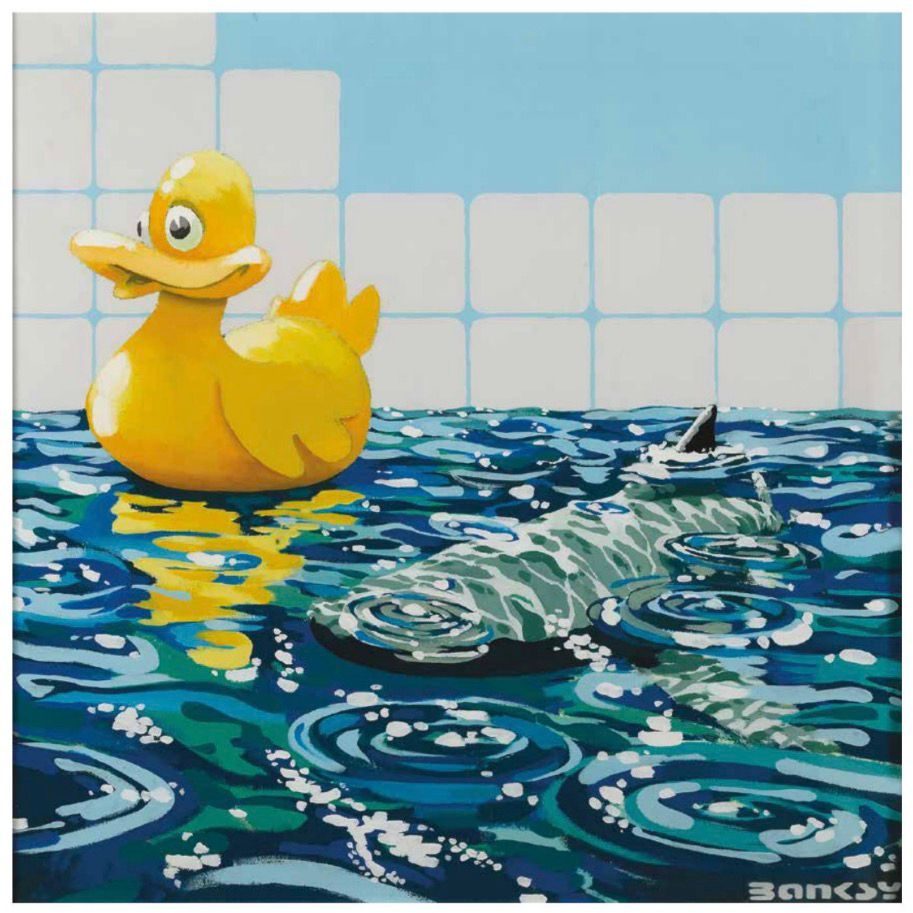
Few Banksy paintings announce danger quite so cheerfully. A bright yellow rubber duck floats across an improbably blue expanse of water. Behind it stretches the familiar grid of bathroom tiles, immediately establishing the supposedly safest and most domestic of environments: a child's bath. Yet only a short distance away, a dark fin breaks the surface. Beneath it, barely visible through the swirling water, lies the enormous body of a shark.
Banksy constructs the scene around that collision between innocence and threat. The rubber duck belongs to childhood, play and protection; the shark belongs to a completely different visual universe. By placing the two together, Banksy turns the bathtub into an ocean and an ordinary bath toy into unsuspecting prey.
The result is funny, but the joke works because something genuinely sinister has entered the room.
Jaws in the Bathtub
There is something unmistakably cinematic about the composition. We do not need to see the shark clearly to understand what is about to happen. Like the fin cutting through the water in Jaws, the fragment is enough: our imagination supplies the predator beneath the surface.
Banksy makes the imbalance deliberately absurd. The duck is enormous, bright yellow and almost comically innocent, while the shark is submerged and difficult to read. Yet psychologically the shark dominates the picture. Once we notice the fin, it becomes almost impossible to look at anything else.
The composition therefore plays a clever game with visibility. The greatest threat in the painting is the thing we can barely see.
Even the duck appears unaware of it. Its fixed cartoon expression remains permanently cheerful as danger approaches from behind. That obliviousness is essential to the work: the viewer knows something the protagonist does not.
From Hockney's Swimming Pools to Banksy's Bathtub
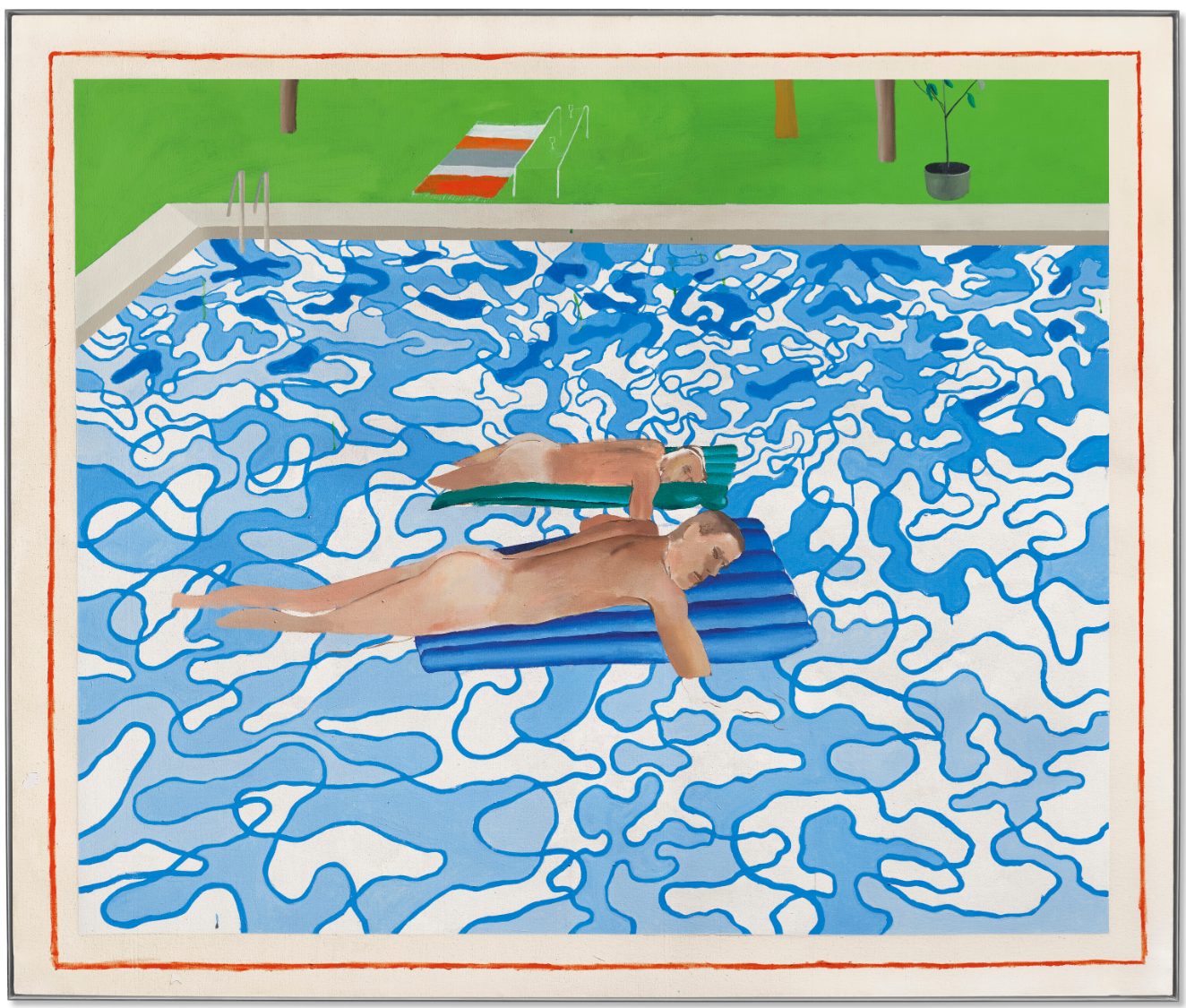
The intensely blue water of Rubber Ducky inevitably recalls the swimming pools that became one of the defining subjects of David Hockney's Californian paintings of the 1960s and 1970s. In works such as California, Hockney transformed the swimming pool into an almost perfect image of Southern Californian pleasure: brilliant light, modern architecture, seductive color and the promise of an effortless life. Water became both subject and surface, something simultaneously transparent, reflective and extraordinarily difficult to paint.
Banksy borrows something of that visual seduction but turns it against itself. His blues and turquoises are equally inviting, and the surface is alive with reflections, ripples and flashes of white. The yellow duck produces its own shimmering reflection, while concentric circles spread across the water with an almost decorative rhythm. For an artist so closely associated with the economy of the stencil, the sheer pleasure taken in painting the water is striking.
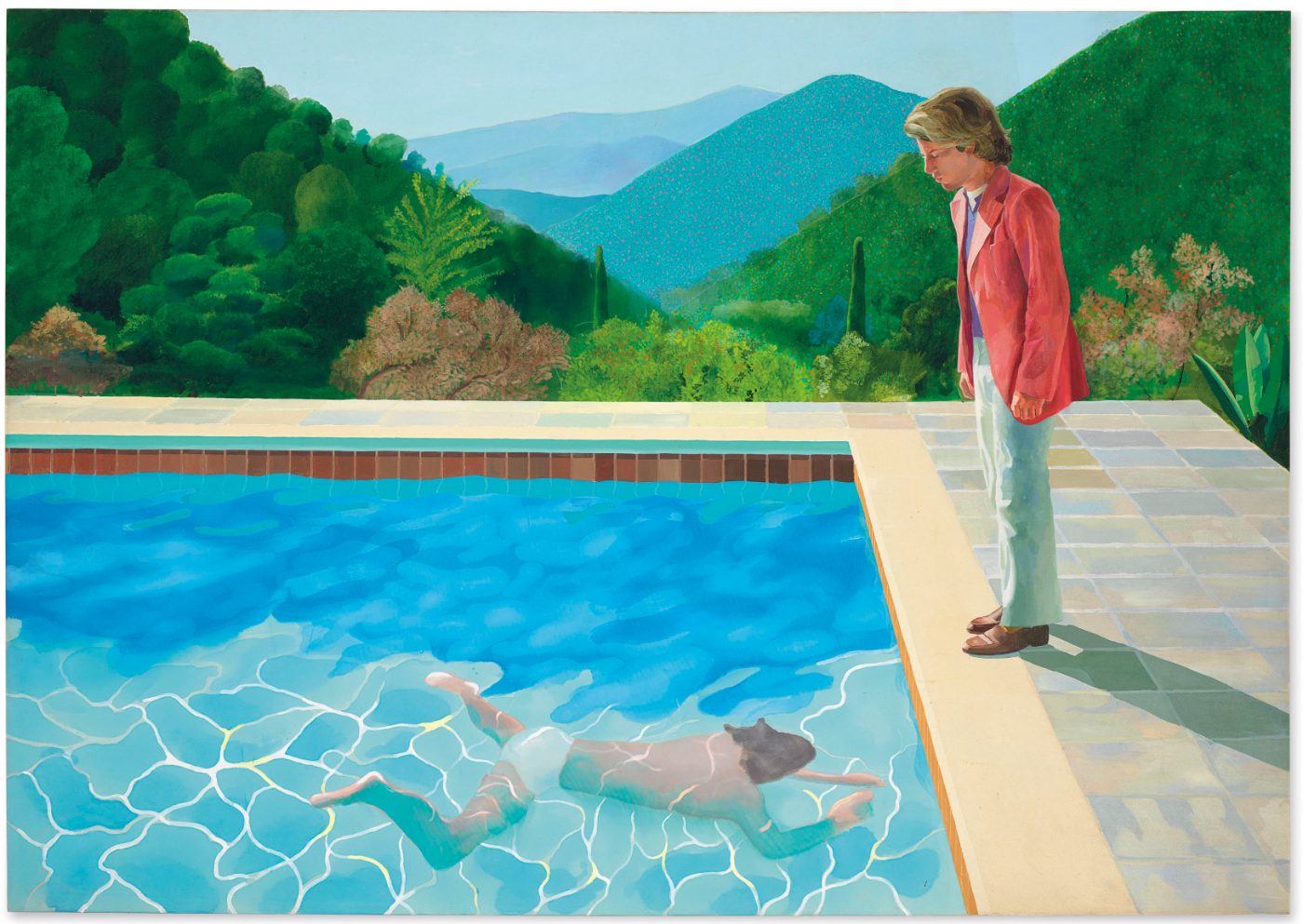
But where Hockney's pools suggest leisure, Banksy's bathtub conceals a predator. The immaculate blue surface no longer represents escape or pleasure; it becomes camouflage. What appears beautiful above the water hides something dangerous beneath it. Even the scale becomes unstable. A child's bath has somehow acquired the visual depth and psychological dimensions of an ocean. The comparison therefore reveals something fundamental about Banksy's method. He does not need to reject beauty in order to undermine it. He can make the water luminous, colorful and inviting—and then place a shark underneath.
Painting Without the Stencil
Rubber Ducky is also unusual within Banksy's practice because of the way it is painted. Rather than relying predominantly upon the crisp silhouettes and graphic economy associated with his stencil language, the composition is rendered in acrylic with an unusually painterly treatment of water.
The lower two-thirds of the canvas are particularly energetic. Turquoise, blue, white and green strokes describe reflections, ripples and foam, while the yellow of the duck spills downward into the water as a distorted reflection. Circular ripples punctuate the surface and give the bathtub an almost improbable physical depth.
This painterliness creates an interesting contradiction. The setting is unmistakably artificial—the tiled wall and rubber toy belong to an ordinary bathroom—yet the water is treated with the drama of a seascape. Banksy has effectively transformed a few inches of bathwater into the open ocean.
The End of Innocence
The rubber duck is one of the most universally recognizable objects of childhood. It belongs to precisely the environment adults construct to make children feel safe: warm water, toys, brightly coloured objects and the controlled enclosure of the family bathroom.
Banksy introduces a predator into that protected space.
This is where Rubber Ducky connects with a recurring mechanism throughout his work. Banksy frequently takes imagery associated with childhood and places it beside something that should not belong there: weapons, surveillance, violence, consumerism or political conflict. The collision works because childhood represents an imagined territory of innocence, while the adult world continually intrudes upon it.
Yet Rubber Ducky remains unusually ambiguous. There is no slogan telling us what the shark represents. It might stand for violence, capitalism, adulthood, fear or simply the uncomfortable recognition that danger can exist beneath apparently reassuring surfaces. Banksy leaves the metaphor open.
That ambiguity makes the painting stronger. The shark can become whatever we fear is hiding underneath.
A Rare Banksy Original
The work has subsequently occupied an interesting position within the exhibition history of Banksy's secondary market. Andipa Gallery records the painting as a 2006 work measuring 91 × 91 cm, and it has appeared in the travelling Building Castles in the Sky project and related unauthorized museum exhibitions, including Palermo and Basel.
Its square format, saturated palette and unusually painterly execution distinguish it immediately from Banksy's more familiar monochromatic stencil paintings. Rather than delivering its message through a handful of graphic elements against an empty ground, Rubber Ducky creates an entire pictorial environment.
Yet the underlying mechanism remains quintessentially Banksy: take something everybody recognizes, introduce one impossible element, and allow the collision to do the thinking.
Rubber Ducky succeeds because Banksy requires remarkably little to destabilize an otherwise joyful image. There is no violence, no blood and no visible attack. The shark has not even reached the duck. It doesn't need to.
The bright colours initially invite us into the painting; the rubber duck makes us smile; the swirling water is almost exuberant. Then we notice the fin, and the entire image changes. What looked like a child's bath becomes dangerous territory.
Perhaps that is the real subject of Rubber Ducky: not the shark itself, but the moment when innocence becomes aware that there may be something underneath the water. Sometimes all it takes to ruin a perfectly good bath is one small fin.
STAY INFORMED
Receive the latest news, exhibitions, artworks and market updates on Banksy.