SEPARATION WALL (BEACH BOYS), 2006
Catalogue Note
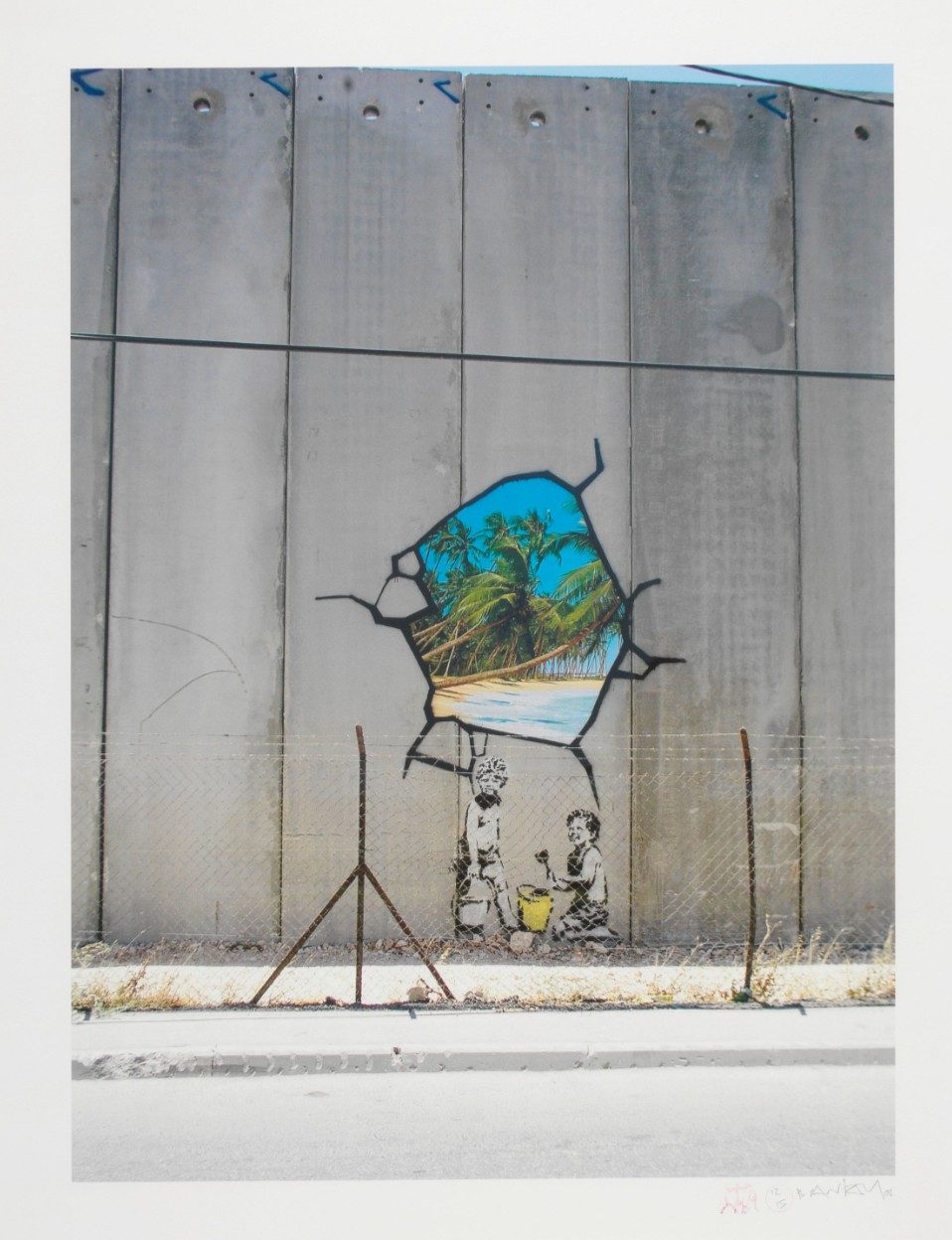
Separation Wall (Beach Boys) belongs to a remarkably small and unusual group of photographic editions created from Banksy's interventions on the West Bank separation barrier, and is among the rarest authenticated editions associated with this pivotal period of his career.
The image originates from Banksy's highly publicized trip to the West Bank, where in 2005 he produced a series of works directly on and around the separation barrier. Rather than simply decorating the wall, Banksy repeatedly treated its physical presence as the subject of the work itself: a barrier designed to prevent passage becomes something that his images imaginatively puncture, climb over or escape through.
Here, two children sit beneath an enormous painted rupture in the concrete. Through the imaginary opening appears an impossibly idyllic tropical beach—blue sky, white sand and palm trees. One child holds a bucket while the other appears to work at the wall, as though they have literally excavated their way toward paradise.
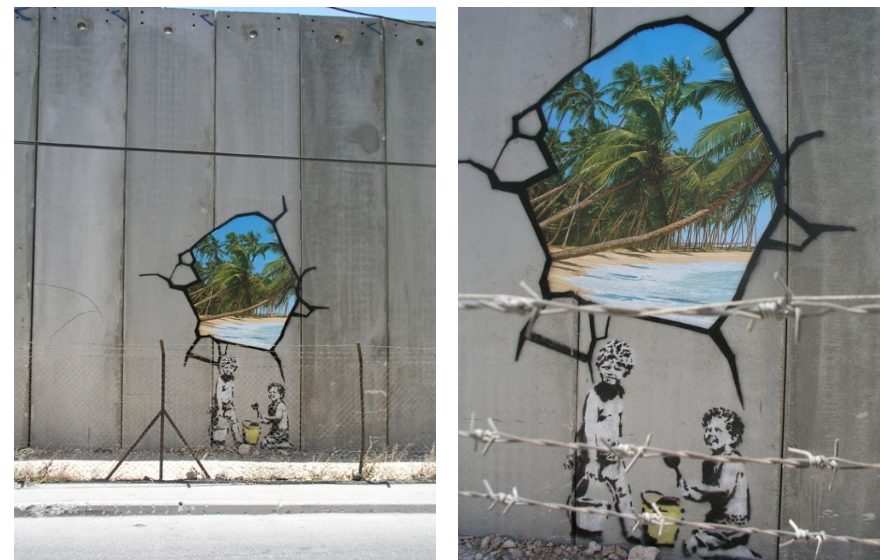
It is one of Banksy's simplest and most effective uses of trompe-l'œil. The brutality of the monumental grey barrier is confronted by an image of unrestricted space. Concrete meets ocean; confinement meets escape; political reality meets the uncomplicated fantasy of children going to the beach.
But the paradise is deliberately artificial. It is essentially a picture postcard pasted conceptually onto a wall. The children have not escaped anywhere. The barrier remains standing, the fence remains in front of them, and the tropical landscape exists only as an image. Banksy offers freedom and withdraws it simultaneously.
That tension between physical confinement and imaginary escape became central to Banksy's interventions in Palestine. The wall itself ceases to function merely as a surface for graffiti and becomes an active component of the composition. Without it, the joke—and much of the political meaning—disappears.
What makes Palestine Photo (Beach Boys) particularly interesting within Banksy's editions is its format. This is not one of the artist's familiar screenprints translating a stencil image onto paper, but a photographic record of an intervention created in a specific political landscape.
This gives the Palestine photographs a peculiar position within Banksy's graphic output. They are simultaneously document, edition and artwork. The photograph preserves an ephemeral intervention, but Banksy's signature, numbering and exceptionally restricted production transform that documentation into an autonomous collectible work.
STAY INFORMED
Receive the latest news, exhibitions, artworks and market updates on Banksy.