MORNING IS BROKEN (SHEET METAL CURTAINS)

Morning Is Broken
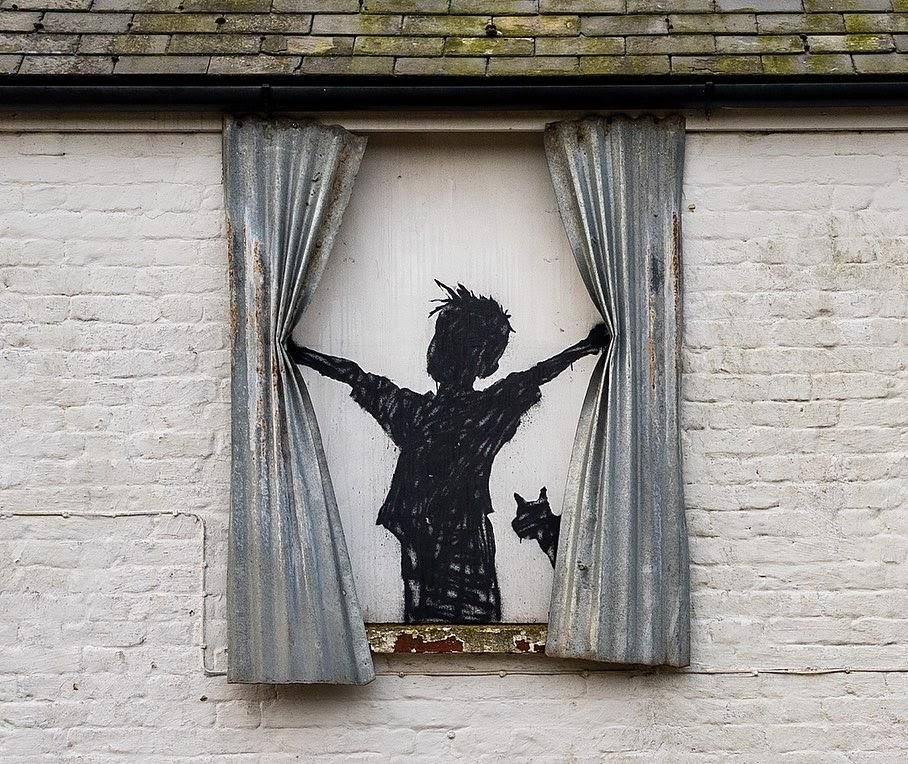
In March 2023, Banksy transformed a boarded window on a dilapidated farmhouse near the seaside town of Herne Bay into one of his simplest and most poetic architectural interventions. A silhouetted boy appears at the window beside a small cat, his arms stretched outward as though pulling open a pair of curtains. The curtains, however, are not fabric. They are the building's existing sheets of corrugated metal, bent outward from the wall and incorporated directly into the composition.
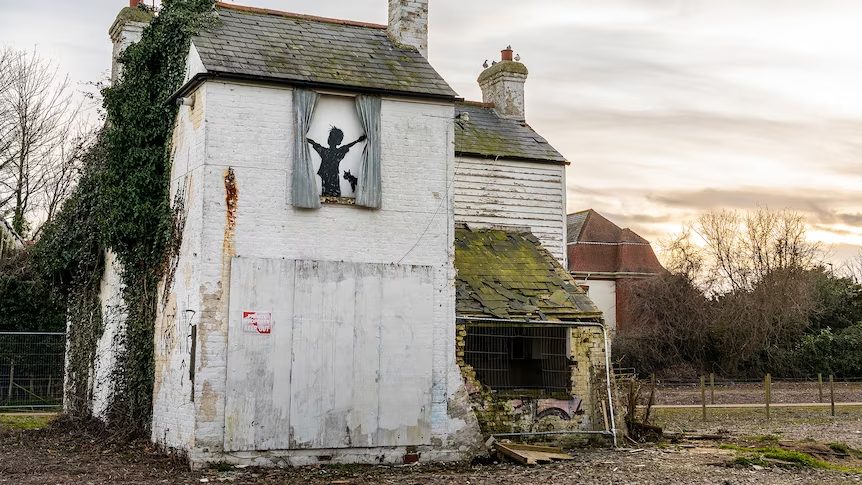
The illusion is beautifully economical. With little more than two black silhouettes, Banksy turns a piece of industrial boarding into the suggestion of a domestic morning ritual. The child seems to have just woken and opened the curtains to greet the day. Yet everything surrounding him contradicts that optimism: peeling paint, exposed brickwork, ivy, missing roof tiles and a farmhouse already awaiting demolition. The window opens onto a morning in a building that has reached the end of its life.
The Building Becomes the Artwork
As with Banksy's best site-specific interventions, the physical structure is not merely a surface on which the image has been painted. It completes the image.
The corrugated metal becomes curtains. The boarded window becomes a bedroom window. The decaying façade becomes the child's home. Even the deterioration of the farmhouse contributes to the atmosphere. Remove the figures from this particular wall and much of the work disappears with them.
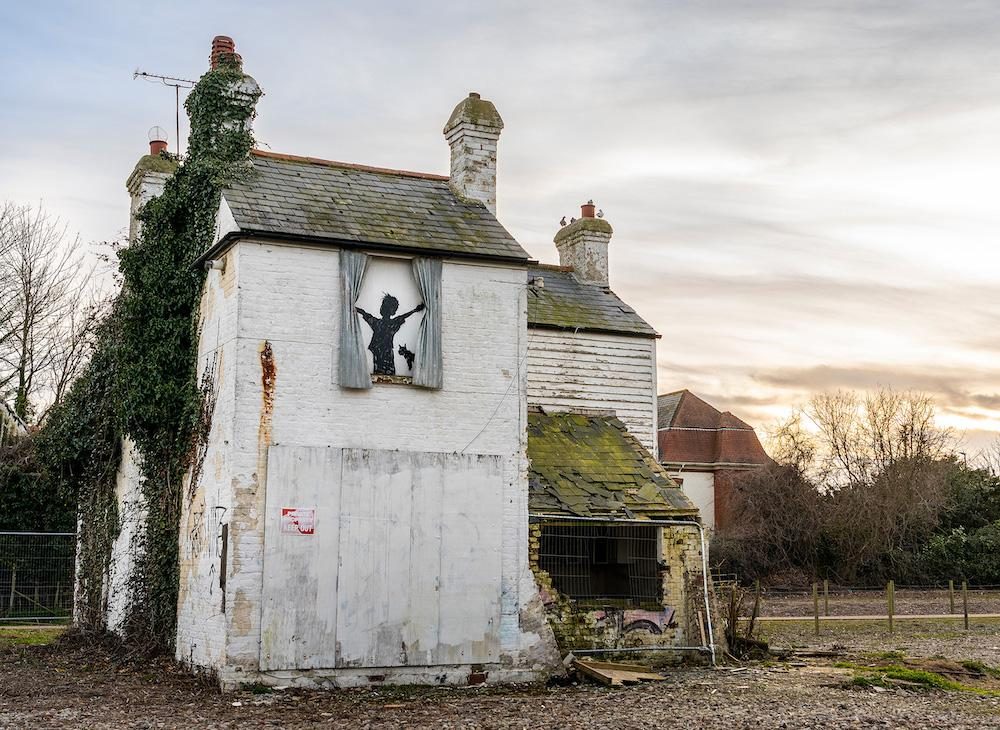
There is something almost theatrical about the composition. The sheets of metal behave like curtains opening onto a stage, but behind them there is no idyllic landscape or sunlit bedroom—only the sealed interior of an abandoned building. Banksy creates the expectation of an opening while simultaneously confronting us with closure.
The small cat is an especially good detail. It adds nothing to the political or conceptual argument of the work, yet it makes the scene immediately domestic and intimate. For a moment, the derelict farmhouse appears inhabited again.
Morning Has Broken
Banksy's title introduces the decisive twist. Morning Is Broken plays on the familiar phrase—and hymn—Morning Has Broken, traditionally associated with renewal, sunlight and the beginning of a new day.
Banksy removes a single word and changes everything.
Morning has not simply arrived. Morning itself is broken.
The phrase can be read against the physical condition of the farmhouse, but it also gives the work a broader melancholy. Childhood, home and the optimism traditionally associated with a new morning are placed inside a structure already condemned to disappear.
It would be tempting to impose a specific political interpretation on the work, but Banksy provided none. Its strength lies precisely in remaining open: it can suggest lost childhood, abandoned homes, the passage of time, redevelopment, displacement or simply the strange beauty of finding signs of life in something approaching destruction.
An Artwork Made to Disappear?
What happened next makes Morning Is Broken considerably more interesting.
The farmhouse stood on Blacksole Farm, a development site earmarked for new housing. Demolition had already begun when Banksy's work appeared. Contractors started tearing down the building on 14 March and later said they had no idea the mural was a Banksy. One worker, George Caudwell, said he felt sick when he discovered what they had destroyed.
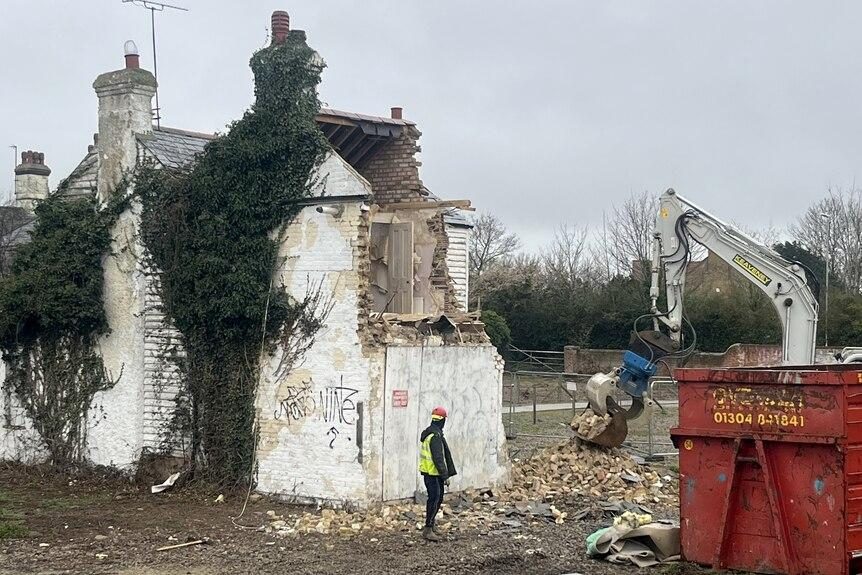
Banksy then authenticated the work in characteristic fashion. Rather than simply publishing photographs of the finished mural, his Instagram post presented three images forming a miniature narrative: the artwork in close-up, the complete derelict farmhouse, and finally the demolition site—with the wall containing the mural already gone.
That third photograph fundamentally changes how the work can be understood. Destruction is not something that happened years later, as with so many Banksy murals. It was incorporated into Banksy's own presentation of the piece.
Whether Banksy deliberately chose the building because he knew demolition was imminent has never been established. The evidence does not justify claiming that he arranged or intended its destruction. But he was clearly aware of what had happened by the time he announced the work, and rather than concealing the accident, he made the demolished wall the final image of the artwork's public unveiling.
Rescued from the Rubble
The story did not entirely end there. Once the contractors realized what had been destroyed, they searched through the rubble and recovered sections of the wall and reportedly elements of the corrugated metal. Contemporary reporting described Banksy enthusiasts arriving at the site as fragments were being retrieved.
The episode produced one of the stranger paradoxes surrounding Banksy's street work. Before authentication, the wall was demolition rubble. Minutes later, fragments of exactly the same bricks potentially constituted pieces of an internationally significant artwork.
That transformation—from building material to artwork and then almost immediately to debris—could hardly be more Banksy.
Here, two bent sheets of corrugated metal become curtains through the addition of a child and a cat. The intervention is almost absurdly modest, yet the decaying farmhouse gives it an emotional weight that a clean gallery wall could never provide.
Morning Is Broken belongs to a particularly interesting group of Banksy works in which an existing architectural element supplies the central visual idea. Banksy does not simply paint onto the building; he looks at the building and discovers an image already waiting inside it.
Its accidental destruction completes the story in a way Banksy himself seems to have immediately understood. The work depicts a child opening the curtains onto a new morning at precisely the moment when the building around him is about to cease to exist. Banksy's final photograph then removes the child, the window, the curtains and almost the entire farmhouse.
For once, the ephemeral nature of street art did not take years to reveal itself. The morning arrived, the curtains opened, and by the end of the day almost everything was gone.
STAY INFORMED
Receive the latest news, exhibitions, artworks and market updates on Banksy.