SLAVE LABOUR (BUNTING JOB), 2012
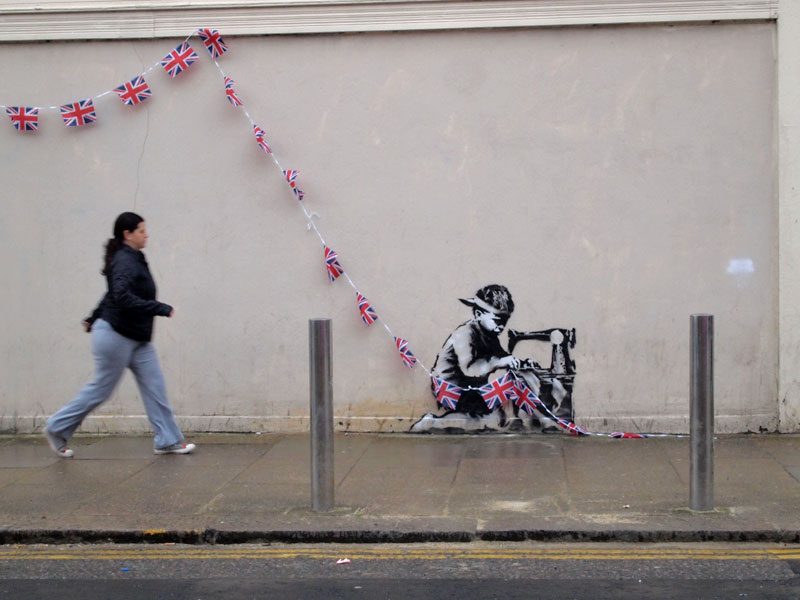
A Child Sewing the Union Jack
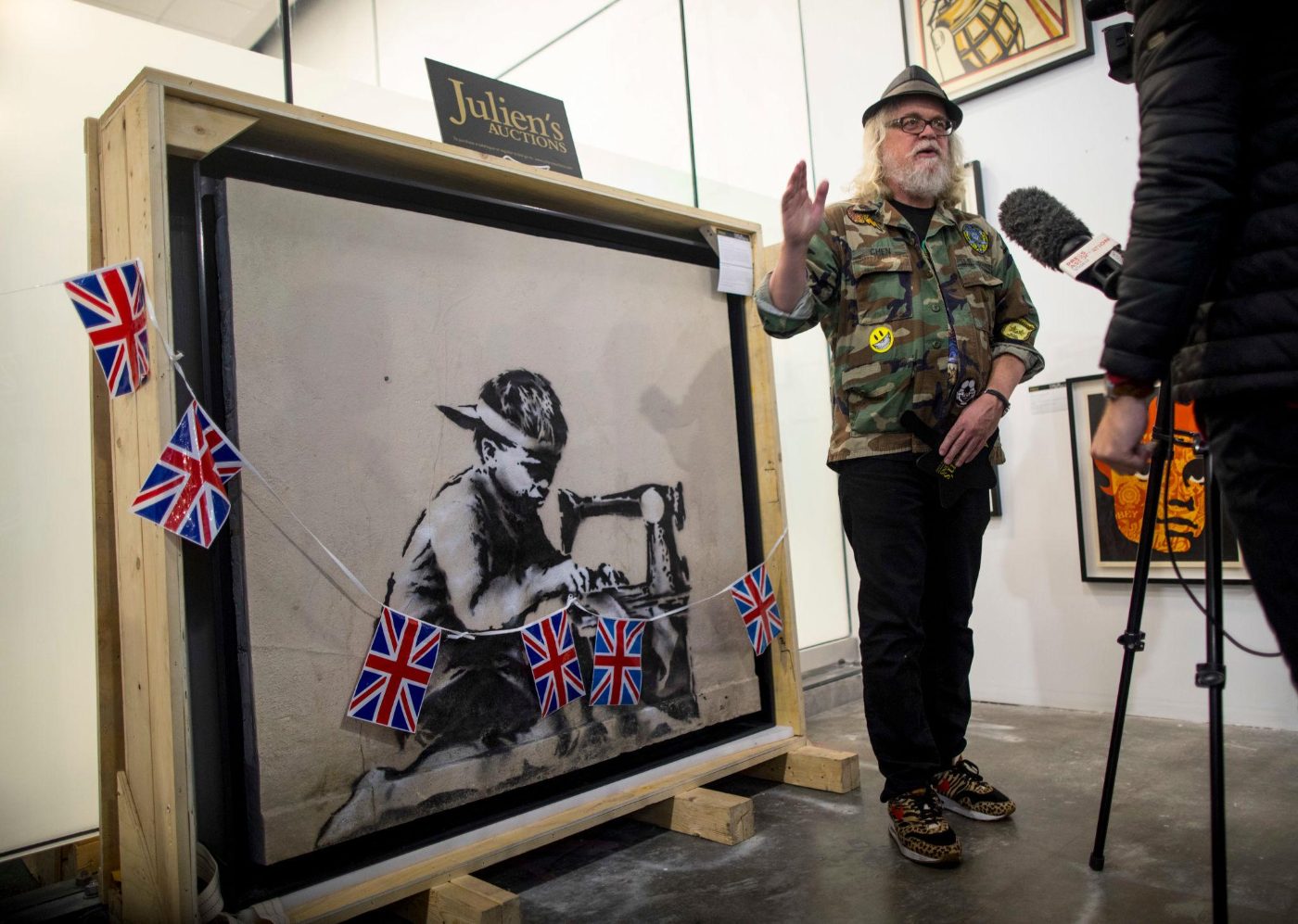
Appearing in May 2012 on the exterior wall of a Poundland store in Wood Green, North London, Slave Labour—also known as Bunting Boy—depicts a barefoot child crouched over an old-fashioned sewing machine, producing a seemingly endless line of Union Jack bunting. The mural appeared only weeks before the celebrations for Queen Elizabeth II's Diamond Jubilee, and in the same year that London hosted the Olympic Games, when patriotic imagery saturated British streets, shops and advertising. The juxtaposition was immediate and deliberately uncomfortable: the cheerful flags of national celebration are revealed as the product of invisible labor.
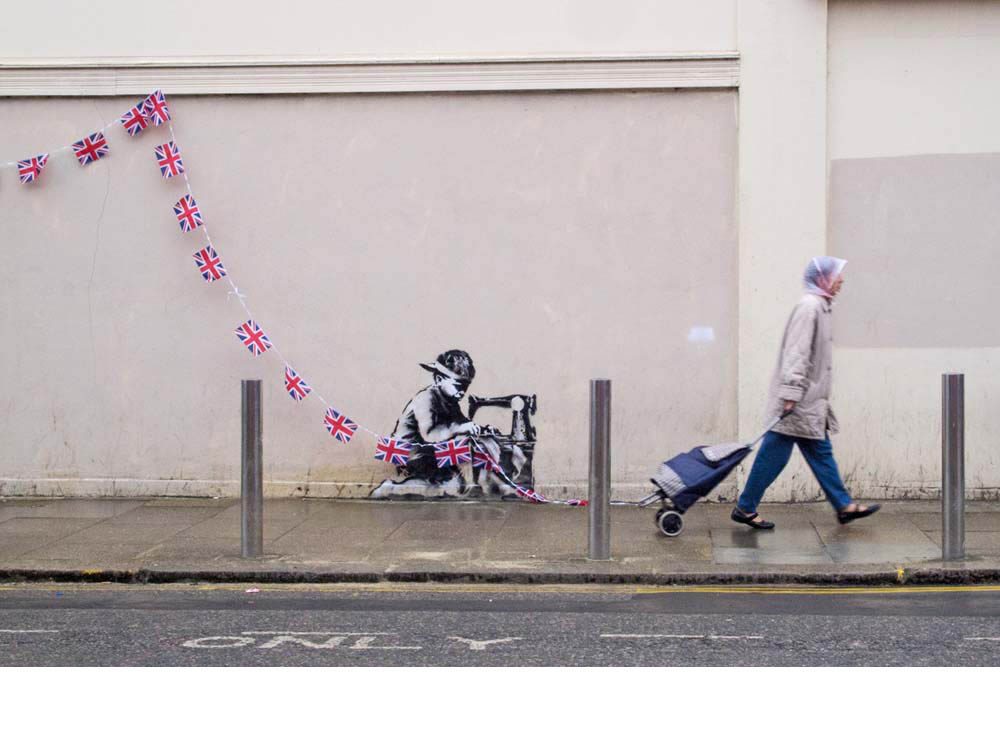
The composition is exceptionally economical. The boy and sewing machine are rendered almost entirely in monochrome, while the small flags emerging from his hands provide the work's principal color and its most recognizable national symbol. Banksy places the child physically beneath the bunting he is manufacturing, hunched over the machine with his attention fixed on repetitive work. There is no factory, supervisor or explicit scene of exploitation. A single child, a sewing machine and a string of flags are sufficient to connect the pleasures of consumption and public celebration with the labor required to produce their material symbols.
Patriotism, Consumption and Invisible Labor
The choice of location sharpened that relationship. Rather than appearing in an abstract political setting, the work was painted on the wall of Poundland, a retailer associated with inexpensive mass-produced goods. The mural was widely interpreted at the time as a criticism of child labor and of the supply chains concealed behind cheap consumer products, while the Union Jack bunting connected that critique directly to the patriotic consumption surrounding the Jubilee.
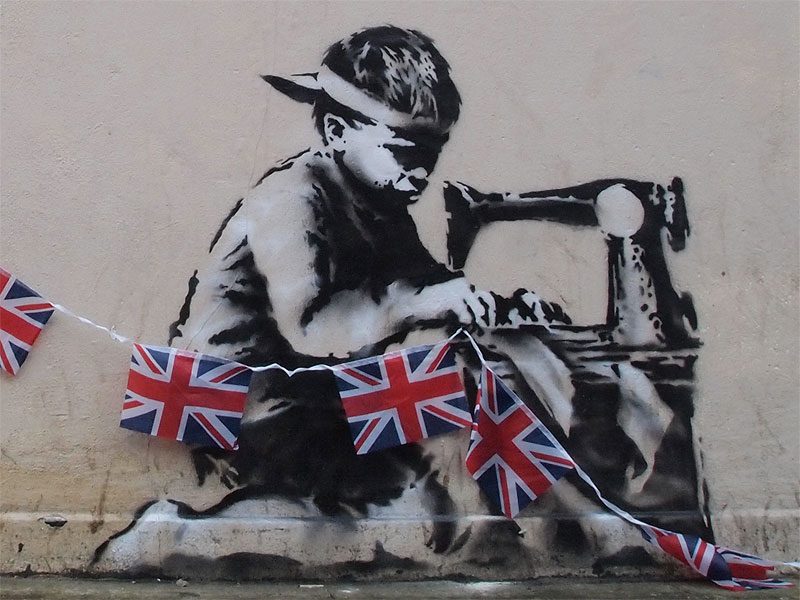
The image does not necessarily attack the flag itself. Its subject is the contradiction between the values represented by patriotic symbols and the economic systems through which those symbols can become commodities. Celebration takes place at one end of the chain; unseen labor occurs at the other. Banksy collapses the distance between the two by showing the child physically manufacturing the symbol that others will wave.
Slave Labour consequently belongs to an important strand of Banksy's practice in which childhood is placed in confrontation with adult economic and political systems. Yet unlike the children of No Ball Games, Follow Your Dreams – Cancelled or Crayon House Foreclosure, this child is neither playing nor imagining an alternative world. He is working. Even the colorful flags passing through his hands belong to somebody else's celebration.
The Disappearance of Slave Labour
The mural rapidly became a familiar local landmark and was protected behind transparent acrylic. In February 2013, however, residents discovered that the entire section of wall carrying the Banksy had disappeared. It had been removed under scaffolding and tarpaulin and soon resurfaced thousands of miles away in the catalogue of Fine Art Auctions Miami, where it was offered with an estimate of $500,000–700,000.
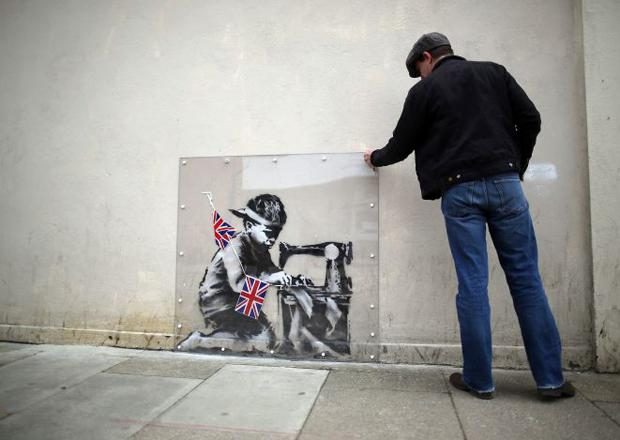
Its disappearance provoked an unusually strong reaction. Local residents campaigned for the mural's return, while Haringey Council argued that a work that had become part of the community should not simply be removed and converted into private property. Poundland stated that it neither owned the building nor had removed the mural, and the identity of the consignor was not publicly disclosed.
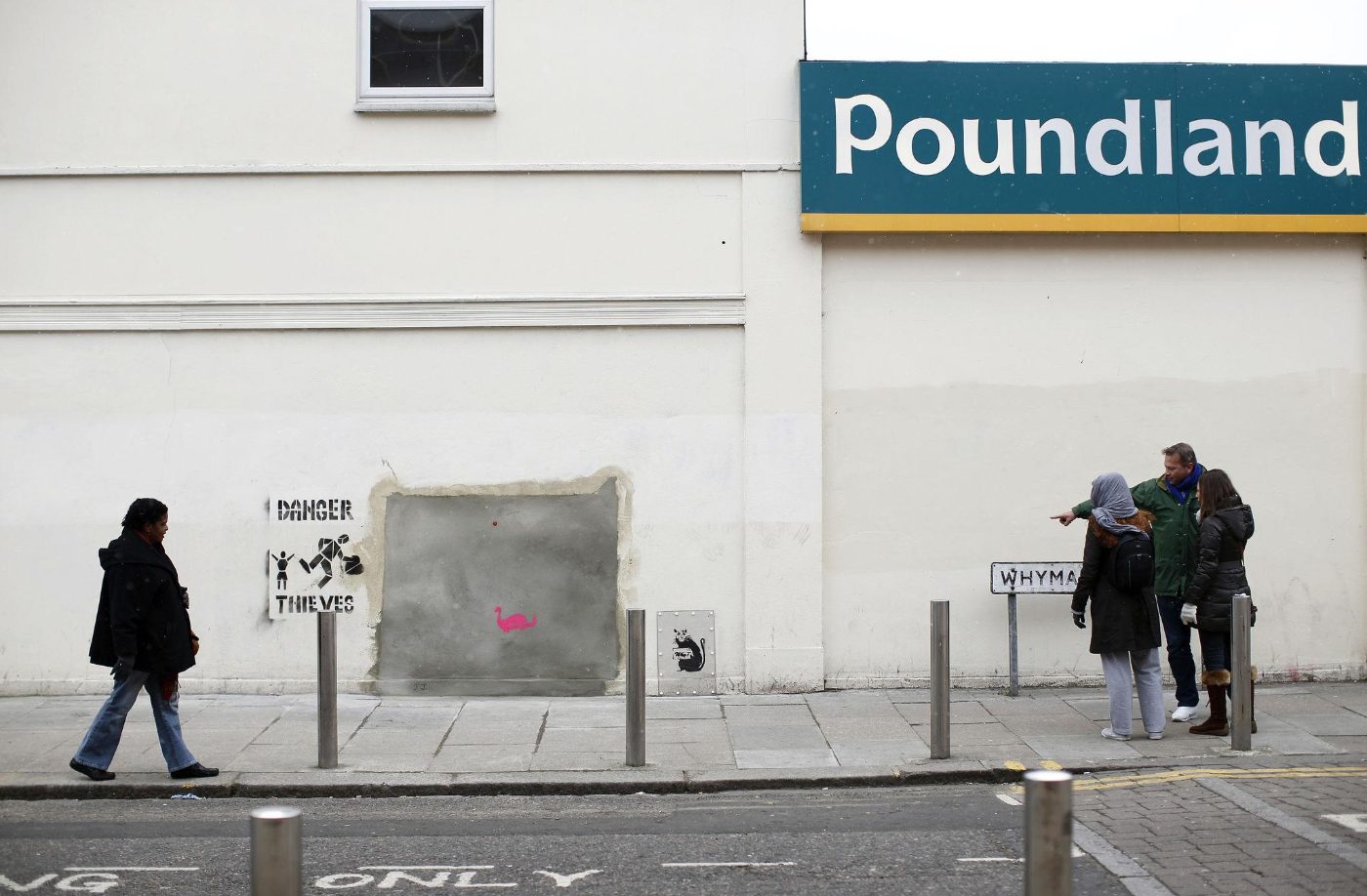
The controversy culminated on 23 February 2013, when the work was dramatically withdrawn from the Miami auction shortly before it was due to be sold. The victory for the local campaign was short-lived. Slave Labour subsequently returned to Britain and was sold through the Sincura Group at a private London auction in June 2013 for more than £750,000, reportedly to an American collector.
Who Owns Street Art?
The removal of Slave Labour became one of the defining episodes in the debate surrounding the ownership of Banksy's street works. A mural can belong physically to the owner of the wall while simultaneously becoming part of the visual identity of a neighborhood and remaining, intellectually, the creation of an artist who never intended it to become a transportable object. Banksy's increasing market value made those competing claims impossible to ignore.
The controversy became even more significant when No Ball Games was removed from another wall in the same London borough only months later. Together, the two cases helped establish a pattern that would recur throughout the following decade: Banksy's murals were simultaneously vulnerable public interventions, valued local landmarks and potentially extremely valuable pieces of private property.
The afterlife of Slave Labour gives the work an irony that is almost inseparable from its meaning. An image concerned with labor, consumption and the production of commodities was itself cut from a public wall and transformed into an extraordinarily valuable commodity. The same market value that ensured the mural would be preserved also provided the incentive to separate it from the place for which it had been created.
Slave Labour began with a child manufacturing flags on the wall of a discount shop. Within a year, the wall itself had become the luxury object.
STAY INFORMED
Receive the latest news, exhibitions, artworks and market updates on Banksy.