Catalogue Note
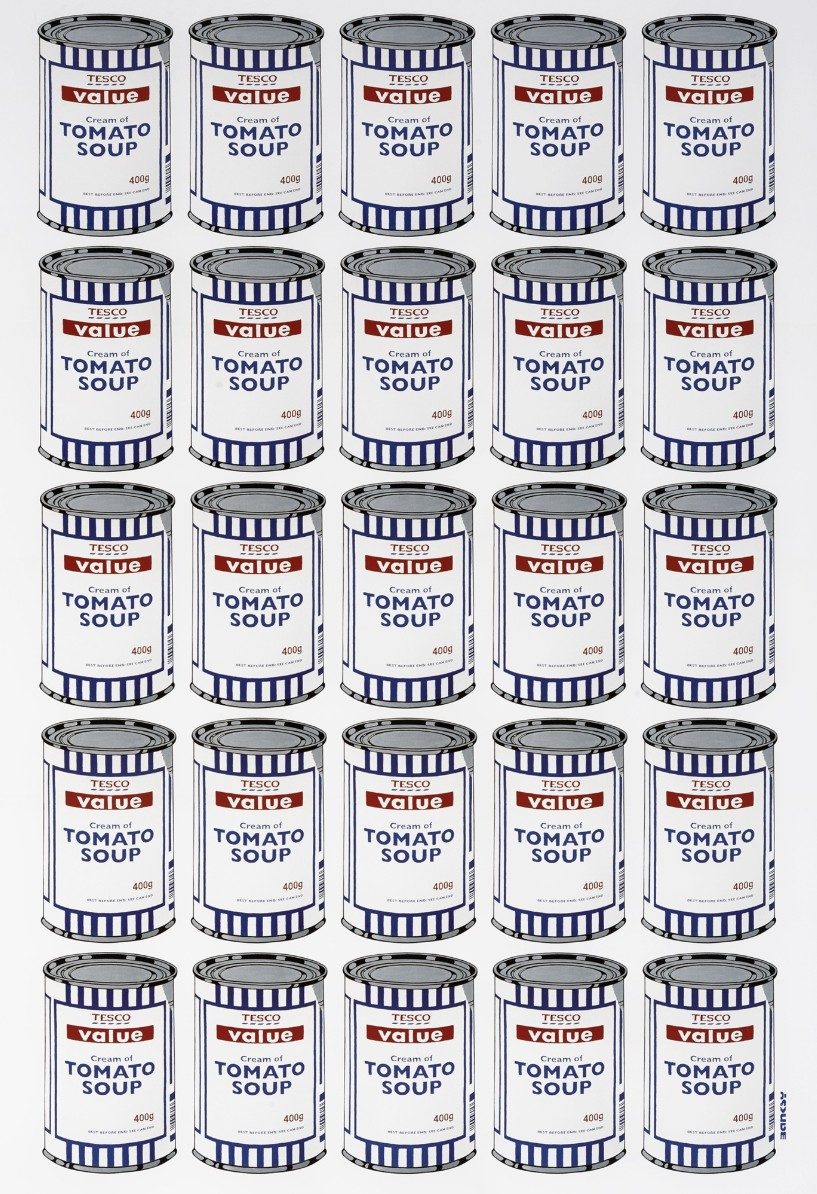
With Soup Cans, Banksy stages a wonderfully cheeky encounter with one of the most famous images in twentieth-century art. Twenty-five identical tins of Tesco Value Cream of Tomato Soup are arranged in a rigid five-by-five grid, immediately recalling Andy Warhol's celebrated Campbell's Soup Cans of 1962. But where Warhol elevated the familiar American supermarket product into the museum, Banksy replaces Campbell's carefully branded red-and-white icon with something considerably less glamorous: a tin from Tesco's resolutely inexpensive Value range.
The substitution is both an homage and a joke. Warhol was fascinated by mass production, repetition, advertising and the strange beauty of consumer packaging. Banksy inherits precisely the same visual language but shifts its social register. Campbell's soup represented the uniformity and abundance of post-war American consumer culture; Tesco Value represented the opposite end of Britain's supermarket hierarchy—the deliberately plain packaging of the budget aisle. Pop Art meets the weekly grocery bill.
The repetition makes the joke sharper. Unlike Warhol's original group of thirty-two canvases, which represented the different varieties of Campbell's soup then available, Banksy's twenty-five tins are all exactly the same: Cream of Tomato Soup. Choice, one of consumer capitalism's great promises, has disappeared. There is plenty on the shelf, but it is all the same thing.
First published in 2006, the poster was produced through Pictures on Walls, the London print collective and publisher closely associated with Banksy's early editions. Auction records document examples retaining their original Pictures on Walls tubes and correspondence, while another recorded example was acquired at Santa's Ghetto, the anarchic Christmas pop-up through which Banksy and Pictures on Walls deliberately offered art outside the conventional gallery system. The poster is generally treated as an open edition; although a figure of 2,000 is sometimes cited by the market, I have not found sufficiently authoritative documentation to establish that number conclusively.
That distinction is important. Soup Cans Poster is a collectible rather than one of Banksy's numbered screenprint editions. Its offset production, relatively broad distribution and modest original status were entirely appropriate to its subject. An image about mass production was itself mass-produced. Turning it into an artificially scarce luxury object would rather have spoiled the joke.
The work nevertheless belongs to an important family of Banksy's Soup Can imagery, which he also developed through paintings and limited-edition screenprints. Across these variations, the reference to Warhol remains unmistakable, but Banksy's choice of Tesco transforms American Pop into something specifically British and more socially pointed. He is not simply borrowing an art-historical masterpiece; he is updating its vocabulary for a world in which enormous supermarket chains have themselves become cultural institutions.
There is an additional Banksy irony here. Warhol took an inexpensive commodity from the supermarket and helped turn its image into enormously valuable art. Banksy took one of Britain's cheapest supermarket products, turned it back into art—and today even the poster has become collectible.
From Campbell's to Tesco Value, from supermarket shelf to art market, the can remains the same kind of object. Only the price tag keeps changing.
STAY INFORMED
Receive the latest news, exhibitions, artworks and market updates on Banksy.