SPY BOOTH
Spy Booth
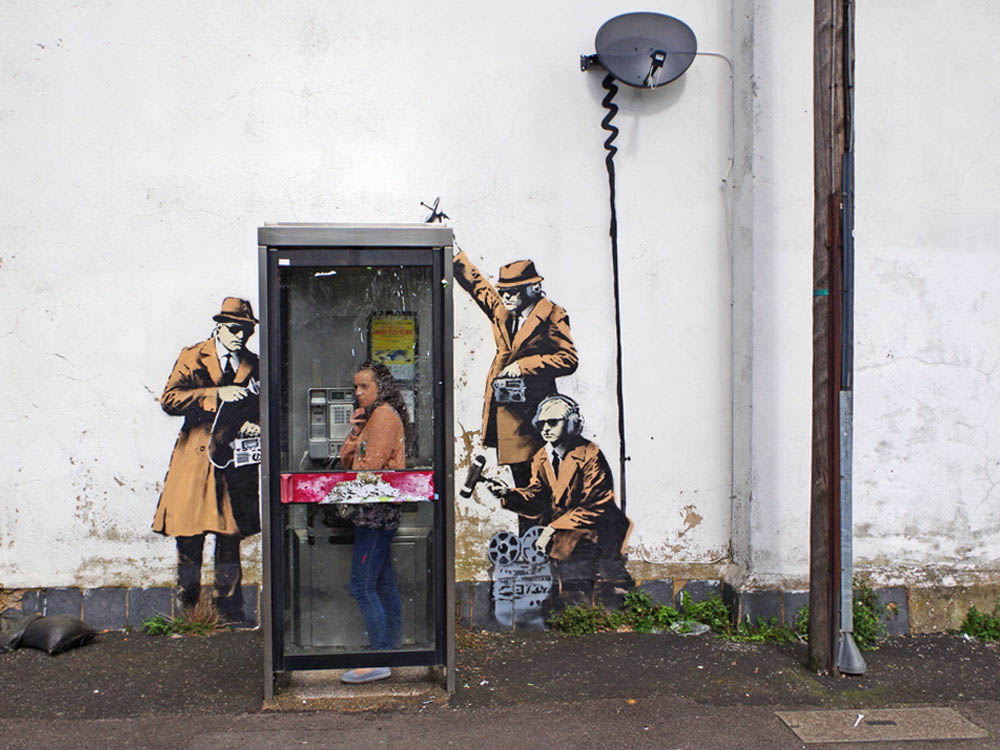
Spy Booth appeared overnight on 13 April 2014 on the gable wall of 159 Fairview Road in Cheltenham, a Grade II-listed Georgian terrace situated approximately three miles from the headquarters of the Government Communications Headquarters (GCHQ). Banksy subsequently confirmed the work on his official website, while Cheltenham Borough Council's own planning documentation recorded both the precise date and location.
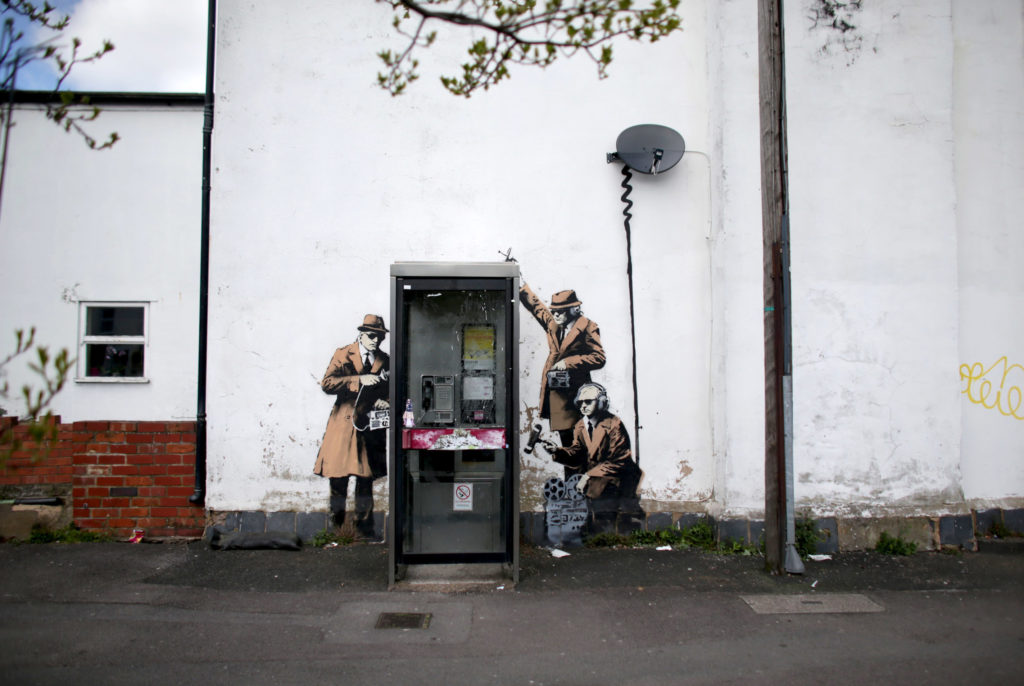
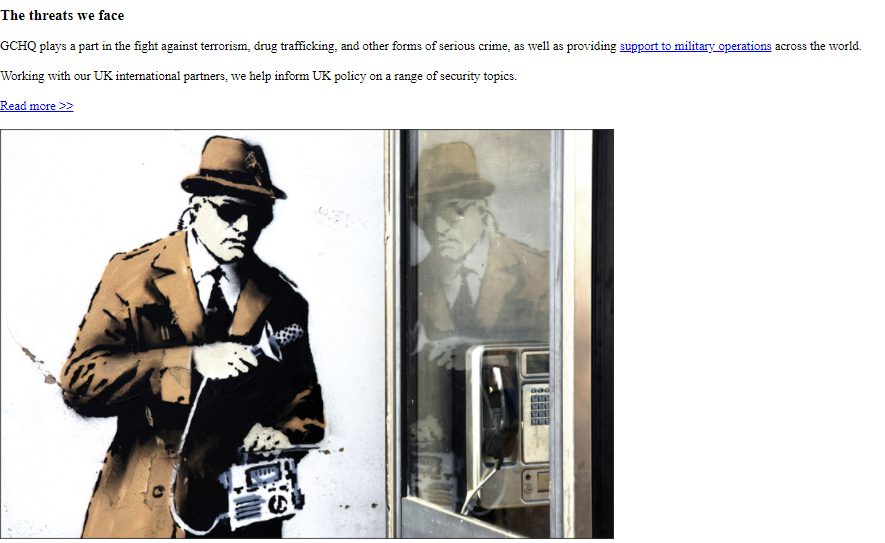
The mural depicted three secret agents in dark glasses, trench coats and trilby hats positioned around an existing public telephone box. Equipped with oversized microphones, headphones and recording devices reminiscent of Cold War espionage films, the figures appear to be secretly intercepting the conversation taking place inside. The telephone box was not merely adjacent to the mural but an integral component of the composition: Banksy transformed an ordinary piece of street furniture into the narrative centre of the work.
This integration of real architecture and painted fiction is what made Spy Booth particularly effective. Rather than representing surveillance within the boundaries of a conventional image, Banksy constructed a scene around an object already belonging to the street. Anyone entering the telephone box effectively became an unwitting participant in the work, apparently surrounded by agents recording every word. The mural consequently altered the way an entirely ordinary object was perceived without physically modifying its function.
GCHQ, Snowden and the Surveillance State
The location was fundamental. Cheltenham is home to GCHQ, Britain's signals-intelligence and cybersecurity agency, and the mural appeared less than a year after Edward Snowden's 2013 disclosures had generated an international debate over the scale of electronic surveillance conducted by American and British intelligence agencies. Contemporary reporting immediately understood Spy Booth within this context.
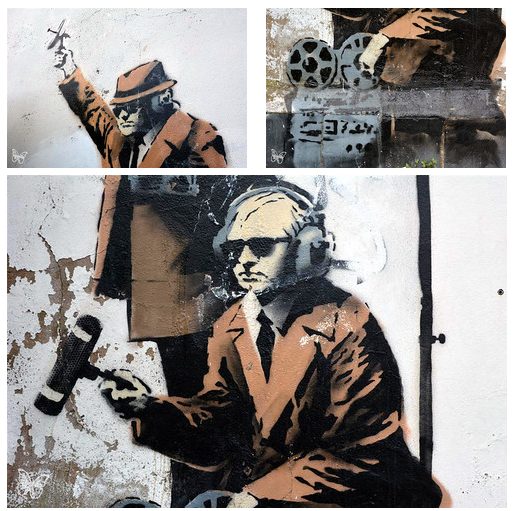
Banksy's decision to represent surveillance through deliberately antiquated technology adds an important layer of humor. The agents resemble characters from a 1950s spy thriller, yet the controversy to which the mural responded concerned a world in which surveillance had become largely invisible: telephone metadata, internet traffic and digital communications could be collected remotely on an enormous scale. The cumbersome microphones and recording equipment therefore make visible something that modern technology had rendered increasingly difficult to see.
The apparent absurdity of three agents physically crowding around a single telephone box also operates through exaggeration. What would be ludicrous if applied to one anonymous telephone conversation becomes considerably less absurd when considered against contemporary revelations about surveillance conducted across entire communications networks. Banksy's old-fashioned spies provide a comic image through which a distinctly twenty-first-century anxiety becomes immediately comprehensible.
The Street as Part of the Work
Like Falling Shopper and No Ball Games, Spy Booth demonstrates how frequently Banksy's strongest murals depend upon their physical setting. Removed from Cheltenham and reproduced simply as three stencilled agents, much of the work's meaning disappears. The existing telephone box completes the composition, while the proximity of GCHQ supplies its political context.
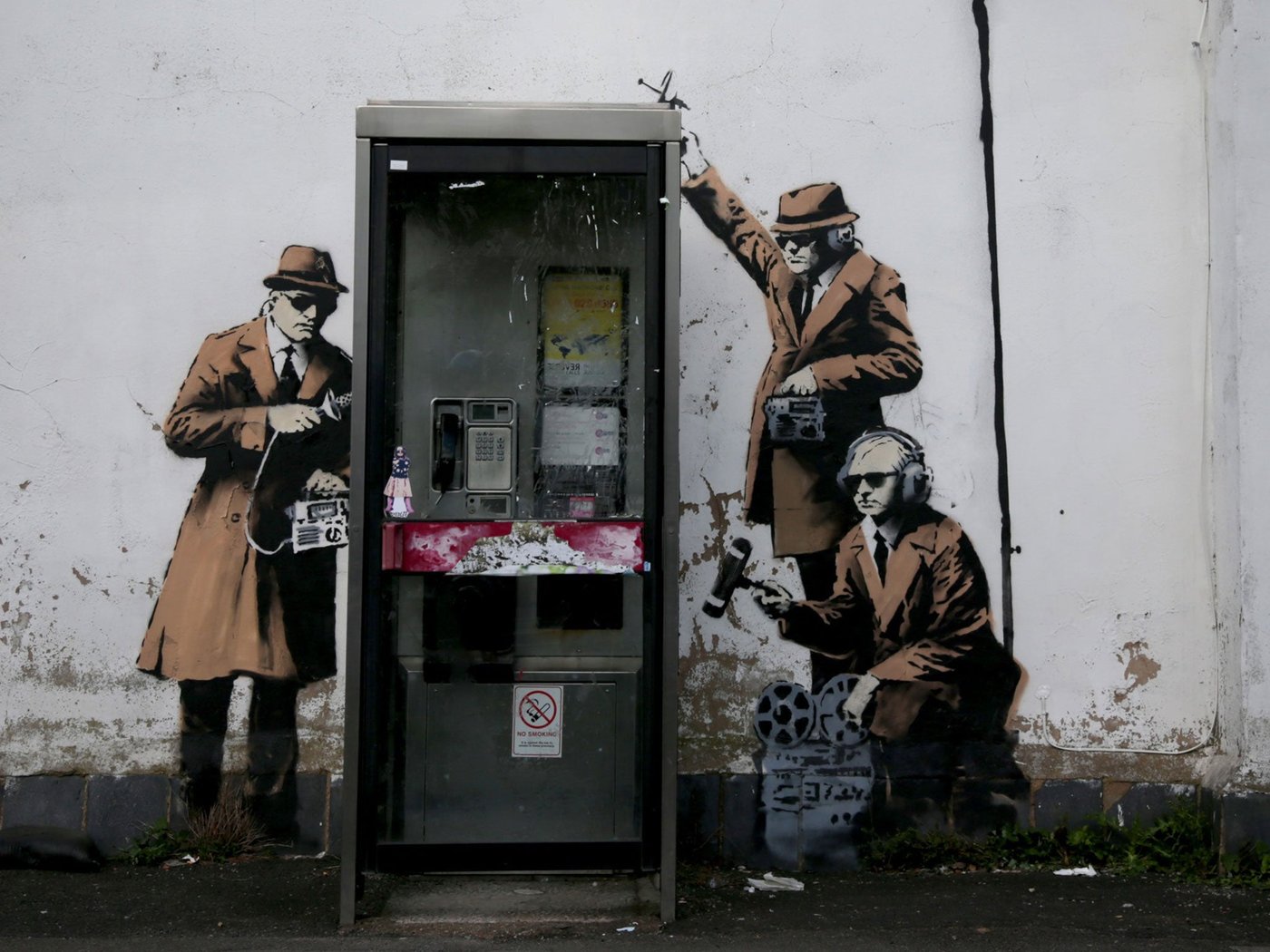
There is also a characteristic inversion of visibility. Intelligence agencies operate most effectively when their surveillance remains unseen; Banksy instead places the watchers in full public view. The spies believe themselves to be observing someone else, but they become the spectacle. Passers-by look at them, photograph them and scrutinize their activity. Surveillance is therefore reversed: the observers themselves are observed.
This explains why Spy Booth became one of Banksy's most widely discussed British murals of the period. Its political subject was immediately recognizable, but the work did not require a slogan or lengthy explanation. Banksy reduced a complex debate about state surveillance to three men, one telephone box and the uncomfortable suspicion that somebody might be listening.
Vandalism, Protection and the Battle to Keep the Mural
Its physical history soon became almost as complicated as its subject. By June 2014, reports emerged that the mural had been sold and was to be removed from the building. Scaffolding appeared around the property and a campaign developed locally to retain the work in Cheltenham. The council subsequently issued a temporary stop notice relating to unauthorized works affecting the Grade II-listed building.
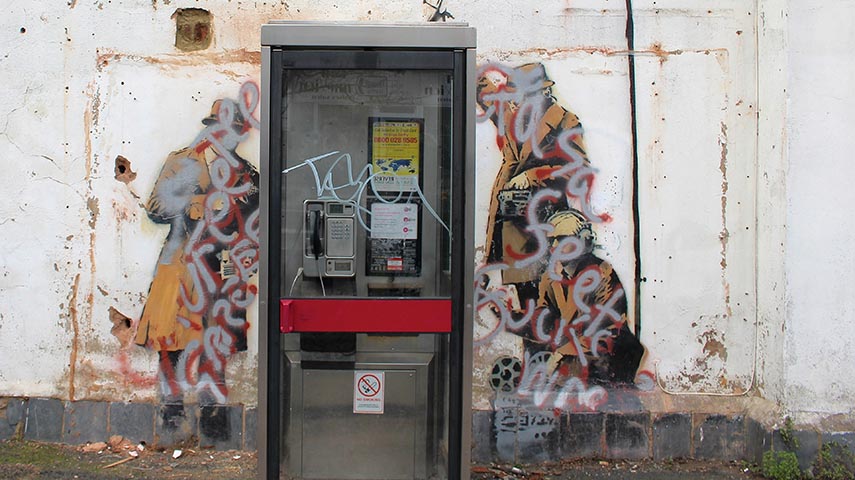
The mural was then repeatedly vandalized. In August 2014, silver and red spray paint was applied across significant portions of the composition. Protective measures and conservation work followed, but its continued exposure and the deteriorating condition of the underlying render presented an increasingly difficult conservation problem.
The legal situation became particularly unusual in February 2015. Cheltenham Borough Council granted retrospective listed-building consent for the mural and associated communications dish. The council's planning report explicitly recognized the work as a genuine Banksy and considered its relationship to GCHQ part of its significance. The decision effectively incorporated an unauthorized work of street art into the protected fabric of an already listed historic building.
This episode created a remarkable contradiction. Banksy had placed the work on the building without conventional permission, yet the planning system subsequently intervened to protect it. An act originating outside the normal mechanisms of authorization had acquired sufficient cultural importance for those mechanisms to begin defending it.
Disappearance in 2016
That protection ultimately proved insufficient. In August 2016, scaffolding and tarpaulins appeared around the property while work was undertaken on the deteriorating wall. When the coverings came down, Spy Booth had disappeared and the wall had been stripped back to brick. Photographs showed rubble beneath the former mural, while Cheltenham Borough Council began investigating what had happened.
At the time, even local authorities could not establish immediately whether the mural had been deliberately removed, accidentally destroyed during building repairs, or whether parts of it had been preserved. This uncertainty became part of the work's unusual afterlife. What is certain is that the mural ceased to exist in situ in August 2016. The present Banksy Explained page therefore needs to be updated substantially: its account currently ends after the earlier vandalism and restoration and does not record the disappearance of the work.
Takeaways
Spy Booth belongs among Banksy's most successful site-specific interventions because image, object and location are inseparable. The spies alone provide a caricature of surveillance; the real telephone box transforms that caricature into a scene; and the presence of GCHQ in Cheltenham converts the scene into pointed political commentary.
It also captures an important transition in the history of surveillance. Banksy represents the watchers through the reassuringly theatrical imagery of Cold War espionage—trench coats, microphones and cumbersome recording equipment—while addressing a controversy generated by technologies that had made surveillance increasingly remote, automated and invisible. The humor of the mural depends upon that discrepancy.
Its subsequent history introduced a further irony that Banksy could hardly have planned. An unauthorized mural about the power of the state became protected by the state; a work about covert observation became one of Cheltenham's most photographed attractions; and an image concerned with the collection and preservation of information ultimately disappeared from the wall despite elaborate attempts to protect it. What survives today is precisely what modern surveillance itself produces so abundantly: a record of something that is no longer there.
STAY INFORMED
Receive the latest news, exhibitions, artworks and market updates on Banksy.