STOP AND SEARCH (GIRL AND A SOLDIER)
Reversing the Search
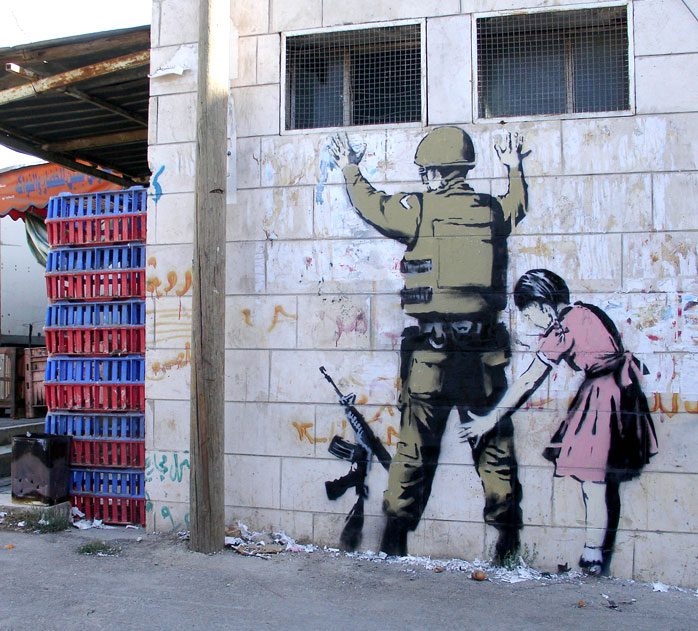
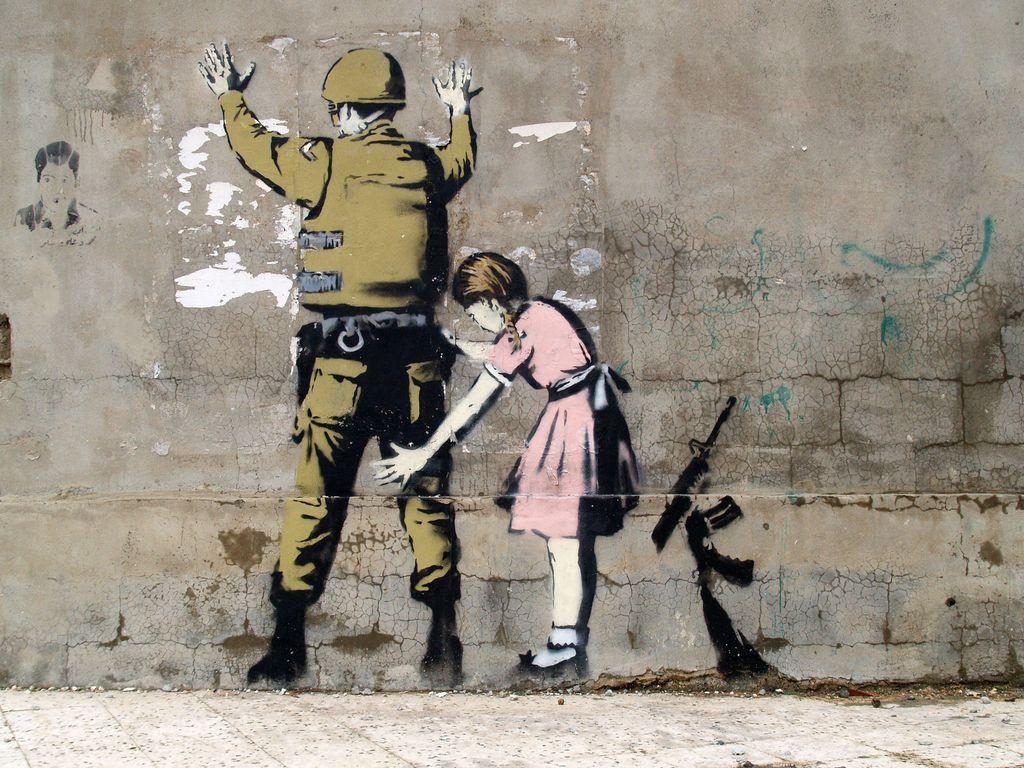
Created in Bethlehem in 2007, Stop and Search depicts a young girl calmly frisking an armed soldier. The soldier stands against the wall with both hands raised, his rifle resting on the ground beside him, while the child searches him from behind. Banksy renders the soldier in military greens and blacks while the girl's dress is a muted pink, immediately separating the two figures despite their physical proximity.
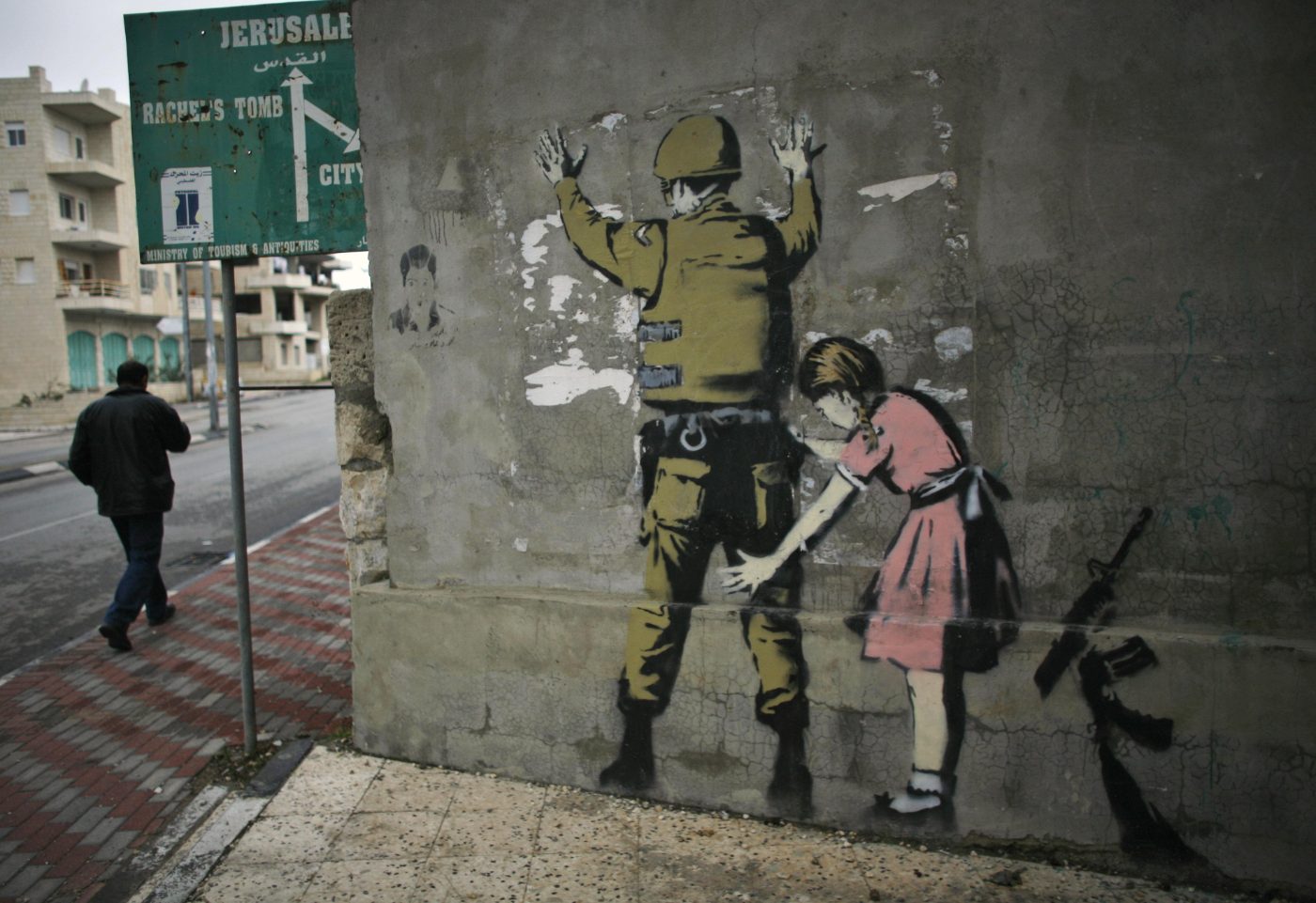
The image depends upon an extraordinarily simple reversal. The adult is armed, armored and physically dominant, yet it is the child who exercises authority. The soldier adopts the familiar position of a civilian being searched at a checkpoint: hands against the wall, legs apart, body exposed to inspection. Banksy does not remove the apparatus of military power—the helmet, protective vest and rifle remain conspicuously present—but temporarily suspends the authority normally attached to them.
The girl's behavior is equally important. She does not appear frightened or aggressive. Her concentration gives the search an almost routine character, as though this inversion of power were entirely ordinary. That calmness prevents the image from becoming a conventional scene of confrontation. Banksy's intervention is instead built around a question: what happens when an everyday exercise of authority is viewed from the opposite side?
Bethlehem and Santa's Ghetto
The mural formed part of Banksy's return to Bethlehem in 2007, two years after his celebrated interventions on and around the West Bank barrier. This second campaign accompanied a special edition of Santa's Ghetto, the annual exhibition previously staged in London, which Banksy and collaborating artists brought to Bethlehem during the Christmas period.
The setting radically changes the significance of the image. Checkpoints, searches, soldiers and restrictions on movement were not abstract political symbols in the West Bank but elements of everyday life. By reducing that complex reality to an encounter between two figures, Banksy avoids illustrating a specific incident. Instead, he reverses one of the most recognizable gestures of security and occupation.
The child's presence also belongs to a broader pattern throughout Banksy's work. Children frequently occupy positions from which adult structures of violence, authority or economic control are exposed as irrational: the girl embraces a bomb in Bomb Hugger, children transform prohibition into play in No Ball Games, and the child worker produces patriotic bunting in Slave Labour. Here, childhood becomes a device through which power can be viewed from an entirely different perspective.
The Rifle on the Ground
One of the strongest details is the soldier's rifle. Banksy could simply have shown the soldier being searched, but instead places the weapon conspicuously against the wall between the two figures. It remains immediately accessible and reminds us that the apparent redistribution of power is imaginary.
That distinction prevents the work from suggesting that the girl has genuinely become powerful. She controls the scene only because Banksy has temporarily rewritten its rules. The soldier's real-world authority remains embodied by his uniform, armor and weapon, while the girl's authority exists entirely within the fictional reversal constructed on the wall.
The mural therefore operates less as an image of victory than as an experiment in perspective. By exchanging the expected positions of soldier and civilian, adult and child, armed authority and vulnerable subject, Banksy makes an established power relationship suddenly appear strange.
Two Versions and an Unusual Afterlife
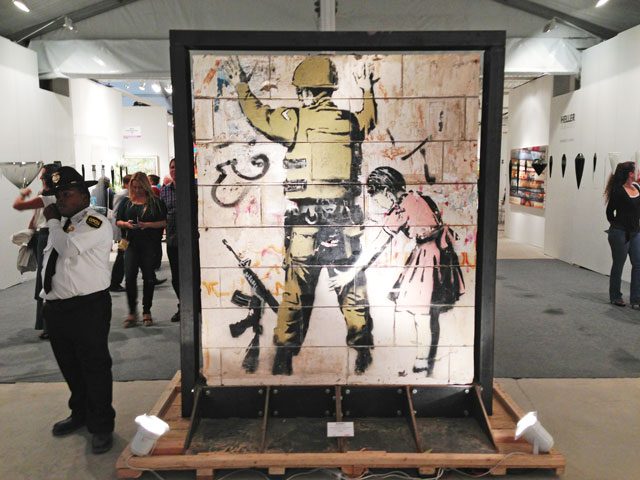
Evidence indicates that Banksy produced two closely related versions of the composition in Bethlehem. One remained visible in the city, while another was subsequently removed from its wall by cutting out a substantial section of masonry. Contemporary reporting later documented the removed Stop and Search together with another Bethlehem work, Wet Dog; the detached pieces weighed several tons and were transported internationally before entering the art market.
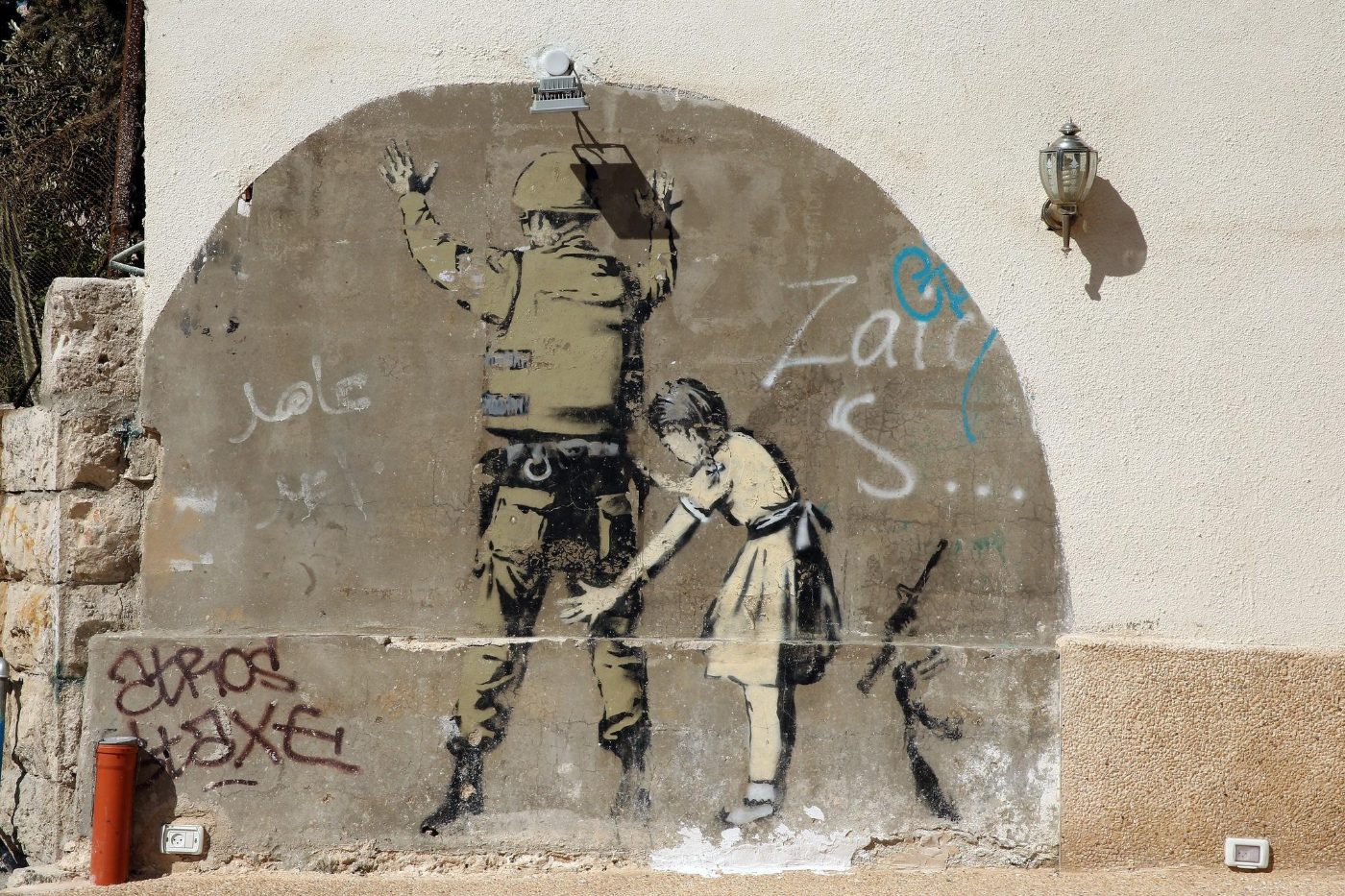
The transformation is significant. A work conceived around the political reality of a particular place became a transportable object once its supporting wall was extracted. The soldier and child remained visually intact, but the streets, architecture and social circumstances that had originally surrounded them disappeared.
Stop and Search is consequently among the clearest examples of Banksy's ability to make a complicated relationship of power immediately legible without reducing it to a slogan. Nothing physically impossible occurs: a soldier stands against a wall while somebody searches him. Banksy changes only one element—the identity of the person conducting the search—and that reversal changes everything.
From Glastonbury to Bethlehem
The Bethlehem composition becomes particularly revealing when compared with another Stop and Search mural Banksy had created only months earlier in Glastonbury in June 2007. There, the relationship of power follows its expected direction: an adult police officer searches a small girl in a red dress, who stands facing the wall with her hands raised. A teddy bear and small pink case lie at her feet. The image attracted immediate attention, with contemporary commentary describing it as a critique of police stop-and-search powers. The mural was subsequently painted over.
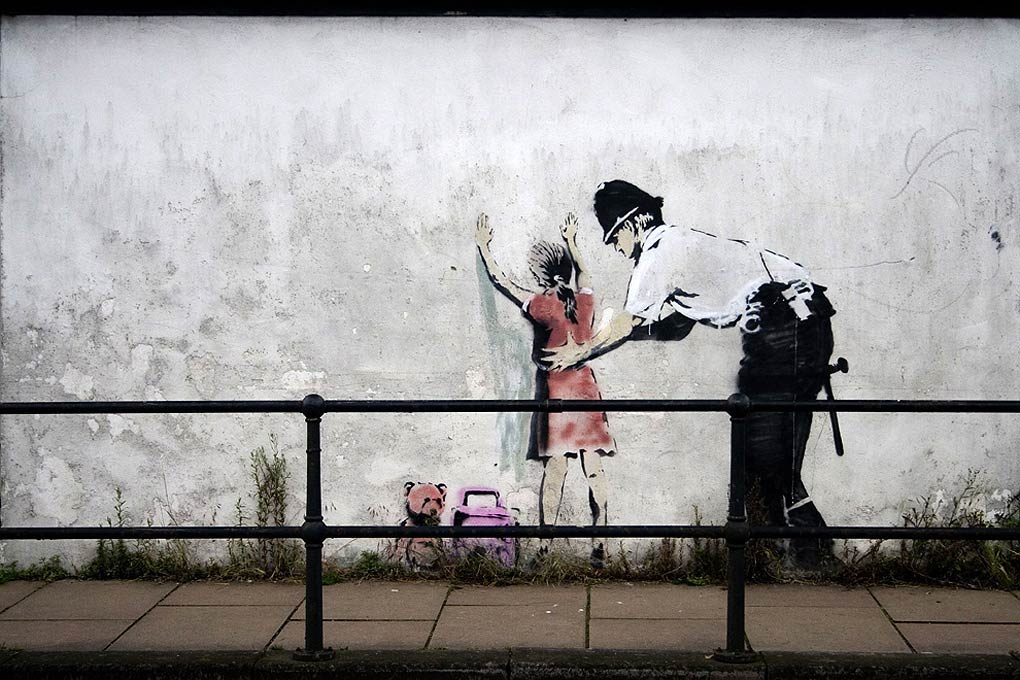
In Bethlehem later that year, Banksy returned to essentially the same visual structure but reversed its protagonists. The child now conducts the search. The uniformed authority figure is placed against the wall with his hands raised, while his rifle rests uselessly beside him. Even the compositions mirror one another: both present a larger uniformed adult and a smaller female child against a wall, but the gesture of searching travels in the opposite direction.
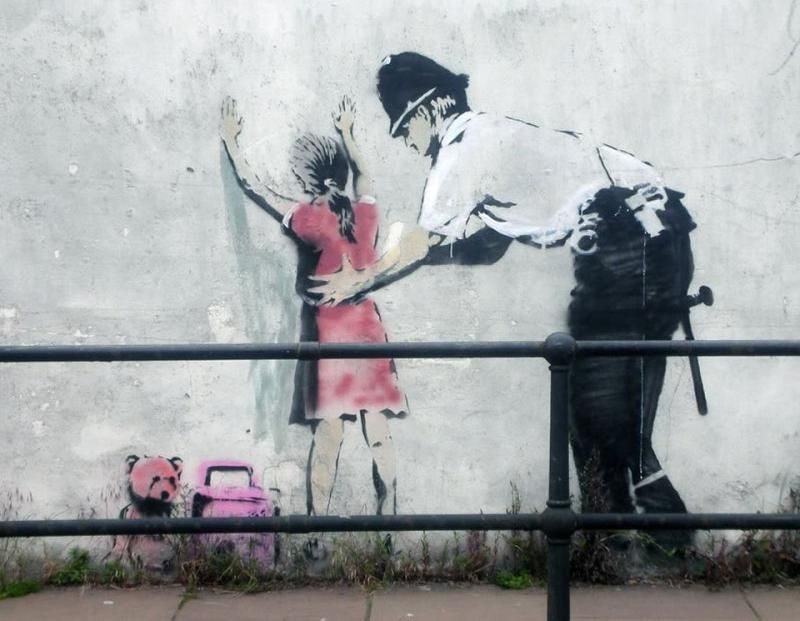
That reversal substantially deepens the Bethlehem image. In Glastonbury, Banksy emphasizes the disproportion between state authority and childhood vulnerability: the absurdity comes from treating a small girl as though she represents a threat. In Bethlehem, he asks the viewer to imagine the same procedure from the other side. The person normally empowered to search becomes the searched, while the child who would conventionally occupy the vulnerable position temporarily assumes authority.
The change in uniform is equally significant. Glastonbury presents a British police officer; Bethlehem presents an armed soldier. Banksy therefore adapts the same visual proposition to two very different political environments. The first concerns the everyday extension of police powers within Britain; the second places the idea within the far more charged realities of military control, checkpoints and restrictions on movement in the West Bank. The two works should not be treated as identical political statements, but their formal relationship is unmistakable.
STAY INFORMED
Receive the latest news, exhibitions, artworks and market updates on Banksy.