SWING GIRL
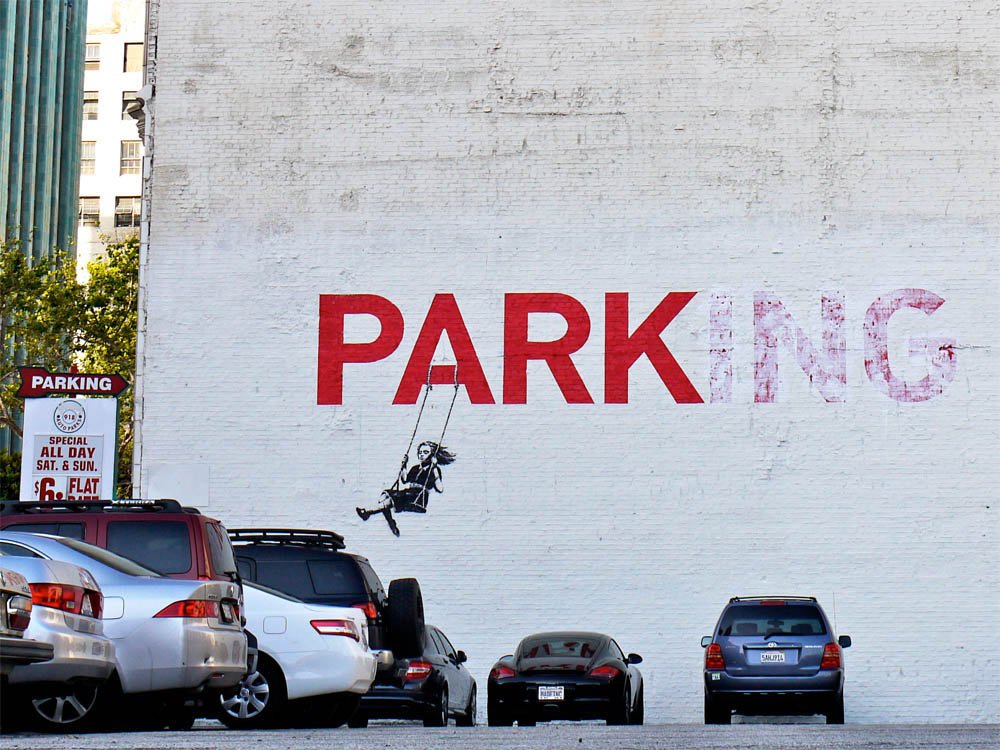
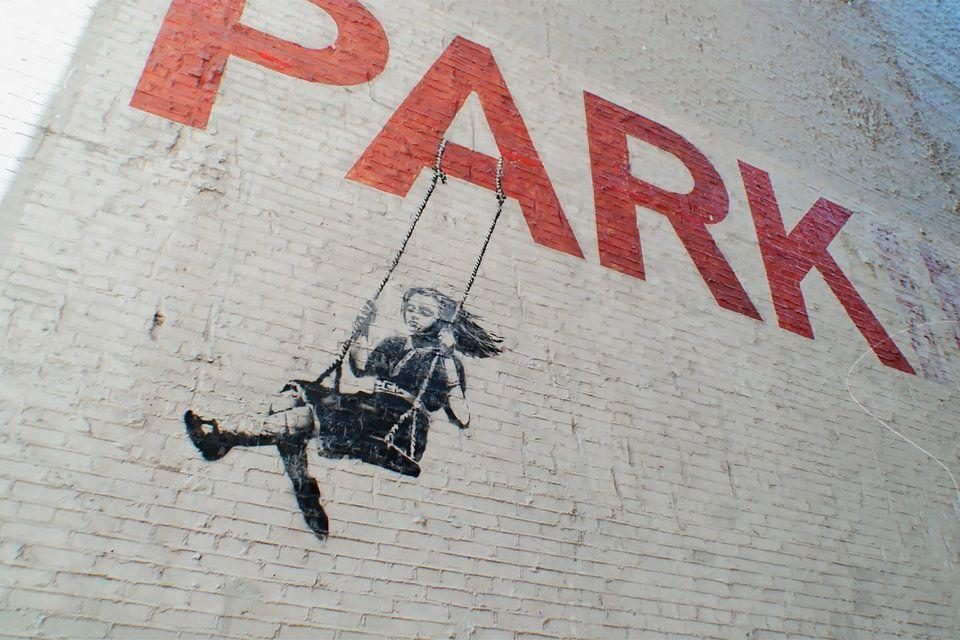
Created in April 2010, shortly before the Los Angeles premiere of Exit Through the Gift Shop, Swing Girl—also frequently known as Parking or Girl on a Swing—is one of Banksy's most accomplished uses of existing urban typography. The work occupies the side wall of the building at 908–910 South Broadway, overlooking what was then a large parking lot in Downtown Los Angeles. Rather than treating the wall as a blank surface, Banksy incorporated the enormous pre-existing word PARKING into the composition, turning a functional commercial sign into the starting point for the work.
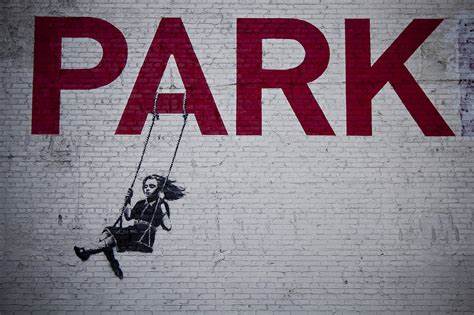
Banksy's intervention is remarkably economical. The final three letters, ING, are largely whitewashed, leaving PARK prominently visible. From the lower opening of the red letter A, a small monochrome girl swings freely above the ground. The existing lettering consequently changes meaning without being completely erased: parking, a word associated with cars and the allocation of urban space to automobiles, becomes park, a word associated with recreation, greenery and play. The girl completes that linguistic transformation by behaving as though the newly created “park” actually exists.
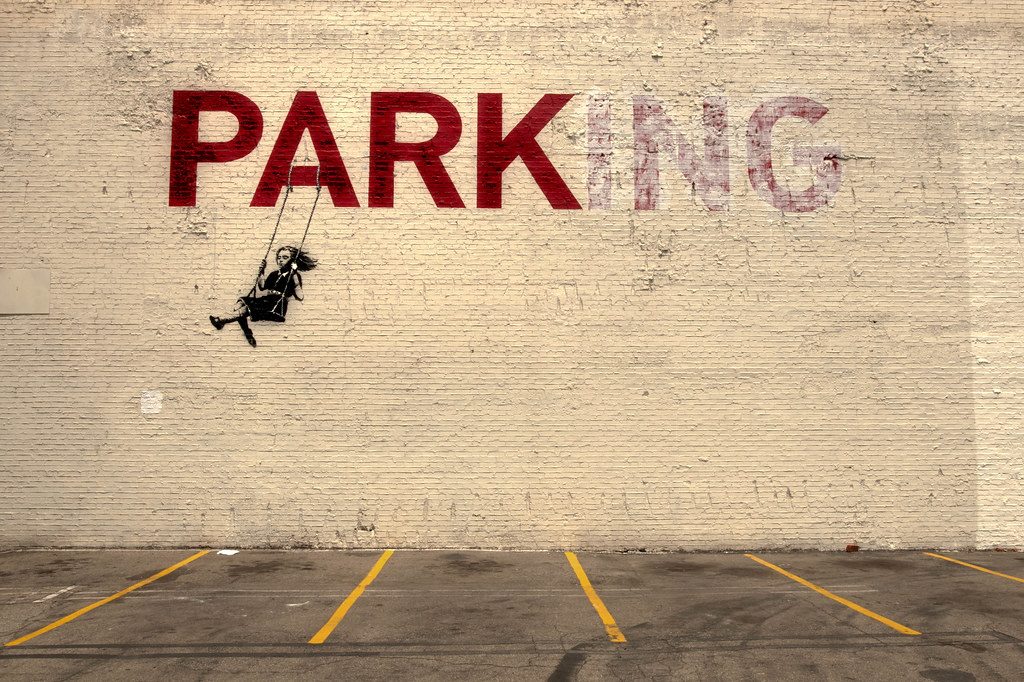
The physical setting is essential to the work. In 2010 the wall faced an expanse devoted overwhelmingly to parked cars rather than people, making the transformation of PARKING into PARK particularly pointed. Swing Girl can therefore be read as a quiet commentary on the priorities of the modern city: enormous areas of valuable urban space are routinely provided for vehicles, while opportunities for children to play can be considerably more restricted. Banksy does not illustrate the park that is missing. Instead, the girl invents one for herself from the architecture and signage already available to her. The work consequently balances criticism with a characteristic sense of improvisation and possibility.
There is also a particularly elegant relationship between language and physical movement. The girl's swing hangs directly from a letter, converting typography into architecture. The rigid geometry of the sign becomes playground equipment, while the arc implied by her body introduces movement into an otherwise static wall. As in Girl with a Pierced Eardrum, Yellow Lines Flower Painter and later Hula-Hooping Girl, Banksy requires something already present at the site to complete the image. Without the PARKING sign, Swing Girl would lose both its composition and much of its meaning.
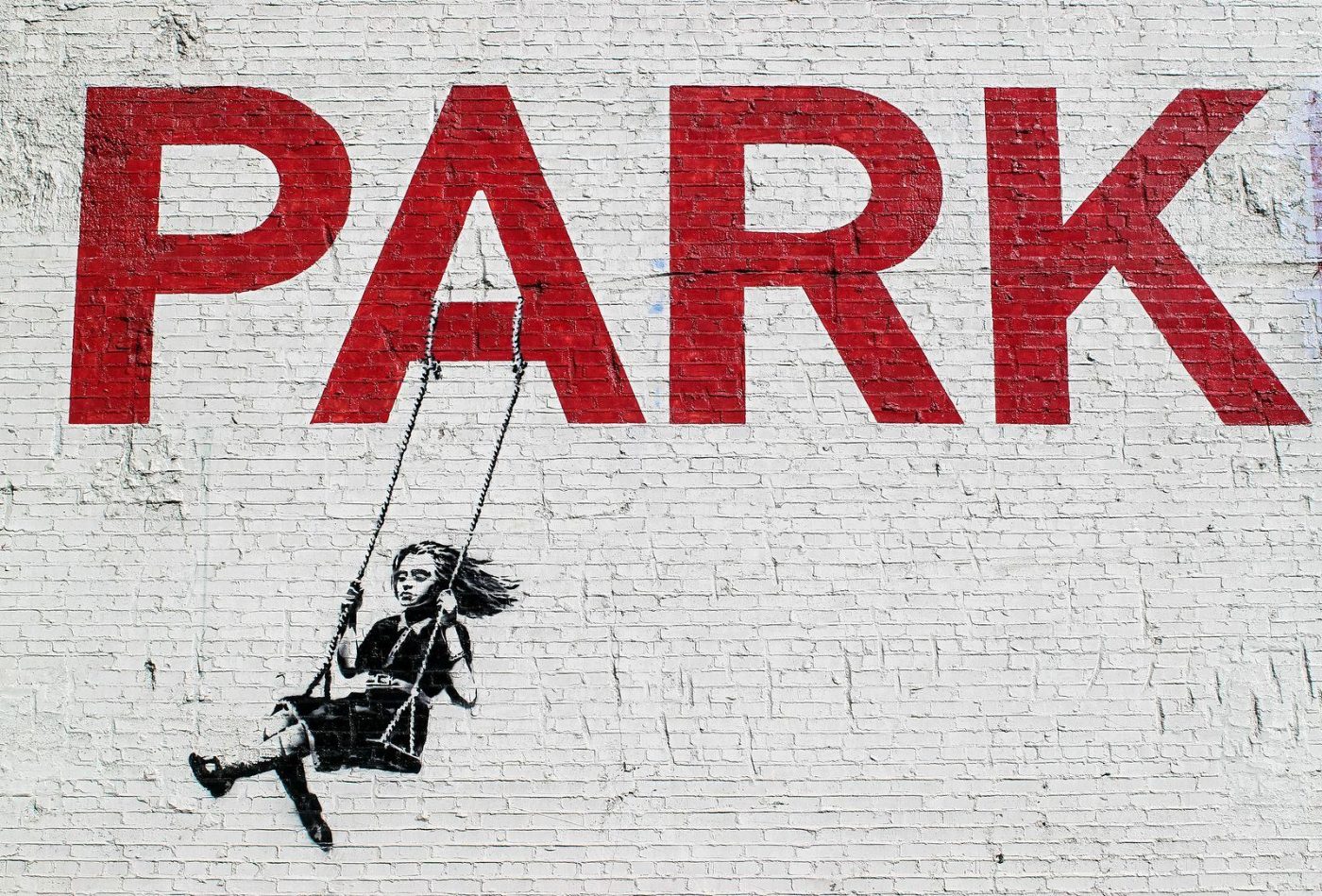
The mural appeared during an important period of Banksy's activity in the United States. Exit Through the Gift Shop premiered in Los Angeles in April 2010, and Banksy produced several American street interventions around the film's release before moving through San Francisco, Boston and other cities. Unlike many works from these campaigns, Swing Girl survived. More than a decade later, its relationship to its surroundings changed as development reduced the open parking-lot view and left the mural visible through a much narrower space between buildings—an unintended evolution that arguably reinforces its original concern with the scarcity of open urban space.
The building itself became part of the mural's later history. When the property was offered at auction in 2022, considerable attention focused on the Banksy permanently attached to its exterior and on the difficulty of separating the value of the artwork from that of the architecture supporting it. This is particularly appropriate for a work that was never conceived independently of its site. Banksy did not simply paint a girl on a swing: he transformed PARKING into PARK, and for a moment allowed a child to reclaim the city around her.
STAY INFORMED
Receive the latest news, exhibitions, artworks and market updates on Banksy.