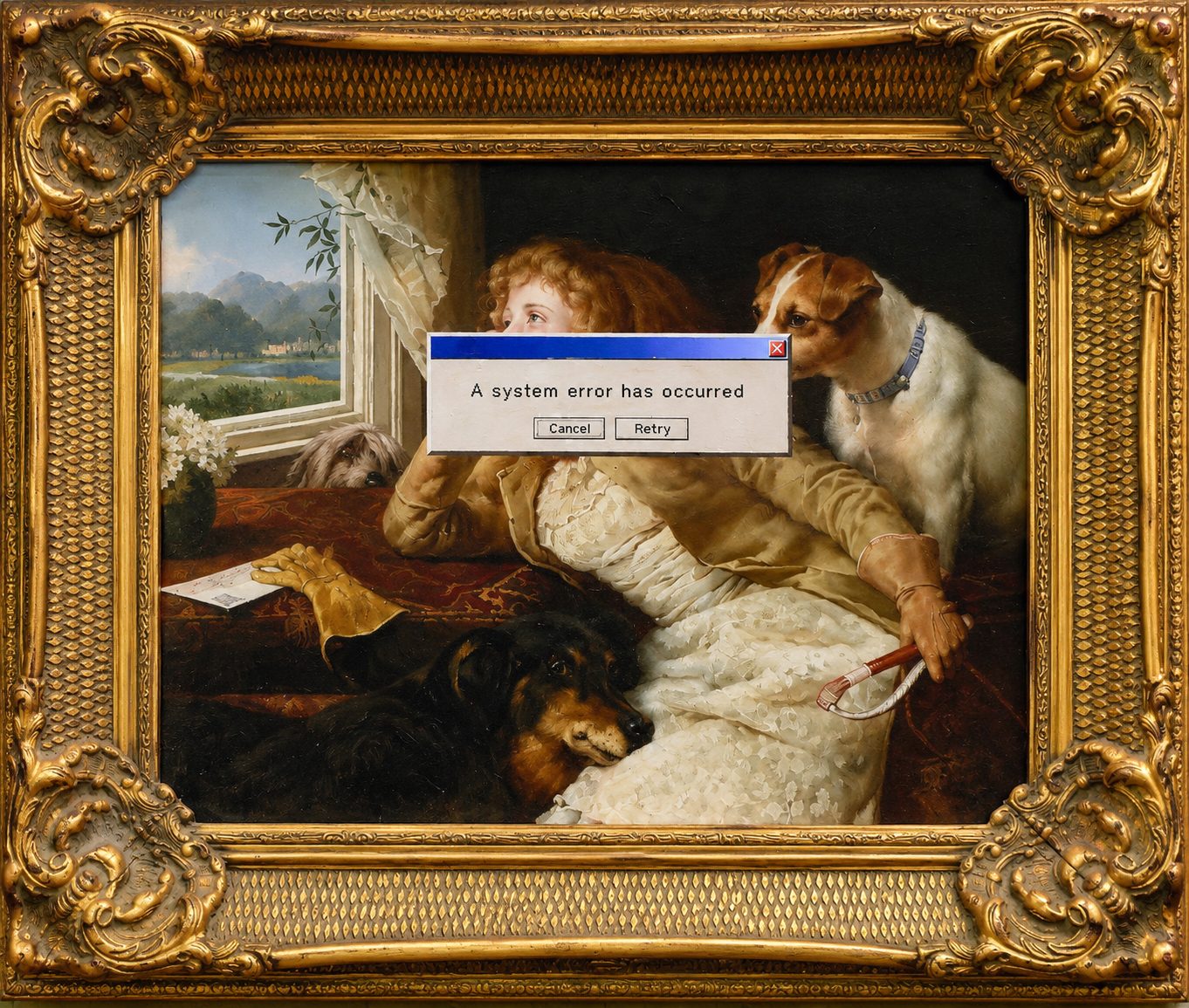
A SYSTEM ERROR HAS OCCURRED
Exhibited at Banksy’s landmark Los Angeles exhibition Barely Legal in September 2006, System Error belongs to the artist’s continuing series of altered or “vandalised” paintings: existing pictures whose conventional narratives are interrupted by the insertion of an image drawn from contemporary life. Here, Banksy appropriates a traditional domestic scene showing an elegantly dressed young woman reclining beside her dogs. Across the center of the composition, obscuring the woman’s face and much of the painting’s narrative focus, he superimposes the unmistakable graphic language of an early computer error message: “A system error has occurred,” accompanied by the options “Cancel” and “Retry.” The work is recorded as oil and spray enamel on found canvas and was shown among the altered paintings at Barely Legal.
The intervention is striking because Banksy adds almost nothing. Unlike many of the vandalised oils in which an unexpected figure enters an existing landscape or historical scene, System Error operates through obstruction. The computer window does not become part of the represented world; it sits emphatically on top of it, as though the painting itself had malfunctioned. The visual language of nineteenth-century domestic painting—ornate frame, cultivated interior, fashionable dress and obedient animals—is abruptly confronted by one of the most mundane frustrations of the digital age. Two incompatible systems of representation occupy the same surface.
THE PAINTING AS MALFUNCTION
The humor depends upon a simple reversal. A computer error normally interrupts whatever the user is attempting to see or accomplish on a screen. Banksy transfers that interruption into a physical painting, transforming a technical failure into an artistic device. The found image remains almost entirely intact, yet access to its central subject has been denied. The viewer encounters not a damaged computer screen but a painting apparently suffering from a software problem.
This collision between old and new also distinguishes System Error within Banksy’s broader practice of appropriating existing paintings. In works such as Silent Night, contemporary technology is introduced into the fictional space of the original picture: the Madonna wears earphones and the Christ Child handles a music player. In System Error, by contrast, the digital element refuses pictorial integration altogether. It belongs neither to the woman nor to her environment. Instead, it occupies the conceptual space between the artwork and its viewer, behaving like an interface imposed upon the painting itself.
The choice of an error message is particularly effective because it introduces the language of systems into an object associated with permanence and cultural authority. The traditional painting and its elaborate gilded frame suggest durability; the computer dialogue box suggests obsolescence, instability and technological failure. Yet Banksy reverses those expectations. It is the antique image that appears inaccessible, while the supposedly ephemeral computer graphic dominates the composition.
FROM CRUDE OILS TO BARELY LEGAL
System Error also occupies an important position in the development of Banksy’s vandalised paintings. The strategy had been present in his work since the beginning of the decade and became the organizing principle of Crude Oils: A Gallery of Re-mixed Masterpieces, Vandalism and Vermin in London in 2005. At Barely Legal the following year, Banksy returned to the format alongside a considerably broader spectacle incorporating paintings, prints, sculpture, installation and the notorious live elephant. The Los Angeles exhibition included numerous altered paintings, among them System Error, Toxic Lady, Waterfall and Hen with Fried Egg.
The work therefore demonstrates that the vandalised oil was not simply a conceit devised for Crude Oils. By 2006 it had become one of Banksy’s established methods: a means of confronting inherited visual culture with the symbols, technologies and anxieties of contemporary society. The underlying paintings provide precisely the stability required for Banksy’s interventions to work. Their familiarity allows a single alien element to destabilize the entire composition.
There is also an appropriate self-referential quality to System Error. Banksy repeatedly inserts himself into systems—museums, galleries, advertising, public space—by placing something where it manifestly does not belong. Here the principle is reduced almost to its purest form. The error message interrupts the painting in much the same way that Banksy’s practice interrupts established cultural environments: the underlying system continues to exist, but once the intrusion has occurred, it becomes impossible to look at it in quite the same way.
STAY INFORMED
Receive the latest news, exhibitions, artworks and market updates on Banksy.