THE MALI MURALS
The Mali Murals
Banksy's journey through Mali produced one of the most unusual and least documented groups of street works in his career. Created around the beginning of 2009 at locations extending from the capital Bamako towards Timbuktu, the murals appeared far removed from the dense urban environments of Bristol, London, Los Angeles or New York in which his visual language had developed. Their existence became widely known several months later when photographs and preparatory material from Mali appeared among the recreated studio material in Banksy versus Bristol Museum. Contemporary reports identified a group that included a woman washing a zebra's stripes, hunters pursuing an animal, a child sitting inside a metal basin and a young girl accompanied by a yellow bird.
The Mali works are striking partly because Banksy adapted his imagery to radically different architecture. Rough mud-brick walls, unpaved ground, simple doors and corrugated roofs are not merely backgrounds to the stencils but frequently complete them. The works are generally smaller and quieter than many of Banksy's contemporary interventions, and several depend upon an almost surreal collision between the painted figure and its immediate surroundings.
They nevertheless require some interpretative caution. It would be reductive to treat Mali merely as an anonymous symbol of African poverty onto which a European artist projected familiar ideas about deprivation. Several works certainly engage with water, aid and economic inequality, but others are playful, enigmatic or even deliberately absurd. Taken together, the series oscillates between social observation and the visual wit that characterizes Banksy's practice elsewhere.
Washing Zebra Stripes
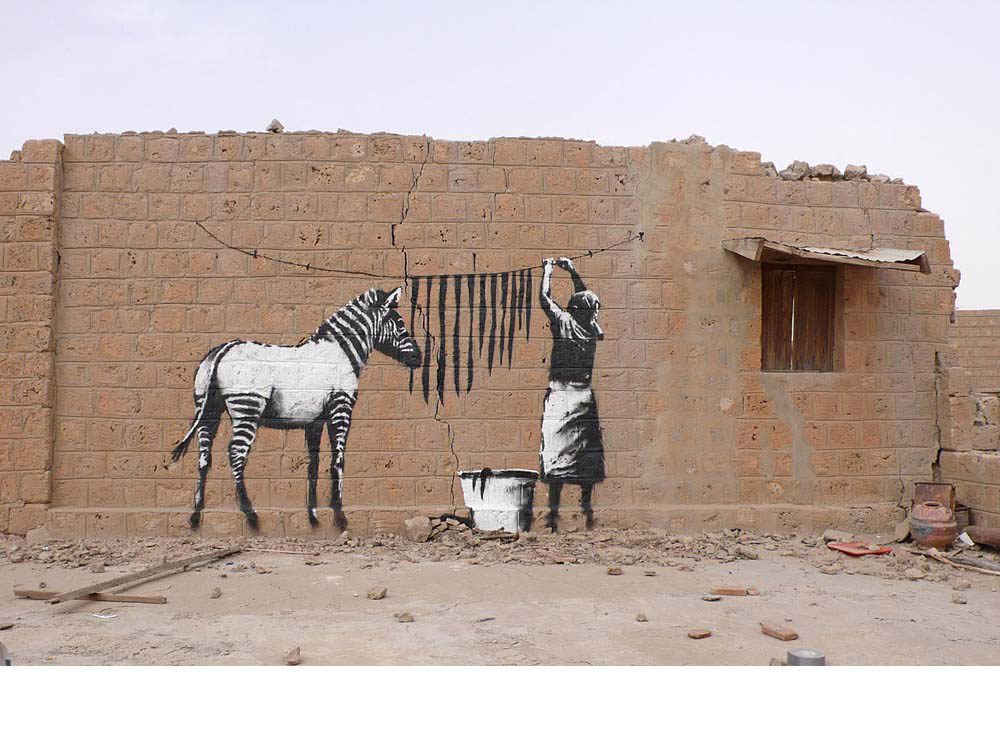
The best-known work from the Mali intervention depicts a woman standing beside a zebra whose black stripes appear to have been removed. Between them stretches a washing line from which the animal's long black stripes hang vertically to dry. A bucket sits at the woman's feet, completing the improbable domestic scene. The work is generally documented as having been painted in Timbuktu.
The image is exceptionally well integrated into its setting. Banksy uses the natural reddish-brown surface of the masonry as a broad field against which the black-and-white animal and human figure become immediately legible. The painted washing line follows the wall horizontally, while the real doorway and corrugated awning to the right make the woman's activity seem almost plausible. The absurdity emerges gradually: what initially resembles an ordinary scene of washing becomes impossible once we realize that the laundry belongs to the animal standing patiently beside her.
The mural can certainly be read in relation to scarcity and domestic labor, particularly within a country where access to water has long been a serious issue. Yet its meaning should not be restricted to a single humanitarian message. The more interesting visual proposition concerns identity and appearance. Remove the stripes from a zebra and the animal becomes something else—or perhaps remains exactly what it was despite no longer looking like one. Banksy treats identity as though it were a garment: something recognizable, removable, washable and capable of being hung out to dry.
There is also an appealing reversal of artistic process. A painter would normally add the black stripes required to turn the white form into a recognizable zebra. Banksy's woman does the opposite. She removes the marks that allow us to identify it. The act of painting therefore becomes an act of unpainting, while the zebra waits patiently for its visual identity to be returned.
Buffalo Hunt / Hunters
Another Mali mural depicted two human figures hunting a large animal with bows and arrows, an image contemporary reports variously described as a buffalo or bison. It belongs to Banksy's recurring interest in collapsing historical periods, placing imagery associated with hunting and subsistence onto a contemporary wall. The work was among those documented through photographs from Banksy's Mali project and shown through the Bristol Museum material.
Here the wall acquires something of the character of a prehistoric surface. The subject inevitably recalls cave painting—the earliest surviving visual records of humans depicting animals and hunting—while Banksy's stencil technique represents one of the most reproducible forms of contemporary image-making. The distance between prehistoric mark-making and modern street art consequently becomes surprisingly small: in both cases, an anonymous image is placed directly onto a communal architectural or geological surface.
That relationship is particularly interesting within Banksy's oeuvre. Only months earlier, at the 2008 Cans Festival, his Cave Paint Remover had depicted a municipal worker pressure-washing prehistoric paintings from a wall. In Mali, the relationship is reversed: rather than removing ancient-looking imagery, Banksy effectively creates a contemporary version of it.
Boy in a Basin
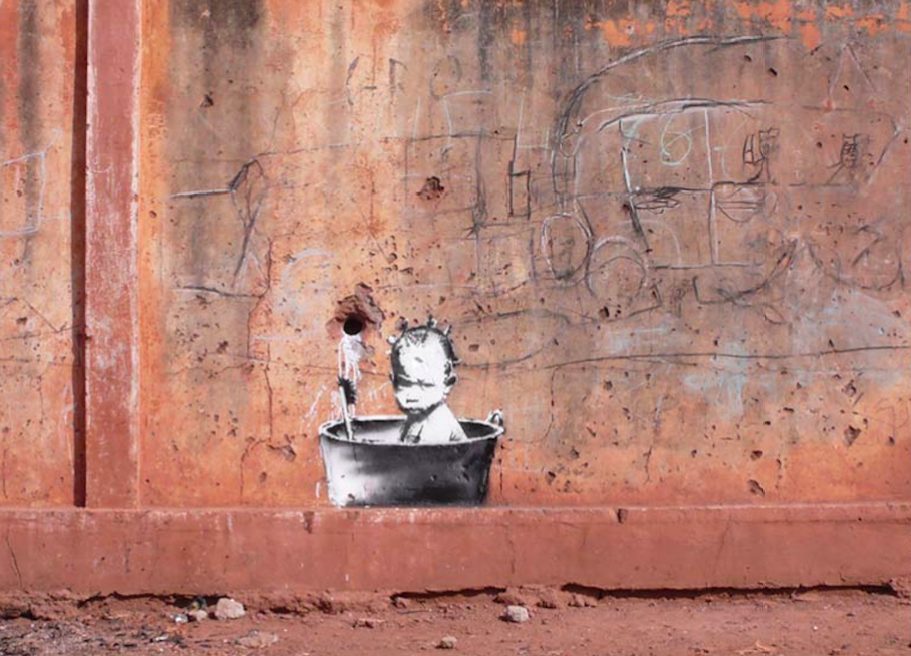
A third work shows a small child looking outward from inside a metal washing basin or tub. Contemporary descriptions specifically identify the image among Banksy's Mali works, and Banksy's own photographic documentation circulated following the Bristol exhibition.
The image is considerably quieter than Washing Zebra Stripes. The basin is transformed through the child's presence from an ordinary domestic object into a miniature environment. Depending upon how it is read, it can resemble a bath, a vessel or simply an improvised place of play. Banksy offers no slogan to direct the interpretation.
Its restraint is significant. Children throughout Banksy's work frequently transform inadequate or restrictive surroundings through imagination. The basin therefore belongs to the same broad visual language as the improvised play of No Ball Games or the later Hula-Hooping Girl, although the social circumstances are very different. Rather than imposing an explicit narrative upon the child, Banksy leaves the relationship between poverty, play and improvisation unresolved.
Mali Girl / Girl with Bird
Among the most delicate works in the group is the young girl commonly known as Mali Girl, depicted with a small yellow bird. Unlike the zebra or the hunters, the composition contains little obvious satire. The contrast between the largely monochrome figure and the small area of intense color gives the bird unusual visual prominence.
Mali Girl is particularly important because it appears to be the only substantial survivor of the group. The wall section was eventually removed from its original location and preserved, subsequently entering private ownership. Banksy Explained has already documented its later history as a removed street work.
Its survival also changes the character of the object. In Mali, the girl belonged to a particular wall and landscape. Once removed, cleaned, stabilized and framed, the masonry became a transportable artwork. As with several later Banksy murals, preservation saved the physical image while simultaneously separating it from the environment for which it had been conceived.
No Clean Water Left
Two further Mali interventions have been documented under the title No Clean Water Left, apparently produced in two versions. They extend the recurring presence of water within the group from playful visual material into more explicit social commentary. Banksy Explained's documentation of Mali Girl identifies both works among the six known Timbuktu interventions.
Their inclusion makes the bucket beneath Washing Zebra Stripes more resonant without requiring the zebra mural itself to carry the entire argument. Across the group, ordinary domestic objects associated with water—basins, buckets and washing—recur with unusual frequency. Seen collectively, the works suggest an awareness of something easily taken for granted in the environments from which Banksy came but considerably less secure in the places through which he was travelling.
Peaches Geldof Please Give Generously
The most culturally specific work in the Mali group is also the most deliberately uncomfortable. Banksy depicted an African child apparently collecting donations beneath an appeal to “Please Give Generously” for Peaches Geldof, daughter of Bob Geldof, whose own public identity was inseparable from the history of British celebrity-led fundraising for Africa. The image was photographed by Banksy and later discussed as an example of work apparently conceived as much for its eventual photographic circulation as for its immediate local audience.
The reversal is intentionally provocative. Instead of a wealthy Western celebrity raising money for Africa, an African child appears to be collecting money for a wealthy Western celebrity. Banksy turns the conventional direction of charitable representation back upon itself, exposing the uneasy relationship between genuine humanitarian concern, celebrity culture and the way Africa has historically been presented to Western audiences.
The work is therefore less a joke about charity than a criticism of its imagery and power relationships. The absurdity depends upon the viewer already understanding the conventional picture Banksy has inverted: Africa as recipient, the West as donor, and celebrity as mediator between the two. By reversing those positions, he makes the structure itself visible.
Banksy in Mali
Taken together, the Mali murals occupy an unusual position within Banksy's street practice. They were geographically dispersed, only sparsely documented at the time and largely encountered by his international audience through photographs rather than through direct experience. Contemporary reporting in 2009 described a “handful” of works extending from Bamako to Timbuktu, while their appearance in the documentation surrounding Banksy versus Bristol Museum brought them to a much wider audience.
They also demonstrate how effectively Banksy's visual language could operate outside the Western city. The materials remained familiar—stencil, spray paint, architectural surface—but the surrounding environment changed the meaning of the images. Mud-brick walls replace advertising hoardings and urban masonry; buckets and basins replace shopping trolleys and telephone boxes; questions of water, aid and economic disparity enter alongside Banksy's established interests in childhood, authority and visual illusion.
Yet the most memorable work of the group may also be the least didactic. In Washing Zebra Stripes, Banksy creates an image that can be understood almost instantly without requiring a slogan, political reference or knowledge of contemporary events. A woman has washed a zebra's stripes and hung them on a line. The impossibility is obvious, but the image remains strangely convincing because every element occupies precisely the place it should. It is a particularly pure example of Banksy's ability to make an ordinary wall briefly obey a different logic.
STAY INFORMED
Receive the latest news, exhibitions, artworks and market updates on Banksy.