THE PAINTER (VANDALISM IS ART)
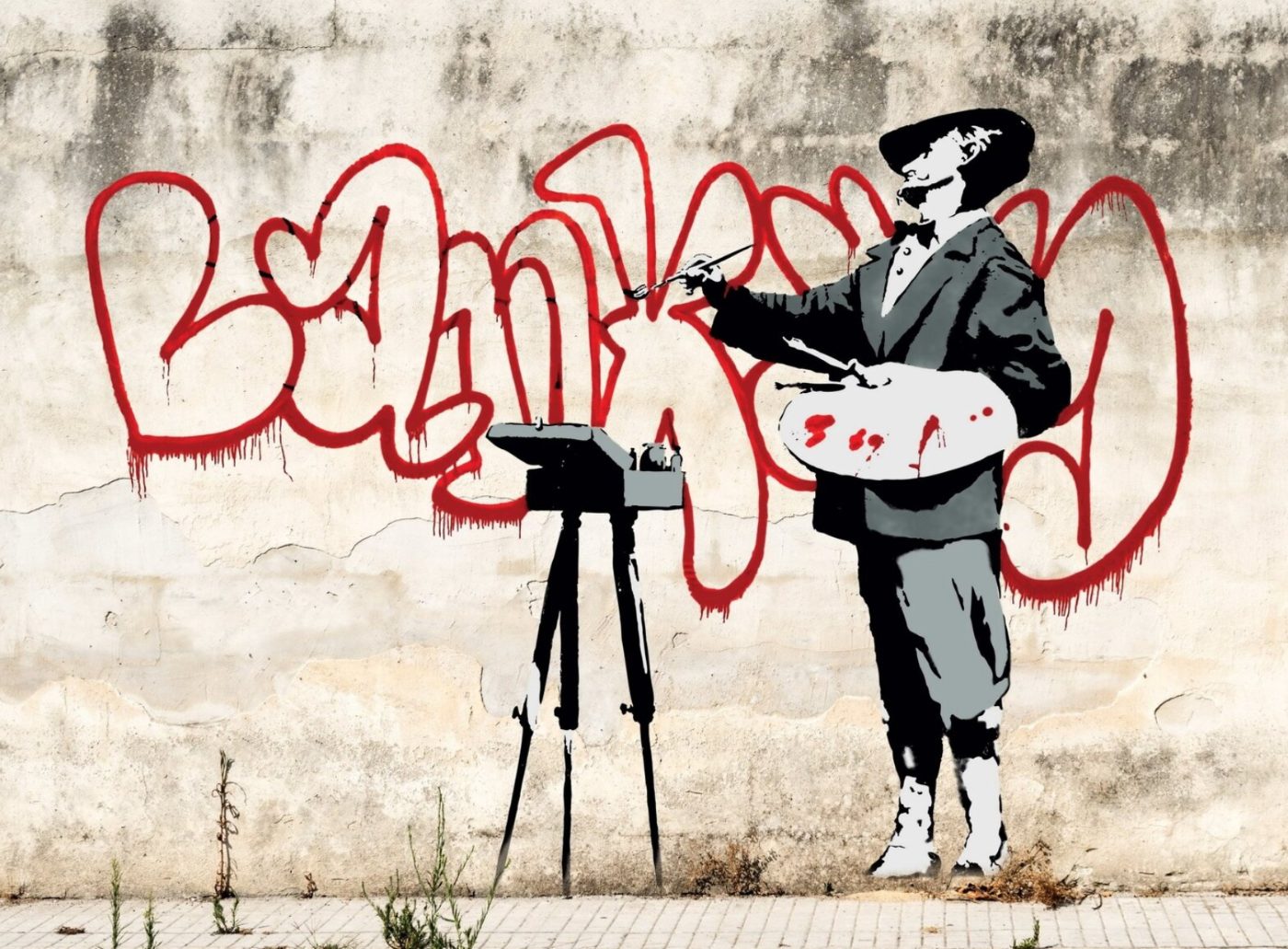
Two Painters, Two Sides of London
During the late summer of 2007, Banksy produced two closely related murals on opposite sides of London. Both introduce the figure of a traditional painter—palette, brushes and easel in hand—into the visual language of contemporary graffiti. Appearing only weeks apart, the two works form an unusually revealing pair in which Banksy stages a collision between the conventions of fine art and the supposedly illicit practice from which his own career had emerged.
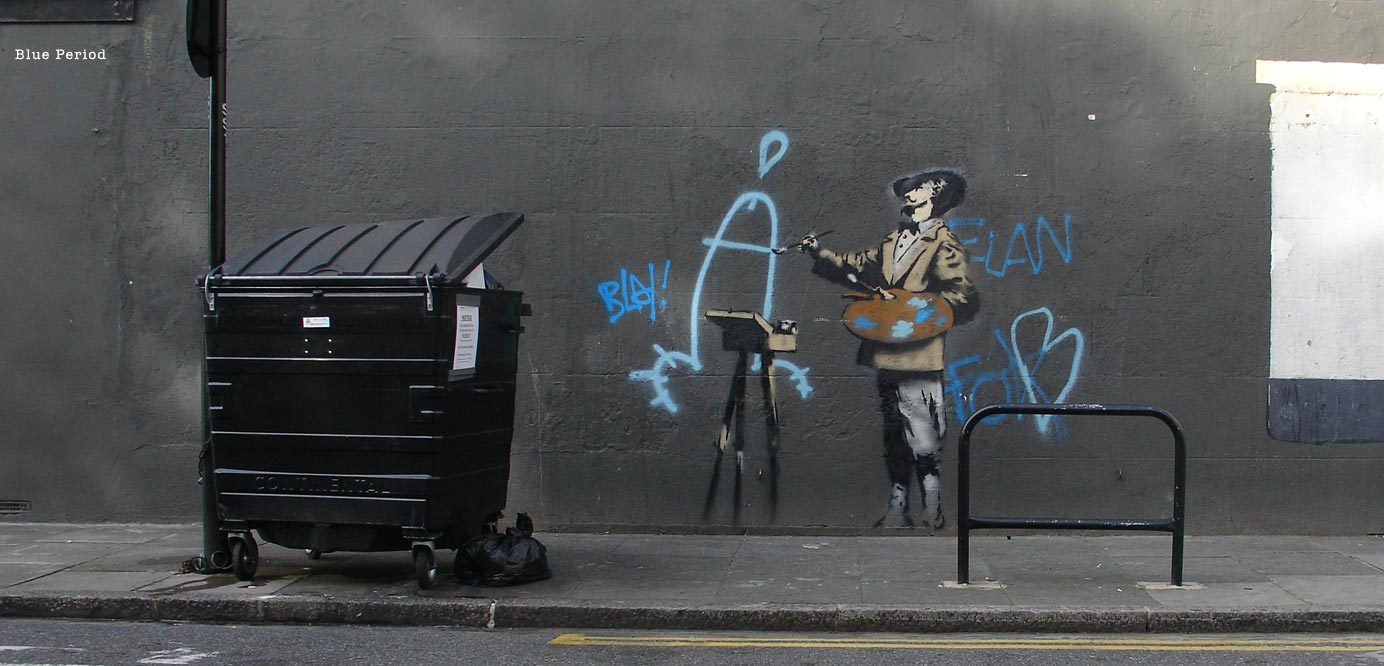
The first appeared in East London over the August Bank Holiday weekend of 2007. Usually referred to as Vandalism Is Art or Graffiti Artist, it depicts a formally dressed painter standing before a small easel, palette in one hand and brush extended toward the wall. Around him spreads an eruption of brilliant blue paint: broad curves, drips and apparently spontaneous graffiti marks that extend far beyond the imaginary limits of his canvas. Contemporary documentation places the work in the E9 area and records its appearance during the holiday weekend, when much of London's police presence was concentrated on the Notting Hill Carnival in the west of the city.
Only weeks later, Banksy returned to essentially the same idea on the other side of London.
From Blue to Red
In September 2007, another old-fashioned painter appeared at the junction of Portobello Road and Acklam Road in Notting Hill. This time the composition was monumental. Instead of loose blue gestures, the painter appears to be completing an enormous red BANKSY tag extending across the wall behind him.
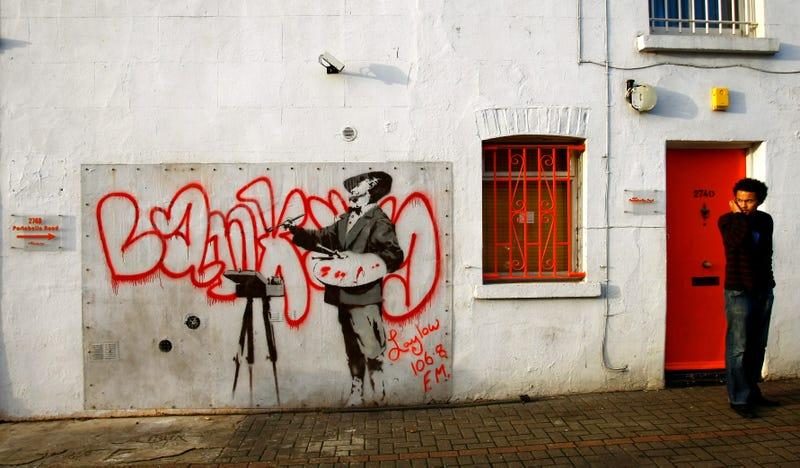
The circumstances of its creation were characteristically theatrical. According to the owner of the building, scaffolding covered with material appeared on a busy Sunday morning while Portobello Market was operating. Curious neighbors were given an explanation by the workers, Banksy painted unseen behind the temporary screen, and several hours later the scaffolding disappeared to reveal the completed mural. Contemporary photographs establish that the work was already visible by 20 September 2007.
The second mural is variously known as The Painter, The Graffiti Artist and Velázquez. The last title reflects the traditional appearance of the figure, although I would be cautious about stating categorically that Banksy intended a literal portrait of Diego Velázquez. Contemporary sources are much more secure about the mural and its location than about the precise identity of the painter.
When Graffiti Becomes Painting
Seen together, the two works are much more interesting than either is alone.
In the East London version, Banksy gives graffiti the gestures of painting. The palette, brush and easel tell us that we are looking at an artist, while the unruly blue marks surrounding him belong to the vocabulary of vandalism. The supposed boundary between the two collapses.
The Portobello version reverses the joke. Here the traditional painter does not merely make graffiti-like marks; he appears to be painting Banksy's own tag. One of the most basic gestures of graffiti—the writing of one's name—is transformed into an enormous act of traditional painting.
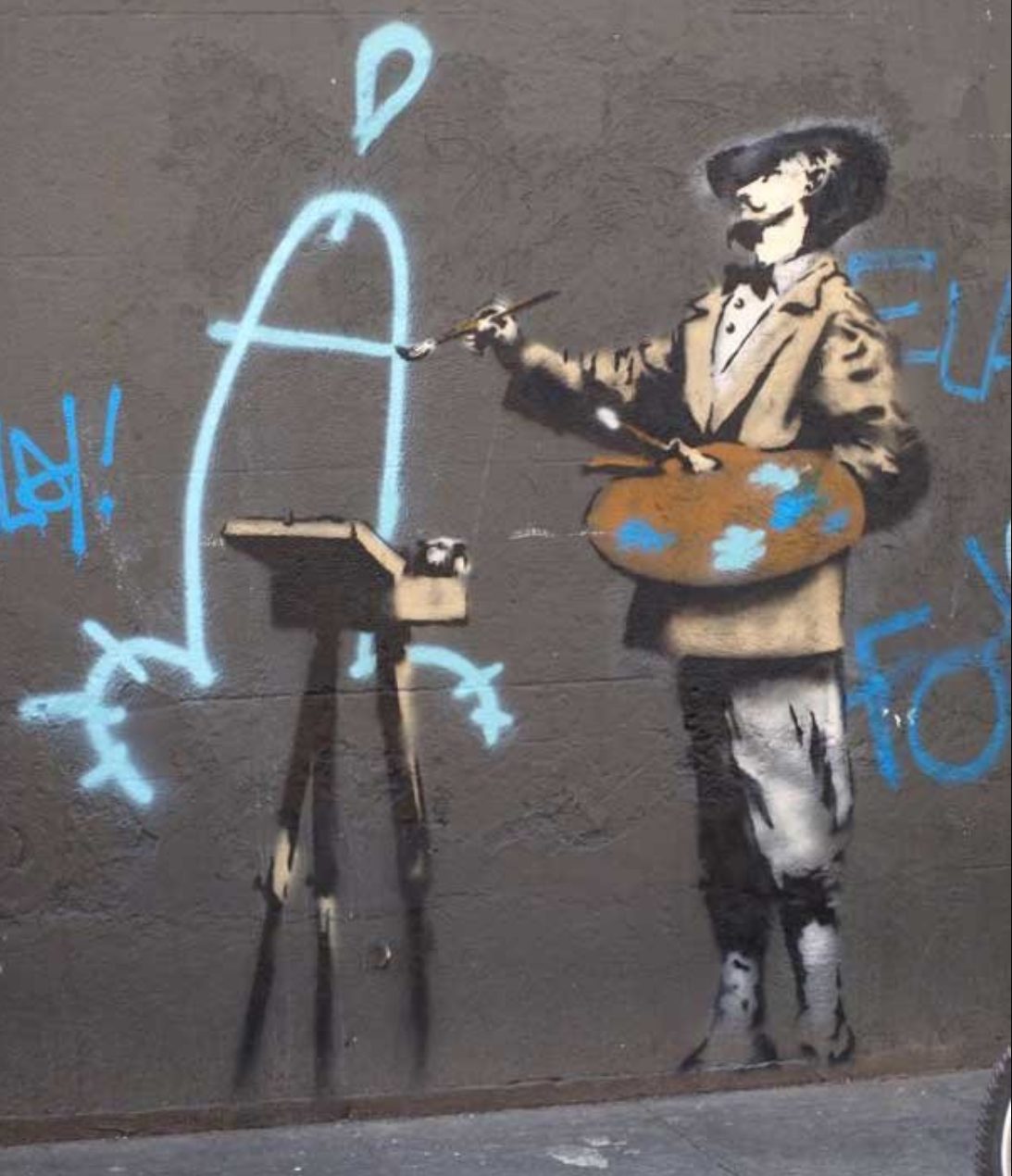
There is another subtle distinction. The blue work is loose and almost abstract. Its marks could have been produced by any anonymous graffiti writer. The red mural, by contrast, culminates in BANKSY, turning anonymity into authorship. The first asks whether vandalism can be art; the second asks what happens when the vandal has become a famous artist.
That distinction is particularly resonant in 2007. Banksy's market was exploding that year: his works were setting increasingly spectacular auction prices, while his unauthorized street works continued to be treated very differently depending upon who owned the wall and who recognized the name. Contemporary reporting in 2007 was already preoccupied with precisely this contradiction—the anonymous vandal whose work had become an increasingly valuable commodity.
From Vandalism to Real Estate
The subsequent history of the Portobello mural almost completes Banksy's joke for him.
Within months, building owner Luti Fagbenle offered the work—and effectively the section of wall supporting it—for sale on eBay. In January 2008 it attracted 69 bids and a winning bid of £208,100, although removing and replacing the wall remained the purchaser's responsibility.
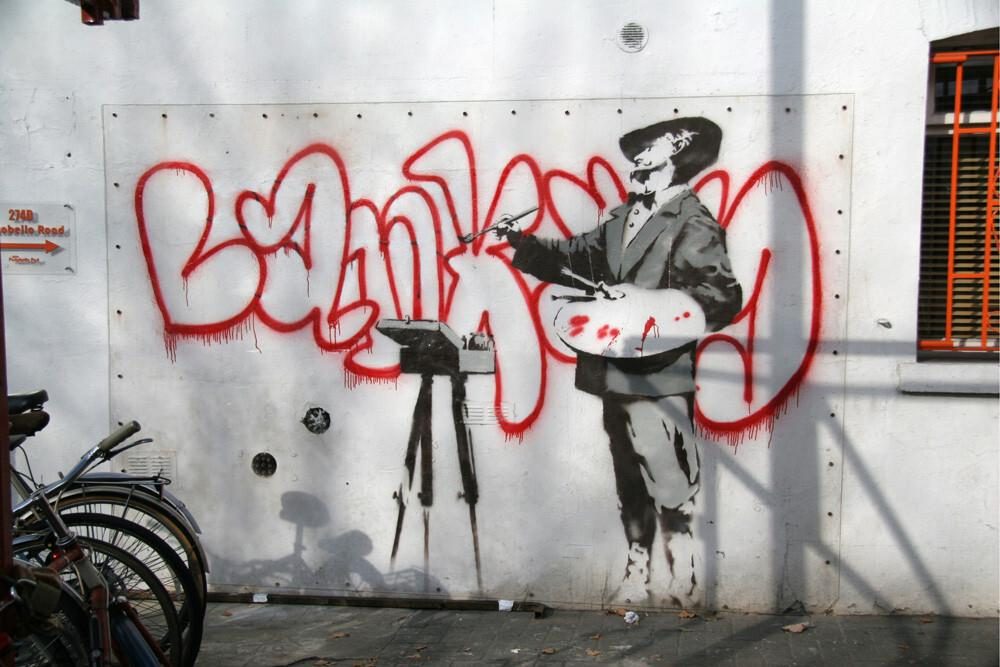
The mural was instead preserved behind protective material and remained associated with the building. Years later, redevelopment plans specifically incorporated the Banksy into a multimillion-pound luxury property project, with plans to reposition and illuminate it as a prominent architectural feature.
The trajectory is almost too perfect. Banksy begins with the image of a traditional painter legitimizing graffiti; within months, the unauthorized graffiti itself has acquired a six-figure price, and eventually it becomes an asset capable of enhancing the value and identity of a luxury property development.
The Artist Painting the Artist
There is an even broader context worth mentioning. Earlier in May 2007, The New Yorker published its major profile Banksy Was Here. At the end of the article, Banksy himself supplied the writer with an image depicting another old-fashioned artist beside an easel whose canvas was covered in graffiti. In other words, the collision between the traditional painter and the graffiti writer was already occupying Banksy's imagination before these two London murals appeared.
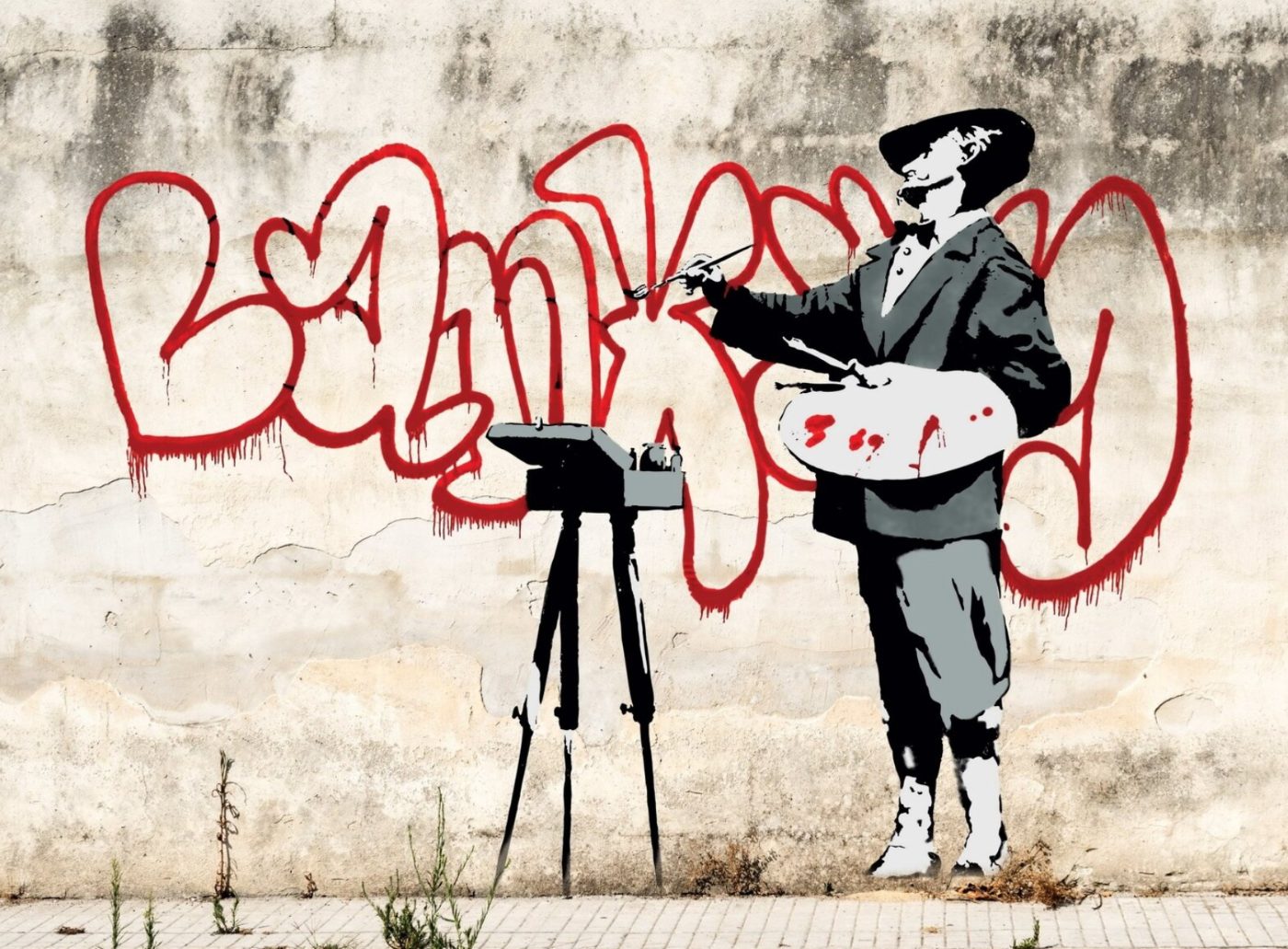
The two street works therefore belong to something larger than a repeated visual joke. They address one of the fundamental contradictions of Banksy's career: the difference between painting and graffiti, artist and vandal, cultural object and criminal damage is not necessarily contained in the object itself. It is produced by context, recognition, ownership and value.
In August 2007, Banksy's painter stood amid blue graffiti in East London. A few weeks later, another painted BANKSY across a wall in Notting Hill. By January, that wall was worth more than £200,000. The vandal had not changed. The definition of vandalism had.
STAY INFORMED
Receive the latest news, exhibitions, artworks and market updates on Banksy.