THE SON OF A MIGRANT FROM SYRIA
The Son of a Migrant
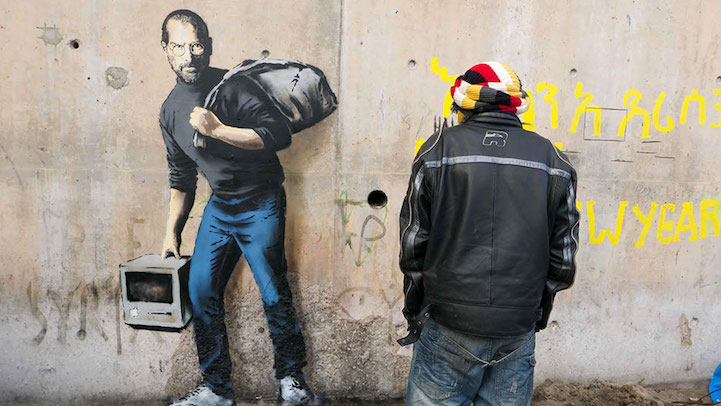
In December 2015, at the height of the European refugee crisis, Banksy painted a portrait of Steve Jobs, co-founder of Apple, on a concrete wall inside the sprawling migrant and refugee camp on the outskirts of Calais known as the Jungle. The work was publicly revealed on 11 December and appears to have been executed immediately beforehand.
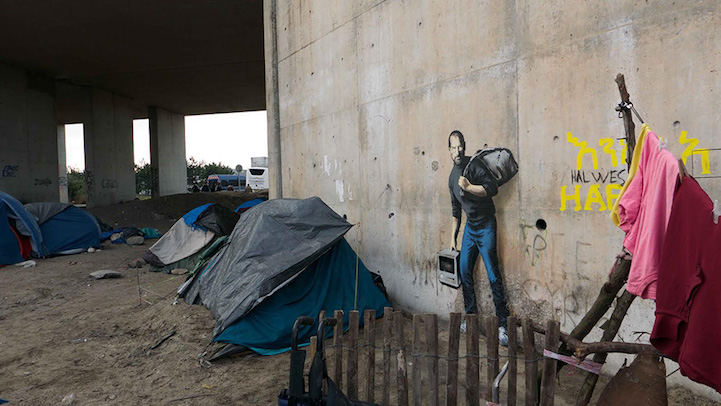
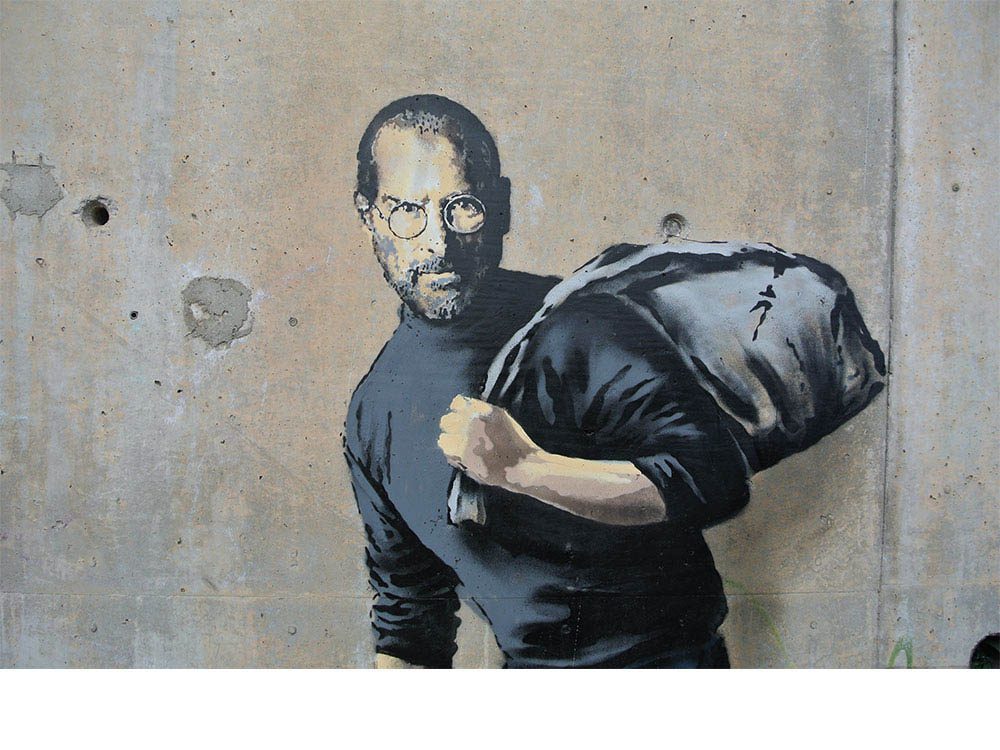
Jobs is instantly recognizable in his black turtleneck and round glasses, but Banksy removes him from the familiar visual world of Silicon Valley. Over one shoulder he carries a black sack containing his possessions; in his other hand he holds an early Apple Macintosh computer. He appears not as one of the most celebrated entrepreneurs of the modern era, but as a newly arrived migrant carrying what he can.
Banksy introduced the image with a simple caption: “the son of a migrant from Syria.” Jobs was born in San Francisco in 1955, but his biological father, Abdulfattah Jandali, was a Syrian who had moved to the United States. The statement deliberately collapses the distance between one of the defining figures of contemporary American culture and the thousands of displaced people then living in precarious conditions at Calais.
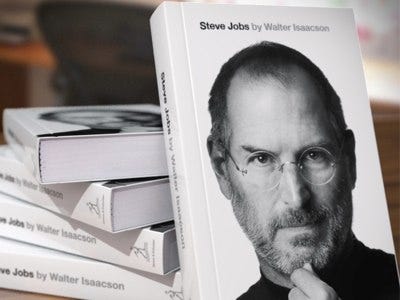
Using Steve Jobs as a representation of Syrian migrants became popular after a tweet in September 2015 by David Galbraith, a technology professional, included a photograph of Jobs with the caption “A Syrian migrants' child.” Jobs' depiction is derived from a 2006 photograph taken by Albert Watson which was later used on the cover of Walter Isaacson's biography of Steve Jobs.
Migration and Value
The message was unusually explicit. Banksy accompanied the work with a statement challenging the characterization of migrants as an economic burden, invoking Jobs's Syrian ancestry and the enormous economic success of Apple. The mural consequently uses one exceptional biography to attack the tendency to regard migrants principally as a cost or threat.
We're often led to believe migration is a drain on the country's resources, But Steve Jobs was the son of a Syrian migrant. Apple is the world's most profitable company, it pays over $7 billion a year in taxes. And it only exists because they allowed in a young man from Homs.
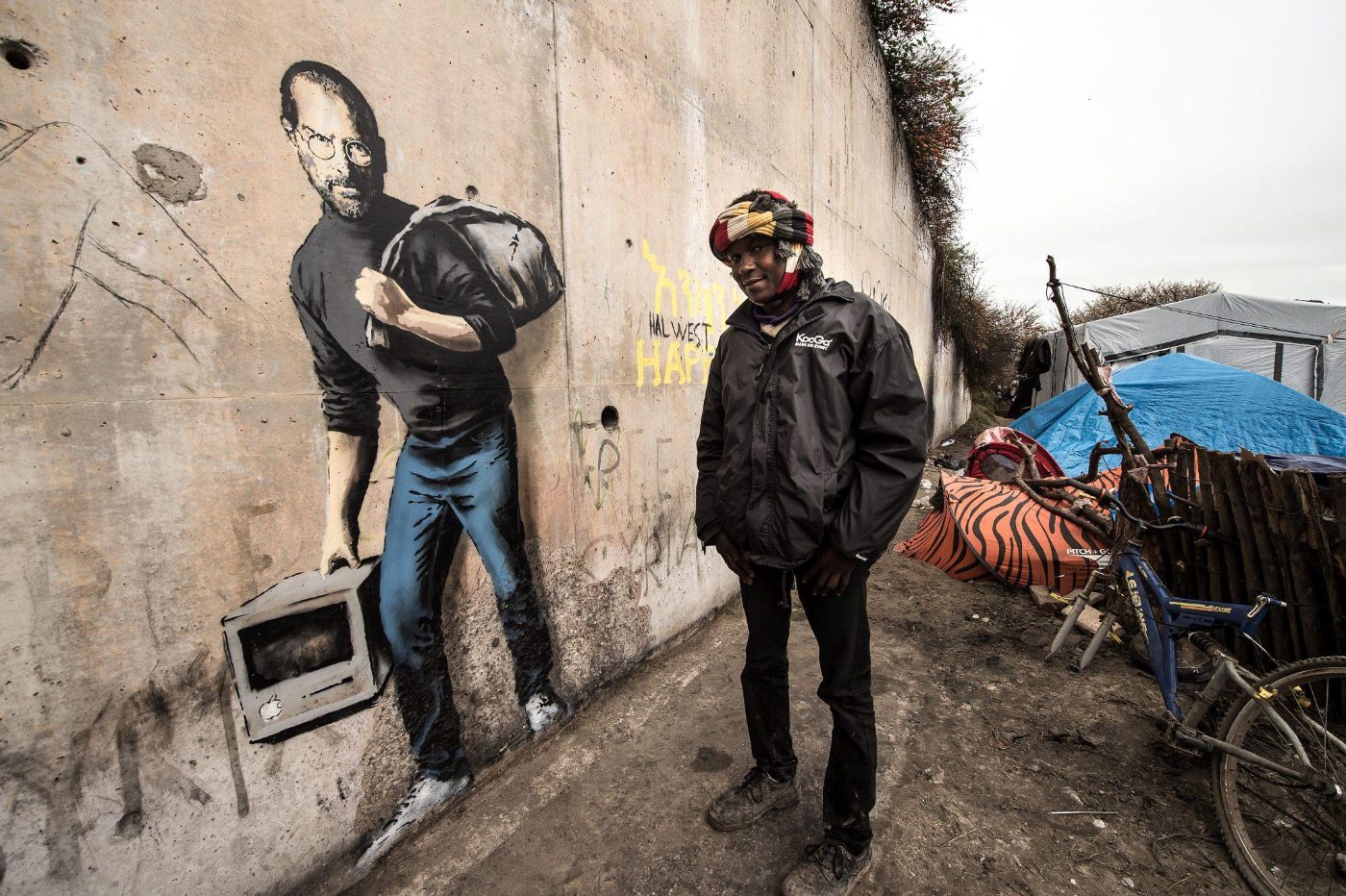
The Macintosh carried by Jobs is central to the composition. It functions first as an identifying attribute, almost like the object held by a saint in a traditional portrait. But it also represents what cannot be seen when an unknown person crosses a border: knowledge, imagination, talent and future contribution. Banksy's Jobs arrives carrying little, yet the viewer already knows what his name will eventually represent.
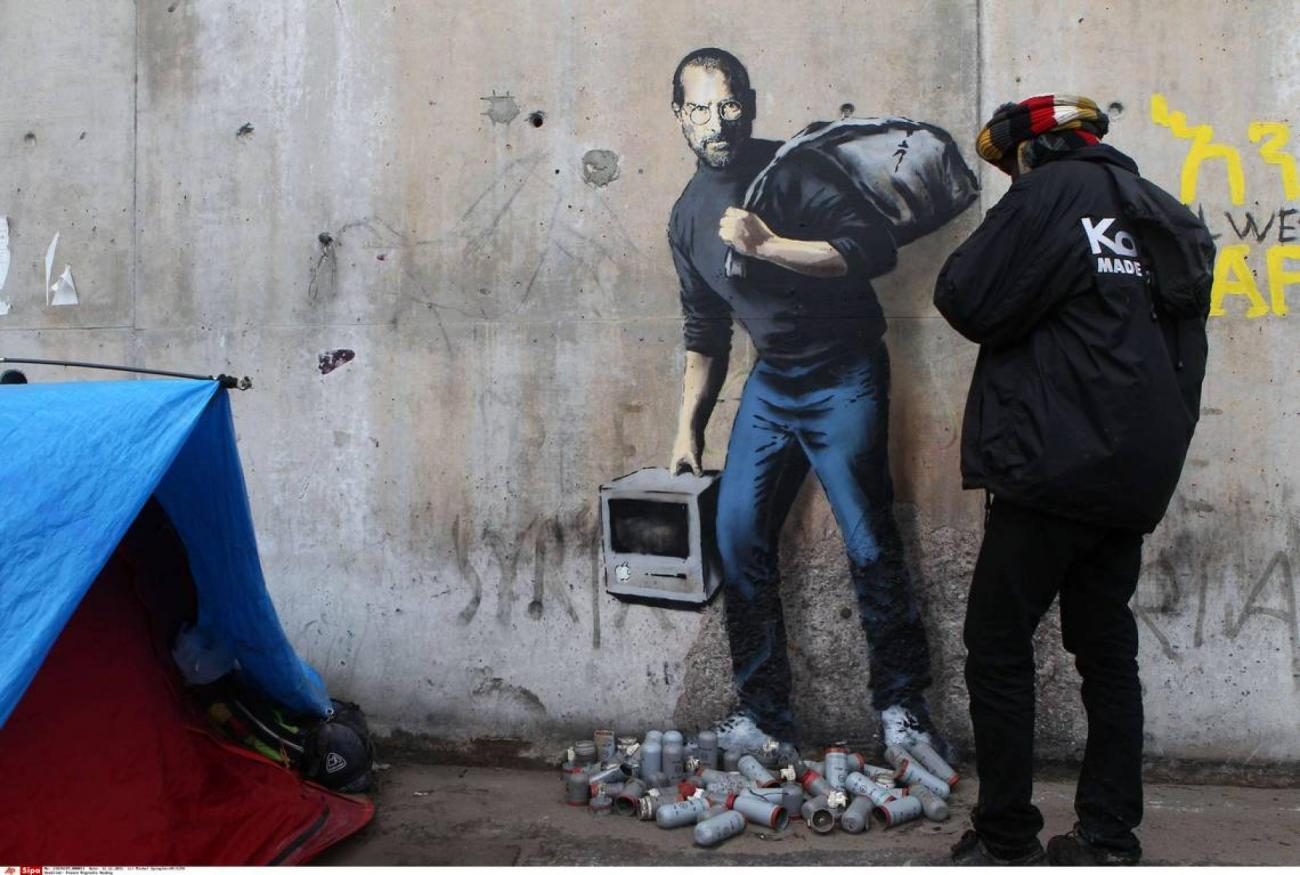
The analogy is deliberately compressed. Jobs himself was not a Syrian refugee: he was American-born, while his biological father came from Syria to the United States as a student. The work therefore operates less as biography than as a visual provocation. Its argument depends upon confronting the viewer with the uncertainty inherent in judging people according to where they come from or the circumstances in which they arrive.
Banksy in Calais
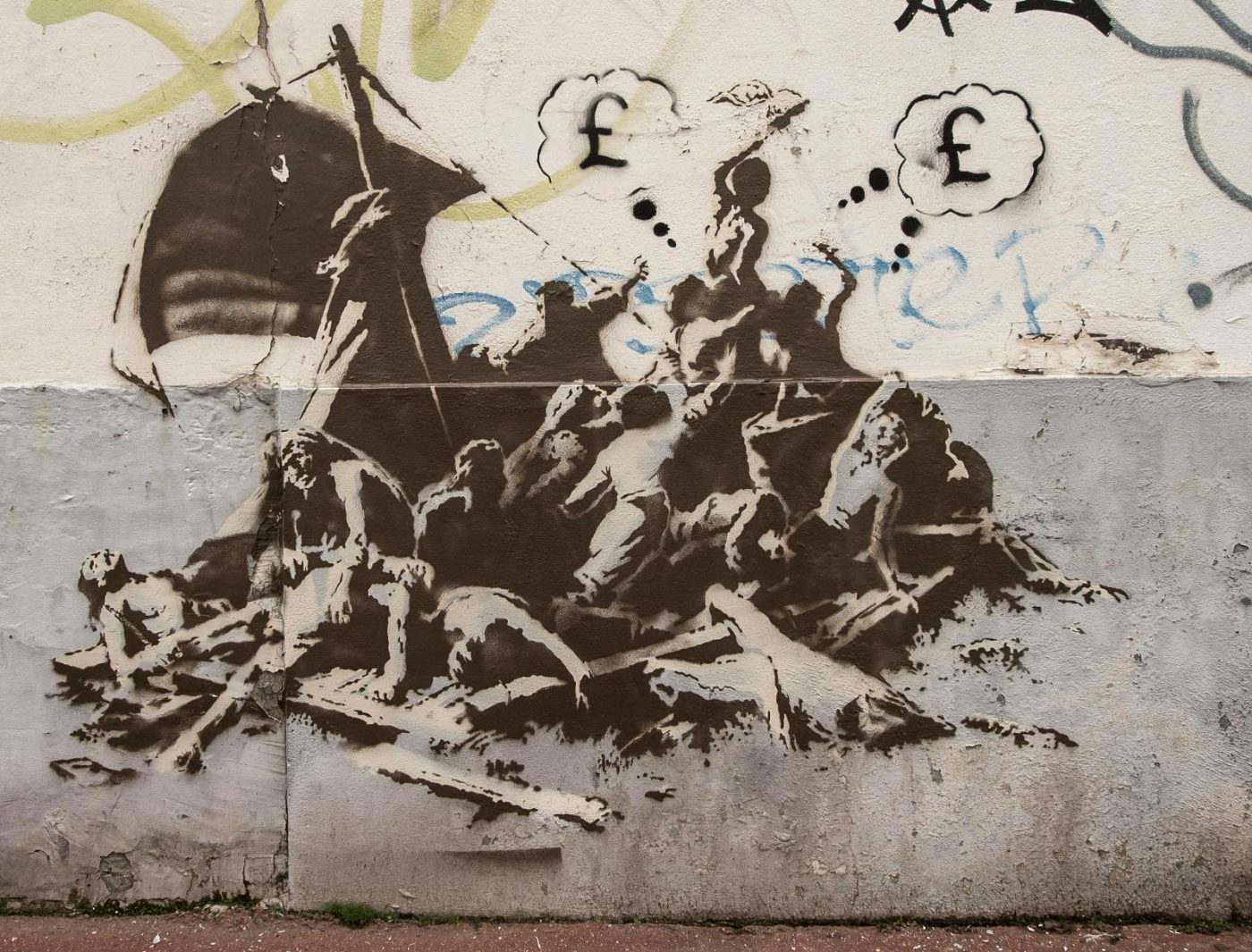
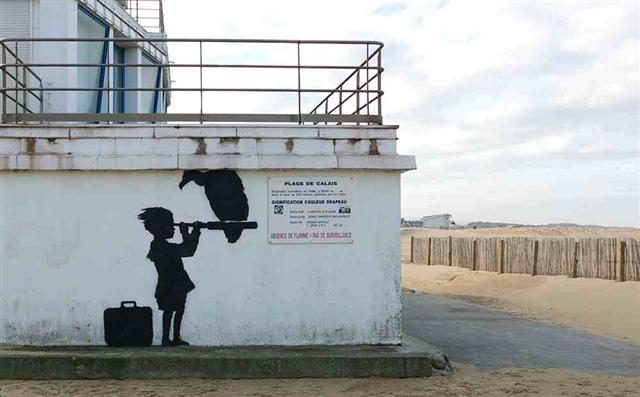
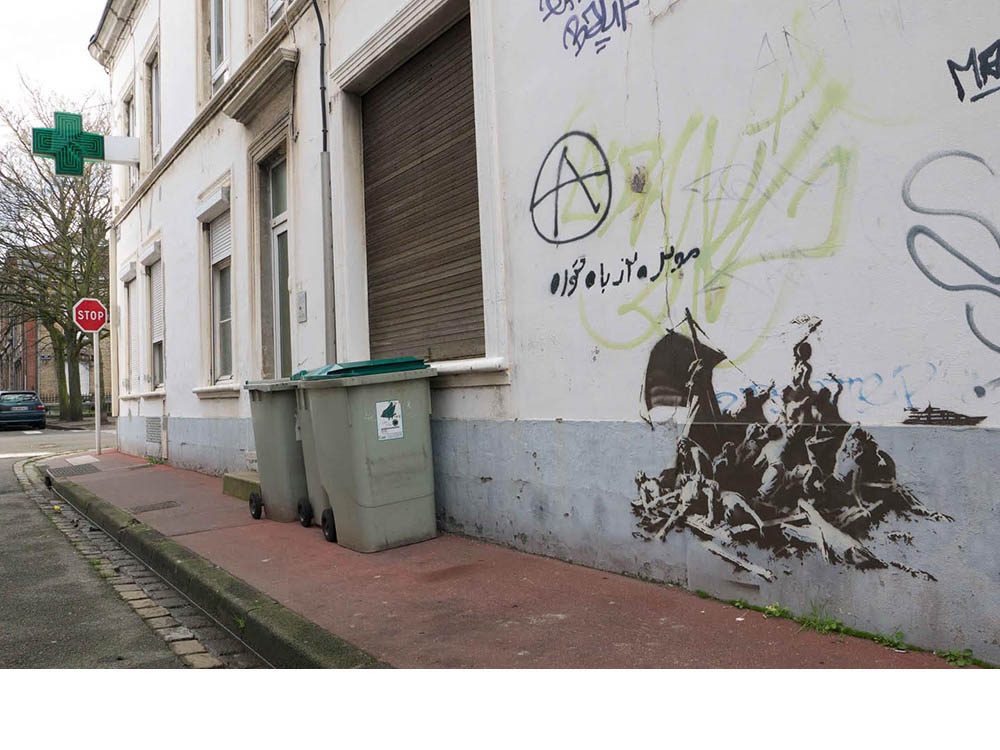
The Son of a Migrant from Syria formed part of a wider group of Banksy interventions around Calais in late 2015. Among them was a reinterpretation of Théodore Géricault's The Raft of the Medusa, in which refugees on an overcrowded makeshift raft desperately signal toward a distant luxury yacht. Another work showed a child looking through a telescope toward Britain, while the phrase “Maybe this whole situation will just sort itself out” appeared nearby.
The Calais interventions followed directly from Banksy's Dismaland, which had closed in Weston-super-Mare in September 2015. Materials from the temporary exhibition were subsequently transported to Calais and reused to construct shelters and facilities for refugees under the name Dismal Aid. Banksy's engagement with the crisis therefore extended beyond the production of murals into the physical reuse of a project that had itself satirized borders, security, inequality and institutional indifference.
A Temporary Image in a Temporary City
The mural quickly acquired the vulnerability of the camp surrounding it. Authorities placed transparent protection over the work, but in January 2016 vandals attacked it, breaking the protective screen and defacing portions of the image.
During 2016, French authorities progressively cleared the Jungle, culminating in the camp's large-scale dismantling in October. The environment in which Banksy had placed Jobs—and which gave the image much of its meaning—disappeared with it.
That disappearance is particularly significant for a work whose subject is displacement. Banksy did not portray Steve Jobs in a gallery, an office or against a neutral wall. He placed him among thousands of people whose identities had largely been reduced in political debate to the collective labels of migrants and refugees. Against that anonymity, Banksy supplied one famous name and an uncomfortable question: when someone arrives carrying everything they own, who can know what they might become?
STAY INFORMED
Receive the latest news, exhibitions, artworks and market updates on Banksy.