THE WHIP
DEVELOPMENT AT ANY PRICE
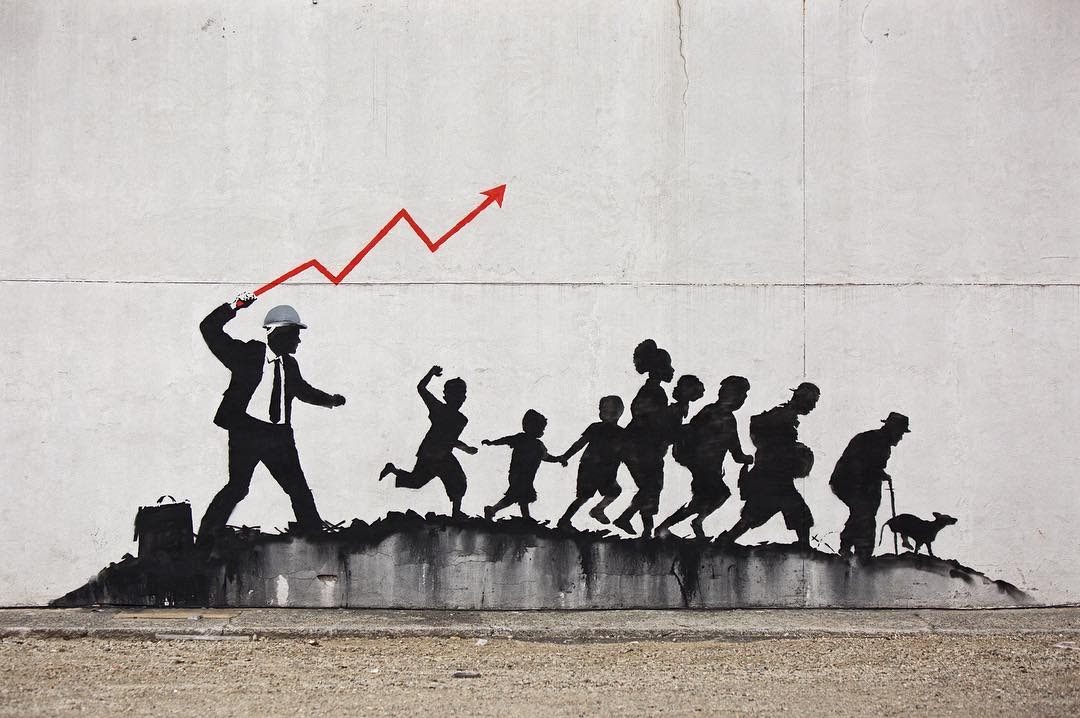
Banksy painted The Whip on the wall bordering a vacant development site at the intersection of Coney Island Avenue and Avenue I in Midwood, Brooklyn. The work had already been noticed locally before Banksy confirmed it through his Instagram account on 19 March 2018, during the same brief New York campaign that produced Clock Rat and his monumental intervention in support of imprisoned Kurdish artist Zehra Doğan on the Bowery Wall. Contemporary reporting indicates that the mural may have appeared several days earlier, possibly around 10 March.
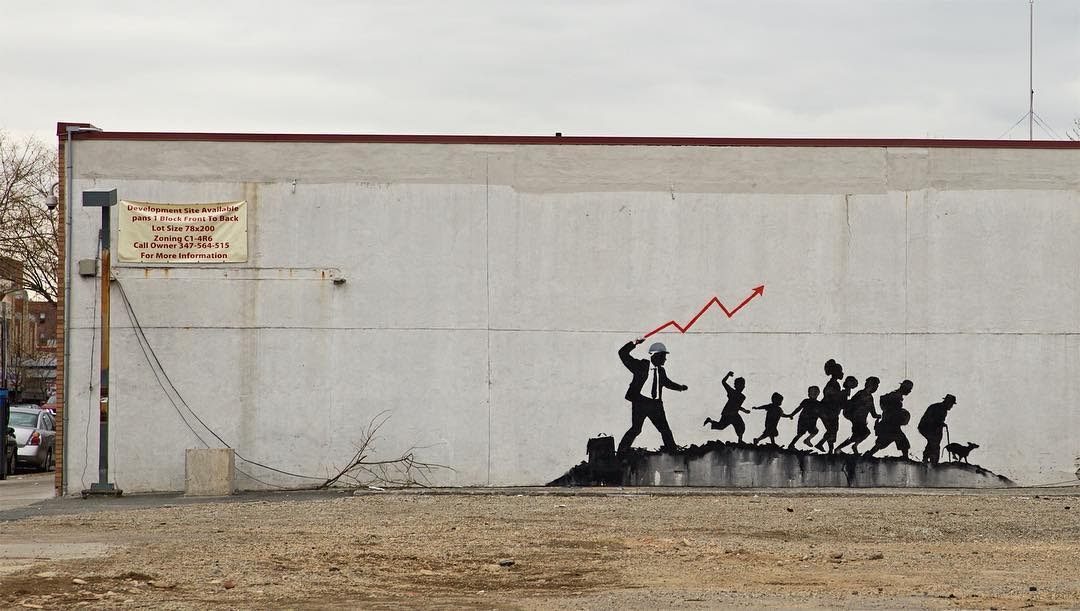
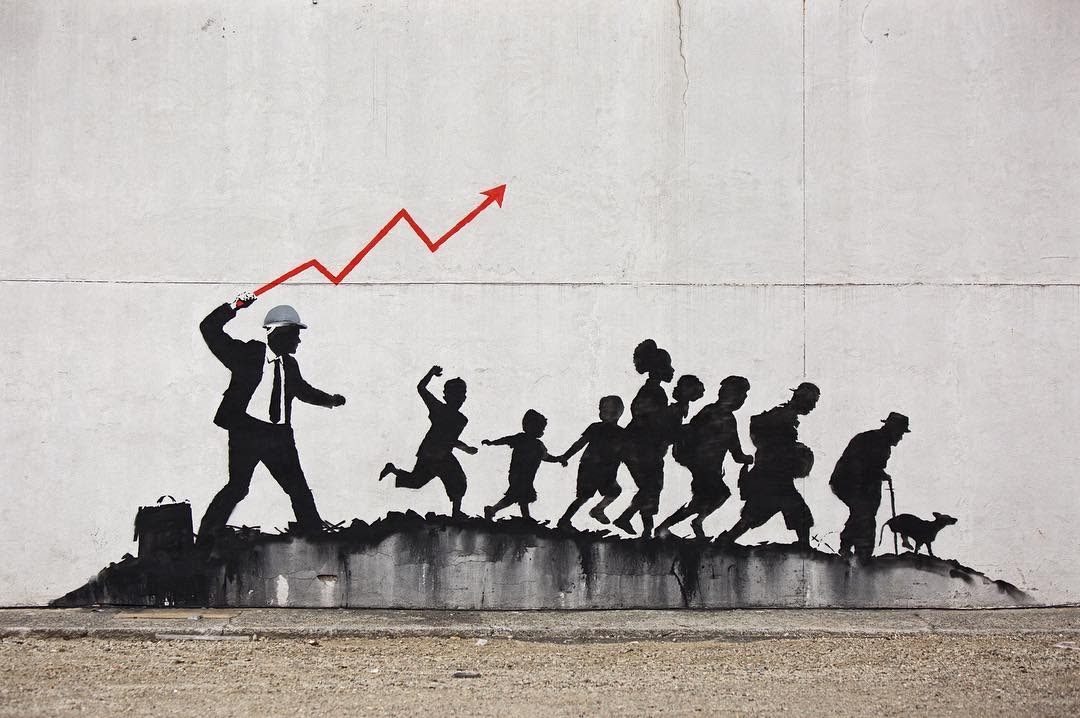
The composition is unusually expansive for a stencil intervention. A businessman in a suit, tie and construction hard hat advances behind a procession of people who appear to be fleeing before him. Children, adults, a mother carrying a baby, an elderly man and a dog form an almost evolutionary sequence across the wall. Instead of an ordinary whip, the developer brandishes a bright red line graph, its sharply rising trajectory terminating in an arrow. The only significant color in the composition is therefore also its most important symbol: economic growth has literally become the instrument driving people from the land.
THE ECONOMICS OF DISPLACEMENT
The image operates as a concise critique of the relationship between property development, rising asset values and displacement. Banksy does not present economic growth as an abstract statistic. By transforming the rising graph into a whip, he gives the language of markets a physical consequence. What appears positive on a financial presentation—the upward movement of prices, profits or property values—is experienced very differently by the people being forced ahead of it.
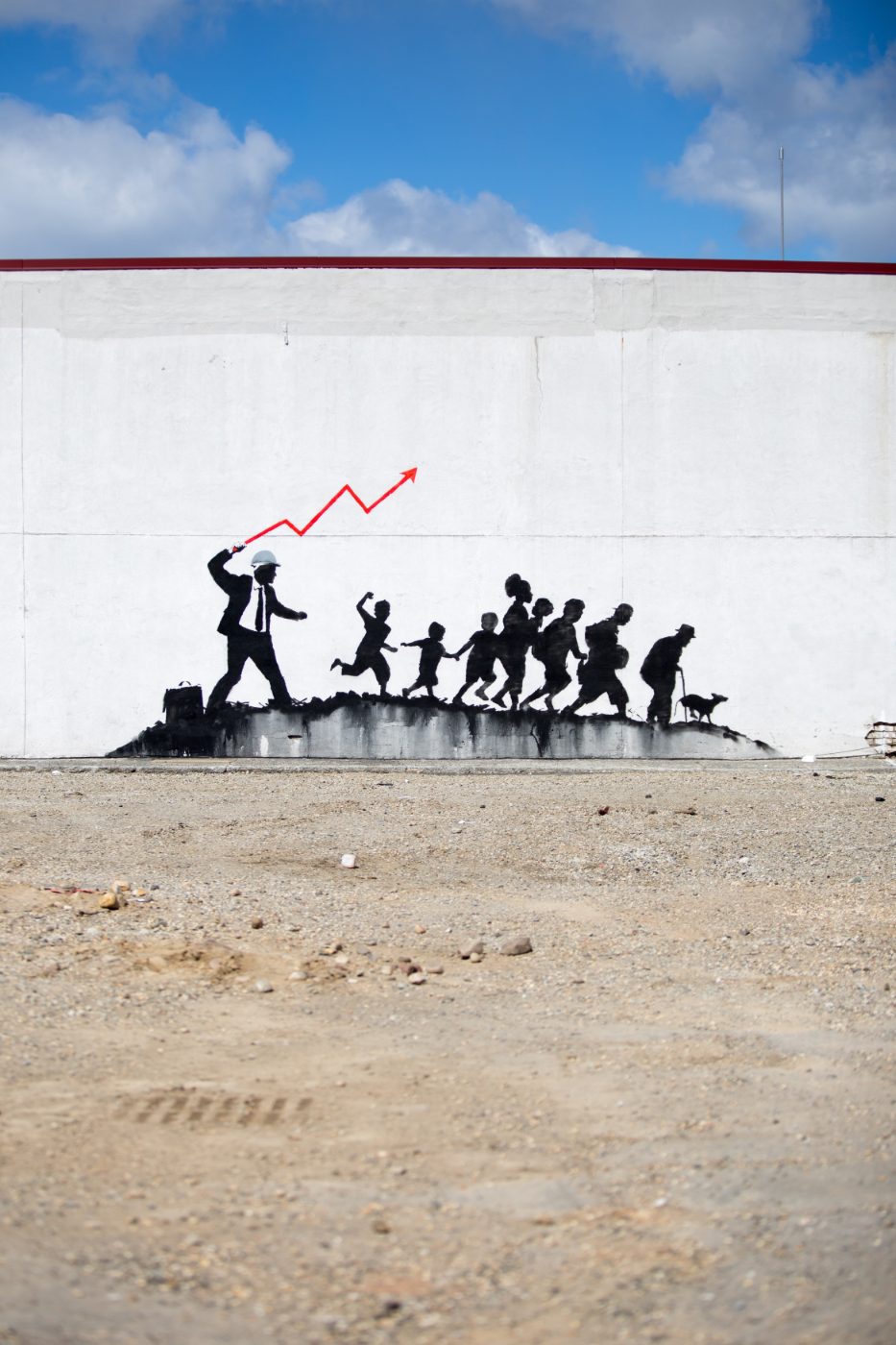
The location made that argument considerably more specific. Banksy chose a wall immediately adjoining a vacant former gas-station site being prepared for redevelopment, and contemporary photographs show a sign advertising the property as a development opportunity. The empty ground in front of the mural was therefore not incidental scenery but part of the work's meaning. A painting concerned with development and displacement appeared on the boundary of an actual development site, collapsing the distance between Banksy's metaphor and the economic process taking place around it.
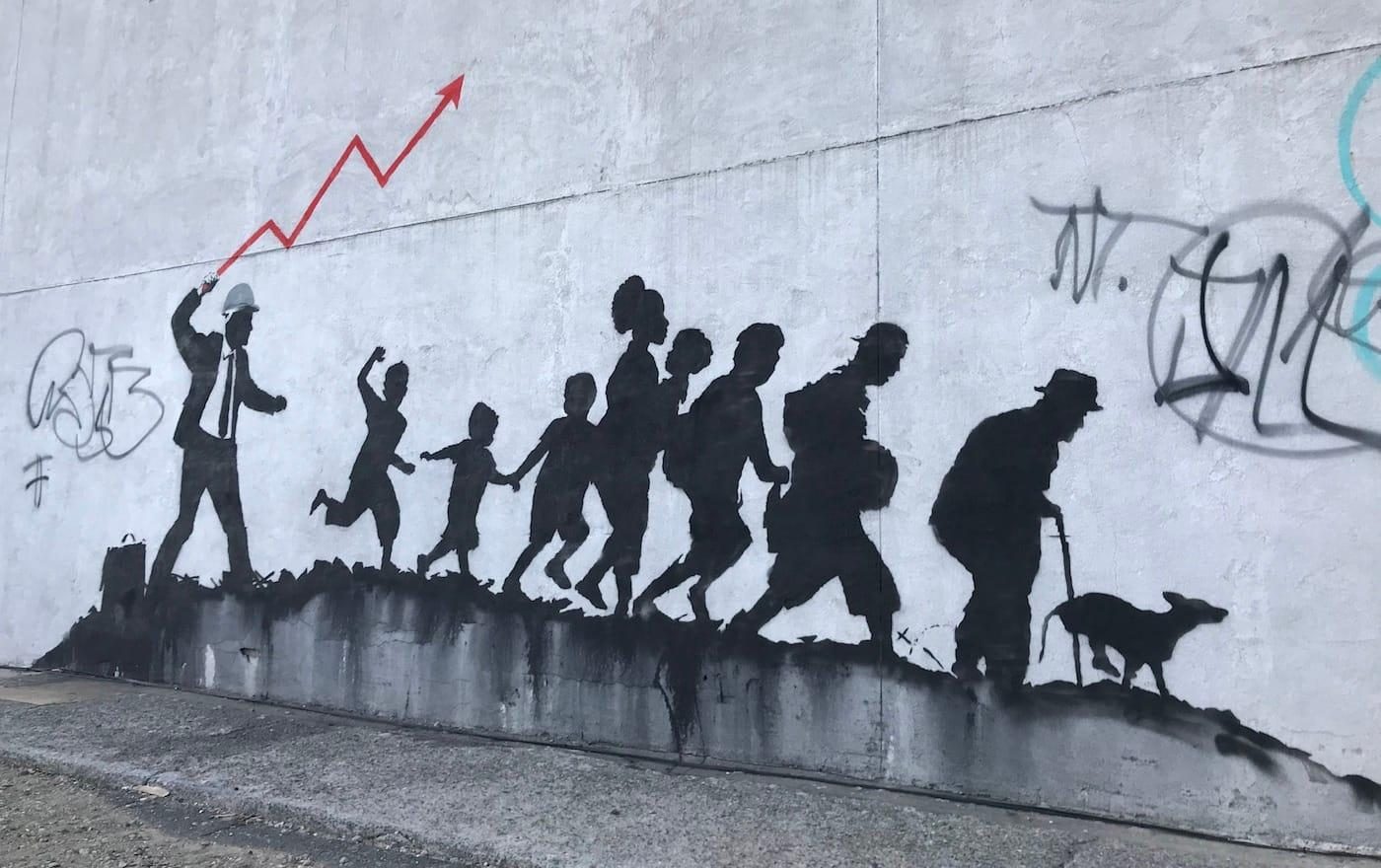
There is an additional subtlety in the figures themselves. Banksy does not isolate one particular social group as the victim of the process. Children, a parent, adults, an elderly person and even a dog move together in the same direction. Their silhouettes transform what might otherwise have been a specific political cartoon into a broader image of a community being displaced. Against this human procession stands the solitary developer, recognizable not through his individuality but through the uniform of business and construction: suit, briefcase and hard hat.
THE RED ARROW
The rising red arrow is particularly effective because Banksy reverses one of the most familiar visual conventions of capitalism. In financial culture, an upward graph conventionally signifies success: higher prices, greater profits and increasing value. Here exactly the same symbol becomes threatening. The higher the graph rises, the more violently it drives the people before it.
That inversion connects The Whip to a recurrent strategy throughout Banksy's work: taking an apparently neutral or optimistic symbol and revealing the power relationship concealed within it. Yet the work remains visually economical. Banksy does not write an explanatory slogan across the wall. The transformation of a financial chart into a weapon is sufficient to make the argument, while the actual development site provides its real-world context.
A PAIR OF SITE-SPECIFIC INTERVENTIONS
Banksy produced a second work immediately nearby: a seal balancing a ball on its nose on the former Mobil service-station building at 1249 Coney Island Avenue. Here again he incorporated the existing architecture into the image. The “ball” occupied the circular space left behind when part of the former gas-station signage had been removed. Banksy confirmed the seal as his work the following day, 20 March 2018.
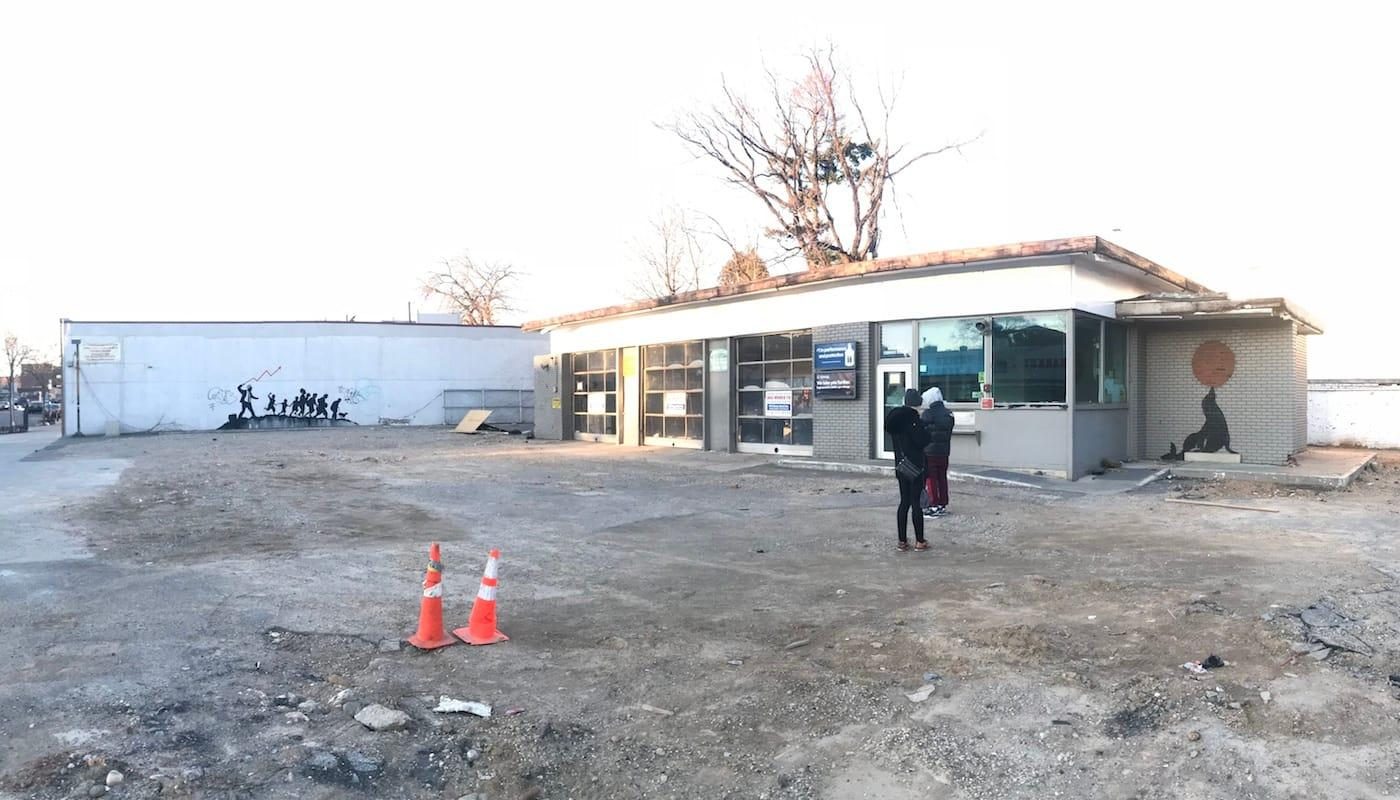
The two works consequently functioned as very different responses to the same transitional urban environment. The Whip addressed redevelopment directly through the language of economics and displacement; the seal transformed a remnant of the site's former commercial identity into an absurd visual joke. Together they demonstrate two complementary aspects of Banksy's street practice—the overtly political stencil and the improvised intervention generated by something already present on the wall.
A SHORT-LIVED WORK
Like Clock Rat, The Whip proved extremely vulnerable. Within days of Banksy's confirmation, the mural was defaced and partially covered with dark and grey paint. Hyperallergic documented the damage by 24 March 2018, barely a week after the work had attracted widespread attention.
Its brief existence nevertheless preserved an important characteristic of Banksy's New York interventions. The Whip was not simply a transferable image about capitalism painted on an arbitrary wall. The vacant lot, redevelopment notice and changing neighborhood were integral to the encounter. The work turned the physical site itself into evidence for its argument: while the red graph promised increasing value, the procession beneath it asked the more difficult question of who ultimately benefits when the value of a city rises.
STAY INFORMED
Receive the latest news, exhibitions, artworks and market updates on Banksy.