THE NEW-YORK LEGAL RATS
The New-York Legal Rats
The New York Legal Rats is the collective title used by Banksy Explained for four monumental rat murals conceived by Banksy and executed across downtown Manhattan in the autumn of 2008. Appearing on prominent commercial walls in SoHo and Greenwich Village, the works transformed one of Banksy's oldest and most recognizable street motifs into images several stories high. Yet their scale was not their only unusual characteristic. Unlike the clandestine stencils through which Banksy's rats had traditionally occupied the city, these murals were legally produced using the infrastructure and techniques of commercial outdoor advertising.
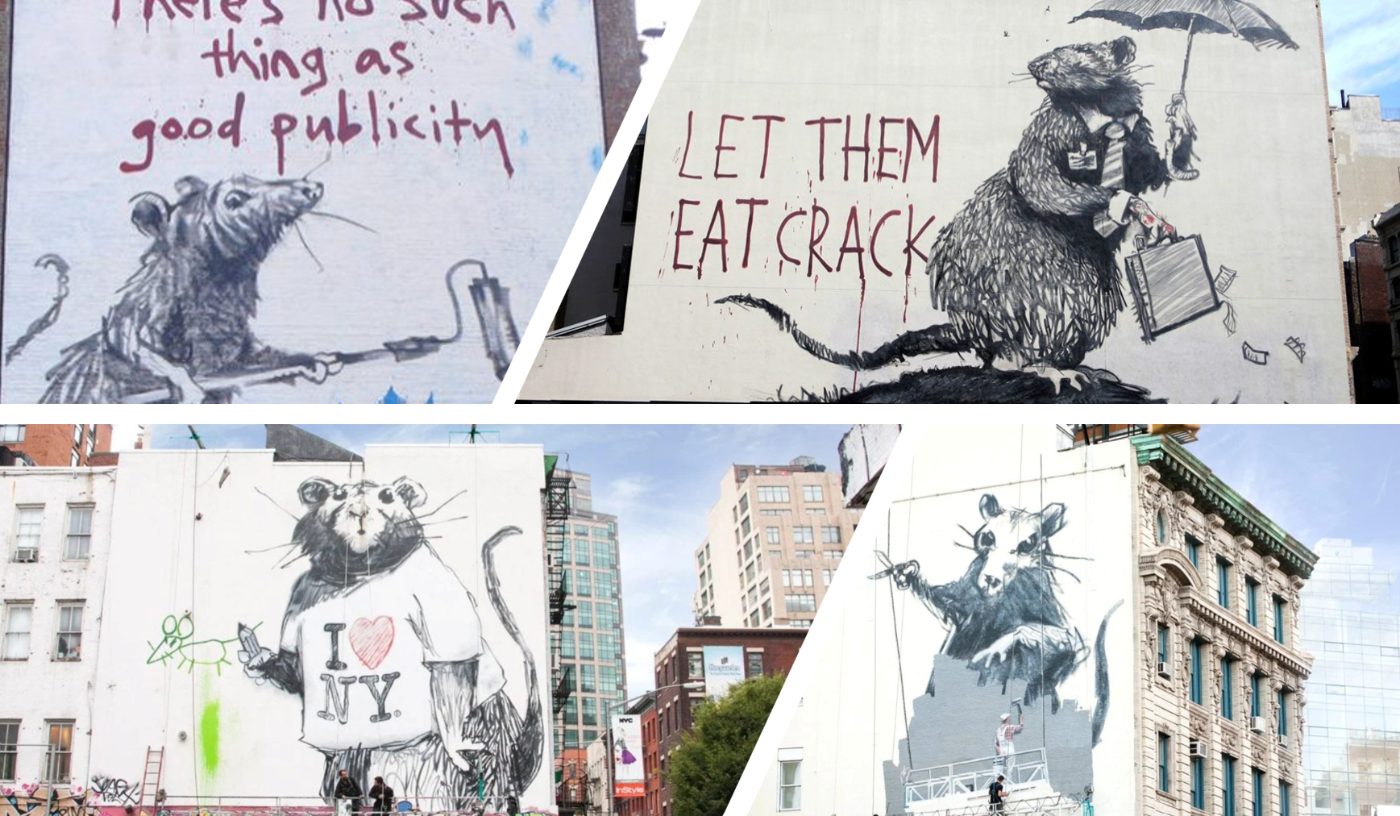
Banksy commissioned Colossal Media, the New York company specializing in hand-painted advertising, to execute the works from his designs. Colossal records that all four murals were painted simultaneously in order to preserve an element of secrecy, although their extraordinary scale inevitably attracted considerable attention. Contemporary observers initially encountered the curious spectacle of professional mural painters, suspended from scaffolding and lifts, meticulously reproducing images that deliberately retained the loose, apparently improvised character of Banksy's street work.
The project coincided with Banksy's presence in New York for The Village Pet Store and Charcoal Grill, his remarkable installation at 89 Seventh Avenue South, which opened in October 2008. The murals therefore operated simultaneously as independent works and as a dispersed urban prelude to the exhibition. Banksy described his strategy at the time as an attempt to compete with corporations on their own terms, using comparable scale and locations. He was particularly interested in the paradox of billboard companies being willing to display almost any message provided that someone was prepared to pay for the space—even a message questioning precisely that arrangement.
The resulting works occupy an unusual position within Banksy's practice. They resemble graffiti but were authorized; they criticize commercial and financial culture while occupying spaces normally reserved for advertising; and although conceived by one of the world's most famous street artists, they were physically executed by professional sign painters. Their subject, appropriately, was the rat: Banksy's longstanding emblem of the unwanted urban outsider, now enlarged to the dimensions of the city itself.
I ♥ NY Rat
Grand Street and Wooster Street
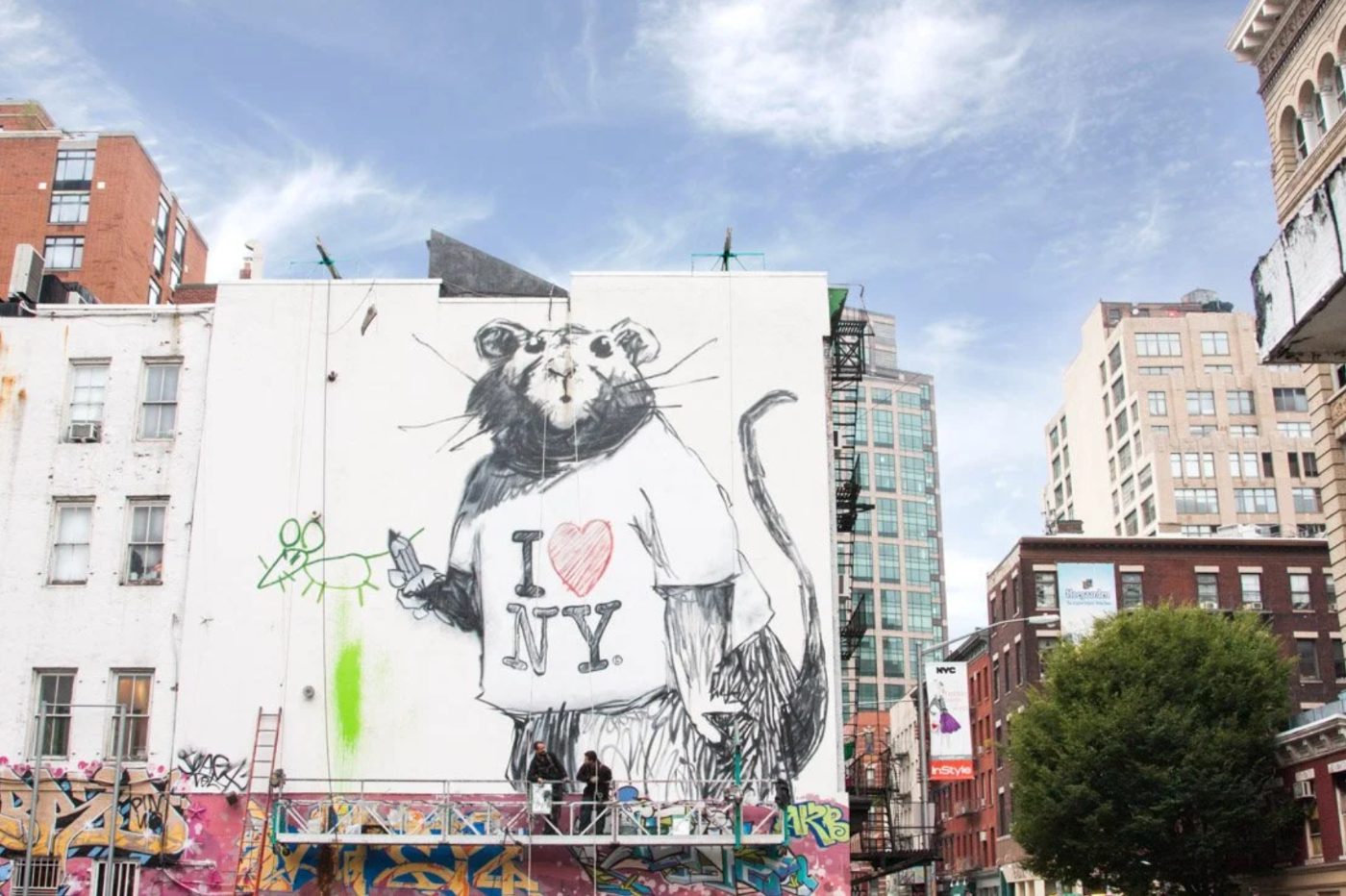
The first of the group appeared at the corner of Grand and Wooster Streets in SoHo, where it was already being documented during its execution on 27 September 2008. A colossal rat wearing the familiar I ♥ NY T-shirt holds a marker or spray can and draws a much smaller rat on the wall beside it. Contemporary reporting described the mural as approximately three stories high and confirmed that it had been executed by Colossal Media.
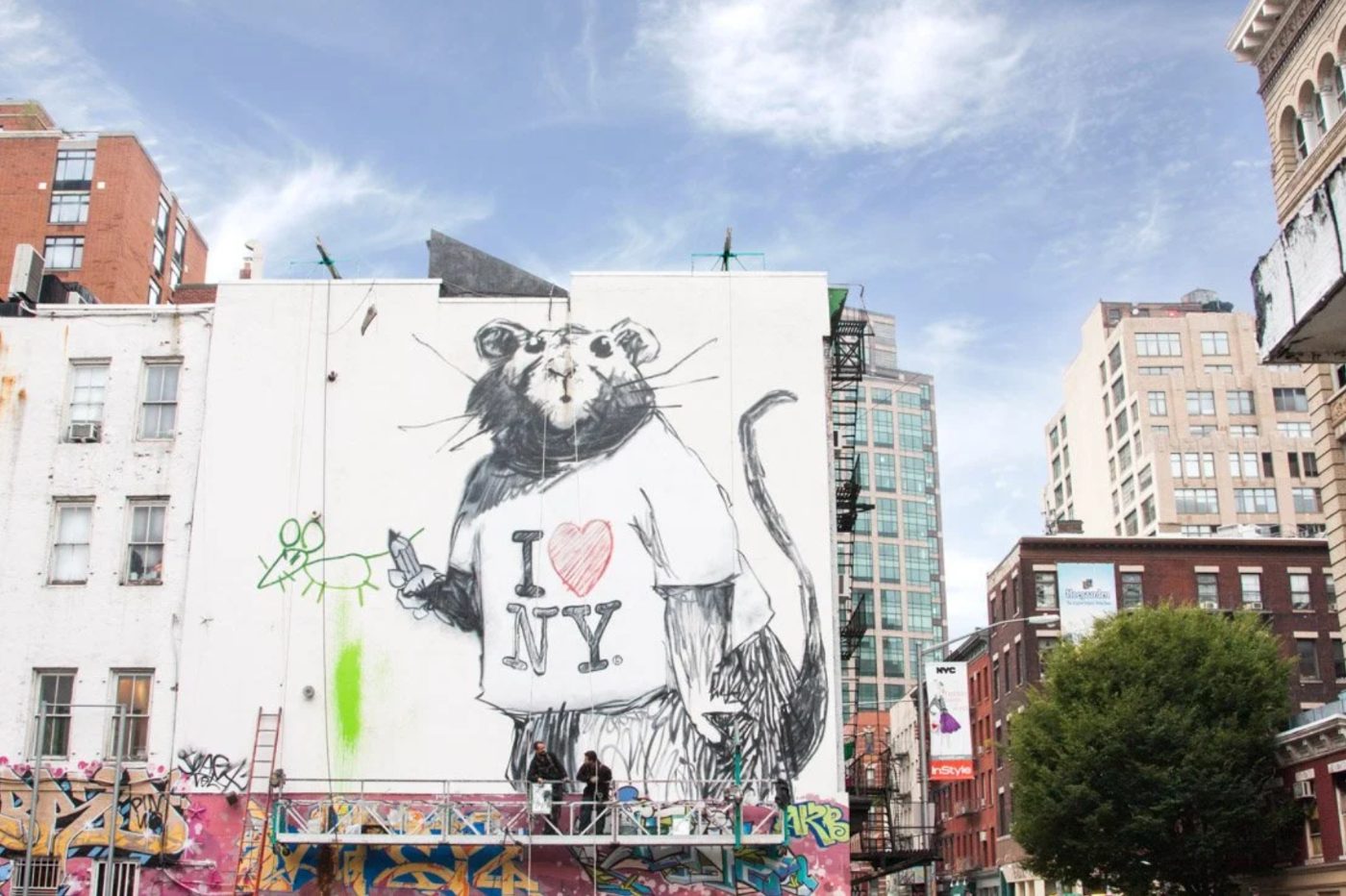
The image is an affectionate but characteristically ironic appropriation of Milton Glaser's celebrated I ♥ NY logo. Banksy substitutes the idealized identity promoted by civic branding with an animal that New York has spent generations attempting to eradicate. Yet the rat appears perfectly comfortable in its surroundings. It has adopted the city's emblem, taken possession of an enormous wall and begun making street art of its own.
There is also an appealing recursion within the image: Banksy creates a rat that creates another Banksy rat. The enormous scale makes the joke particularly effective. A creature normally encountered furtively near pavement level has become a monumental citizen of New York, while the small animal it draws recalls the scale at which Banksy's rats traditionally inhabited the street.
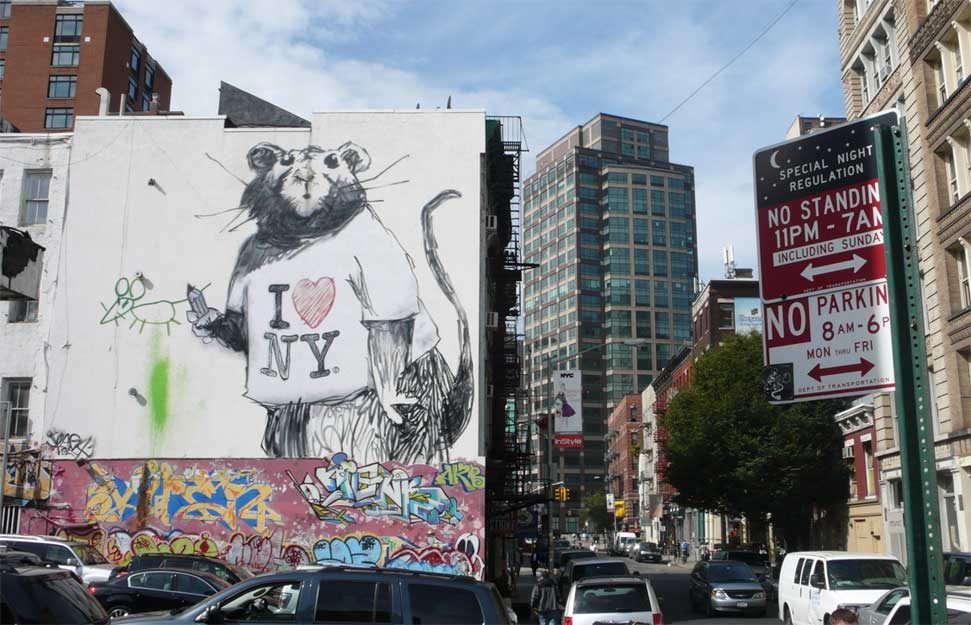
The work therefore feels less hostile than the other three murals. Rather than attacking advertising, finance or the mechanisms responsible for its own production, it amounts to an idiosyncratic declaration of affection for New York. The city may prefer the heart of its famous logo; Banksy characteristically chooses the rat.
Let Them Eat Crack
Howard Street and Broadway
At Howard Street and Broadway, Banksy introduced a considerably darker protagonist. An enormous rat wearing a tie and carrying an umbrella walks across the façade with a briefcase from which papers or money appear to escape. Beside it, painted in large dripping red letters, are the words LET THEM EAT CRACK. The mural was documented at the beginning of October and was photographed on 9 October 2008; contemporary observers reported that it was already being painted over by early November.
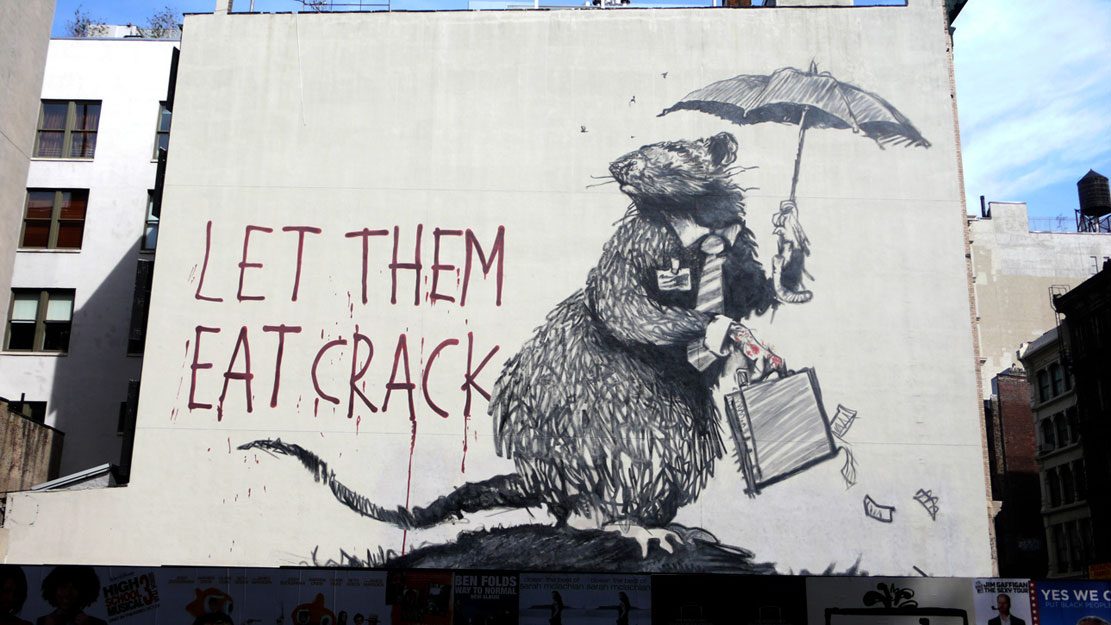
The phrase unmistakably transforms the proverbial “Let them eat cake,” traditionally attributed to Marie Antoinette as an expression of aristocratic indifference toward the poor. Banksy relocates that metaphor to contemporary New York, replacing cake with crack and aristocracy with the visual vocabulary of corporate finance. The tie, briefcase and umbrella turn the rat into a caricature of the prosperous businessman, while the red marks on the composition suggest that his apparent respectability conceals rather less respectable consequences.
The timing is essential. The mural appeared only weeks after the collapse of Lehman Brothers on 15 September 2008, at the height of the global financial crisis and amid rapidly growing public anger toward Wall Street. Contemporary commentators immediately interpreted the work in relation to the crisis. Banksy's rat is therefore quite different from his traditional marginal rodent. Here the rat has acquired a suit, money and status. It is no longer excluded from the system but appears to have prospered within it.
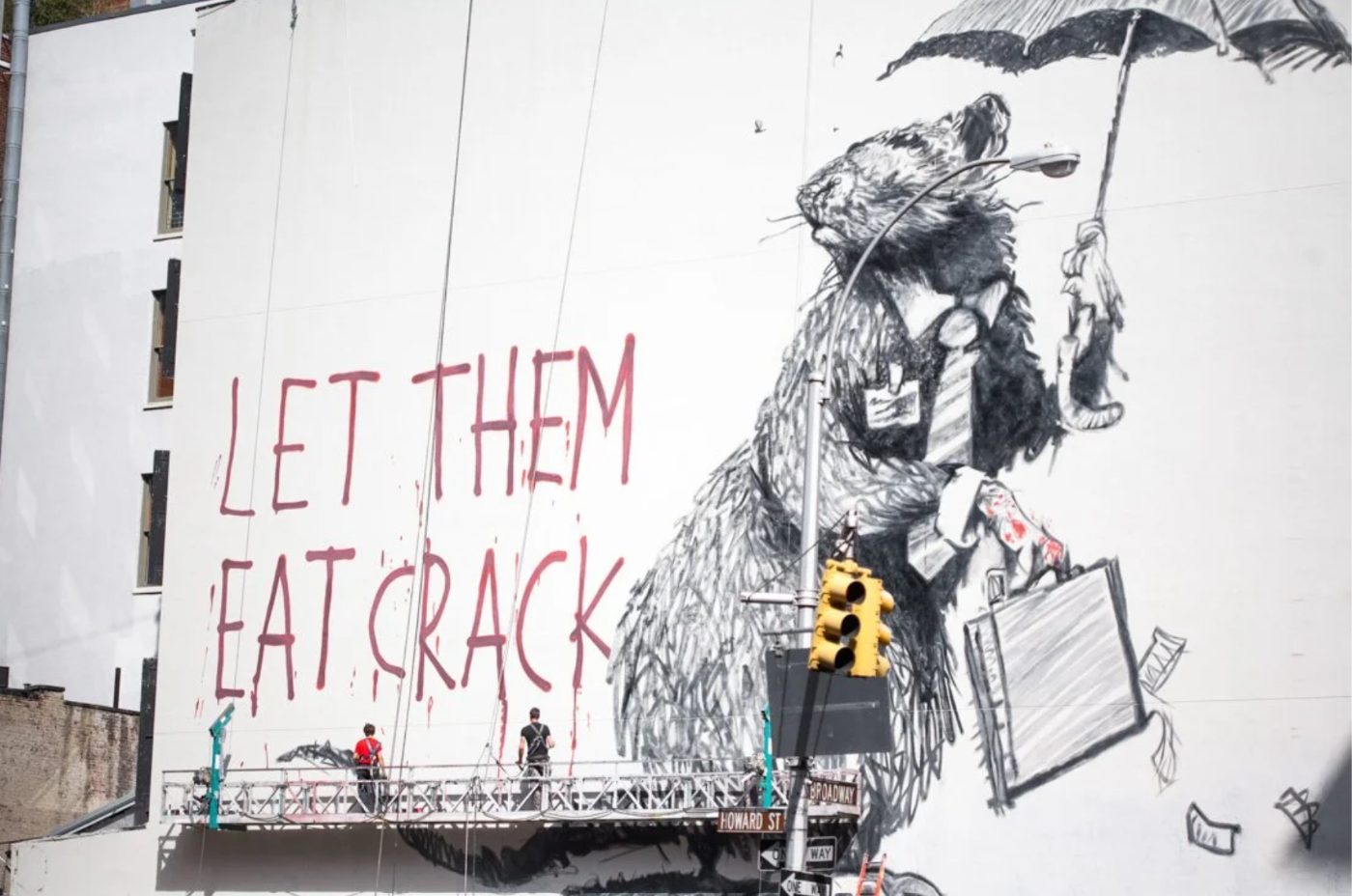
The work is among the most historically specific of the four murals. Banksy did not need to identify Wall Street explicitly; in New York in October 2008, the combination of money, corporate attire, social indifference and the phrase Let Them Eat Crack required little explanation.
Scissors Rat
Canal Street and West Broadway
The mural at Canal Street and West Broadway is perhaps the most conceptually ingenious of the series because it incorporated the process of its own production into the image. A monumental rat holds a pair of scissors and appears to cut one of the suspension lines supporting a scaffold. On that scaffold, a painter is covering the lower portion of the rat with grey paint. Contemporary descriptions explicitly recognized the joke: the rat is attempting to sever the support of the very workers who appear to be painting it out.
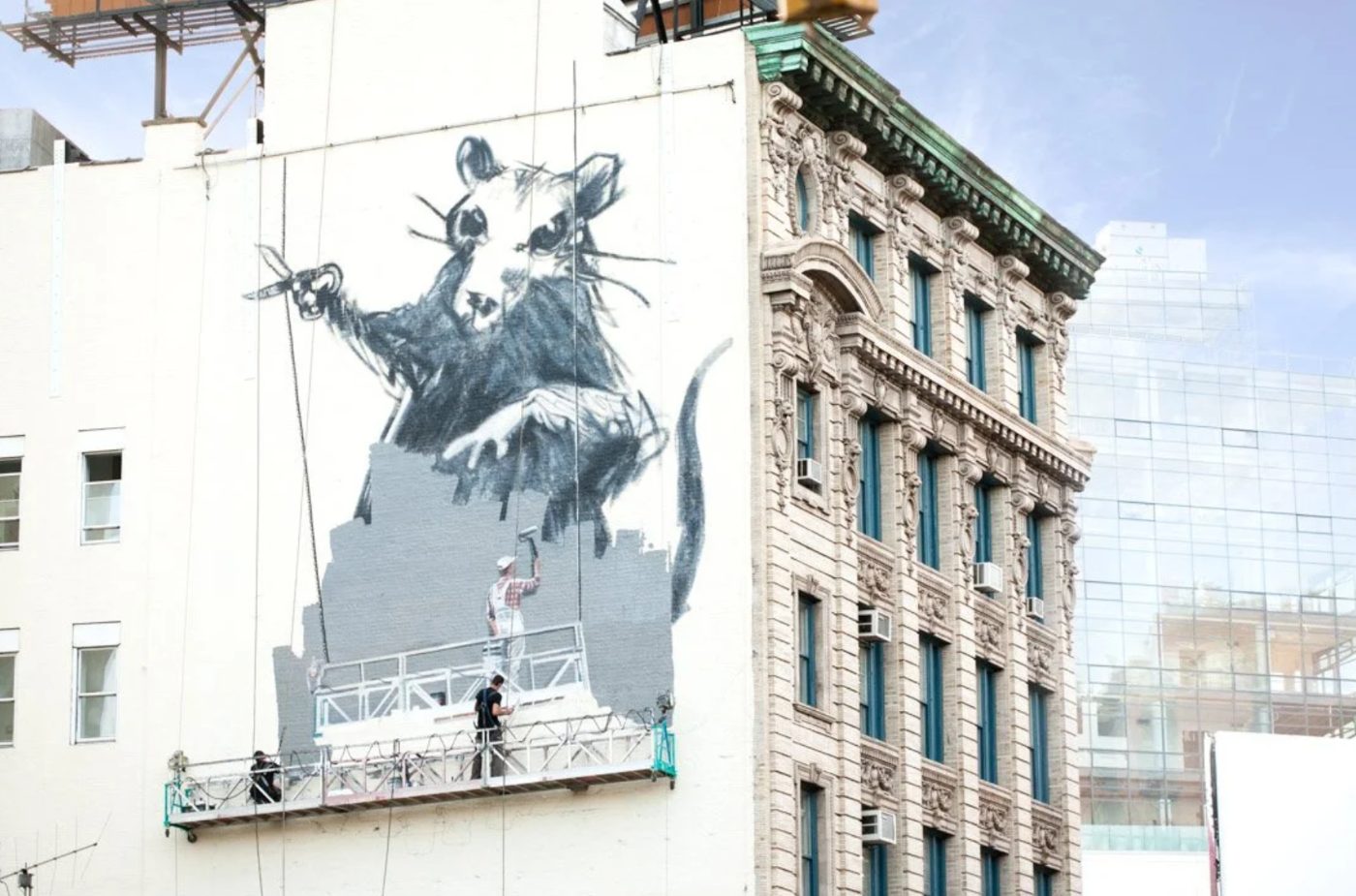
This photograph is particularly valuable because it captures the work during execution, making the relationship between painted fiction and physical reality exceptionally clear. The real Colossal Media painters occupy the suspended platform immediately beneath Banksy's enormous rat, while the painted rat appears to interfere with the ropes supporting them. The boundary between the represented scene and the actual process of creating the mural consequently becomes deliberately unstable.
This is also the work in which the paradox of the entire Legal Rats project becomes most explicit. Banksy's rats traditionally represent unauthorized occupation of urban space, while municipal workers and property owners represent the forces that remove them. Here Banksy has legally hired professional painters to reproduce an image of a rat apparently resisting the people employed to paint over it. The machinery of commercial mural production becomes part of a visual joke about the eradication of graffiti.
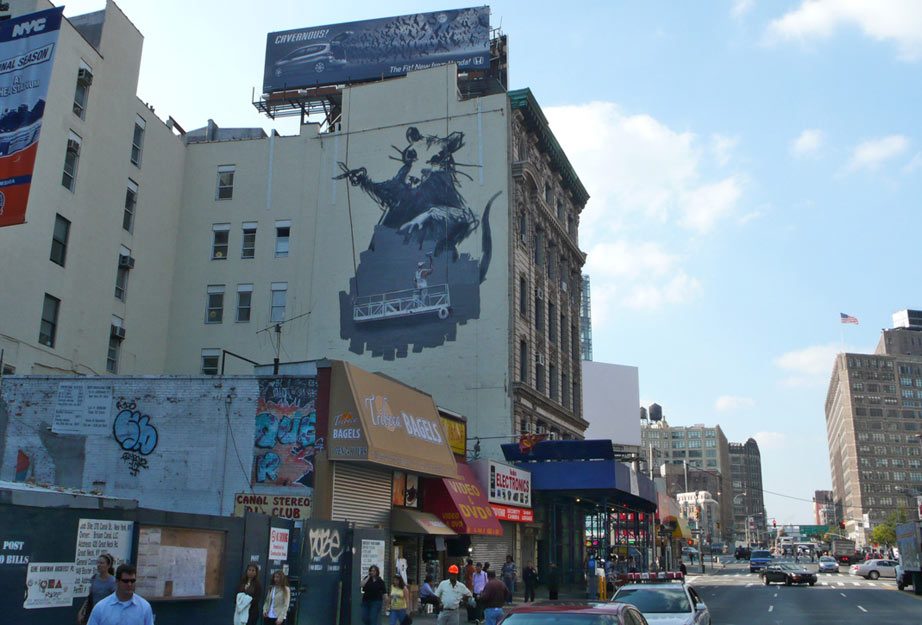
The work consequently functions almost as a commentary on its three companions. Banksy is no longer simply using a wall; he is examining the mechanisms by which images are placed upon walls, removed from them and granted or denied permission to exist.
There’s No Such Thing as Good Publicity
West Houston and MacDougal Streets
The fourth mural occupied a prominent wall at West Houston and MacDougal Streets. Here a monumental rat wielding a paint roller appears to whitewash an existing FOX advertisement, leaving fragments of the commercial imagery visible around the margins. Across the billboard Banksy added the phrase THERE'S NO SUCH THING AS GOOD PUBLICITY.
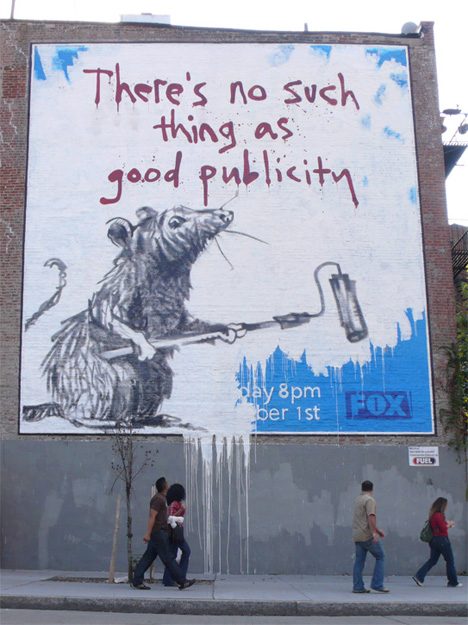
The existing advertisement is fundamental to the composition. Unlike the relatively neutral white backgrounds of the other murals, this work directly appropriated an established piece of commercial communication. The rat appears to suppress the advertisement, yet in doing so replaces it with another enormous message demanding public attention. Banksy's supposed attack upon publicity therefore becomes publicity itself.
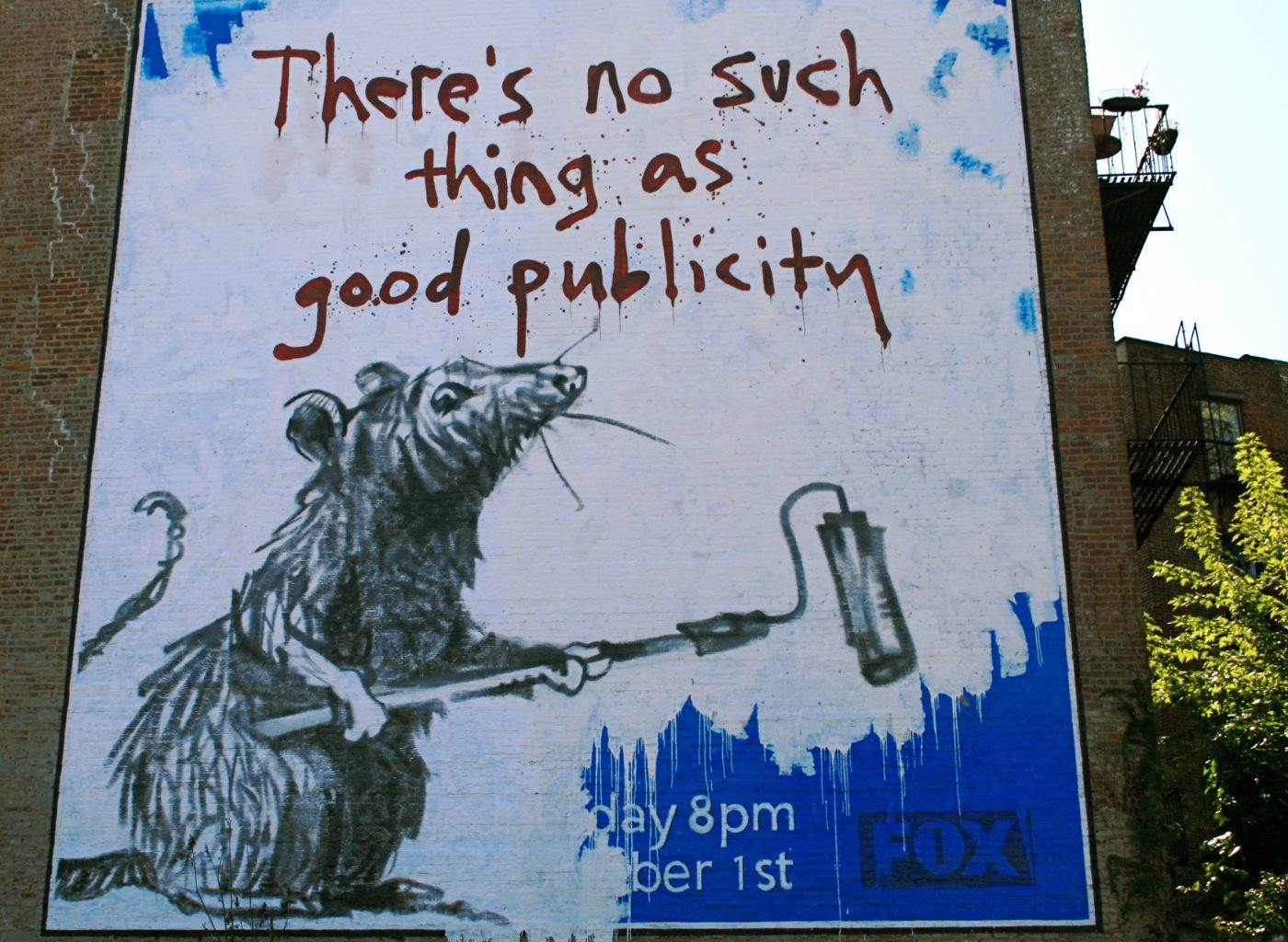
The contradiction was particularly pointed because the four murals were appearing at precisely the moment when The Village Pet Store and Charcoal Grill was opening nearby. The rat that rejects publicity simultaneously generated considerable publicity for Banksy's New York project. Rather than weakening the work, this self-implication makes it considerably more interesting. Banksy does not pretend to stand entirely outside the commercial system he criticizes; instead, he demonstrates how easily criticism itself can become another commodity competing for attention.
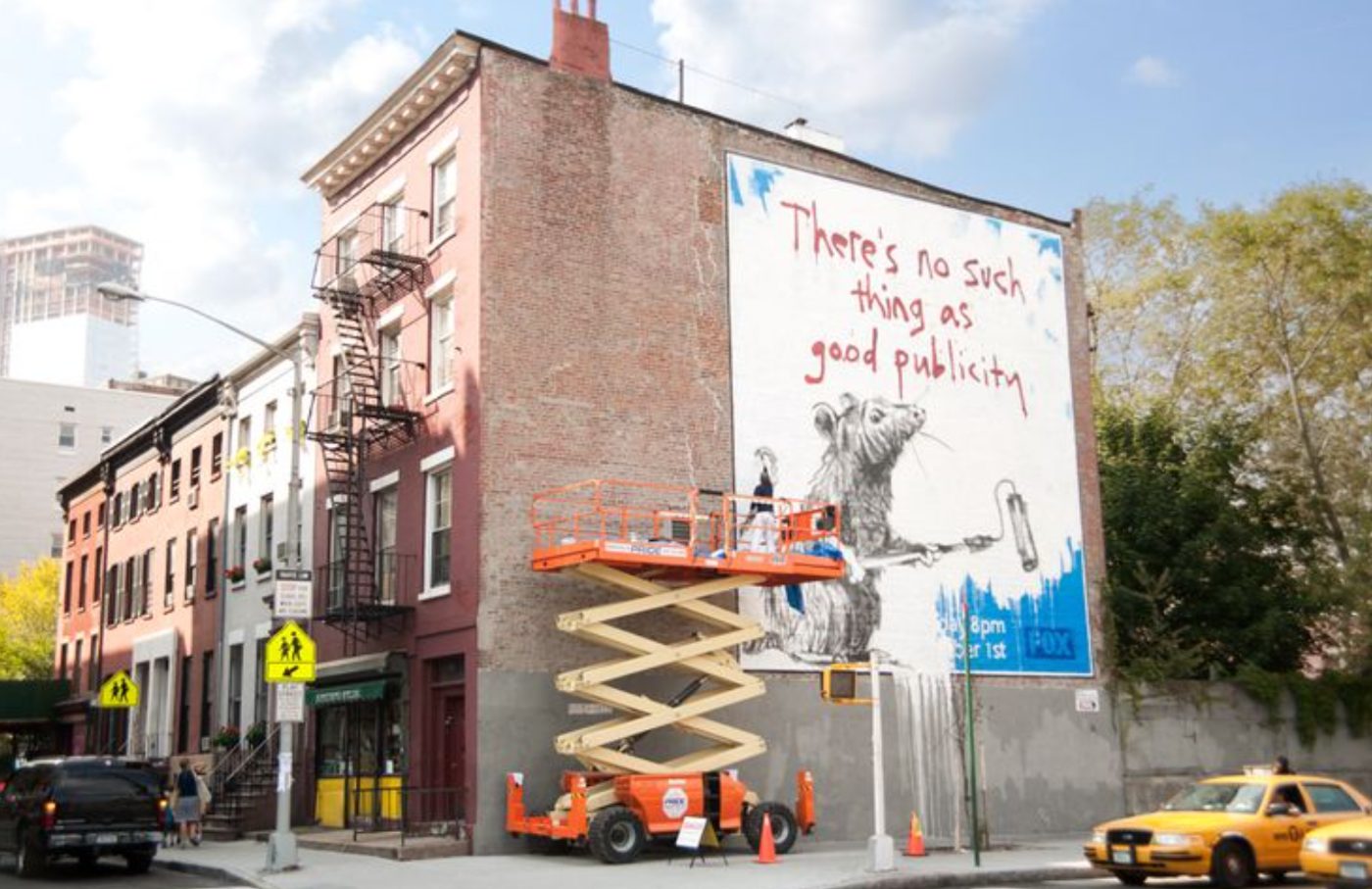
The circumstances of production sharpen the paradox further. The rat appears to be illegally defacing an advertisement, but the entire intervention had been produced through the legitimate mechanisms of the billboard industry. Banksy had effectively purchased the right to simulate vandalism. The visual language remained that of graffiti, while the economic and legal structure beneath it belonged entirely to advertising.
Banksy, New York and the Legal Rat
Taken together, the four murals constitute a particularly coherent experiment in Banksy's long engagement with public space. Since his earliest work in Bristol, the rat had functioned as an alter ego for the graffiti artist: nocturnal, unwanted, resourceful and capable of surviving despite repeated attempts at eradication. In New York, however, Banksy fundamentally altered that relationship by making the rats enormous and, more importantly, legal.
The transformation is significant. Graffiti traditionally occupies the city without purchasing permission, whereas advertising occupies vastly greater areas of the same visual environment because permission has been purchased. Banksy's Legal Rats temporarily crossed that boundary. By hiring Colossal Media and securing commercial walls, he obtained access to the same scale normally available to brands and advertisers while retaining the imagery of an outlaw practice. Colossal's own documentation now confirms that the four walls were produced simultaneously as a single 2008 project.
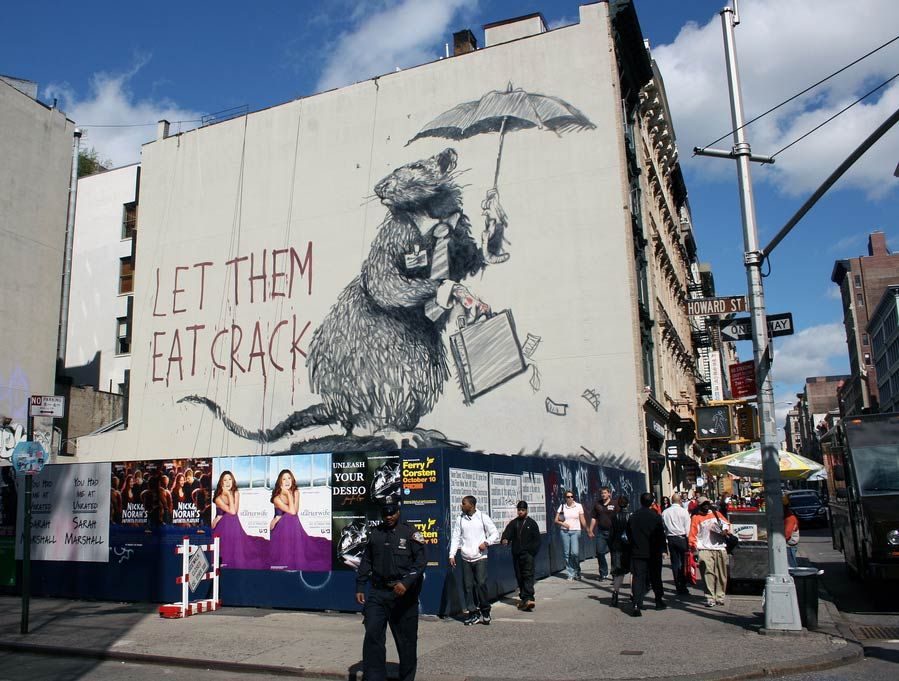
New York itself was an ideal setting for the experiment. The rat belongs as naturally to the city's cultural imagination as the skyscraper, taxi or subway, although it represents a decidedly less marketable version of urban identity. Banksy converted that unwanted resident into a monumental protagonist: one rat professes its love for New York, another resembles a financial executive, another attacks the apparatus threatening to erase it, and the last attempts to whitewash commercial publicity.
The murals also appeared at an unusually charged historical moment. In the autumn of 2008, New York was experiencing the immediate consequences of a financial crisis that called into question the authority of precisely the corporations and institutions normally capable of purchasing the city's most prominent visual spaces. Banksy responded by occupying those spaces with rats. The gesture was humorous, but its underlying argument was serious: the appearance of the city is determined not simply by what people wish to say, but by who possesses the legal and financial means to say it at scale.
The New York Legal Rats therefore represent more than an enlargement of a familiar Banksy motif. They constitute an experiment in authorship, advertising, legality and the ownership of public visual space. Banksy temporarily exchanged the clandestine stencil for the commercial billboard, but retained the outsider that had accompanied him from the beginning. For a few weeks in the autumn of 2008, New York's rats no longer needed to hide.
STAY INFORMED
Receive the latest news, exhibitions, artworks and market updates on Banksy.