VALENTINE DAY
Valentine’s Day
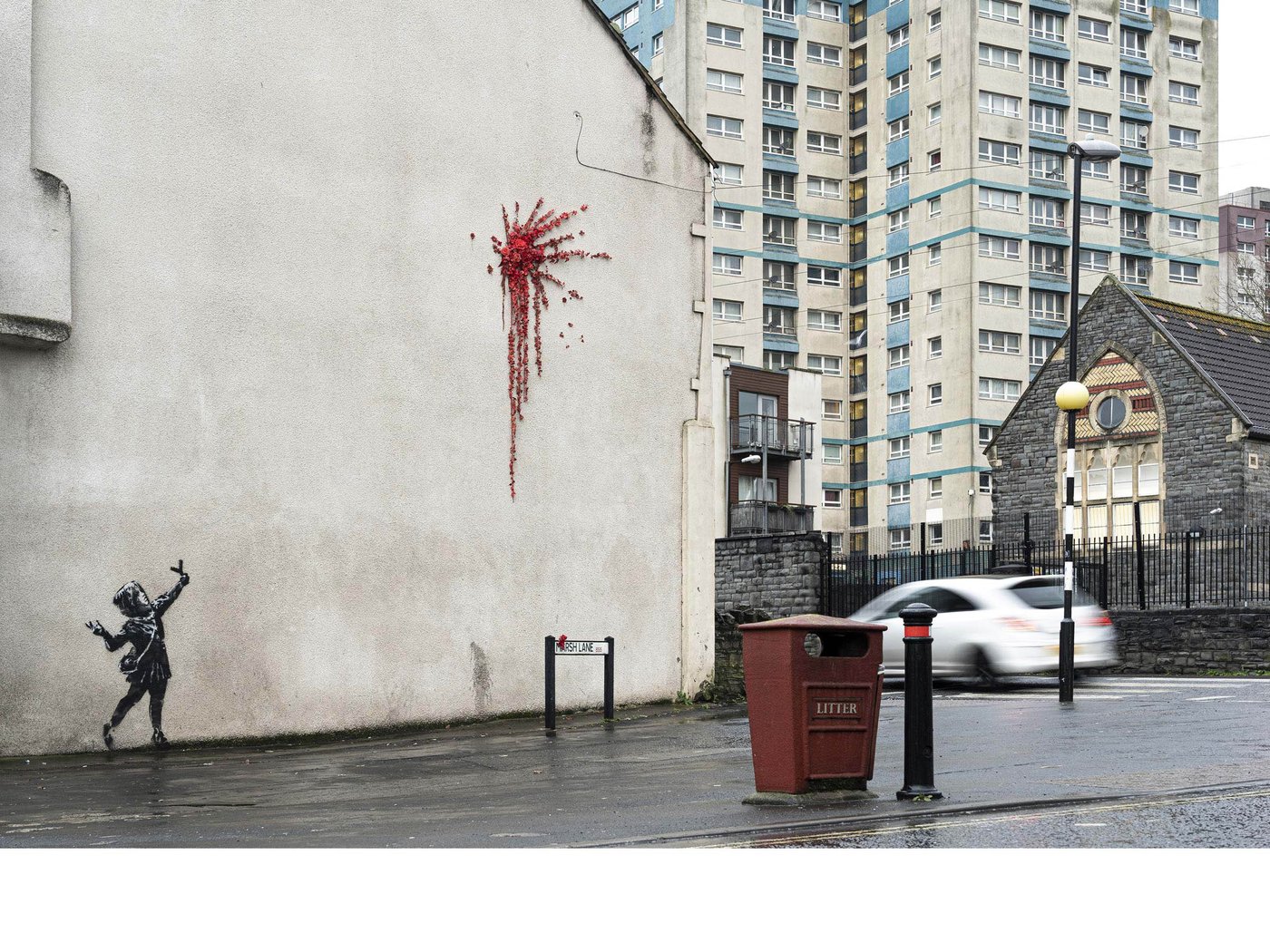
Appearing on the side of a house in Barton Hill, Bristol, on the eve of Valentine's Day 2020, Banksy's Valentine's Day depicts a young girl firing a slingshot towards an extraordinary burst of red flowers and foliage several metres above her. Residents discovered the work on the morning of 13 February, and Banksy confirmed it by publishing photographs on his website and Instagram in the early hours of 14 February. The precise site is at the junction of Marsh Lane and Avonvale Road, in an area of Bristol closely associated with Banksy's early years.
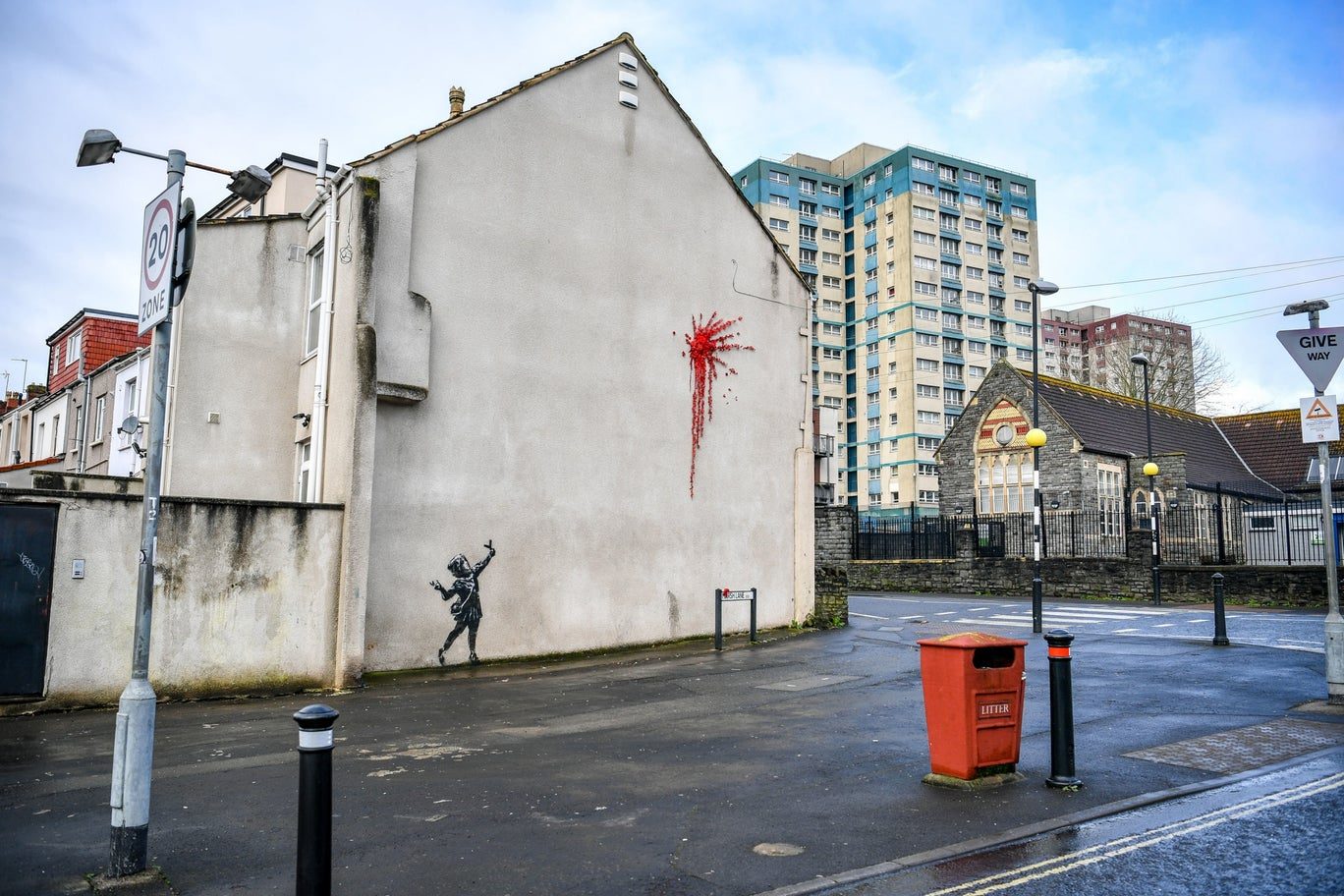
The composition is divided between two very different visual languages. The girl is rendered in Banksy's familiar black-and-white stencil, standing close to pavement level and pulling the elastic of the slingshot backwards with considerable force. High above her, the imagined projectile has apparently struck the wall and exploded into an exuberant mass of red flowers and leaves. The intense red provides the work's only substantial color and gives the impact an almost visceral quality: at first glance the floral burst resembles an explosion or splatter before resolving itself into vegetation.
The architecture is essential to the effect. Banksy separates the girl from the point of impact by a large expanse of empty wall, allowing the viewer to reconstruct the invisible trajectory between them. The blank masonry becomes pictorial space, while the real height of the building gives the girl's action an improbable force. As in Falling Shopper or Spy Booth, the mural cannot be understood entirely through the stencil itself; the wall participates in the composition.
Love as a Projectile
The image belongs to a recurring Banksy vocabulary in which objects associated with violence are unexpectedly redirected towards tenderness. Its most obvious precedent is Love Is in the Air (Flower Thrower), where the pose of a masked rioter preparing to throw a projectile culminates instead in a bouquet of flowers. Valentine's Day reverses that structure. Here the weapon is actually discharged, but what results from the impact is not destruction but an eruption of flowers.
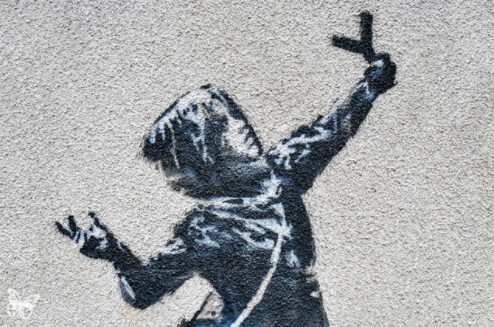
There is also an evident visual kinship with Banksy's numerous images of children, particularly Girl with Balloon. In both works, a monochrome girl is connected across an expanse of empty space to an isolated field of red. Yet their emotional dynamics are almost opposite. In Girl with Balloon, the red object appears to be escaping from the child's reach; in Valentine's Day, the girl actively creates the red event herself. She is not watching something disappear but producing something through an act of considerable physical energy.

This distinction makes the work more complex than a simple Valentine's greeting. Banksy combines the visual grammar of aggression—the weapon, the stretched elastic, the impact—with the conventional symbolism of flowers and romantic love. Violence and affection are not presented as opposites but compressed into the same gesture. The slingshot becomes a device for generating beauty.
Barton Hill and Banksy’s Return to Bristol
The location gives the mural additional significance. Barton Hill lies within the Bristol environment in which Banksy's early practice developed, and contemporary local sources noted its proximity to the youth club he had frequented when younger. By 2020 Banksy had become an international cultural phenomenon, yet this unusually optimistic work appeared not in a global art capital or at an institutional event but on the wall of an ordinary residential property in his home city.
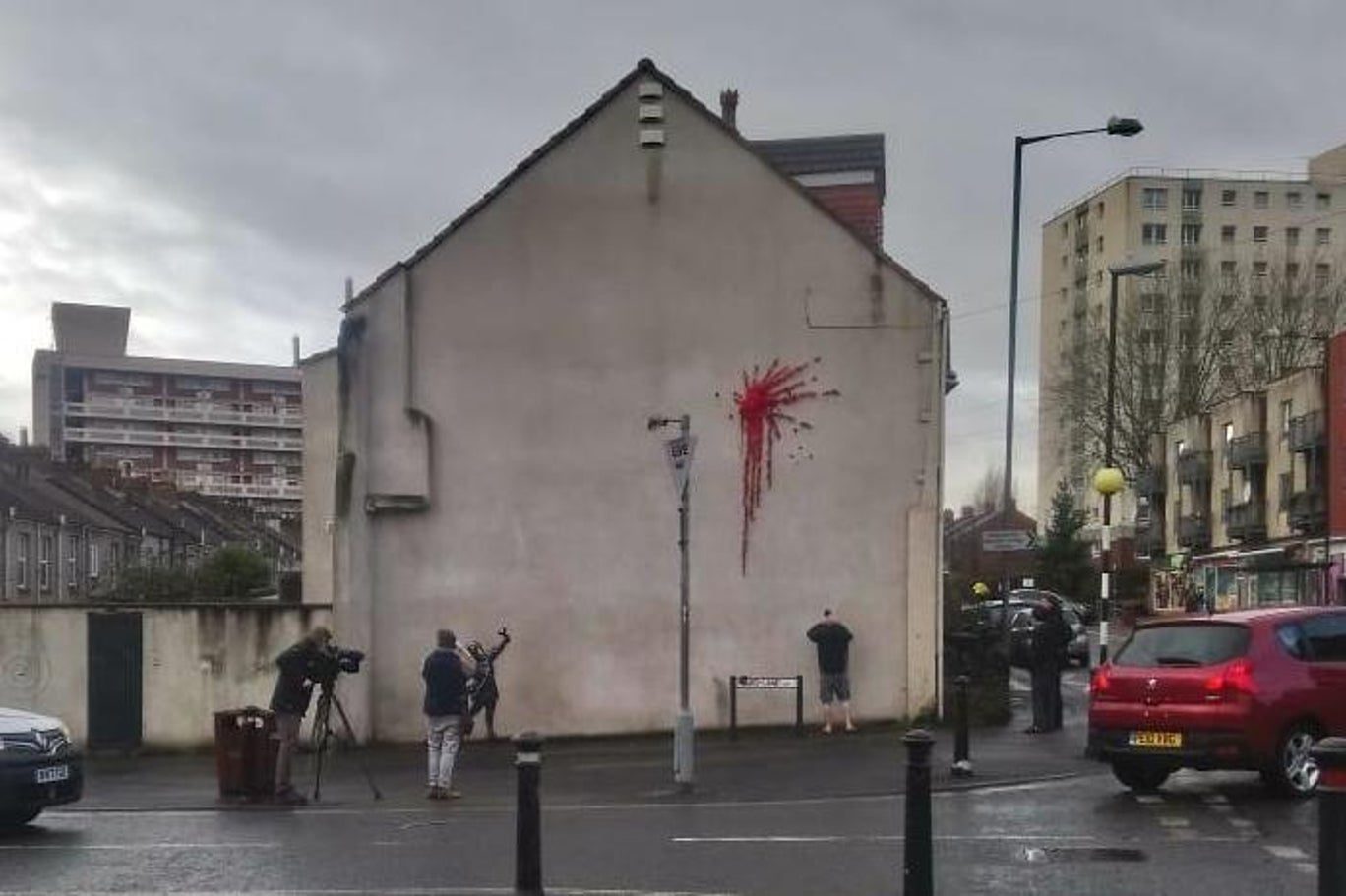
The circumstances also generated the familiar collision between street art and private ownership. The mural appeared on a rented house belonging to Edwin Simons, whose 67th birthday happened to fall on 13 February. His family initially welcomed the unexpected intervention and immediately began considering ways of protecting it, particularly with Storm Dennis approaching Bristol that weekend.
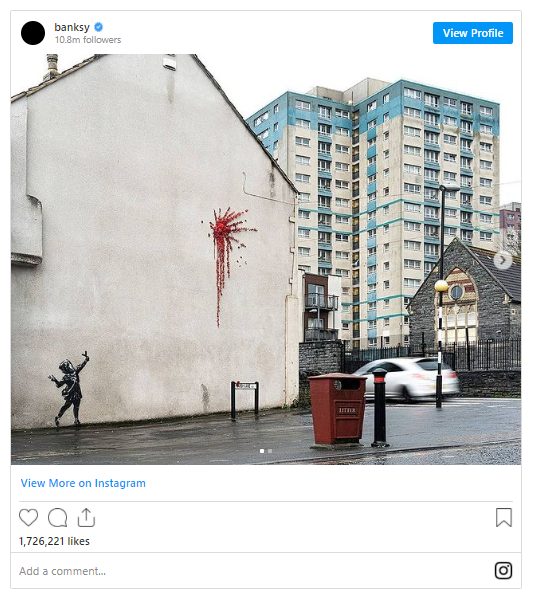
The work quickly became a local attraction, drawing visitors to Barton Hill almost immediately after its discovery. That enthusiastic reception is worth retaining in the catalogue because it illustrates the peculiar transformation in Banksy's relationship with the street. An unauthorized image that might once have been treated simply as graffiti was now being protected within hours of its appearance.
Vandalism and Banksy’s Preliminary Drawing
That protection came too late. On 15 February, barely a day after Banksy's confirmation, bright pink graffiti was sprayed across the lower part of the mural. A temporary protective sheet had also been damaged, and flowers incorporated around the site were reportedly removed. More substantial boarding, fencing and security measures followed.
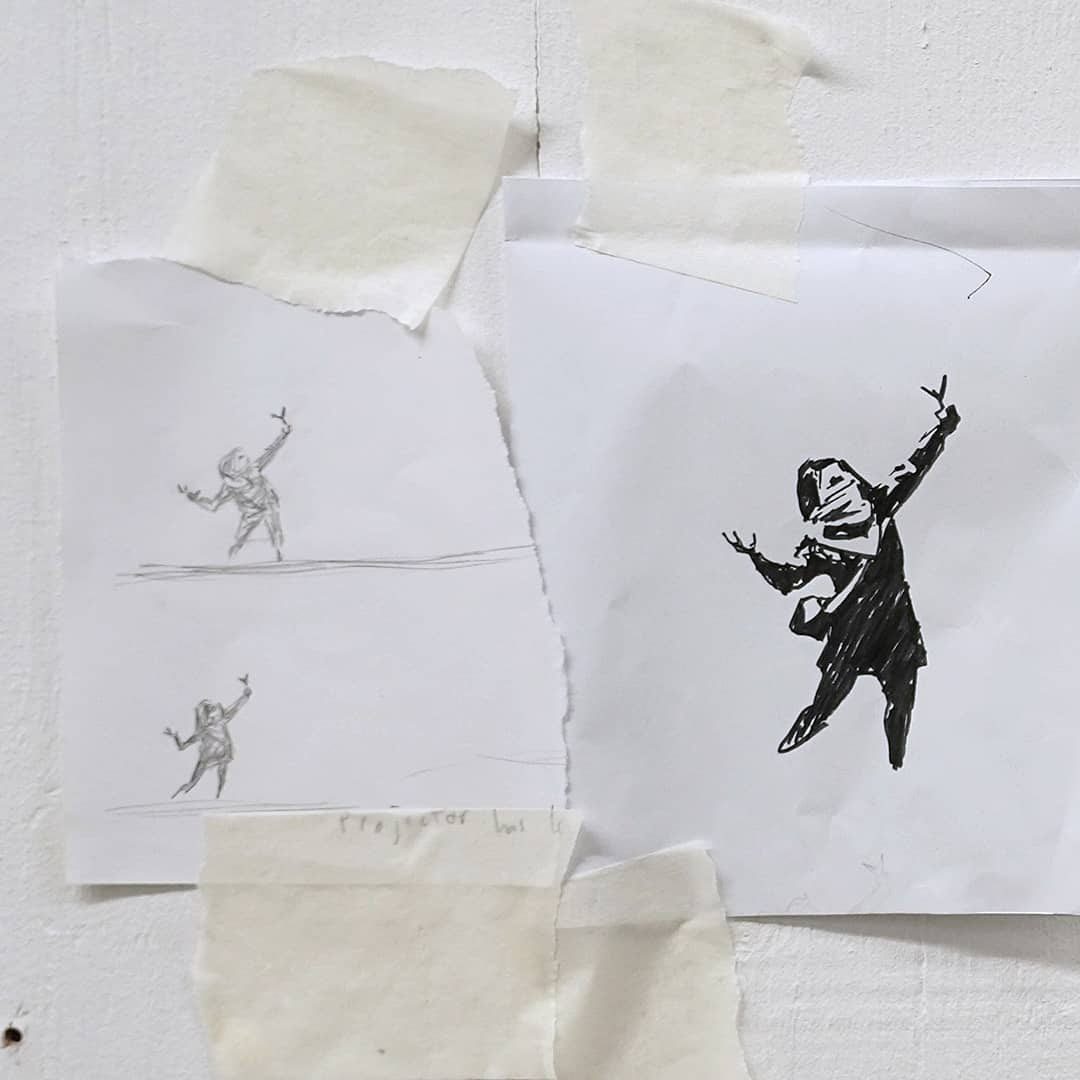
Banksy's response is an unusually important part of the work's history. Several days later he published his original preparatory sketch, accompanied by the remark that he was “kind of glad” the mural had been vandalized because the initial sketch had been better. Your existing page mentions these preliminary sketches, but I would give them considerably greater prominence because they provide rare evidence of Banksy's process and reveal that the apparently spontaneous street intervention had been carefully composed beforehand.
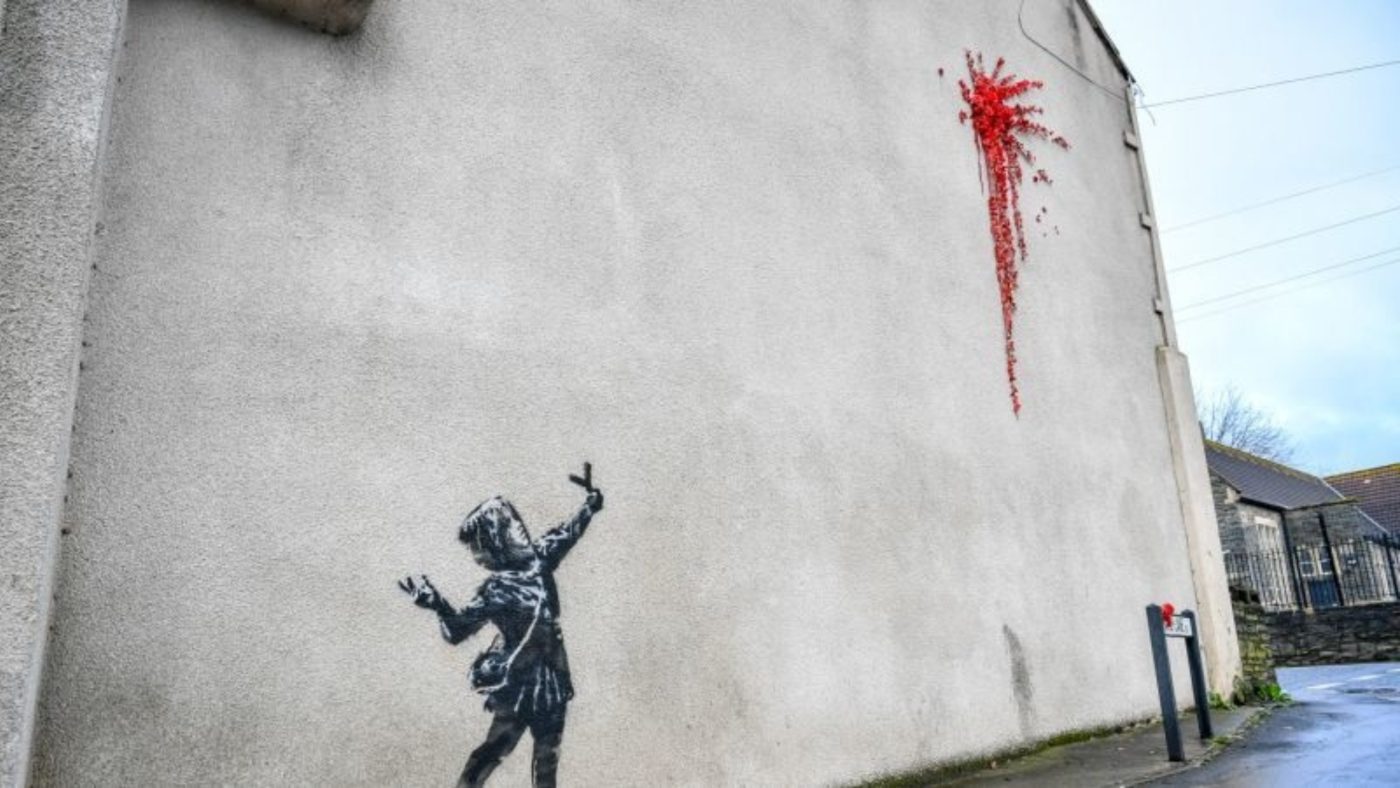
The episode also produced an unintended extension of the work's central idea. The original mural transformed an apparent act of violence into flowers; the subsequent vandalism introduced actual aggression against the image. Banksy's response was characteristically unsentimental. Rather than treating the mural as an untouchable object requiring reverence, he used its damage as an opportunity to reveal the drawing from which it had developed.
TAkeaways
Valentine's Day is particularly effective because Banksy constructs the image around a contradiction rather than a slogan. The slingshot belongs to the vocabulary of conflict, while the flowers belong to the vocabulary of affection. Neither cancels the other. The force of the girl's gesture is necessary to produce the explosion of color above her, allowing aggression itself to become the mechanism through which beauty enters the composition.
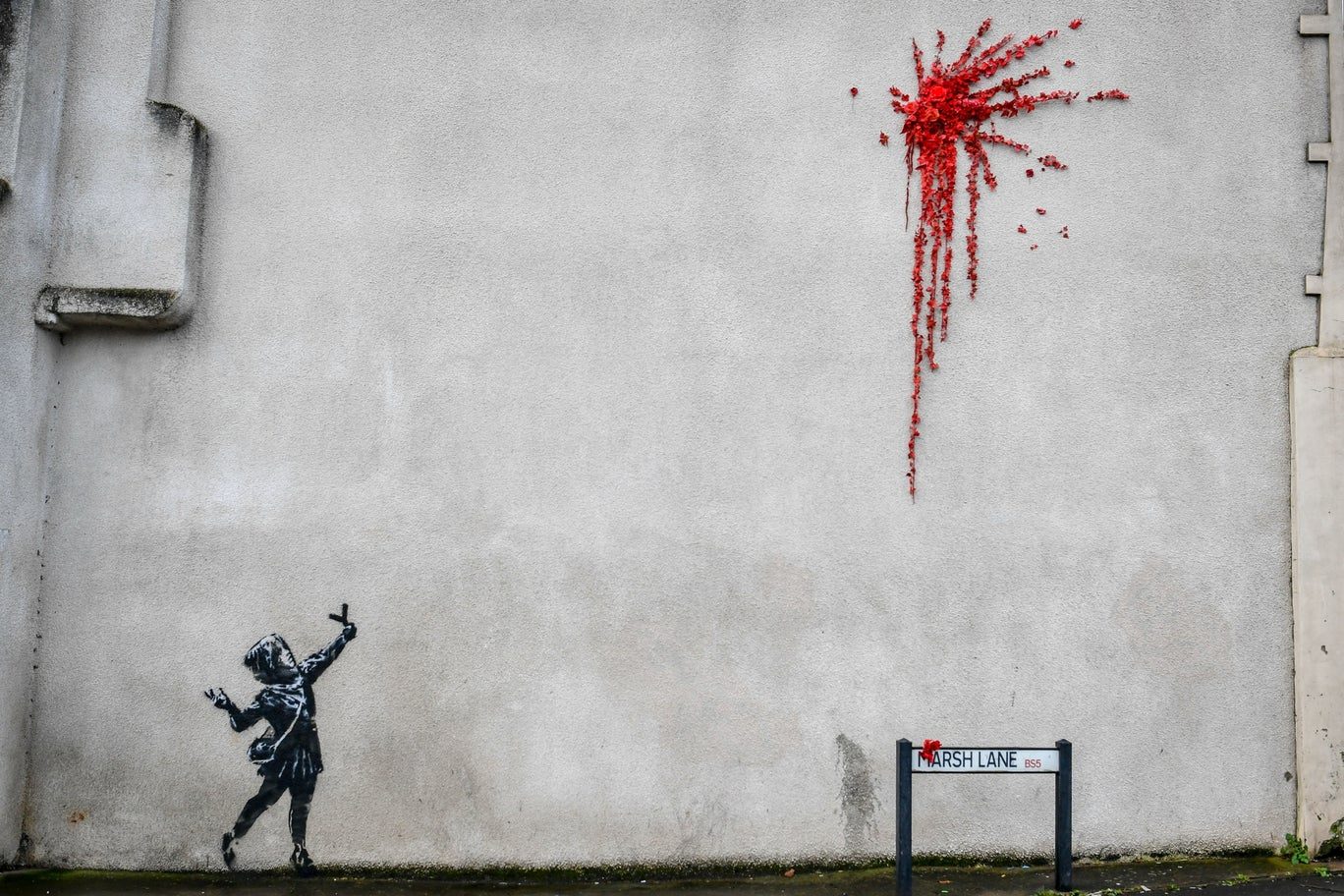
The work also forms an interesting counterpart to Love Is in the Air. In the earlier image, Banksy interrupts the anticipated act of violence by substituting flowers for the expected weapon. Nearly two decades later, Valentine's Day goes one step further: the projectile has already been released and has struck its target, yet its impact produces life rather than damage. The underlying proposition remains recognizably Banksy's, but its formulation has evolved.
STAY INFORMED
Receive the latest news, exhibitions, artworks and market updates on Banksy.