Placard Rats
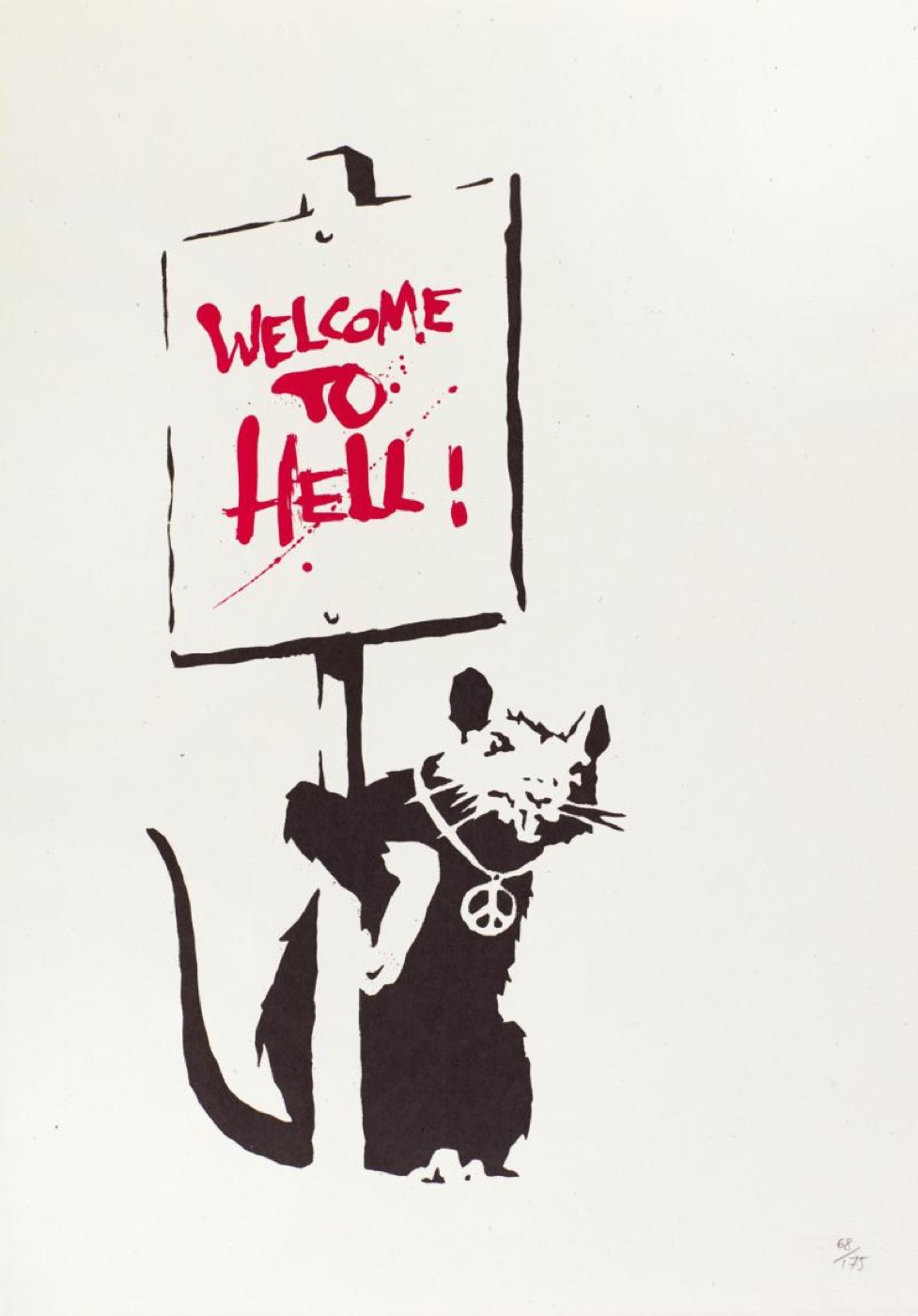
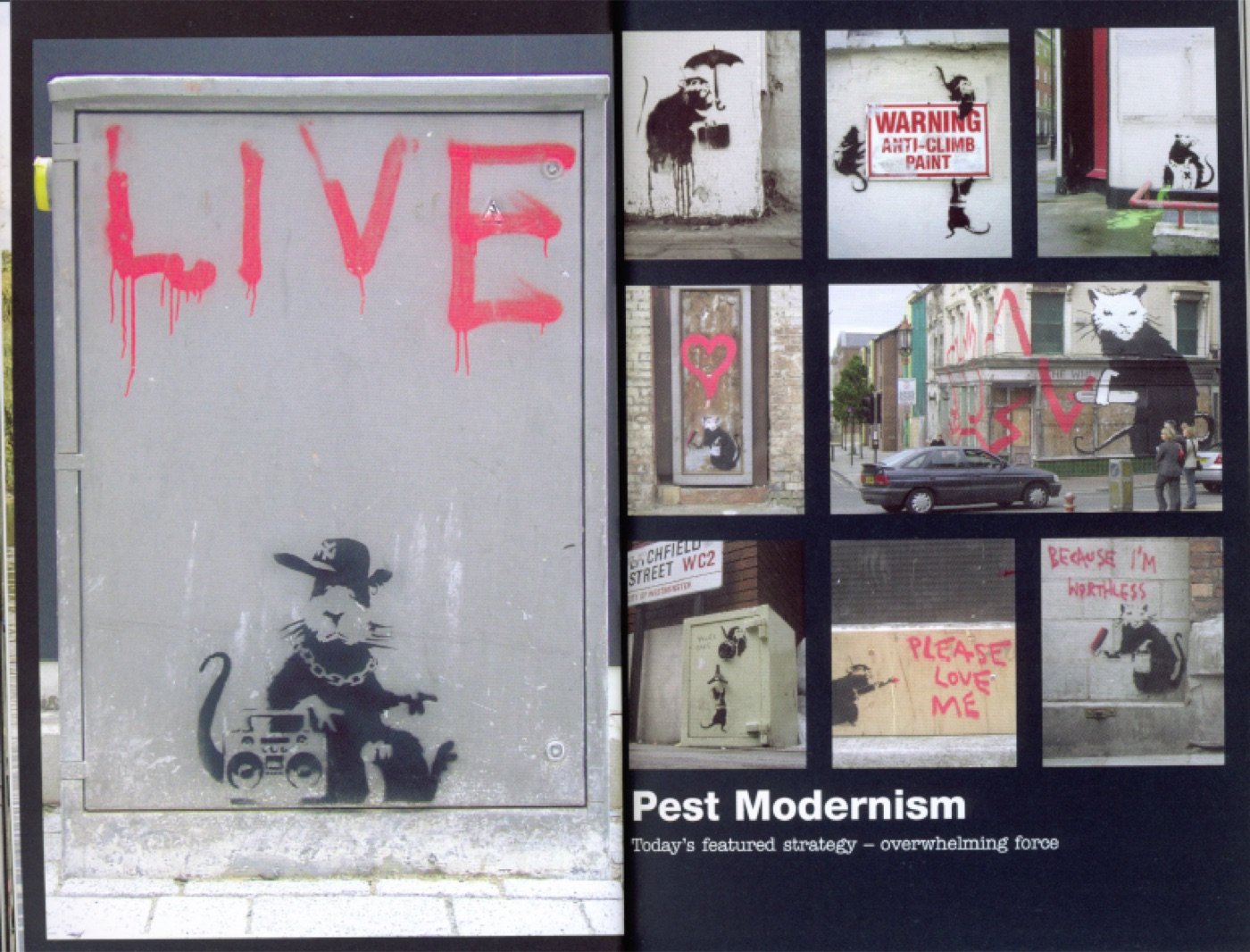
In 2004, Banksy produced one of his most concise and conceptually powerful groups of prints: the Placard Rats, published by Pictures on Walls. In this series, his now-iconic rat, long used as a symbol of marginality, survival, and quiet rebellion, stands upright holding a sign bearing a short, striking message. Drawing inspiration from George Marshall's Get Out While You Can: Escape the Rat Race, Banksy transforms the rat into both victim and messenger, giving voice to the psychological pressures and contradictions of modern urban life. With their stark visual language and razor-sharp slogans, the Placard Rats distill Banksy's practice into its purest form: immediate, ironic, and deeply unsettling.
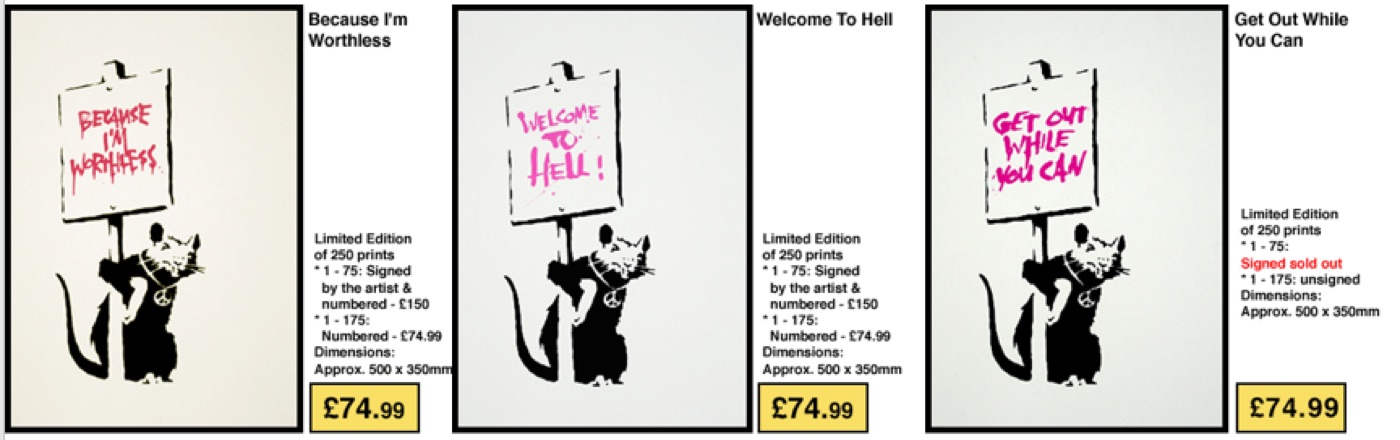
Among the three Placard Rats released in 2004, Welcome to Hell is the most direct, and the most uncompromising. If Because I'm Worthless reflects internalized judgment and Get Out While You Can introduces the possibility of escape, this final work closes the loop entirely. There is no longer any ambiguity. No escape is proposed. No condition is explained. The message is delivered as a statement of fact.
From Warning to Conclusion
As part of the series published by Pictures on Walls and conceptually linked to George Marshall's Get Out While You Can: Escape the Rat Race, this work represents the endpoint of the trajectory. The rat is no longer describing or warning: it is announcing.
The composition adheres to the now-familiar structure: a black stenciled rat, upright, holding a placard bearing the phrase “Welcome to Hell” in bold red or pink lettering. The visual language remains deliberately minimal. The rat is sharply defined, reduced to its essential contours, while the sign dominates the composition. As in the other Placard Rats, the use of color is limited but highly strategic. The red or pink text cuts through the monochrome figure with a sense of immediacy that borders on aggression. There is no narrative setting, no contextual clue. The work operates in a vacuum: one that the viewer is implicitly invited to inhabit. The greeting is addressed to no one in particular, which is precisely why it applies to everyone.
As it is often the case with Banksy, there is an inversion at the heart of the work. The phrase “Welcome to Hell” mimics the language of hospitality, welcome signs, polite greetings, the rituals of entry into a space, only to subvert it entirely. This is not an invitation. It is a realization. Banksy transforms a familiar social gesture into something deeply hostile, exposing the violence that can lie beneath systems that present themselves as normal, functional, even welcoming. The city, the workplace, the social structure, whatever “hell” represents here, is not introduced as an exception. It is presented as the default condition. One does not arrive there. One discovers that one is already inside.
The Rat as Witness
Within the logic of the Placard Rats, this figure is no longer merely symbolic. It has become a witness. The rat does not appear panicked or animated. It stands calmly, holding its sign with a kind of detached clarity. This composure is crucial. The horror of the message is not dramatized: it is normalized. Here, the rat functions as a mirror of human society, exposing its contradictions and excesses. It embodies the marginalized figure, the one who sees what others refuse to acknowledge. In this final iteration, however, it no longer attempts to persuade or warn. It simply states what is.
What makes Welcome to Hell particularly effective is its tonal precision. The phrase is extreme, almost theatrical, yet the image remains understated. There is no chaos, no flames, no visual representation of hell itself. Only a small animal holding a sign. This restraint intensifies the impact. The viewer is left to fill in the meaning, to project their own understanding of what “hell” might be: whether social, economic, political, or existential.
Banksy does not define the term. He allows it to expand. In doing so, the work moves from irony to something closer to inevitability. Within the trio of Placard Rats, Welcome to Hell functions as a conclusion. There is a progression across the series: from internalized worthlessness to the possibility of escape, to the recognition that the system itself may be inescapable. This final image does not offer resistance, nor does it suggest collapse. It offers clarity. And that clarity is precisely what makes it so unsettling. Banksy does not need to show us hell. He simply needs to suggest that we might already be living in it.
Variations
STAY INFORMED
Receive the latest news, exhibitions, artworks and market updates on Banksy.