WINDOW ON THE WEST BANK
A Room with a View
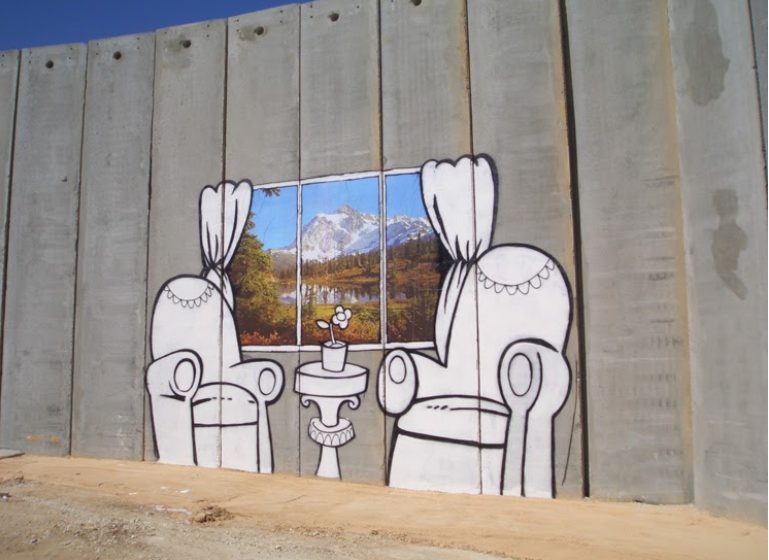
Window on the West Bank transforms a section of the concrete barrier into the wall of an imaginary room. Banksy paints an elegant window, complete with curtains drawn back on either side, opening onto an idyllic landscape of mountains, water and clear blue sky. Beneath it sit two armchairs, creating the improbable suggestion of a comfortable domestic interior in the middle of the monumental barrier.
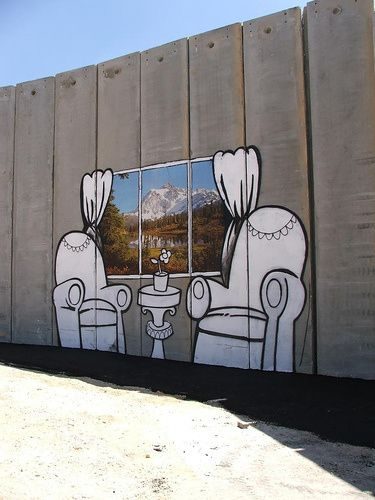
The illusion is deliberately seductive. For a moment, the heavy concrete seems to disappear and the viewer is invited to look through it toward an open landscape beyond. The furniture reinforces the fantasy: this is not merely a hole in the wall but a place from which the view might be contemplated at leisure, as though the barrier were nothing more than the wall of a living room.
The contrast with the actual surroundings could hardly be greater. Banksy borrows the visual language of comfort, domesticity and picturesque landscape and places it against a structure associated with separation and restricted movement.
The View That Cannot Be Seen
The window belongs to a long tradition in Western art in which painting itself is understood as an opening onto another world. Banksy takes that familiar idea unusually literally. His painted window promises transparency precisely where the real architecture provides opacity.
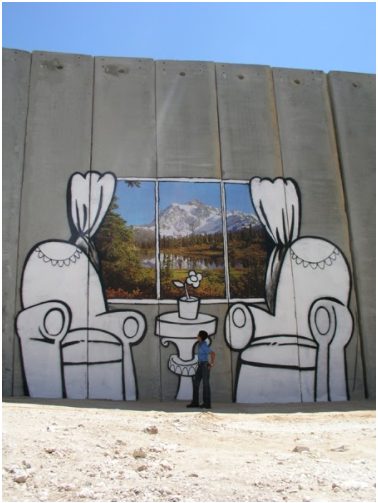
What appears beyond it is equally significant. Banksy does not reproduce the landscape actually hidden behind the barrier. Instead, he offers an idealized panorama, closer to a holiday view or romantic landscape than documentary reality. The exaggerated beauty makes the fiction immediately understandable: this is the world as the wall prevents it from being experienced.
The two armchairs deepen the irony. They suggest that the viewer might simply sit down and enjoy the scenery, yet there is no real window and therefore no real view. Comfort exists only within the painted fiction. The barrier remains physically present behind every element of the illusion.
Painting Through Concrete
Like Child Through the Wall and Beach Boys, the work belongs to a group of images in which Banksy repeatedly attacks the apparent solidity of the barrier without physically altering it. Rather than covering the concrete with an independent picture, he imagines the architecture becoming permeable.
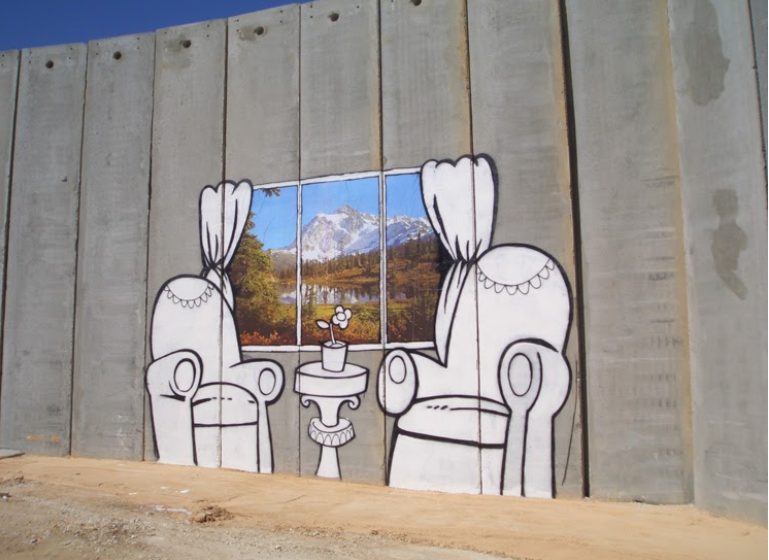
Here, however, there is no violent rupture. Child Through the Wall appears to break through the concrete; Window on the West Bank simply behaves as though the wall had always contained a window. That quietness gives the work a different character. Banksy temporarily replaces the architecture of separation with the architecture of a home.
The trompe-l'œil is therefore more than a visual joke. The real wall is indispensable to it. Its blankness, scale and impenetrability create the conditions against which the impossible window acquires its force.
Beyond the Wall
Among Banksy's 2005 Palestine works, Window on the West Bank is perhaps the most explicitly concerned with the act of looking. The viewer is offered a beautiful landscape but is simultaneously reminded that the view is fabricated. The image creates visual access where physical access remains impossible.
That contradiction runs throughout the intervention. Banksy cannot remove the wall, so he repeatedly imagines ways of seeing through it, passing through it or escaping beyond it. In Window on the West Bank, the gesture is almost architectural: concrete becomes a room, the barrier becomes a picture wall, and confinement is briefly replaced by an expansive horizon. The transformation lasts only as long as the illusion. Behind the painted window, there is still concrete.
STAY INFORMED
Receive the latest news, exhibitions, artworks and market updates on Banksy.