YELLOW LINE FLOWER PAINTER
Painting Outside the Lines
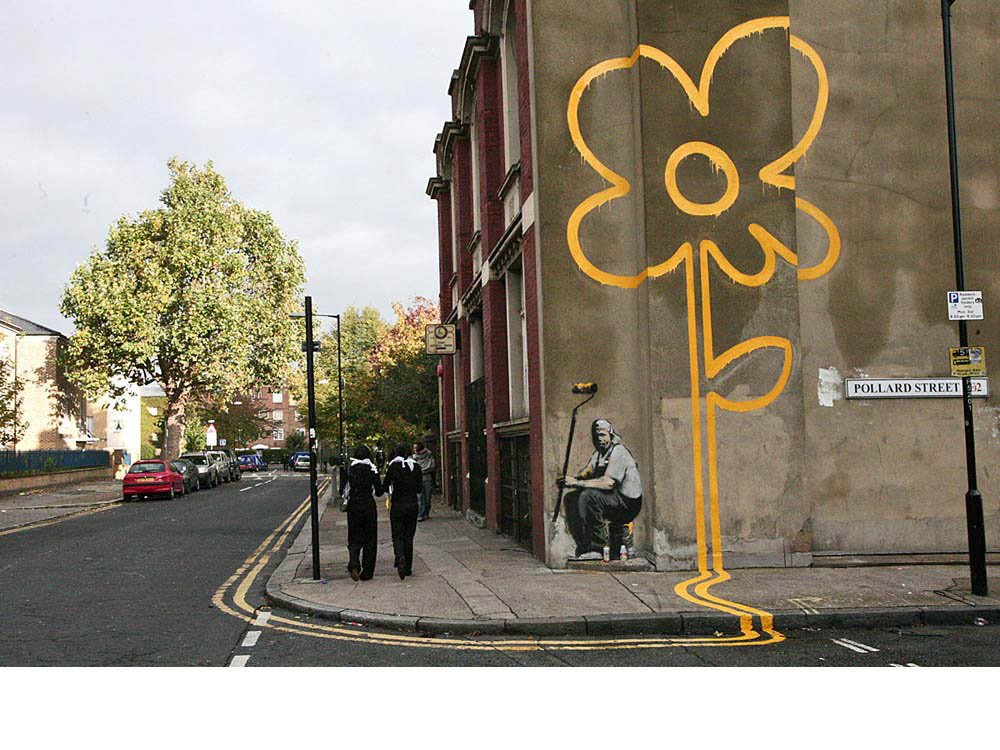
In 2007, Banksy transformed one of the most mundane elements of the London streetscape—the double yellow lines regulating where motorists may park—into an enormous flower climbing the side of a building in Bethnal Green.
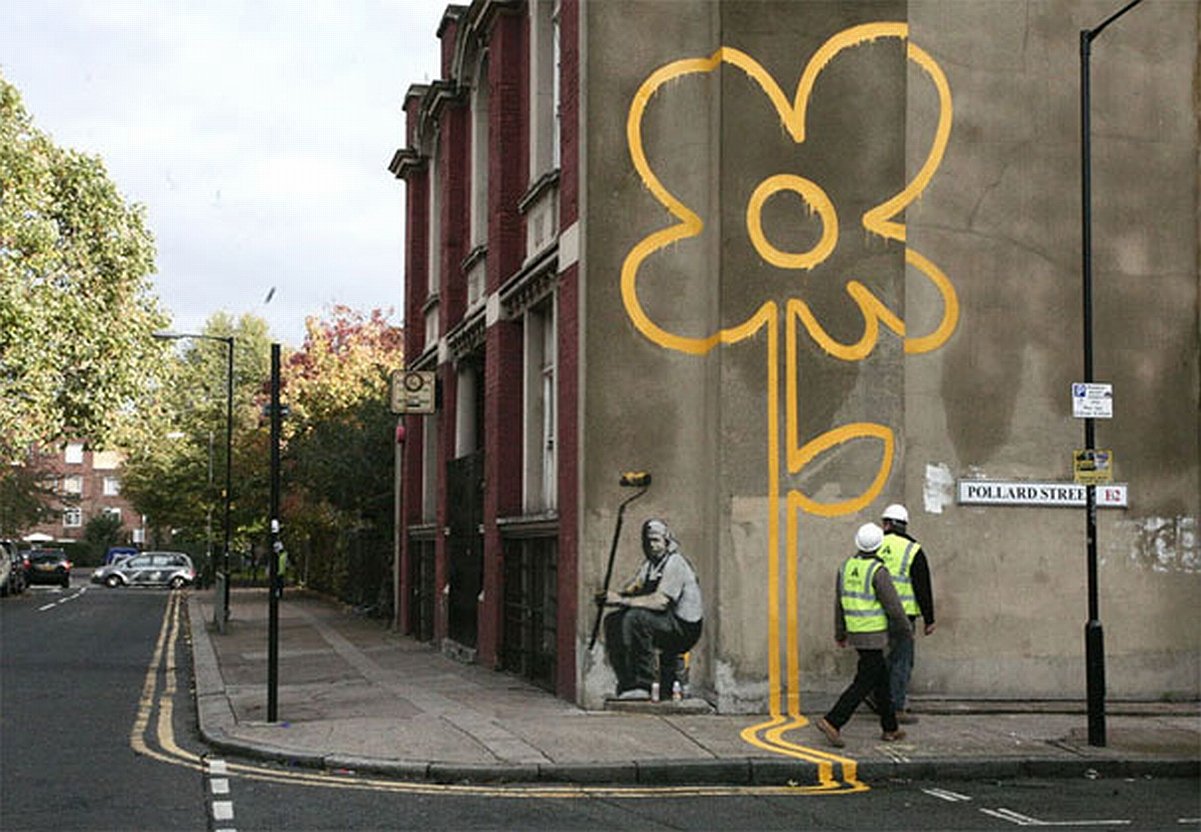
At street level, a monochrome road worker sits beside the wall holding his paint roller, apparently taking a break from his duties. Instead of obediently following the edge of the road, however, the yellow lines have escaped their prescribed route. They cross the kerb, travel over the pavement and climb vertically up the building before exploding into the outline of an enormous flower.
The illusion is wonderfully simple. Banksy does not merely paint an image on the city; he takes something that already belongs to the city's visual infrastructure and changes its purpose. A municipal marking designed to impose order becomes the stem of something exuberant and completely unnecessary.
The Road Painter
The seated worker is crucial to the joke. Dressed in overalls and rendered with the relatively naturalistic stencil technique characteristic of Banksy's figures from this period, he appears tired rather than rebellious. His roller rests beside him as he surveys what he has apparently just created.
That makes the transformation more amusing. The person employed to maintain the rules of the street has quietly abandoned his instructions and become an artist.
Banksy repeatedly gives anonymous workers unexpected creative agency. Policemen kiss, soldiers paint peace signs, cleaners lift the surface of walls, and here a road painter allows a regulated yellow line to escape its function entirely. The figure remains recognizably a worker, but for a moment his labor is no longer useful in the conventional sense. It has become imaginative.
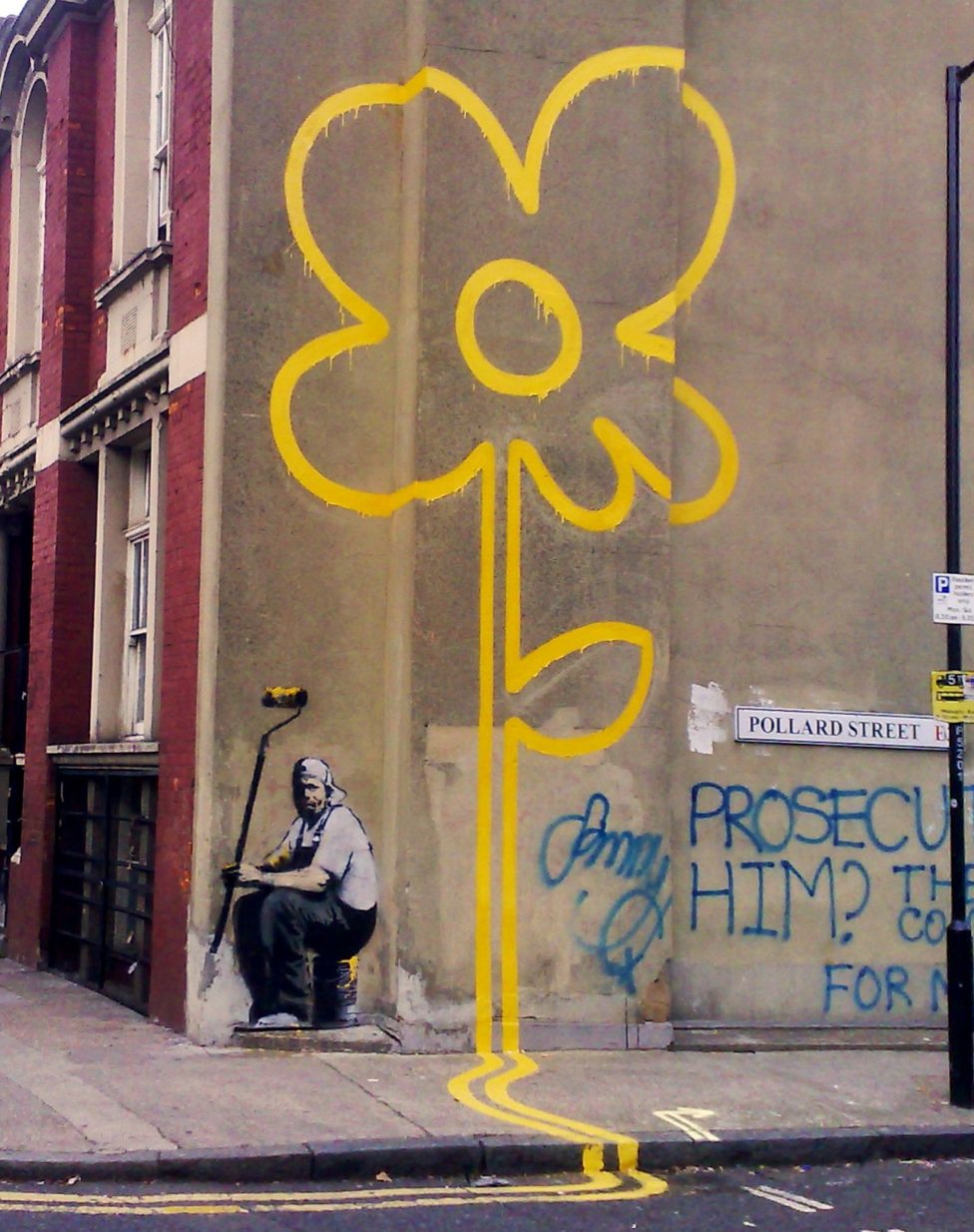
There is also a lovely contrast between the two forms of painting. The worker is an intricate black-and-white stencil, carefully constructed from light and shadow; the flower is deliberately crude, almost childlike, consisting of little more than a thick yellow outline. The sophisticated image depicts the person who has supposedly created the primitive one.
From Regulation to Imagination
The double yellow line is an unusually good Banksy material because its meaning is so rigid. In Britain it is not decoration. It is a legal instruction.
Banksy changes none of its essential visual characteristics. The color remains the familiar traffic yellow and the line initially follows the street exactly as expected. The transformation occurs only when it refuses to remain where it belongs.
That movement gives the work its broader resonance. Yellow Lines Flower Painter can easily be read as a celebration of imagination escaping regulation: the straight line becomes organic, municipal order becomes individual expression, and something designed to tell us what not to do unexpectedly produces something beautiful.
But Banksy wisely avoids writing the message down. There is no slogan explaining that creativity requires breaking rules. The visual joke does the work. It is quite literally about painting outside the lines.
A Work Made from the Street
The original setting is particularly important. The yellow stem did not merely imitate road markings—it physically connected with the actual double yellow lines running along Pollard Street. Contemporary photographs show the line turning away from the road, crossing the pavement and continuing directly into the enormous flower.
This makes the work fundamentally site-specific. Remove the road and pavement and the composition loses its beginning. Remove the wall and it loses its conclusion.
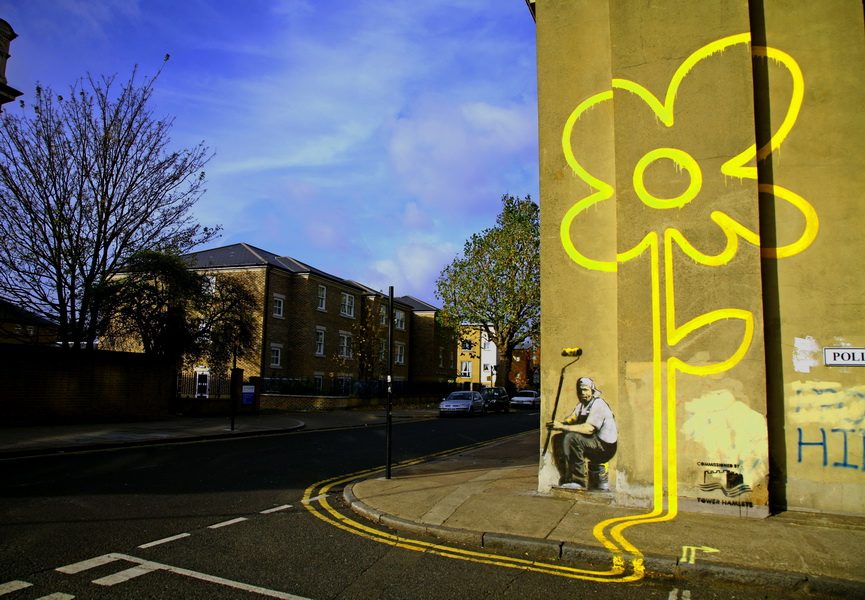
The authorities subsequently removed the yellow paint that Banksy had extended across the pavement while the portions painted on private property were allowed to remain.
The result was almost inadvertently conceptual. The city restored the regulated yellow lines to their proper function while severing Banksy's imaginative extension from them. The flower remained standing on the wall, but its roots had effectively been cut.
Unlike many Banksy murals that disappeared suddenly beneath a coat of paint or during redevelopment, Yellow Lines Flower Painter has experienced a much slower deterioration.
A Slowly Disappearing Banksy
Historical records provide an unusually useful chronology. By July 2008, tagging had begun to obscure the painter and the yellow connection between road and wall had been removed. By May 2009, further graffiti had been placed directly over the worker's face. In February 2010, part of the wall around his arm had been removed, and subsequent damage to the protective Perspex made the figure increasingly difficult to see. By 2014 the painter was described as barely visible, although the enormous yellow flower remained recognizable.
That deterioration has altered the balance of the composition. Originally, the eye could follow a complete narrative: road markings become stem, stem becomes flower, and the seated painter explains the impossible transformation. Today much of that visual sentence has disappeared.
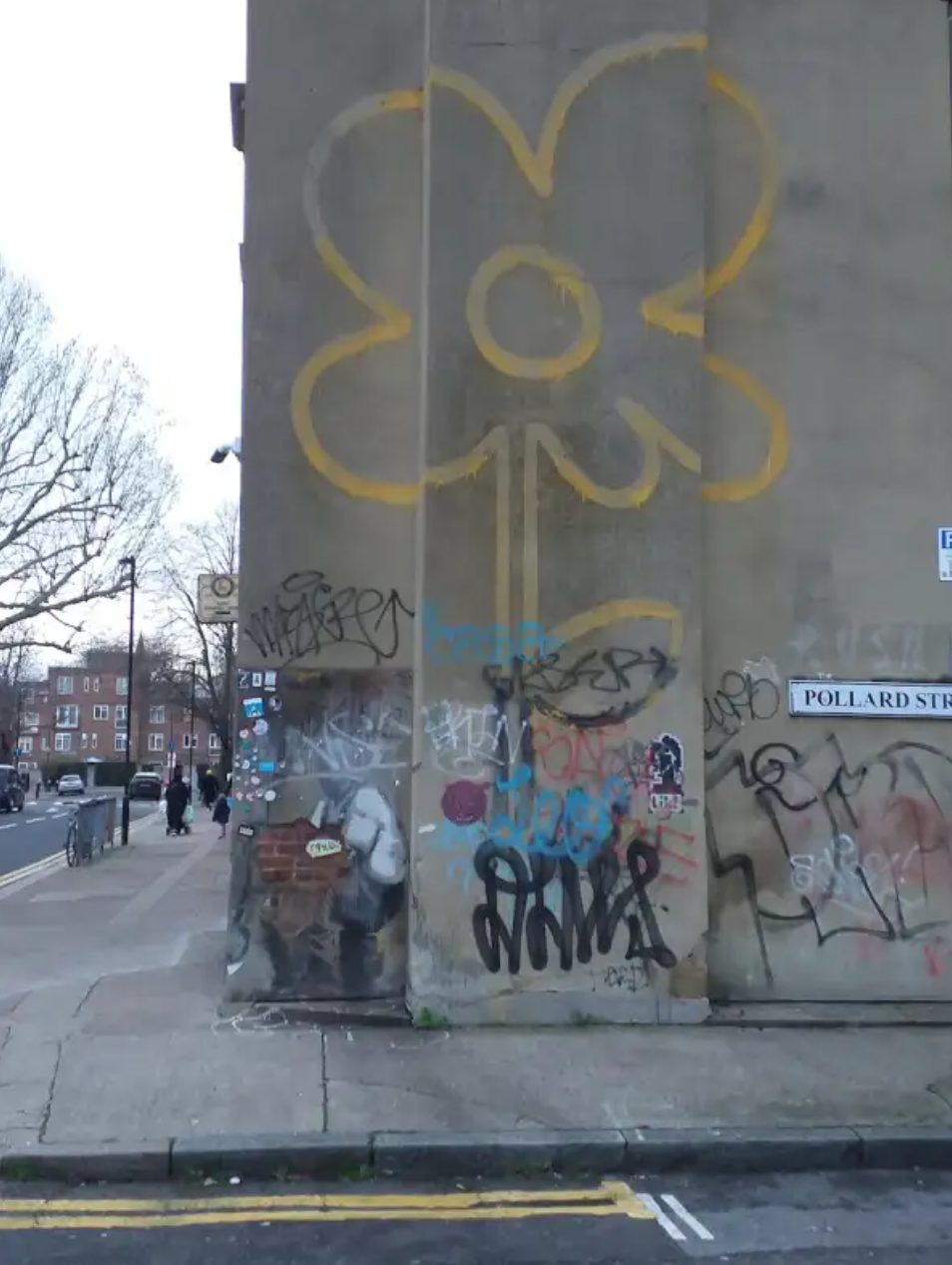
Yet the flower has proved remarkably persistent. Recent documentation continues to identify its remnants at the Pollard Street location, although the surrounding work is heavily compromised.
Yellow Lines Flower Painter is a particularly pure example of Banksy's ability to look at the ordinary infrastructure of a city and see something that apparently nobody else has noticed.
The work's message is therefore almost embarrassingly simple—and perhaps better for it: sometimes the most interesting thing you can do with a straight line is refuse to keep it straight.
The double yellow line is simultaneously material, subject and idea. It represents regulation, but it also provides the physical line from which Banksy's flower grows. The anonymous worker who should maintain that regulation becomes responsible for disrupting it, while the wall that should mark the boundary between road and private property becomes the place where his imagination finally blooms.
It is difficult not to see something of Banksy's own practice in the road painter. Both begin with the functional surfaces of the city, both possess paint and a wall, and both occasionally decide that the line does not have to go where somebody else has told them it should.
STAY INFORMED
Receive the latest news, exhibitions, artworks and market updates on Banksy.