ZERO INTEREST IN PEOPLE
Zero Percent Interest
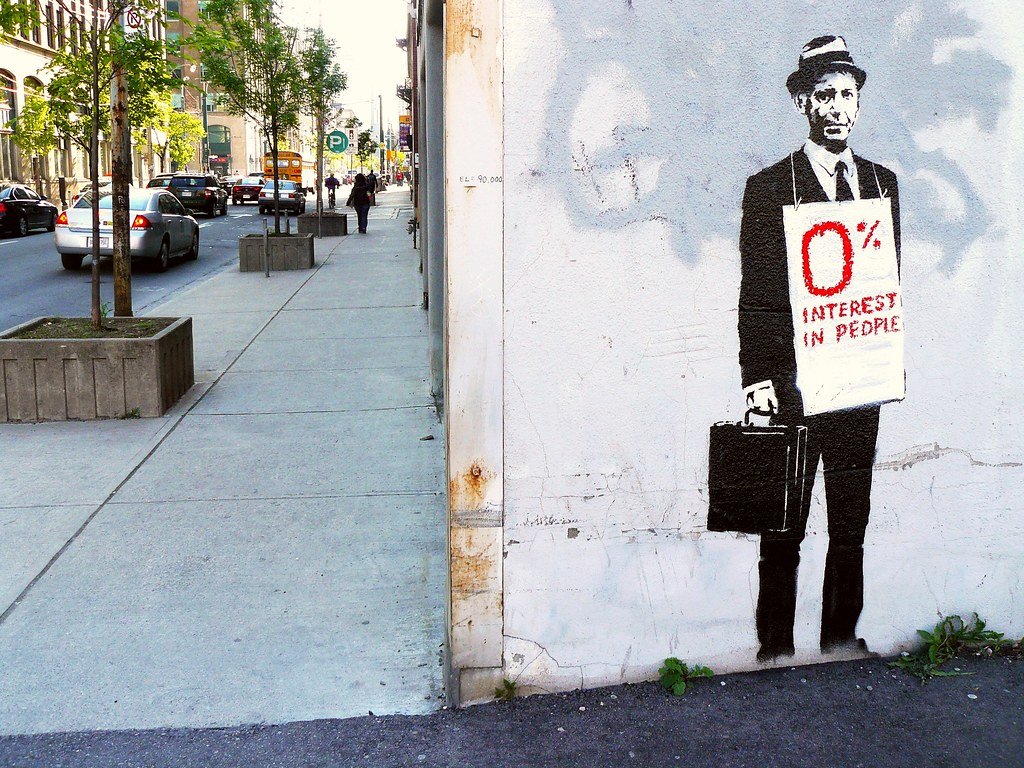
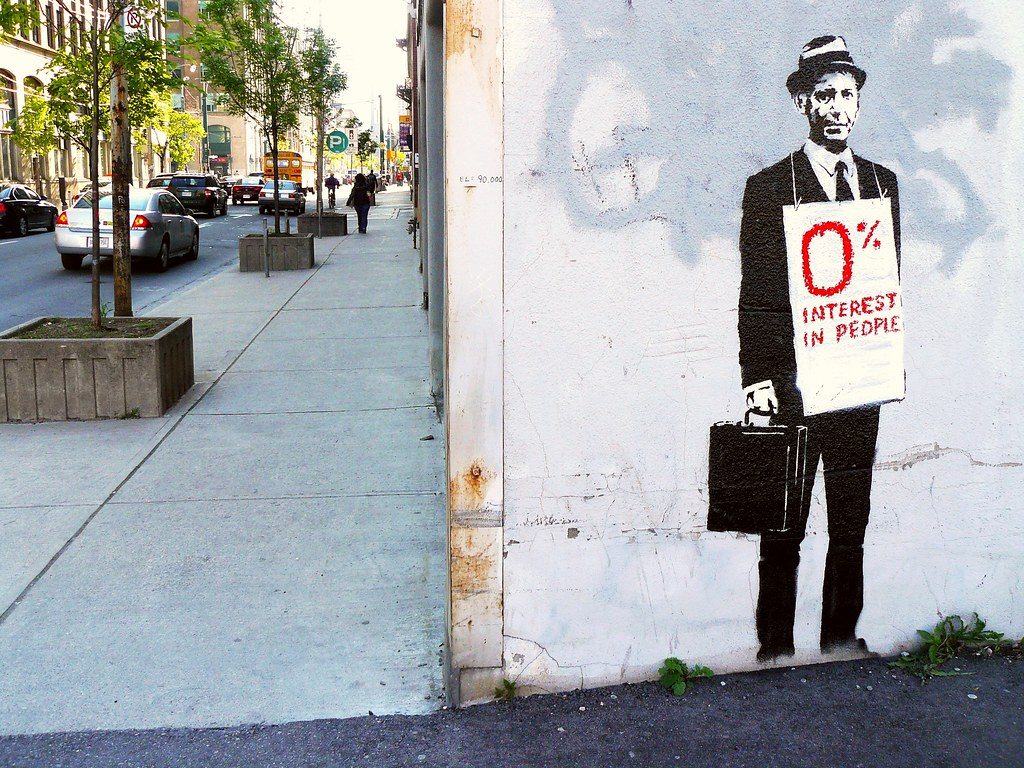
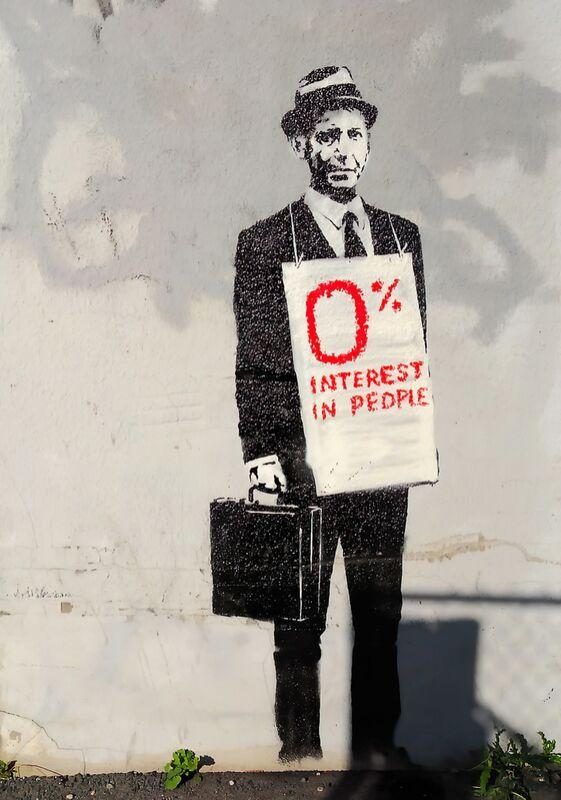
During Banksy’s visit to Toronto in May 2010, a number of new works appeared across the city. Among the most pointed was Zero Interest in People, painted on the exterior of a clothing store. The mural depicts a solitary businessman or salesman in a hat and overcoat, carrying a briefcase in one hand while holding a large placard in the other. The sign reads: 0% INTEREST IN PEOPLE
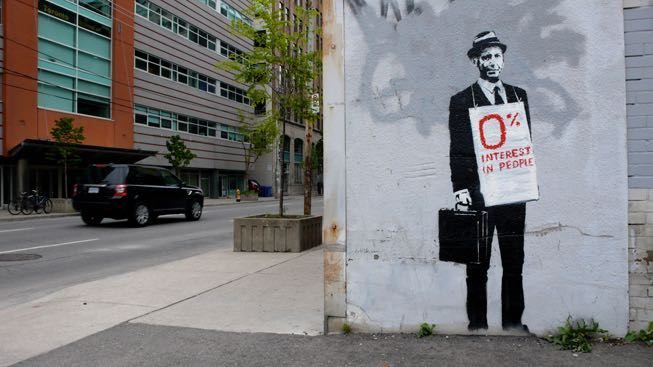
The composition is deliberately austere. The anonymous businessman is rendered almost entirely in black and white, while the language of the placard provides the work with its meaning. Banksy borrows the vocabulary of financial advertising—particularly the familiar promise of “0% interest” used to market loans, credit cards and consumer purchases—and changes only its object. Instead of offering zero interest on money, the figure announces his lack of interest in other human beings. The work is documented as one of Banksy’s Toronto interventions of May 2010.
Finance Without Humanity
The timing sharpened the joke. Zero Interest in People appeared less than two years after the 2008 global financial crisis, when interest rates, bank rescues, household debt and the consequences of financial speculation remained central to public debate. The Bank of Canada had kept its key policy rate at exceptionally low levels through much of the aftermath of the crisis, making the language of “zero interest” particularly recognizable.
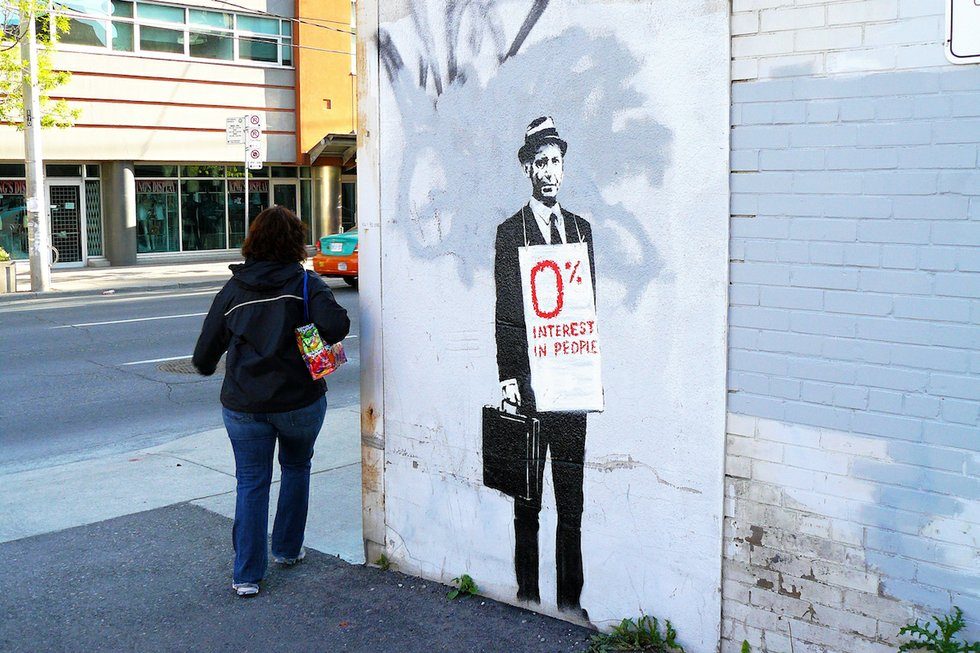
Banksy converts that technical financial expression into a judgment about priorities. The businessman is not portrayed as overtly villainous; he is ordinary, respectable and almost deliberately generic. His briefcase and advertising placard identify him with commerce, while the slogan suggests a system capable of assigning precise values to money while failing to value the people living within it.
This distinction is important. The mural works less as an attack on one banker or corporation than as a compact satire of economic thinking detached from human consequences. Money attracts interest; people do not. The wordplay reduces a much larger criticism of capitalism and consumer culture to four words.
Banksy in Toronto
The mural formed part of a small concentration of Banksy works that appeared in Toronto during May 2010, including Security Guard with Koons Dog and other interventions. The visit belonged to a broader North American period surrounding the release of Exit Through the Gift Shop, during which Banksy left works in cities including Los Angeles, San Francisco, Boston and Toronto.
As elsewhere, the Toronto works responded to the ordinary surfaces and visual language of the city rather than behaving like conventional public commissions. In Zero Interest in People, Banksy appropriated not only a wall but the language of advertising itself. The figure resembles someone who might ordinarily stand outside a shop promoting a sale or financial offer; only the wording turns the commercial message against the culture that produced it.
The mural was short-lived. Contemporary documentation indicates that employees of the store painted over it only a few days after it appeared. Its disappearance reproduced a familiar pattern in Banksy’s street practice: before authorship and value could transform an unauthorized stencil into something worth protecting, it could still be treated simply as graffiti.
Zero Interest in People remains one of Banksy’s most economical uses of language. By changing the object of a familiar financial promise, he turns an attractive commercial proposition—0% interest—into an indictment of a society in which economic value can appear to matter more than human value.
STAY INFORMED
Receive the latest news, exhibitions, artworks and market updates on Banksy.