CATALOGUE NOTE
The Great Escape
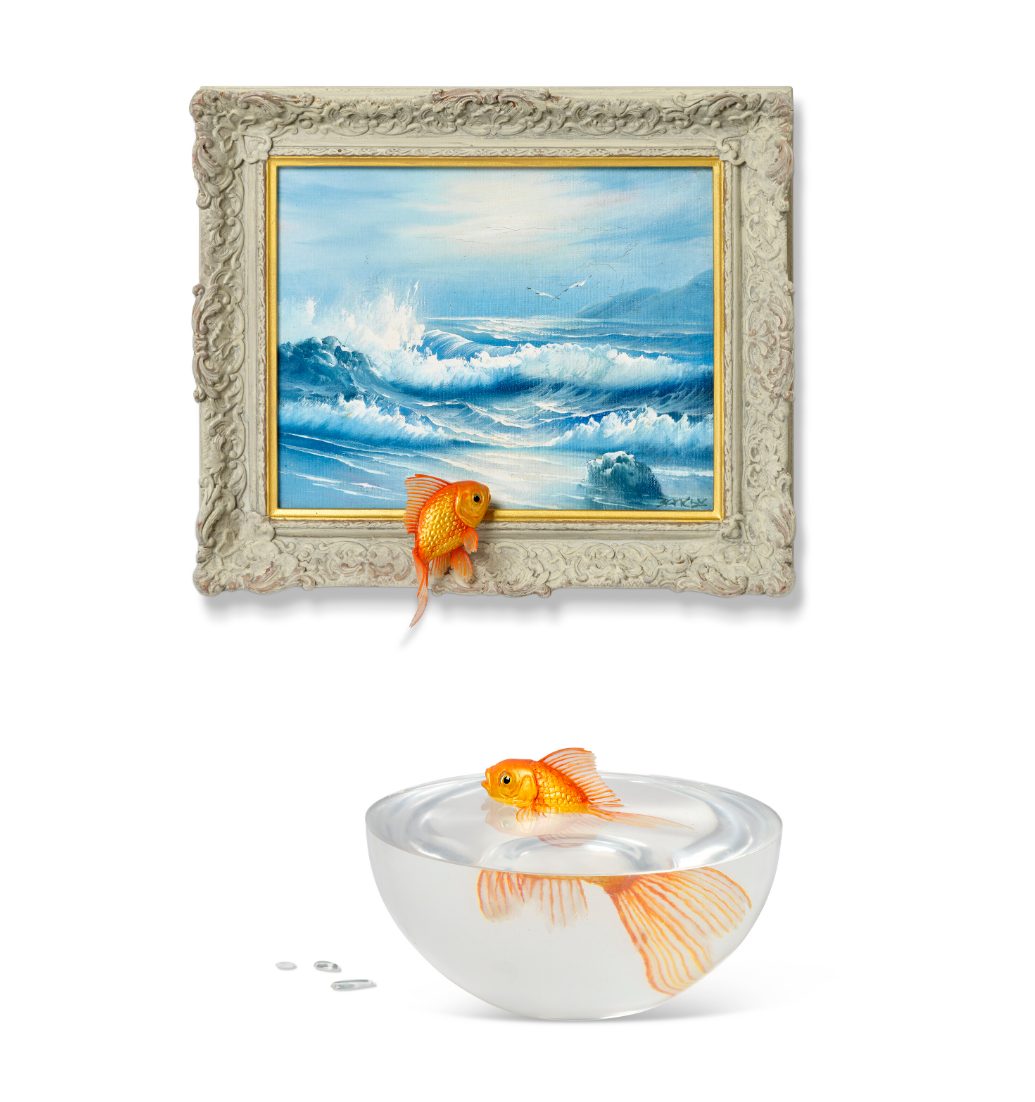
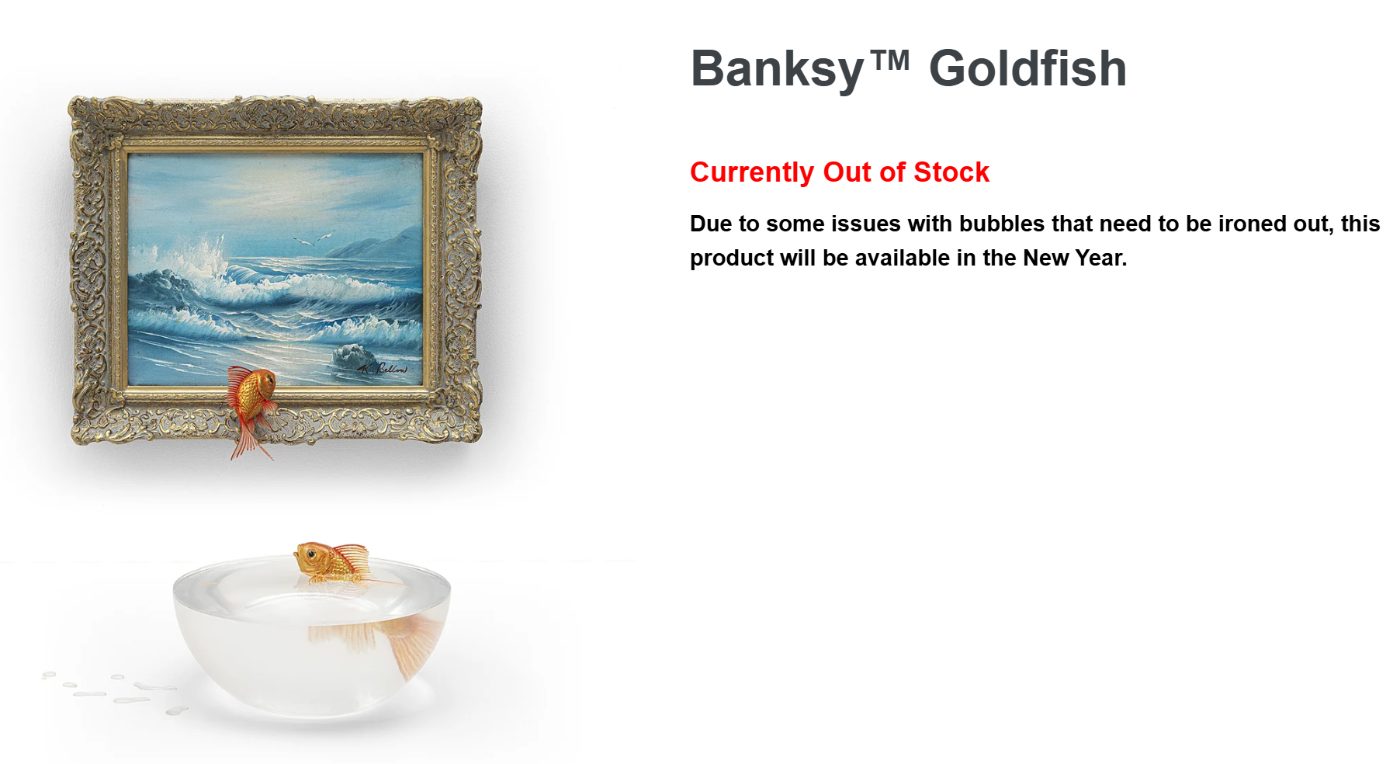
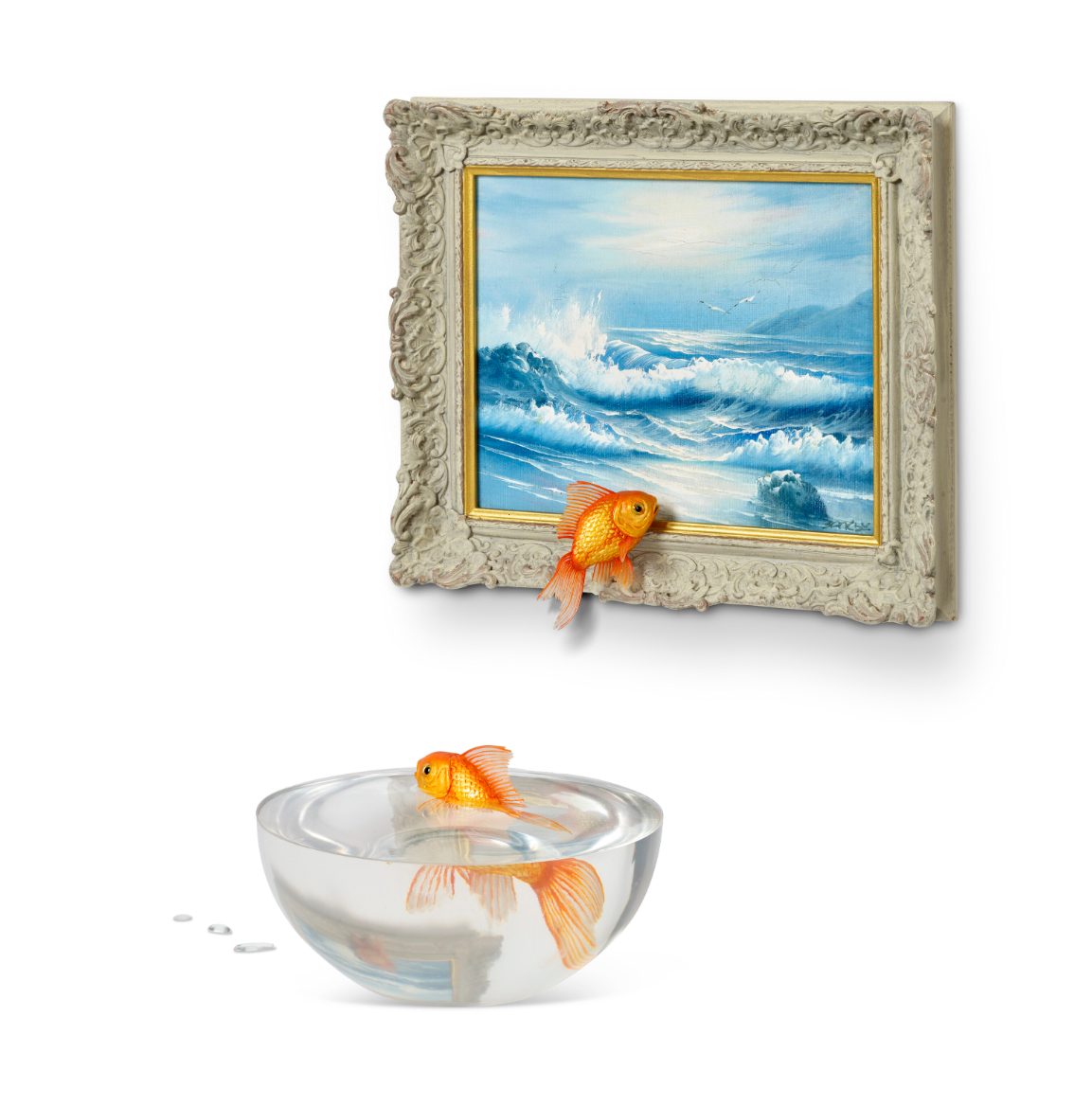
At first glance, Banksy™ Goldfish looks like one of Banksy's more playful creations. A goldfish has escaped from its bowl and, in an impressive act of piscine ambition, launched itself toward an idyllic painting of the sea hanging above. It has made it as far as the lower edge of the ornate frame, where it now gazes longingly toward the enormous blue waves that appear to promise everything its tiny glass bowl cannot: space, adventure and freedom.

Unfortunately, there is a problem. The ocean isn't real.
The fish has escaped one artificial environment only to pursue another. Its heroic journey from the confines of the bowl has left it stranded on the frame of a cheap reproduction, suspended between the water it has rejected below and an impossible paradise above. What initially resembles an optimistic story of escape gradually becomes something considerably more Banksy-like: a comedy about the distance between what we desire and what actually exists.
A Goldfish Dreaming of the Ocean
The simplicity of the metaphor gives the work much of its charm. The goldfish bowl represents a perfectly comfortable prison. The fish is fed, protected and surrounded by water, yet its entire universe is contained within a few inches of glass. Above it appears the opposite: an immense ocean extending toward an apparently limitless horizon.
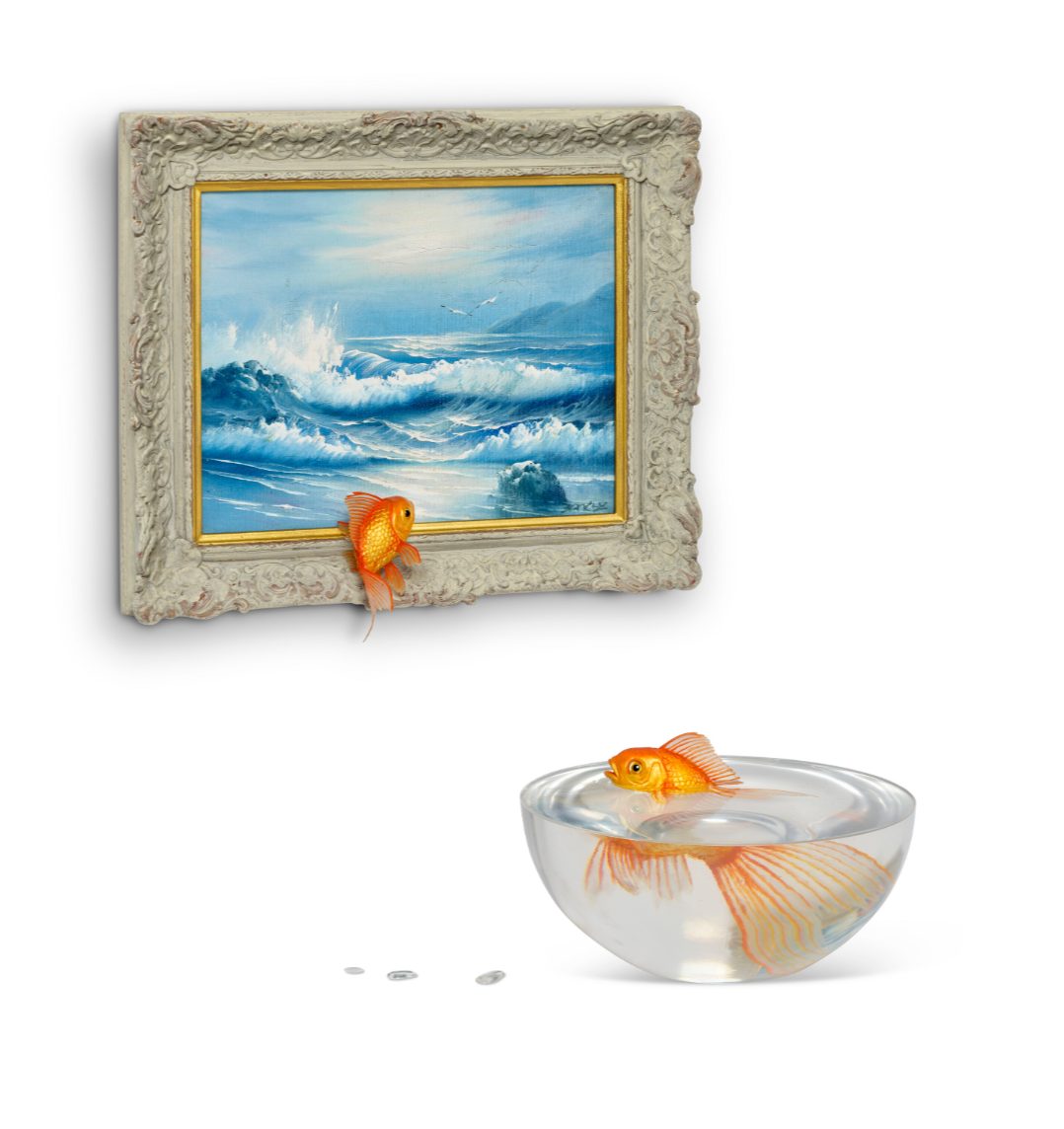
Banksy places the fish precisely between those two worlds. It has possessed enough imagination to recognize the limitations of its existence and enough courage to escape them, but not enough knowledge to understand that the alternative being offered is merely an image. The freedom it desires exists only as representation.
That predicament allows Banksy™ Goldfish to extend naturally beyond its comic narrative. The fish becomes a small surrogate for human aspiration: forever looking beyond the limits of the world we inhabit toward images of somewhere better. Advertising, consumer culture and social aspiration depend upon precisely this mechanism, continually presenting idealized versions of happiness that appear close enough to pursue but remain perpetually beyond reach.
Nothing Is Quite What It Seems
The materials make the joke considerably sharper. Almost everything in the composition pretends to be something it is not. The antique-looking frame is painted resin. The apparently traditional seascape is a printed canvas. The goldfish are synthetic constructions made from resin and glass eyes. Even the droplets of water falling toward the floor are carefully fabricated objects.
Banksy therefore creates an entire little universe of counterfeits.
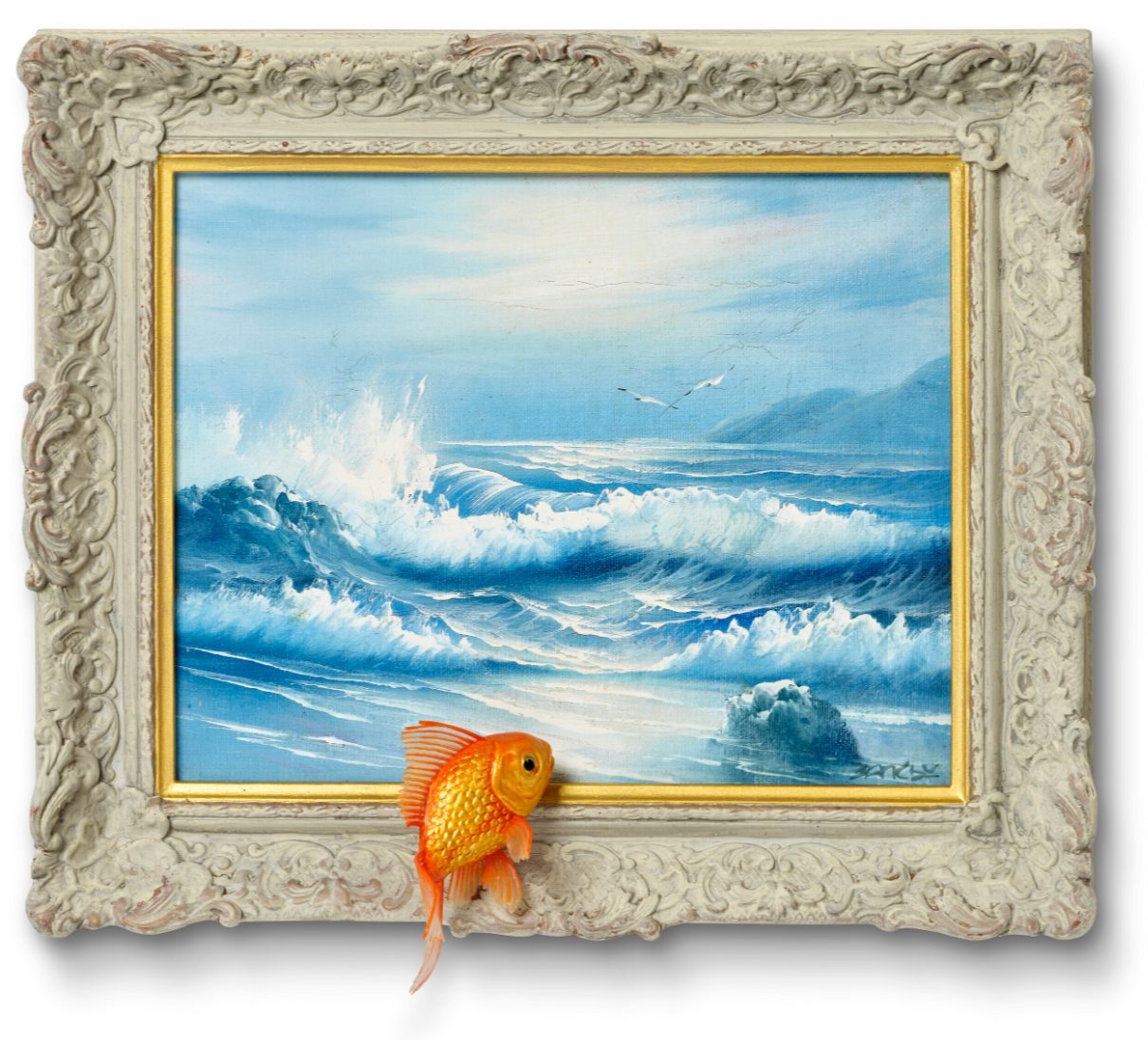
The distinction between representation and reality becomes deliberately unstable. A three-dimensional fish attempts to enter a two-dimensional ocean, while artificial water droplets appear to fall out into the viewer's own space. The picture refuses to remain a picture, and the sculpture refuses to remain comfortably separate from it.
This makes Banksy™ Goldfish one of the more formally ambitious objects produced for Gross Domestic Product. Banksy effectively dismantles the boundary between painting and sculpture, allowing the artwork to spill physically beyond the frame.
From Camden to Gross Domestic Product
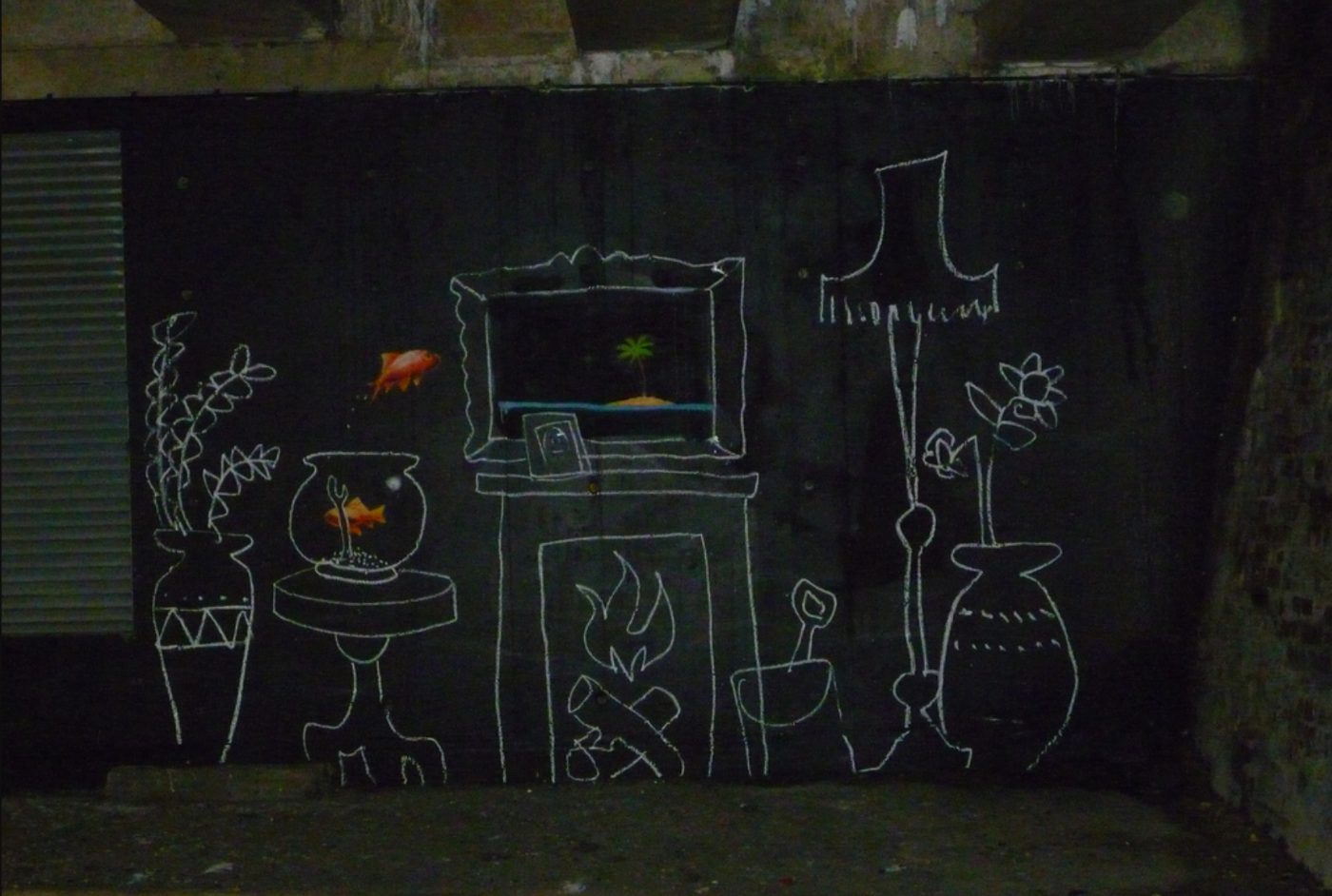
The idea behind Banksy™ Goldfish appears to reach back at least eight years before Gross Domestic Product. In January 2011, a remarkable intervention appeared beside Regent’s Canal in Camden depicting an entire domestic interior drawn directly onto a dark wall. A fireplace, plants, lamp and furniture were rendered in simple white outlines, while two brightly coloured goldfish provided the principal elements of reality within the otherwise imaginary room. Contemporary photographs show one fish confined within a bowl while another has apparently escaped and swims toward a framed tropical landscape hanging above the fireplace. Although the work was not confirmed on Banksy’s website at the time, contemporary street-art documentation attributed it to him while noting techniques and imagery consistent with his practice.
Banksy™ Goldfish, created for Gross Domestic Product in 2019, develops essentially the same visual proposition in three dimensions. The domestic interior has disappeared, but the essential actors remain: the bowl, the escaping fish and the picture promising another world. This time, however, the fish has progressed further. It has actually reached the ornate frame and now hangs precariously from its lower edge, staring toward the enormous waves of an ocean it can never enter.
The transition from the 2011 street intervention to the 2019 sculpture is particularly revealing. On the wall, Banksy used drawing and stencil to create the illusion of objects occupying different dimensions. Eight years later, those imagined objects become physically real—or at least apparently so. The bowl projects into space, resin droplets fall toward the ground and the goldfish literally breaches the boundary of the picture frame. What had originally been a visual joke painted onto a London wall becomes an elaborate sculptural construction about the same impossible desire to escape one reality and enter another.
Where Art Irritates Life
Created in an edition of only fifteen, Goldfish Bowl was among the rarer objects produced for Gross Domestic Product, Banksy's 2019 experiment in which the conventional boundaries between artwork, merchandise and household goods were deliberately scrambled. GDP offered a bizarre collection of dysfunctional domestic products under the wonderfully appropriate slogan “where art irritates life.”
Few objects embodied that idea better than Goldfish Bowl. It resembles a decorative object one might conceivably encounter in an eccentric home, yet everything about it is subtly wrong. The fish bowl cannot comfortably contain its fish, the landscape cannot contain its ocean, and the escaping goldfish cannot survive in either world.
Banksy takes the harmless language of domestic decoration and turns it into a miniature existential drama.
Banksy™ Goldfish is one of the most imaginative works to emerge from Gross Domestic Product because its humor, materials and meaning are inseparable. The physical construction completes the story: the fish genuinely leaves one space and attempts to enter another, crossing the boundary between sculpture and painting in the process.
There are broader readings involving migration, environmental degradation and the repetitive routines of contemporary life, all of which resonate with Banksy's wider practice. But perhaps the work is strongest when its central metaphor is allowed to remain universal. We spend much of our lives looking beyond our own goldfish bowls, convinced that happiness must exist somewhere on the other side.
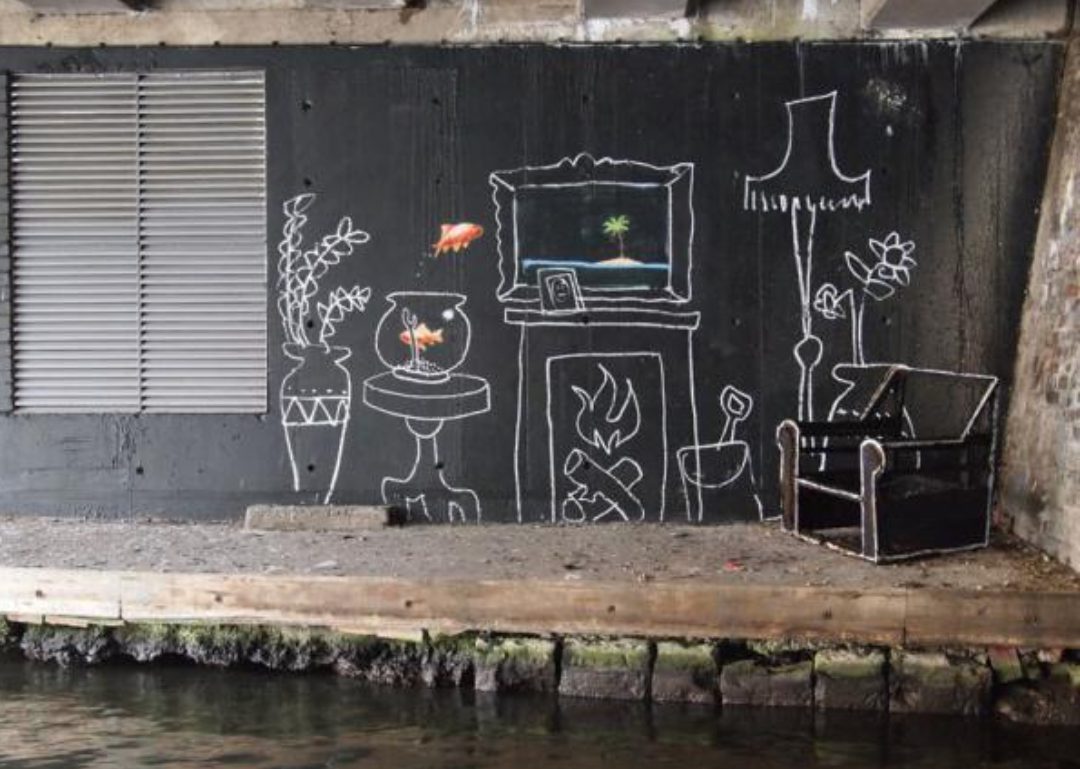
Banksy™ Goldfish becomes considerably more interesting when seen in relation to the 2011 Camden intervention. Rather than an isolated joke created for Gross Domestic Product, it represents Banksy returning to an earlier idea and developing it through an entirely different medium. The sketch-like immediacy of the street work becomes a meticulously constructed sculptural object, yet the central metaphor remains remarkably consistent. The fish recognizes the limitations of its bowl and imagines another existence beyond it. In 2011 it swims toward the picture; by 2019 it has reached the frame. But Banksy refuses to reward its courage. The promised ocean remains nothing more than an image. Eight years later, the goldfish finally reaches paradise—only to discover that paradise is still a picture on the wall.
STAY INFORMED
Receive the latest news, exhibitions, artworks and market updates on Banksy.