Market Players
Who Shapes the Banksy Market?

Introduction — A Market Without a Conventional Centre
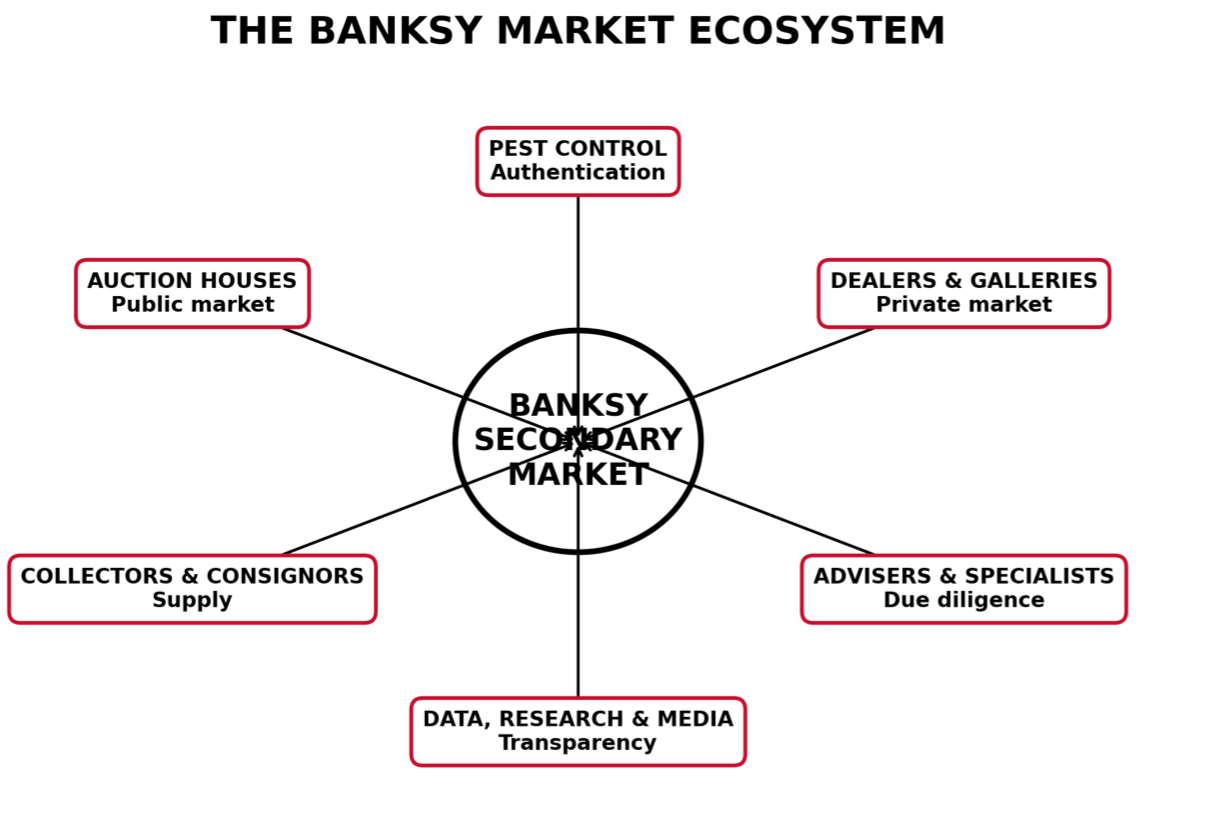
Banksy's market is one of the most unusual in contemporary art. The artist has achieved global recognition and a secondary market measured in hundreds of millions of dollars without following the conventional path of long-term representation by a dominant commercial gallery. Instead, the market has developed through a network of institutions and intermediaries: Pest Control, collectors, auction houses, specialist dealers, galleries, advisers, online platforms, researchers and data providers. Their roles overlap, but they are not interchangeable.
Understanding these players is essential because price alone does not explain how the market functions. A Banksy work must first be identifiable and, where applicable, authenticated; it must be assessed for condition and provenance; it must then reach an appropriate channel, whether public auction or private sale; and buyers must have sufficient confidence in both the object and the intermediary to transact. The market is therefore best understood as an ecosystem rather than a simple chain between artist and collector.
1. Pest Control — The Authentication Gatekeeper
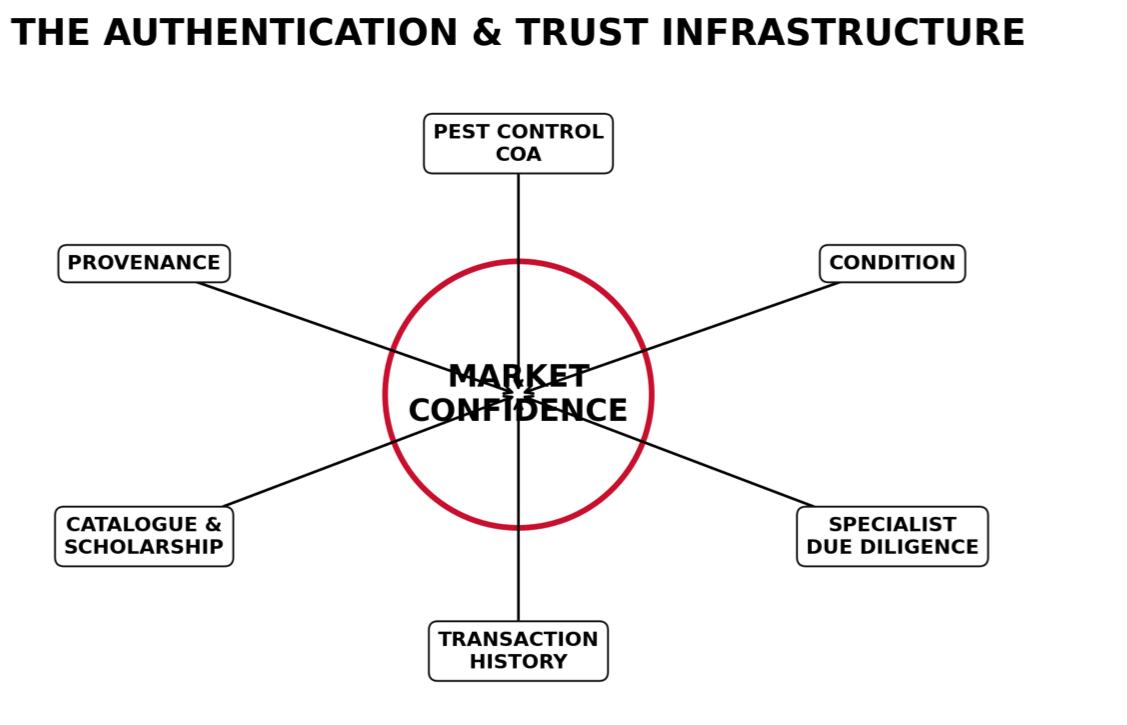
Pest Control Office occupies a singular position in the Banksy market. It is the body established to authenticate Banksy's works and issue certificates of authenticity for works that fall within its remit. For paintings, drawings and editioned works circulating on the secondary market, the presence of a Pest Control certificate has become a fundamental element of marketability. Auction houses and professional dealers generally require authentication before offering significant Banksy works, and the certificate follows the work as a critical component of its documentary history.
Its importance should not, however, be confused with conventional artist representation. Pest Control is not simply a gallery, auction house or pricing service. Its role is primarily one of authentication and administration, and this creates an unusual separation between artistic authority and commercial distribution. The result is a market in which no single dealer controls supply, yet a central authentication mechanism still provides an essential point of confidence.
2. Collectors and Consignors — The Source of Secondary Supply
Because Banksy's market is not organised around a conventional primary gallery programme, collectors themselves play an unusually visible role in the circulation of works. Early buyers acquired prints through Pictures on Walls, exhibitions and other direct or semi-direct channels; later collectors entered through dealers and auctions. As these works return to market, the quality of their provenance, condition and documentation can materially affect both confidence and price.
The consignor also determines the route to market. A major unique painting may justify the international theatre of an evening auction, while a standard unsigned edition may be better served by a specialist print auctioneer or a discreet private sale. This makes supply fragmented and episodic. The market is liquid, particularly in prints, but it is not centrally released or managed in the manner of an artist represented by a single global gallery.
3. Auction Houses — The Public Market
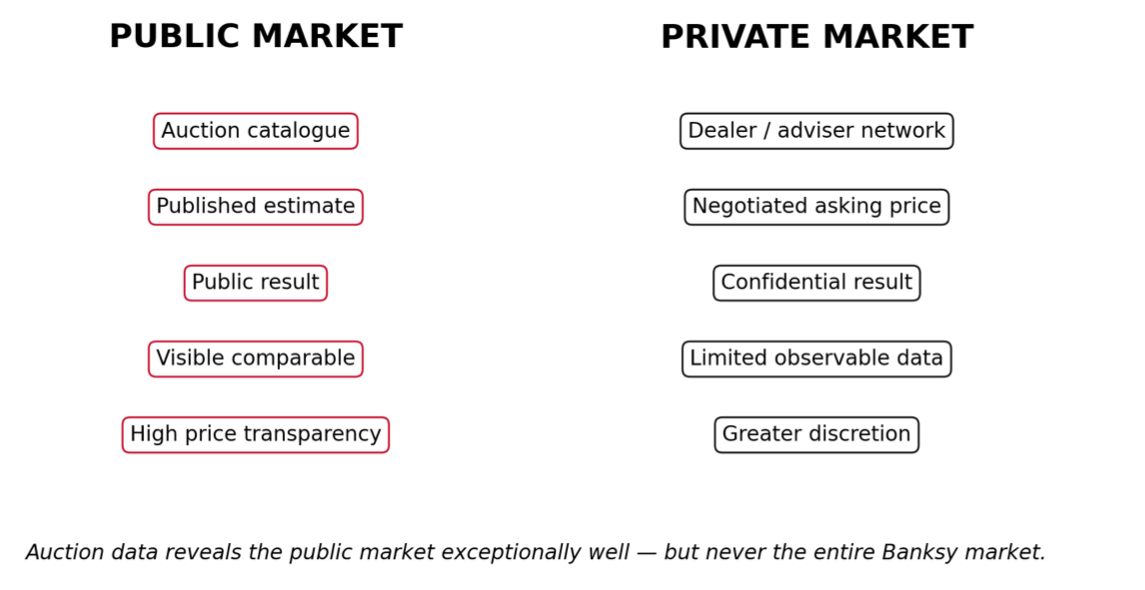
Auction houses provide the most visible layer of the Banksy market because their catalogues, estimates and results create a public record. Sotheby's, Christie's, Phillips and Bonhams dominate the upper end of the originals market, while specialist and regional houses — particularly in the United Kingdom and Japan — provide much of the recurring liquidity in editions. Their influence is therefore dual: the international houses establish trophy prices, while specialists generate the repeated comparables through which the broader market discovers value.
The auction market also supplies a form of public theatre that is unusually compatible with Banksy's cultural position. The shredding of Girl with Balloon at Sotheby's in 2018 is the most obvious example: an auction itself became part of the artwork's history. Yet most auction influence is less spectacular. It lies in estimates, catalogue scholarship, specialist judgment, bidding depth and the continuous accumulation of observable transactions.
4. Dealers, Galleries and Private Sales — The Less Visible Market
A substantial part of Banksy's market takes place privately. Specialist dealers, contemporary galleries, advisers and the private-sale departments of auction houses source works from collectors and place them directly with buyers. These transactions can offer discretion, speed and control over price, particularly for owners who do not want the public exposure or binary outcome of an auction.
The difficulty for market analysis is obvious: private transactions are rarely disclosed with the same precision as auction results. Asking prices may be visible, but negotiated prices usually are not. Public auction data is therefore indispensable for valuation and market research, yet it describes only the observable part of a larger secondary market. Any serious analysis of Banksy must keep this distinction in view.
5. Advisers and Specialists — Navigating a Fragmented Market
Professional advisers operate between supply, authentication and distribution. Their role can include identifying appropriate works, assessing authenticity documentation, reviewing condition, analysing comparables, negotiating price and selecting the correct route to market. In a market as geographically dispersed as Banksy's, access to a network of collectors, dealers and auction specialists can be as important as access to inventory.
This role becomes particularly significant when the object is not a standard print. Colour variants, artist's proofs, hand-finished works, early originals, unusual supports and street works can require considerably more research than a straightforward edition. The quality of advice is therefore inseparable from scholarship and due diligence.
6. Online Platforms — Access, Distribution and Price Visibility
Online bidding transformed the practical geography of the Banksy market. A collector in Tokyo can bid in London, while a London consignor can reach American or Asian buyers without the work changing markets physically before the sale. The pandemic accelerated a transition already underway, and Banksy's highly recognisable editions proved particularly well suited to digital catalogues and remote bidding.
Online platforms also blur traditional categories. Some are auction houses in their own right; others aggregate sales, advertise dealer inventory or provide price databases. Their contribution is not merely transactional. They have increased access to historical comparables and made the market more legible to collectors who previously depended almost entirely on dealer knowledge.
7. Research, Data and Market Intelligence
As Banksy's market matured, information itself became a market resource. Catalogue histories, auction databases, condition records, edition details and provenance research allow collectors to distinguish between superficially similar objects. This is particularly important in prints, where signed and unsigned editions, colourways, proofs and special variants can carry radically different values.
Independent research platforms also perform a corrective function. Auction houses naturally present works in the context of a sale, while dealers present inventory in the context of an offer. Longitudinal databases can instead examine repeated transactions across houses and regions, revealing liquidity, market cycles, price dispersion and the relative influence of different venues. The increasing availability of such data is one of the clearest signs that Banksy's secondary market has matured.
8. How a Banksy Reaches the Market
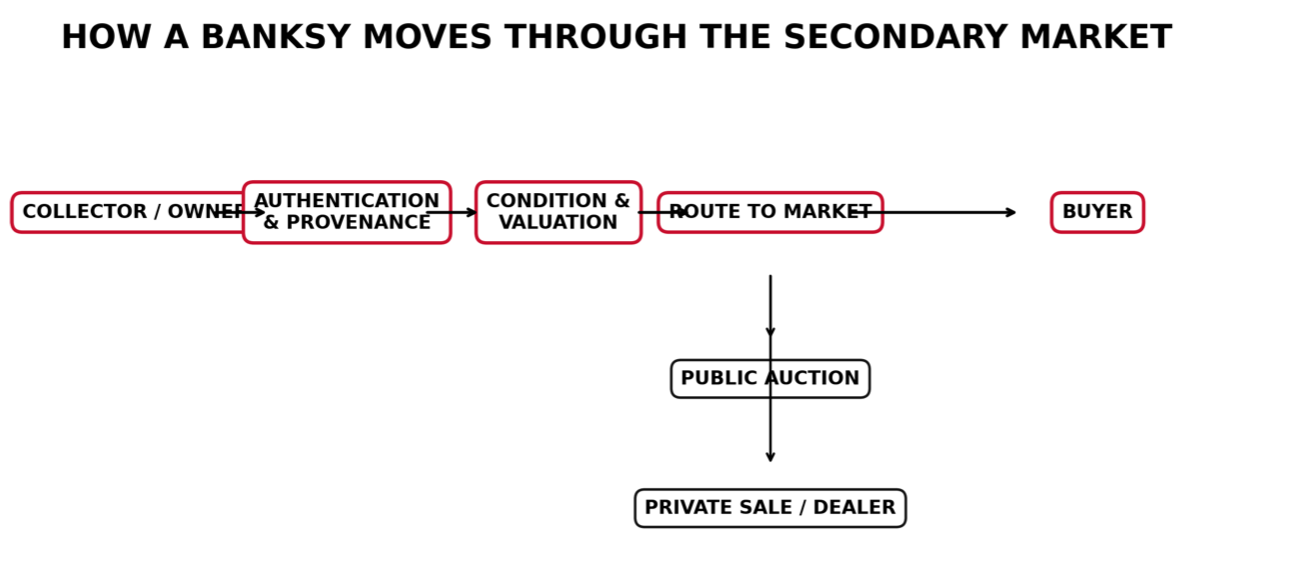
The route shown above is deliberately simplified, but it illustrates an important point: the auction house or dealer is not the beginning of the process. Authentication, provenance, condition and valuation precede the sale decision. Nor does the process end at the hammer or invoice. Shipping, insurance, framing, import rules, resale documentation and the preservation of certificates all form part of the continuing life of the object.
Conclusion — A Decentralised but Highly Structured Market
Banksy's market appears decentralised because no single gallery controls it, but it is not unstructured. Pest Control provides an authentication anchor; collectors supply works; auction houses and dealers create competing routes to market; advisers and specialists manage information asymmetry; and research platforms make the public record increasingly transparent. Each participant solves a different problem.
That structure also explains the market's resilience. A Banksy can move between London, New York, Paris, Tokyo and Hong Kong; between auction and private sale; and between specialist print collectors and broader contemporary-art buyers. The market is global precisely because it is distributed. Its complexity is not a weakness but one of the mechanisms through which Banksy has become one of the most liquid and closely watched secondary markets in contemporary art.
STAY INFORMED
Receive the latest news, exhibitions, artworks and market updates on Banksy.