BIRD SINGING IN TREE
A TREE BUILT FROM THE STREET
Bird Singing in Tree appeared in San Francisco’s Mission District in April 2010 as part of the group of interventions Banksy produced in the city around the American release of Exit Through the Gift Shop. Contemporary photographs taken on 25–28 April locate the work in an empty parking lot at Erie and Mission Streets, while later documentation identifies the building as 161 Erie Street.
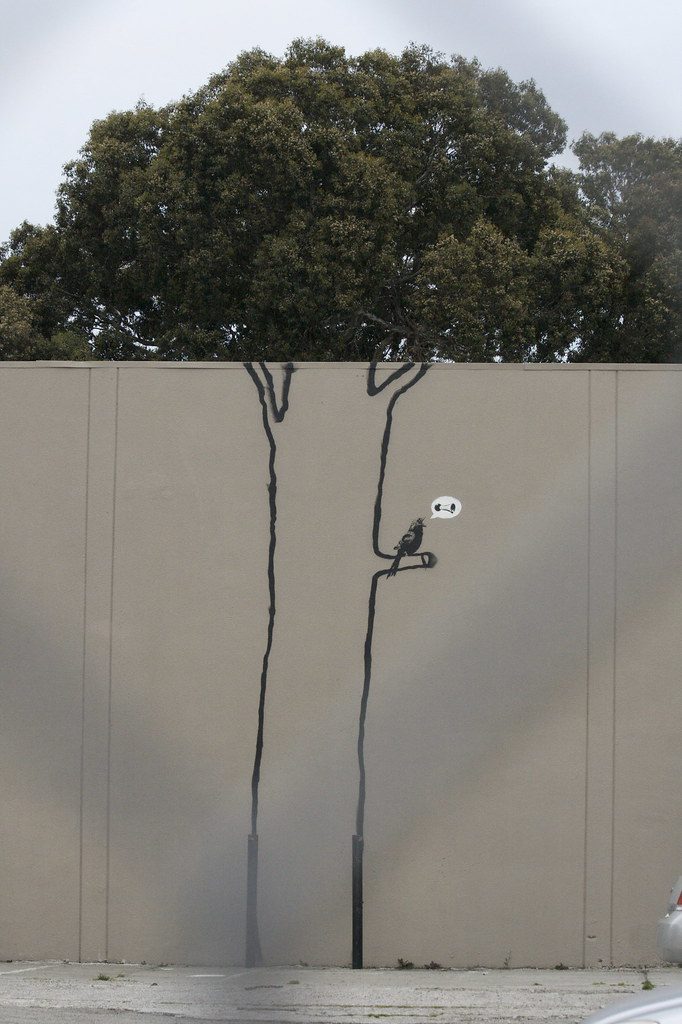
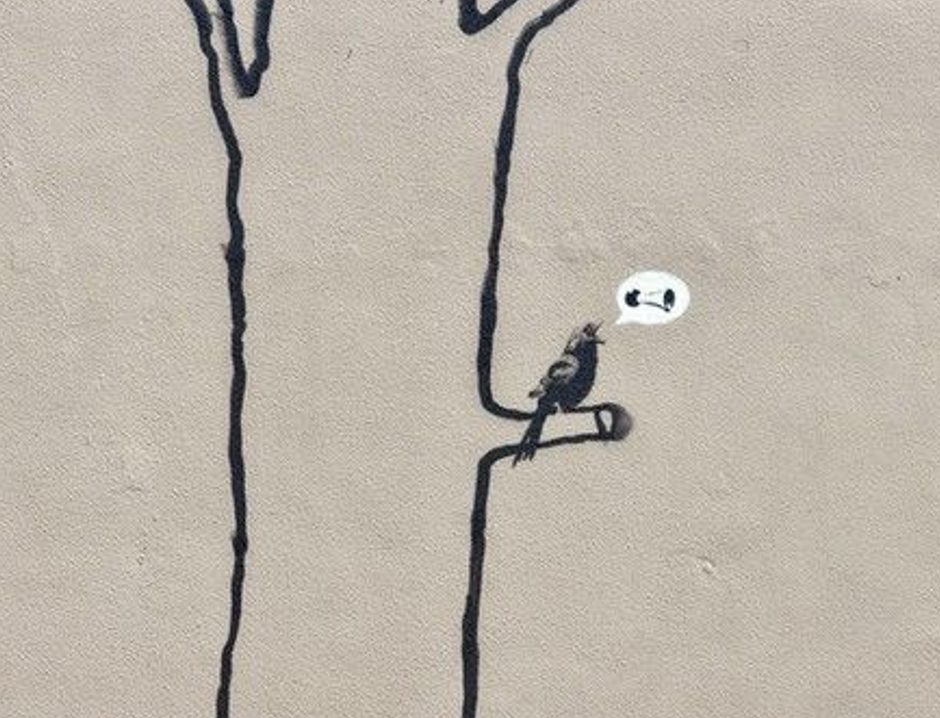
The composition is among the most economical and site-specific of Banksy’s San Francisco works. Two existing vertical pipes rising from the ground are transformed into the trunks of an enormous tree through a few painted black lines that continue upward and divide into branches. A small stenciled bird sits on one of them. Banksy therefore contributes only part of the image: the architecture supplies the trunks, the real trees visible above the wall extend the illusion beyond its surface, and the viewer mentally assembles these separate elements into a single composition.
The intervention demonstrates a fundamental aspect of Banksy’s street practice. Rather than treating a wall as a neutral substitute for canvas, he frequently begins with something already present—a pipe, sign, doorway, crack or architectural feature—and changes the way it is perceived. Here, two ordinary pieces of urban infrastructure become a monumental tree through an exceptionally small amount of paint. The physical site is therefore not merely the support for the work but one of its principal materials.
THE BIRD’S SONG
Perched on the painted branch, the bird appears to be singing. Its call is represented by a small white speech bubble containing a simple black pictogram. The tiny detail introduces a narrative element into an otherwise sparse composition, transforming the anonymous parking-lot wall into an imagined natural environment inhabited by a solitary bird.
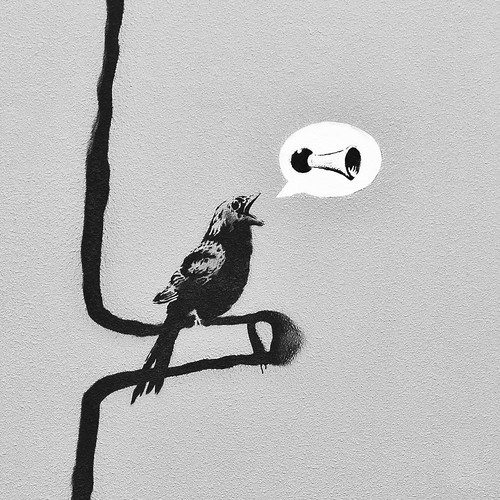
The contrast between nature and the built environment is central to the work. A tree has been constructed from pipes and paint rather than grown from the earth, while a stencilled bird occupies an environment assembled from concrete, masonry and utility infrastructure. Yet the illusion remains remarkably convincing. Banksy does not attempt to conceal the industrial origins of the tree; the pleasure of the work depends precisely upon recognizing the pipes and simultaneously seeing them as something else.
This transformation also distinguishes Bird Singing in Tree from many of Banksy’s more explicitly political interventions. There is no extended slogan and no elaborate narrative. Instead, the work relies on visual economy, wit and the imaginative reuse of the existing city. It belongs to the strand of Banksy’s practice in which street furniture and architecture are altered through minimal additions, allowing an overlooked fragment of the urban environment to acquire an entirely different identity.
SAN FRANCISCO, 2010
The mural was one of at least six Banksy works documented around San Francisco during April 2010. Other interventions included No Trespassing on Mission Street, Skull and Crossbones Rat on Howard Street, Marker Rat in Haight-Ashbury, Peaceful Hearts Doctor in Chinatown and This’ll Look Nice When It’s Framed on Valencia Street. Contemporary documentation by Warholian recorded all six locations while the works were still relatively fresh.

Their appearance coincided with the American theatrical release of Exit Through the Gift Shop. The San Francisco works consequently provide an interesting counterpoint to the film. While Banksy was entering cinemas and reaching an increasingly international audience, he continued to work anonymously on ordinary urban surfaces, producing images whose survival remained dependent upon property owners, weather, other graffiti writers and the changing city around them.
PRESERVATION AND TRANSFORMATION
Unlike most of Banksy’s 2010 San Francisco interventions, Bird Singing in Tree survived at its original location for many years. The owners of the property recognized the work shortly after it appeared and expressed their intention to preserve it. Contemporary reporting described it as a roughly 25-foot-tall tree, emphasizing the striking difference between the tiny bird and the scale of the architectural composition.
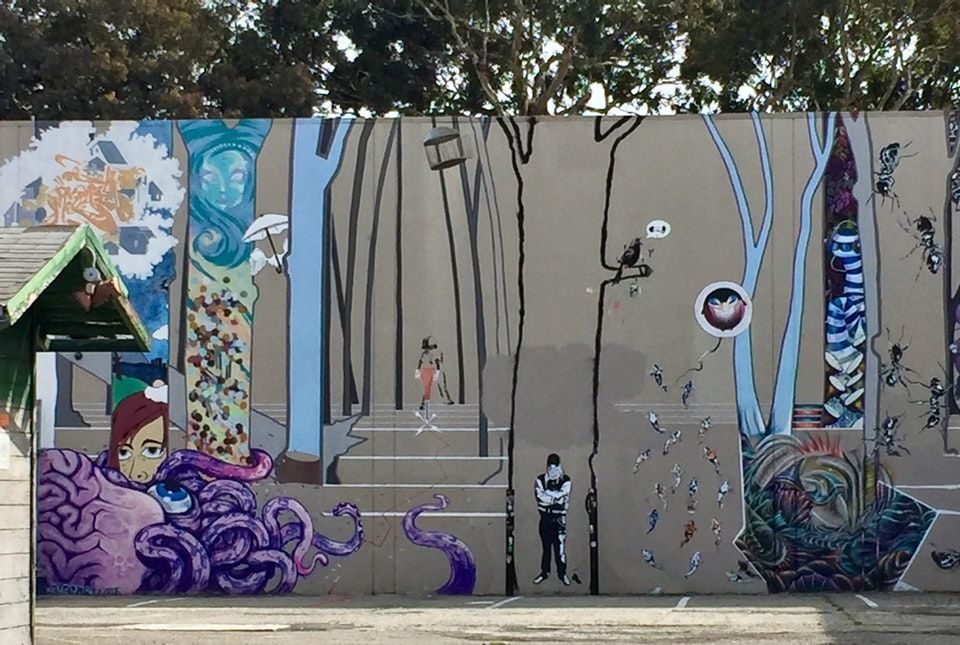
The wall subsequently acquired a second life. In August 2010, local artists were invited to create additional works around Banksy’s tree as part of an outdoor art event. New trees, animals and figures gradually transformed the once largely empty wall into a collaborative environment, while Banksy’s original composition remained embedded within it. The mural was later protected behind fencing, although it was eventually subjected to tagging and deterioration.
Its changing surroundings are particularly appropriate for a work conceived through adaptation in the first place. Bird Singing in Tree was never an autonomous image imposed upon a neutral surface: it depended upon pipes, architecture, vegetation and the particular characteristics of its location. Its subsequent history continued that process, as other artists and the evolving neighborhood became additional layers in a work whose meaning had always depended upon the environment around it.
STAY INFORMED
Receive the latest news, exhibitions, artworks and market updates on Banksy.