BOMB HUGGER
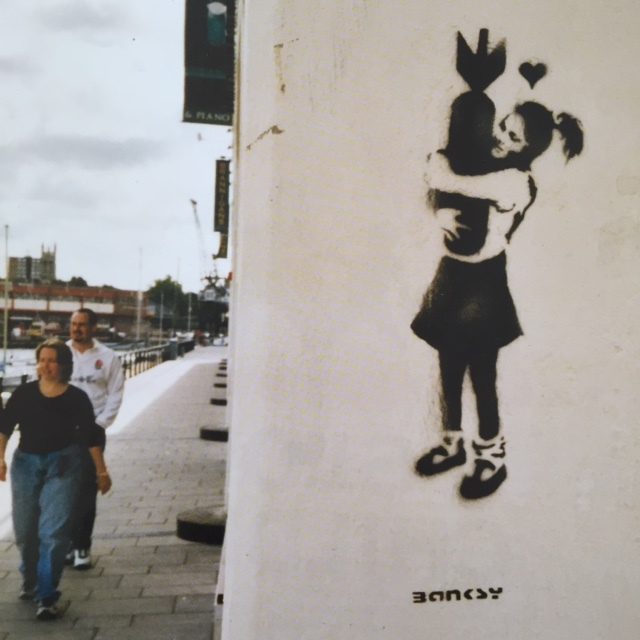
INNOCENCE AND DESTRUCTION
Among Banksy's earliest surviving motifs, Bomb Hugger, also widely known as Bomb Love, depicts a young girl wrapping her arms affectionately around a large aerial bomb. Her eyes are closed and her body presses against the weapon as though she were embracing a favorite toy. The contradiction is immediate: childhood innocence and physical tenderness are brought into direct contact with an object designed for destruction.
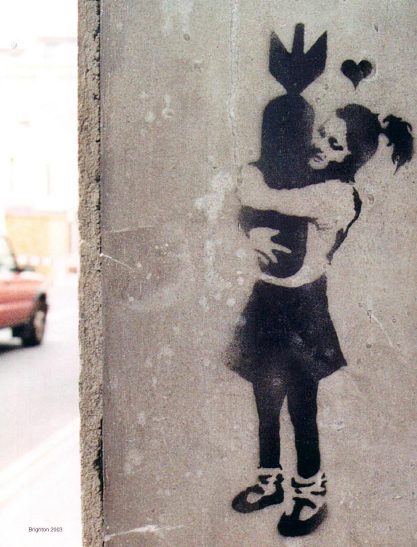
The image already contains a visual strategy that would become fundamental to Banksy's work. Rather than representing violence directly, he places two incompatible ideas within the same composition and allows their collision to create meaning. The bomb remains unmistakably a weapon, but the girl's gesture belongs to an entirely different emotional vocabulary. Affection, security and childhood are attached to something whose purpose is precisely their destruction.
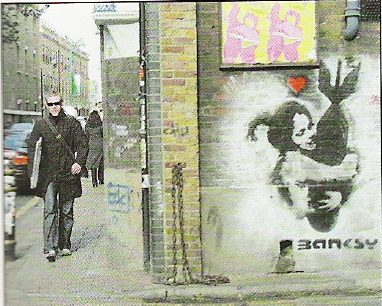
Its simplicity is crucial. There is no battlefield, soldier or explosion, and no slogan instructing the viewer how to interpret the scene. Banksy reduces the subject of warfare to a relationship between two figures: a child and a bomb. The resulting image can be read simultaneously as an anti-war statement and as a broader reflection on the normalization of military violence—on the ways societies learn to accommodate, justify and ultimately live alongside instruments of destruction.
AN EARLY BANKSY IMAGE
The Bristol mural is particularly significant because it places Bomb Hugger remarkably early within Banksy's development. By 1998, Banksy was still working within Bristol's graffiti culture and had not yet established the predominantly stencil-based visual language for which he would become internationally recognized. The appearance of such a conceptually economical image at this stage anticipates much of his subsequent practice.
The young girl would become one of Banksy's most effective recurring protagonists. Children appear throughout his work because they bring vulnerability, imagination and an instinctive moral clarity into environments shaped by adults. In later images such as Girl with Balloon, No Ball Games and Kids on Guns, childhood similarly becomes a means of examining the world that has been constructed around it. In Bomb Hugger, however, the contrast is unusually severe: the object the child embraces is not merely a symbol of authority or restriction but a weapon capable of annihilating her.
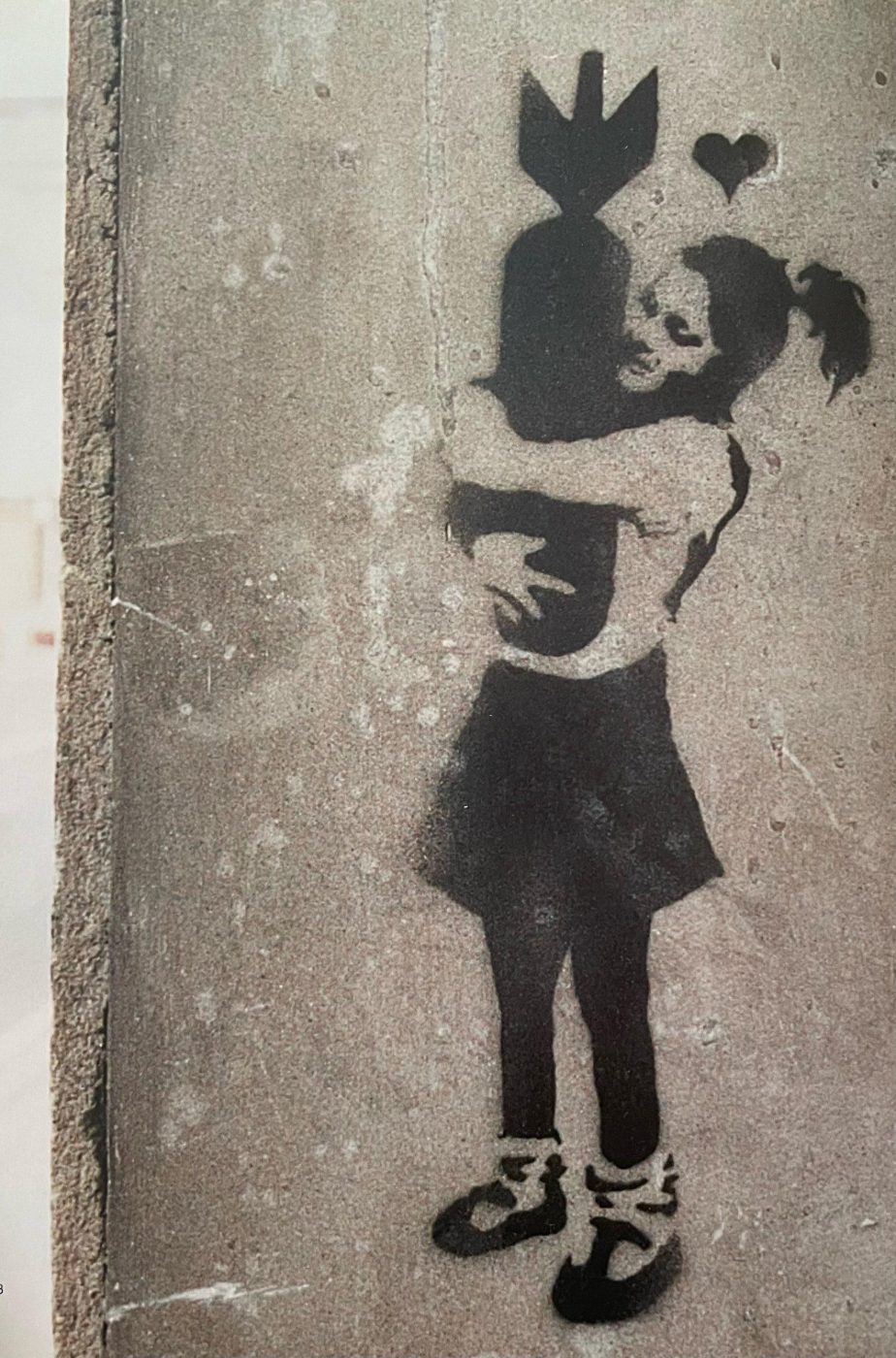
The mural also belongs to an important group of early Bristol works—including The Mild Mild West, Monkey Detonator, Precision Bombing and Leopard Chasing Policemen—through which Banksy's political vocabulary began to emerge before his move toward the London street interventions of the early 2000s.
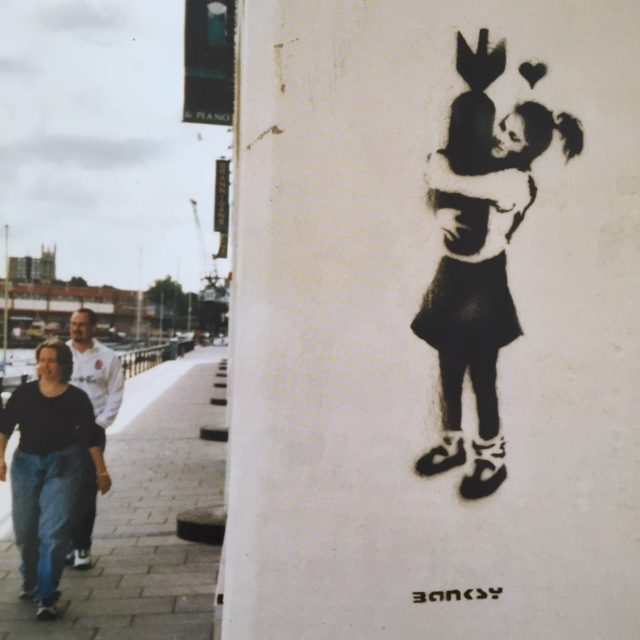
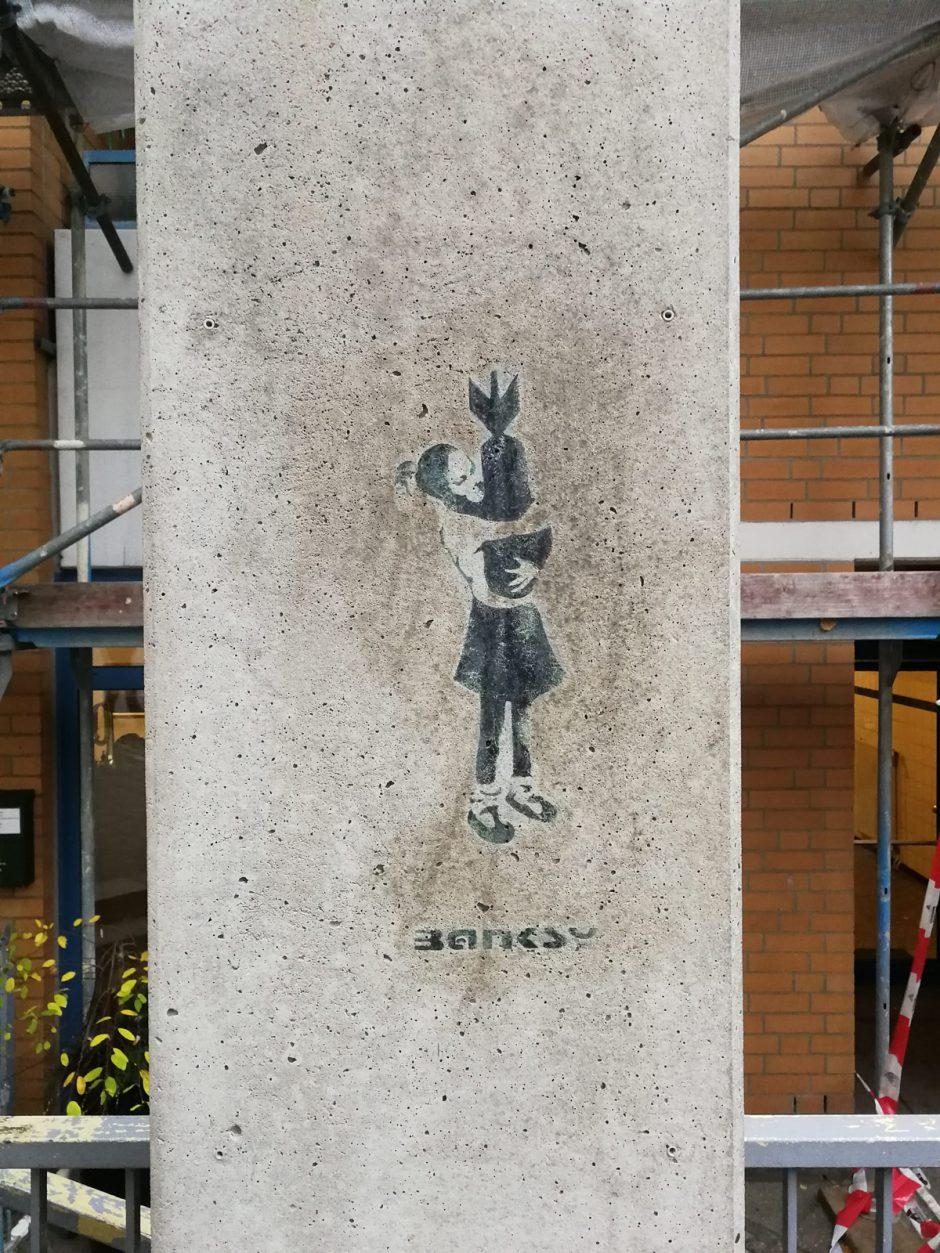
Bomb Hugger was not confined to a single wall but was repeatedly deployed by Banksy during the early 2000s, with documented executions in London, Hamburg and Brighton. One of the best recorded appeared in Hamburg in 2002, on a concrete pillar in the Steinwegpassage, where it survived for years before being protected behind acrylic glass and later heavily damaged. These different street versions demonstrate Banksy's early practice of reusing a stencil across changing urban environments, allowing location and architecture to alter the encounter with an otherwise stable image. The motif subsequently migrated beyond the street into unique paintings from 2002, hand-sprayed anti-Iraq War protest placards in 2003, and the pink Bomb Love screenprint released the same year, establishing the girl embracing a bomb as one of the most enduring images of Banksy's early anti-war vocabulary.
FROM BOMB HUGGER TO BOMB LOVE
The importance of the image becomes clearer through what Banksy subsequently did with it. Rather than abandoning the motif after its appearance on the street, he repeatedly translated it across different media. By 2002, Bomb Love appeared in unique works on canvas and board, including examples associated with Santa's Ghetto in London and Existencilism, Banksy's first Los Angeles exhibition. One 2002 canvas uses a soft pink ground, bringing the visual language of childhood into even sharper opposition with the dark silhouette of the bomb.
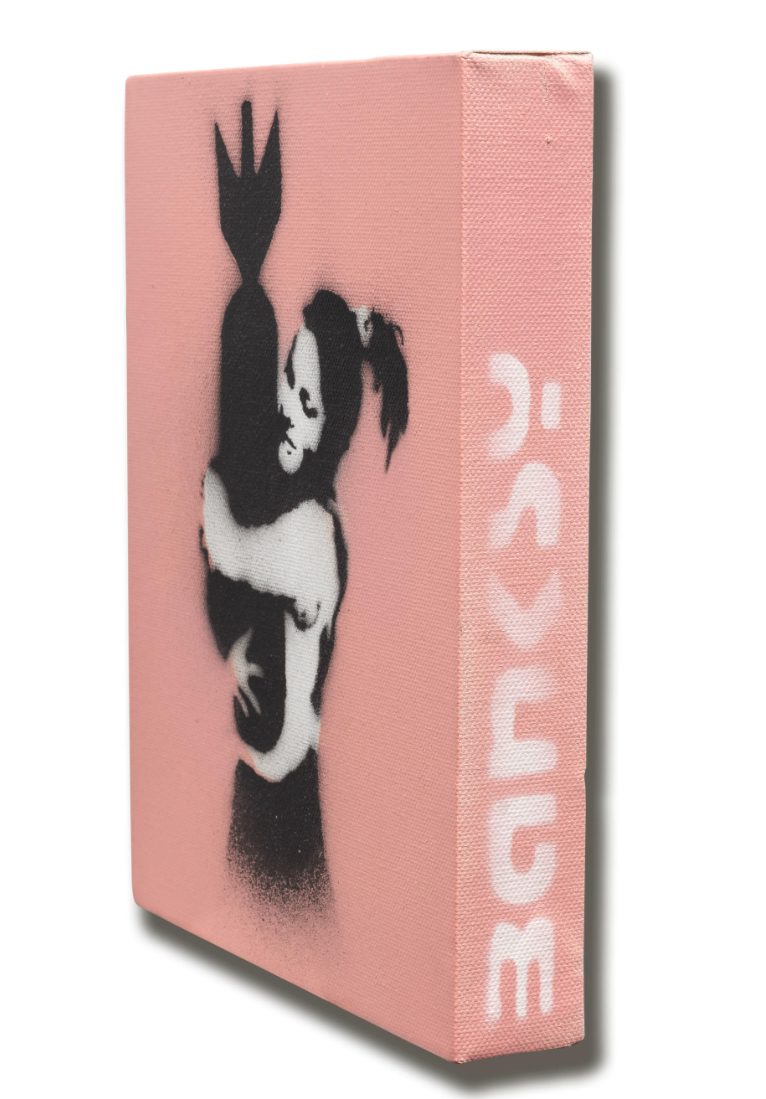
This movement between wall and studio is characteristic of Banksy's practice during the period. The street provided an environment in which an image could be tested publicly and encountered unexpectedly; paintings allowed the same stencil to be isolated, recolored and developed as an autonomous artwork. Bomb Hugger therefore provides an early example of the fluid relationship between Banksy's street imagery and the works that would soon circulate through exhibitions and collections.
FROM STREET ART TO ANTI-WAR PROTEST
The political meaning of Bomb Hugger became considerably more explicit in 2003, as Britain prepared for and entered the Iraq War. Banksy produced hand-sprayed cardboard placards using images including Bomb Hugger, Happy Choppers and Grim Reaper in connection with anti-war demonstrations. In these objects, an image that had originally appeared as street art became an instrument of protest.
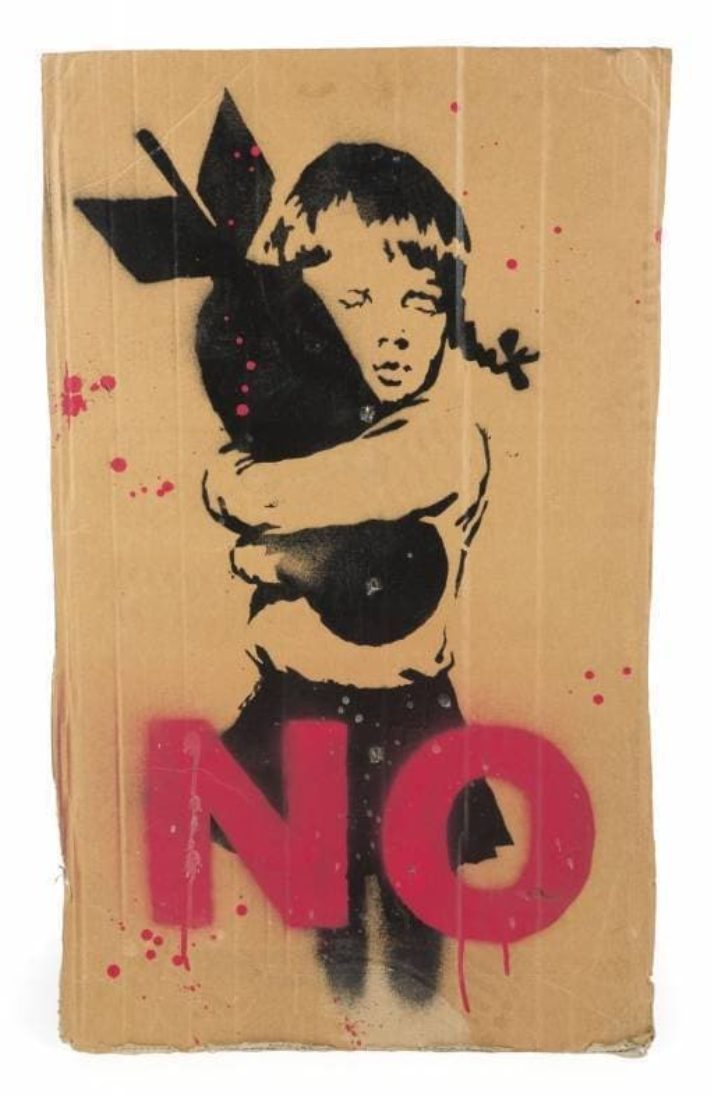
One surviving Bomb Hugger placard is especially well documented. A contemporary photograph published by the Basingstoke Gazette on 24 March 2003 shows eighteen-year-old Annie Hurn carrying it during an anti-war demonstration outside the council offices in Basingstoke. The girl embracing the bomb is accompanied by the word NO sprayed prominently in red above her head. The addition removes much of the ambiguity possible in the earlier image: the visual paradox is now explicitly mobilized in opposition to war.
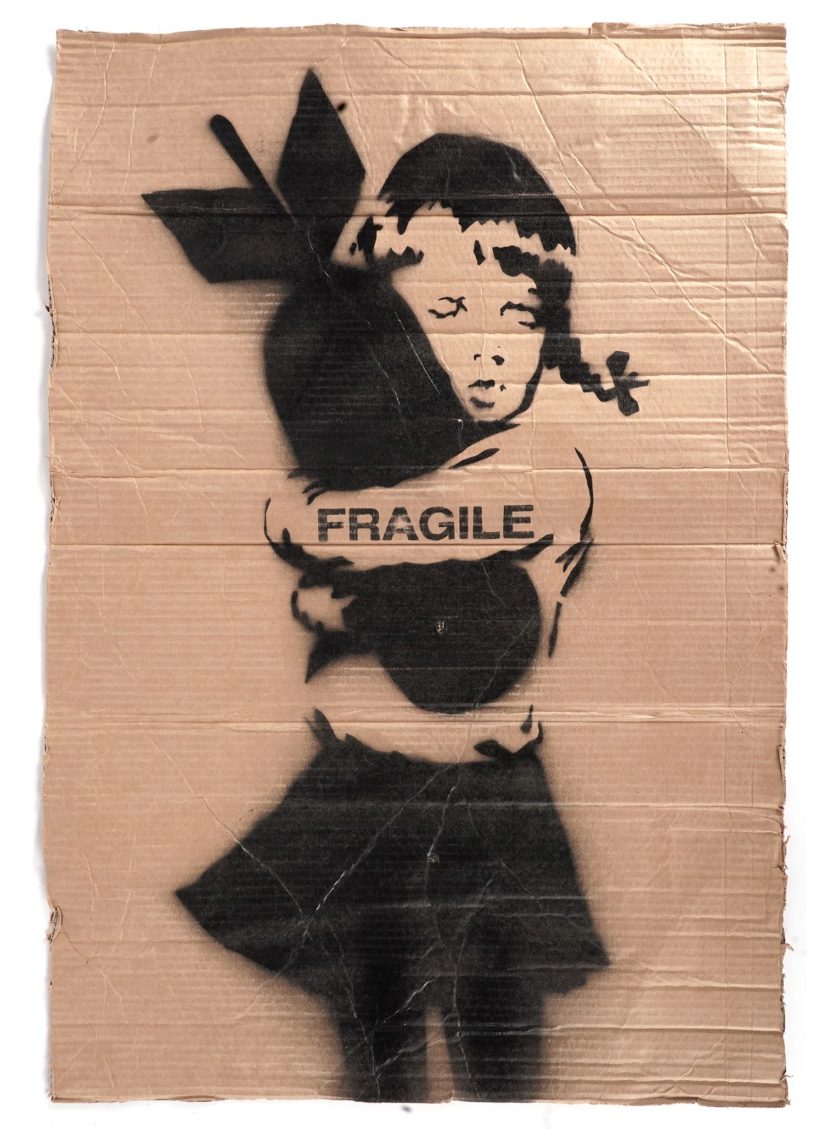
The transformation is particularly revealing of Banksy's understanding of public art. A stencil on a wall waits for people to encounter it; a placard is carried through the city by its audience. The image becomes mobile, rising above a demonstration and circulating through newspaper photographs and television coverage. The progression from Bristol wall to protest placard therefore did not diminish the street origins of Bomb Hugger; it returned the image to public space in an even more explicitly political form.
AN IMAGE BECOMES AN ICON
Also in 2003, Banksy released Bomb Love as a screenprint through Pictures on Walls, with an edition of 150 signed and 600 unsigned impressions, together with signed artist's proofs. Against the print's vivid bubblegum-pink background, the black-and-white child and bomb acquire an almost commercial brightness. The color is deliberately seductive, borrowing from the visual world of toys, confectionery and childhood while preserving the disturbing contradiction at the center of the image.
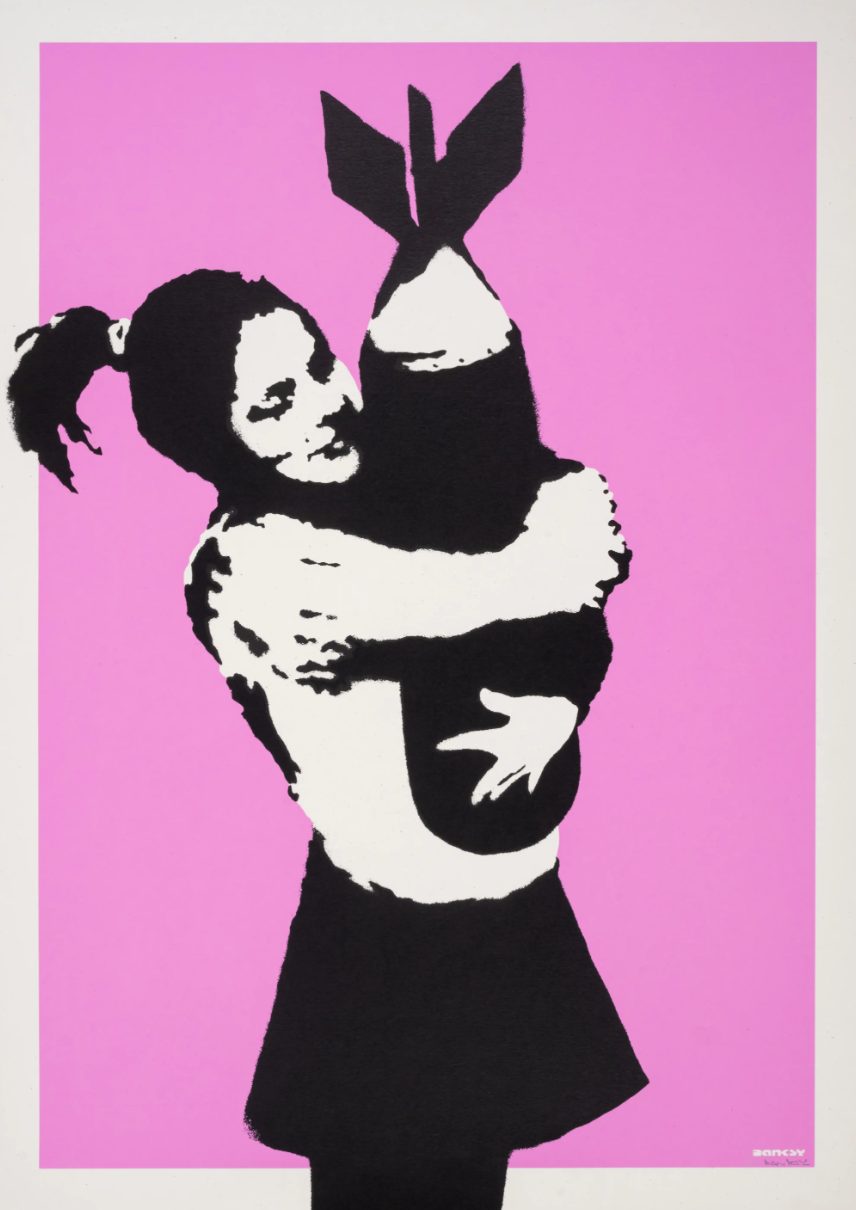
Within approximately five years, the same fundamental image had therefore occupied radically different contexts: an early Bristol wall, unique paintings, an international exhibition, anti-war demonstrations and a published edition. Each changed the way the image functioned without changing its essential proposition.
That trajectory helps explain why Bomb Hugger became one of Banksy's defining early images. Its meaning does not depend upon a particular war, although its use during the protests of 2003 gave it a specific historical urgency. At its core is a more enduring contradiction between the language societies use to describe violence and the reality of the objects through which violence is exercised. Banksy gives that contradiction physical form by asking a child to embrace the bomb.
STAY INFORMED
Receive the latest news, exhibitions, artworks and market updates on Banksy.