BOMB HUGGER NO, 2003
Provenance
- Basingstoke anti-war protest, England, 2003
- Acquired at the time by the former owner
Literature
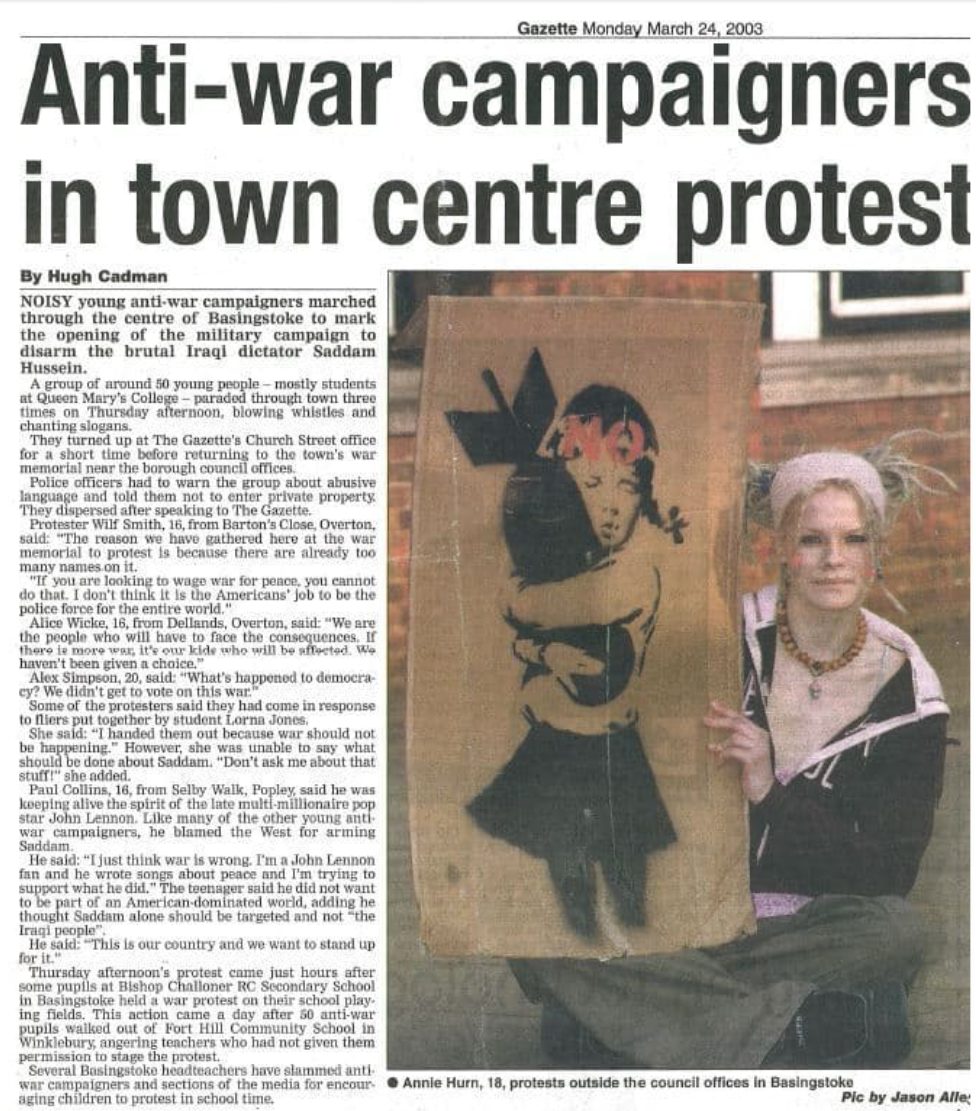
Basingstoke Gazette, 24 March 2003, illustrated
Auction History
Prices are inclusive of buyer’s premium unless stated otherwise, as reported by the auction houses.
From Image to Protest
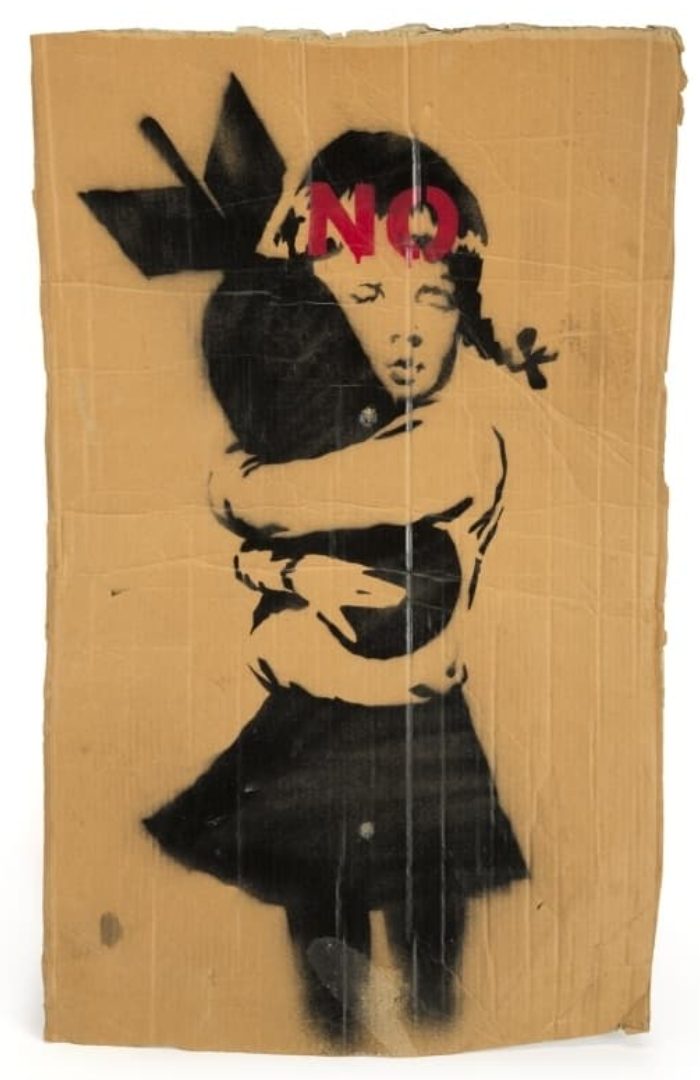
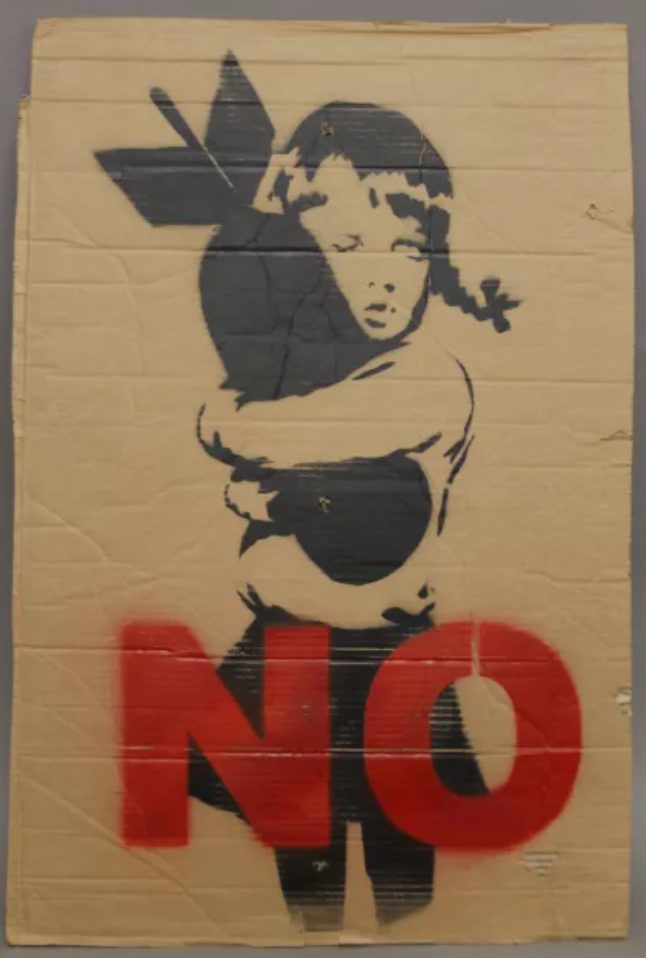
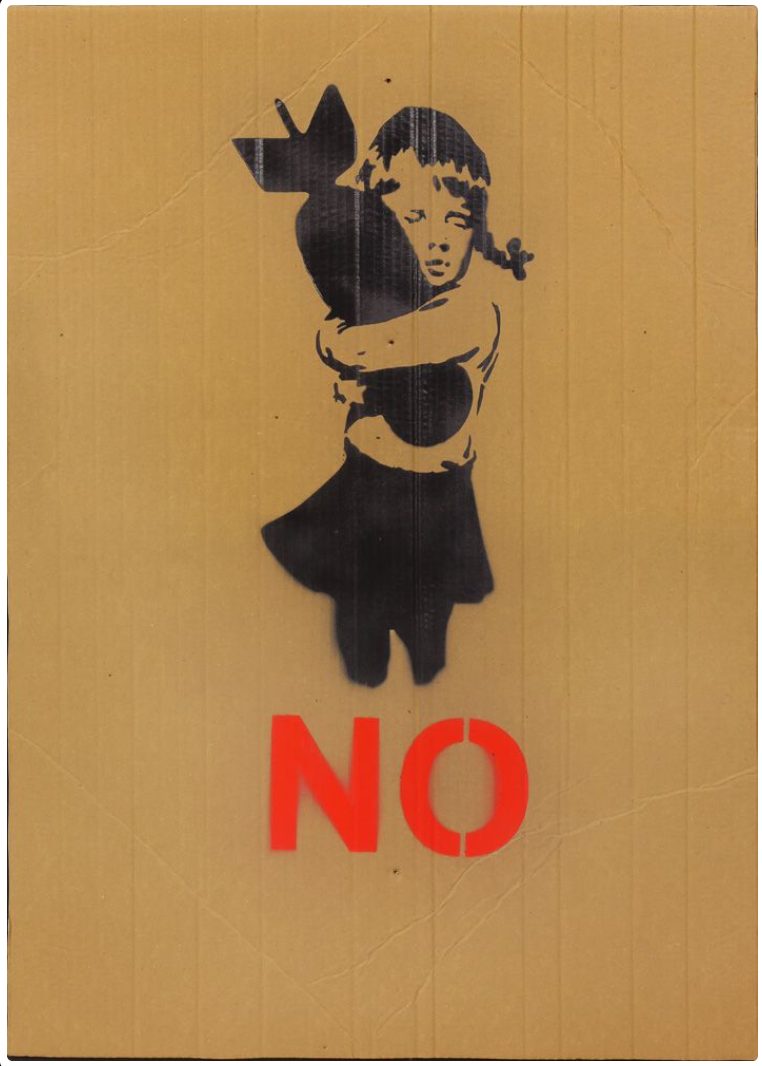
Bomb Hugger has become one of Banksy's most recognizable images, but this extraordinary cardboard version takes the motif back to its original political environment. Rather than a print or painting intended for display, it belongs to the group of spray-painted placards produced in connection with the British anti-war movement of 2003, when Banksy's imagery moved directly from street art into political protest. Examples of Bomb Hugger, Happy Choppers and Grim Reaper were produced on cardboard for demonstrations opposing British involvement in the Iraq War.
The significance of this particular example lies in its exceptionally strong contemporary documentation. A photograph published in the Basingstoke Gazette on 24 March 2003 shows its owner, eighteen-year-old Annie Hurn, holding the placard during an anti-war protest outside the council offices in Basingstoke. The image allows us to see the artwork exactly as it was intended to function: not framed, protected or isolated on a white wall, but held by a protester in the middle of a political demonstration.
Innocence Embracing Destruction
The composition contains one of Banksy's most characteristic visual contradictions. A young girl with braided hair tenderly embraces an enormous aerial bomb as though it were a toy. Her closed eyes and enveloping arms suggest affection and security, while the object she embraces has been designed for precisely the opposite purpose. Banksy places innocence and destruction within the same gesture, allowing the contradiction itself to carry the political argument.
Above the girl's head, the word NO appears in vivid red. On this protest version, the addition fundamentally changes the image. Bomb Hugger can support several readings when encountered independently: a critique of the normalization of violence, the seduction of military power, or the way warfare can be packaged as protection. On the placard, ambiguity gives way to direct political opposition. The image provides the emotional argument and the single word provides the answer.
The work also demonstrates Banksy's remarkable visual economy. Almost the entire composition is black against untreated brown cardboard, with the red NO providing the only significant colour. The girl's body and the bomb merge into a powerful central silhouette, allowing the image to remain legible at considerable distance—exactly what was required of an object intended to rise above a crowd.
An Image That Became an Icon
The importance of this placard is amplified by what happened to Bomb Hugger afterwards. The motif had already appeared in Banksy's early work and was included among the paintings associated with his 2002 Existencilism period. It subsequently became one of the defining images of his anti-war vocabulary and was released as a screenprint, allowing an image rooted in street culture and political protest to enter collections around the world.
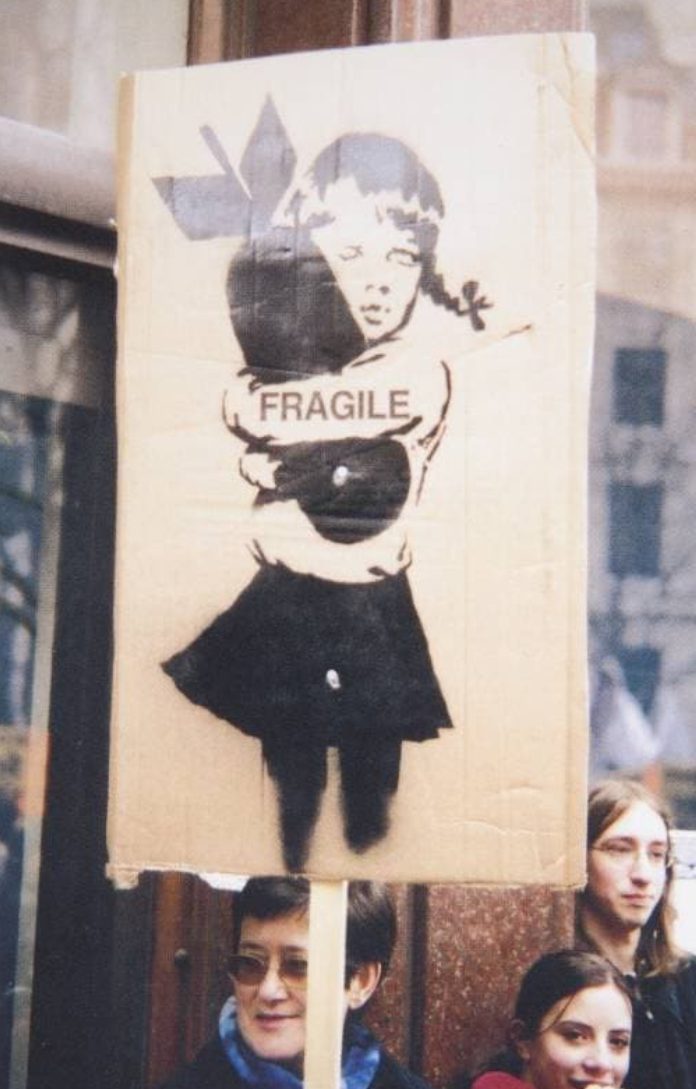
Yet the cardboard placards occupy a fundamentally different position from those later editions. They were inexpensive, functional objects made for political action rather than preservation. Many were presumably damaged, discarded or simply left behind after demonstrations. Their folds, torn edges and worn surfaces are therefore not incidental imperfections but evidence of what these objects originally were. Other surviving examples with direct protest provenance reinforce the ephemeral nature of the group.
The Photograph Changes Everything
What distinguishes this example is the remarkable survival not only of the placard but of its historical context. The newspaper clipping effectively reconnects the physical object with the moment in which it was used. The creased cardboard visible today is the same cardboard photographed in the hands of a young protester in March 2003.
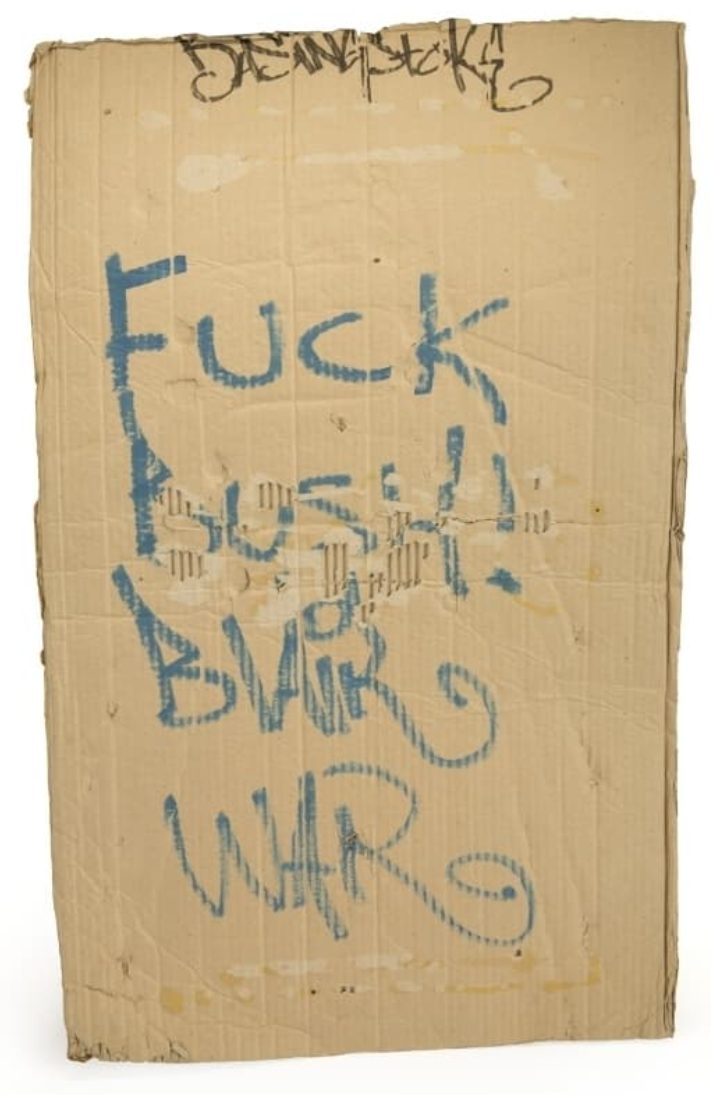
Even the reverse contributes to that biography. Covered with handwritten graffiti and the emphatic words “Fuck Bush! Blair’s War,” it reminds us that the placard existed within a living protest environment. Banksy's stencil was not treated as an untouchable artwork; the cardboard continued to accumulate messages, marks and traces of the people around it. Front and back consequently preserve two different visual languages of protest: Banksy's carefully constructed stencil on one side and the spontaneous handwriting of the street on the other.
Bomb Hugger (NO) is therefore more than an early version of an image that subsequently became iconic. It is a surviving artifact from the moment when that image was actively participating in the political culture from which it emerged.
Today, Bomb Hugger can be encountered as a valuable screenprint or painting, carefully framed and authenticated. This example reminds us of something considerably more immediate. In 2003 it was simply a piece of cardboard carried through an English town by an eighteen-year-old protester who wanted to say that she opposed a war.
The contemporary newspaper photograph makes that history unusually tangible. We do not have to reconstruct what this Banksy was originally made to do. We can actually see it doing it.
Variations Sold at Auction
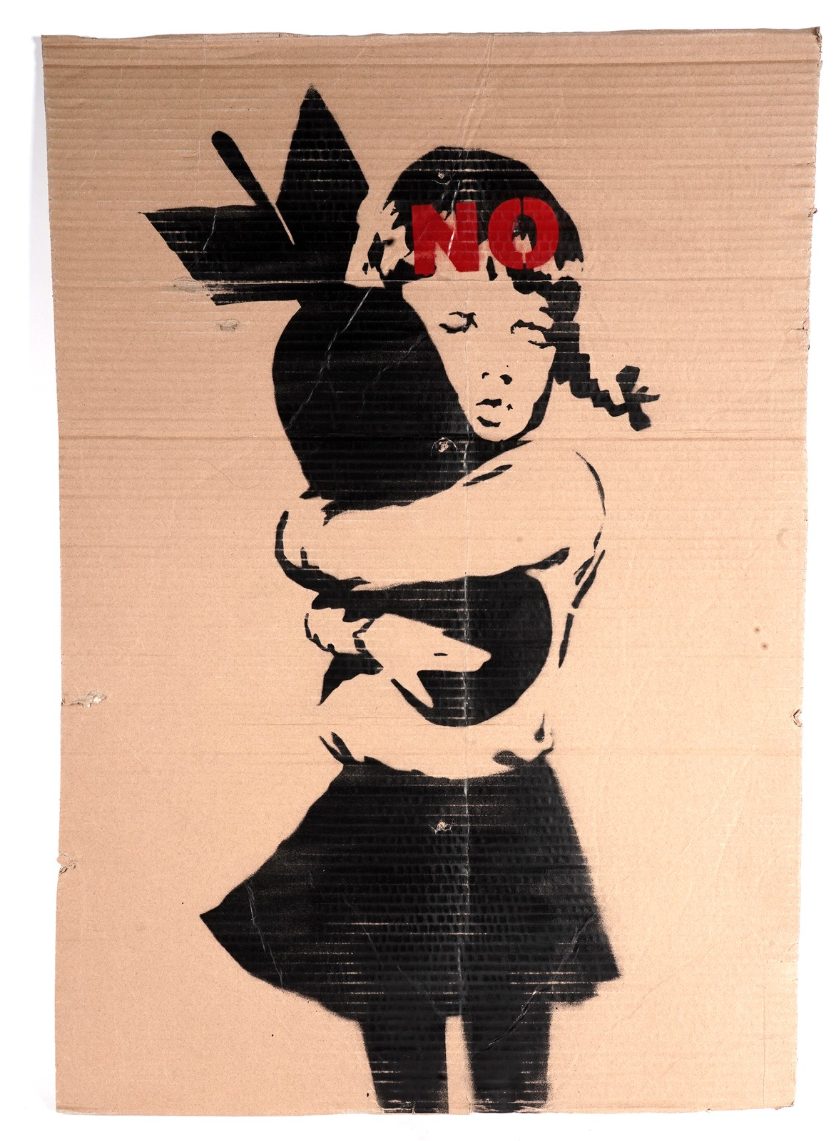
- Bomb Hugger / NO, 2003
- Spraypaint on cardboard
- 81 x 56.5 cm (32 x 21 1/4 inches)
Prices are inclusive of buyer’s premium unless stated otherwise, as reported by the auction houses.
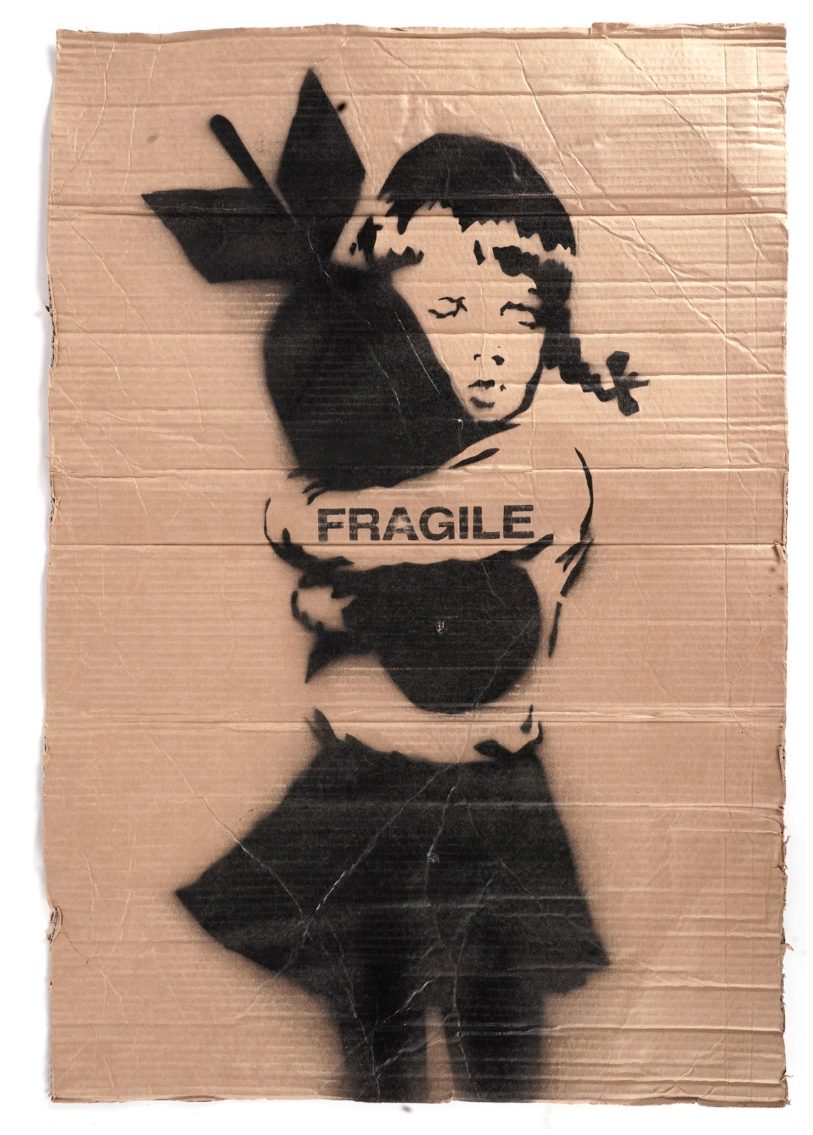
- Bomb Hugger / FRAGILE, 2003
- Spraypaint and stencil on cardboard
- 81.5 x 55 cm (32 x 21 3/4 inches)
Prices are inclusive of buyer’s premium unless stated otherwise, as reported by the auction houses.
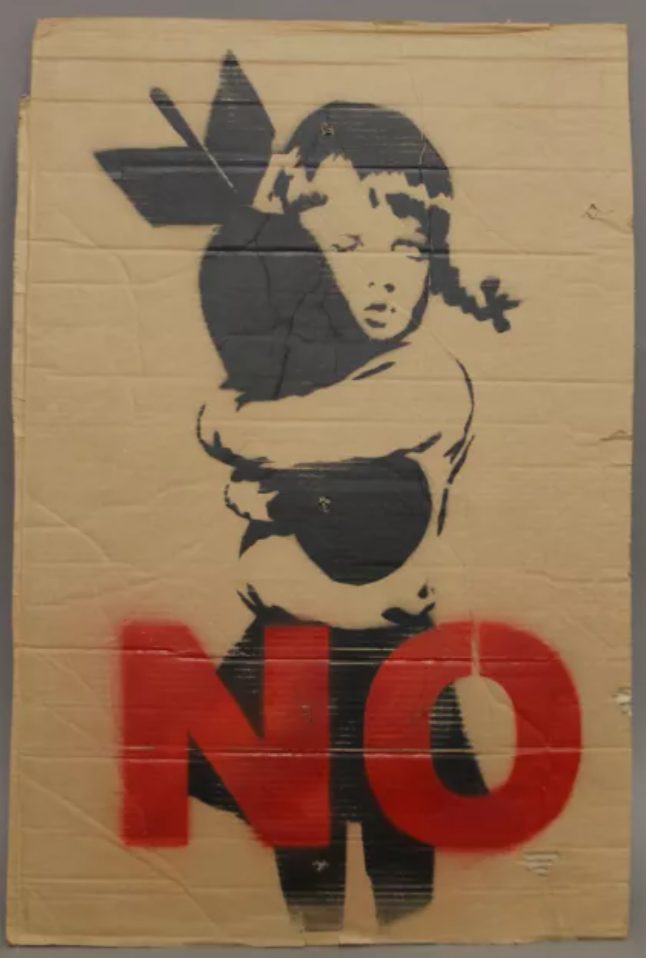
- Bomb Hugger NO, 2003
- Aerosol stencil on cardboard
- 56 x 84.5 cm (22 x 33 1/4 inches)
Prices are inclusive of buyer’s premium unless stated otherwise, as reported by the auction houses.
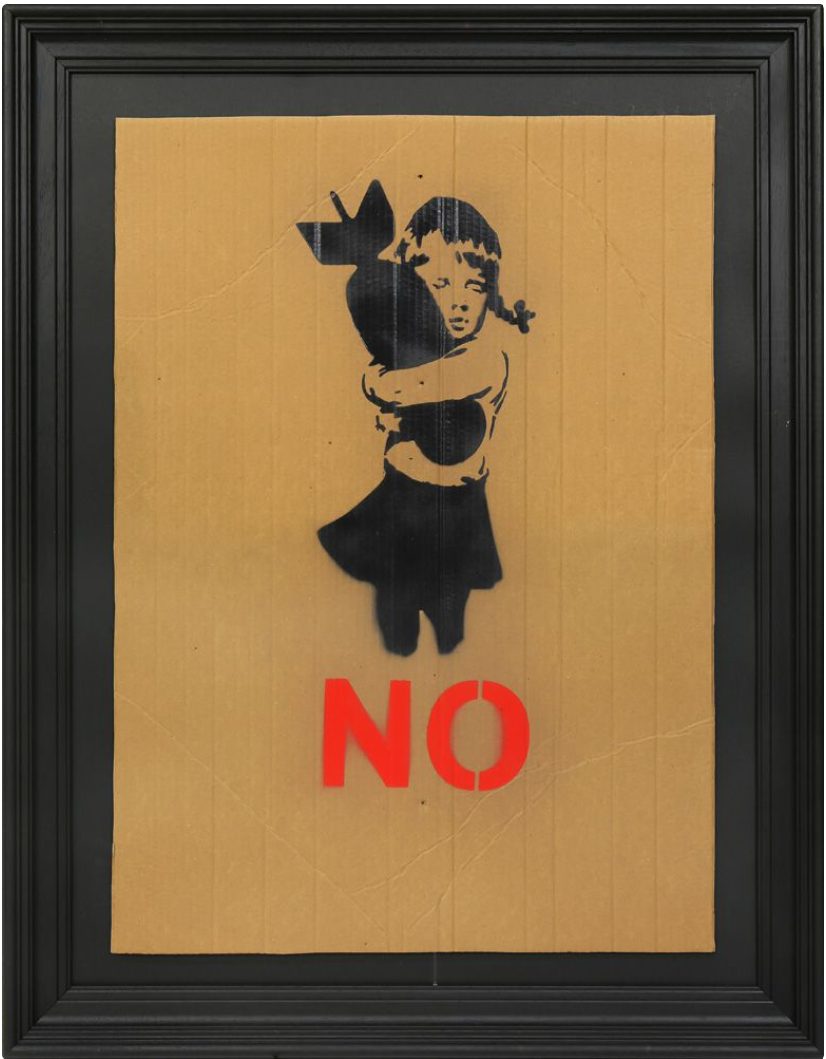
- Bomb Hugger, 2003
- Spraypaint and stencil on cardboard
- 90.8 x 65.4 cm (35 3/4 x 25 3/4 inches)
Prices are inclusive of buyer’s premium unless stated otherwise, as reported by the auction houses.
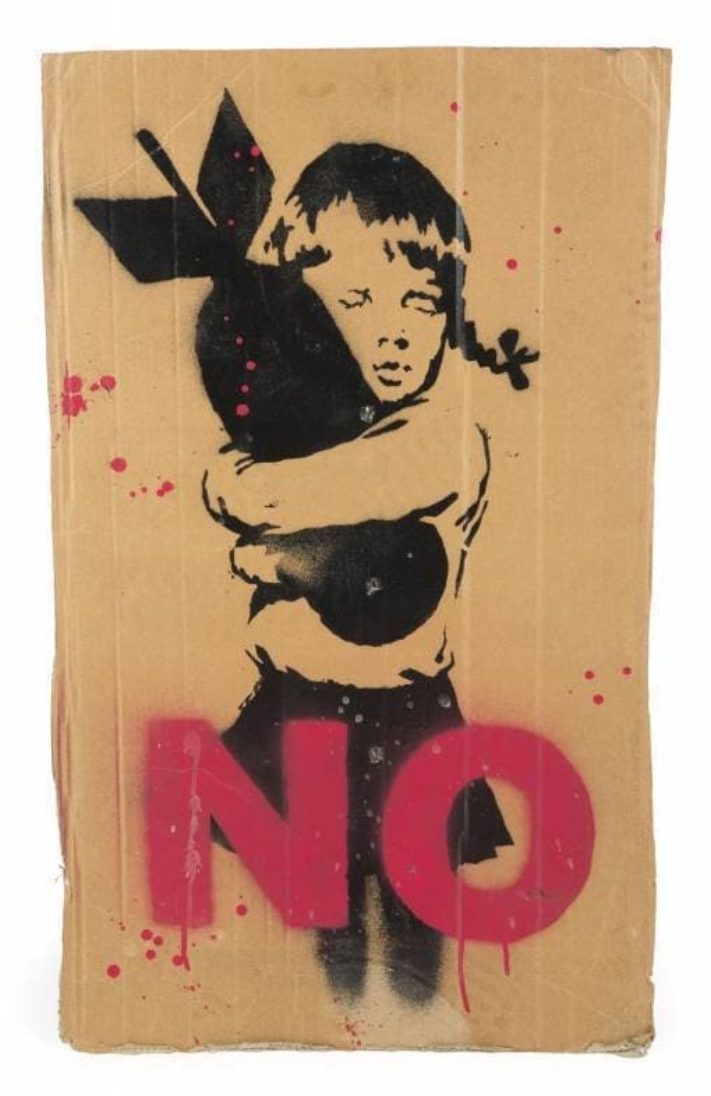
- Bomb Hugger, 2003
- Aerosol stencil in black and red on cardboard
- 94 x 54.6 cm (37 x 21 1/2 inches)
Prices are inclusive of buyer’s premium unless stated otherwise, as reported by the auction houses.
STAY INFORMED
Receive the latest news, exhibitions, artworks and market updates on Banksy.