BOY ON A LIFE PRESERVER SWING
Playing in the Aftermath
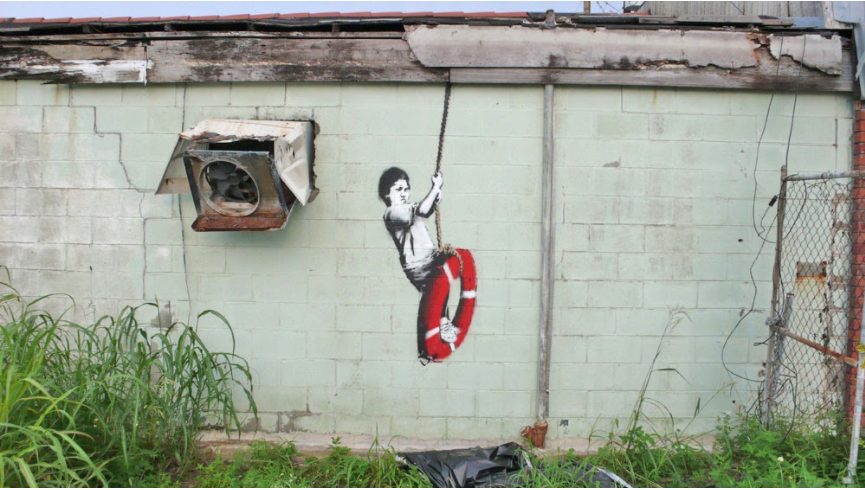
Among Banksy's New Orleans works, Boy on a Life Preserver Swing is one of the simplest and most affecting. Painted on the exterior wall of the Fat Cat, a neighborhood bar in the Lower Ninth Ward, it depicts a small child suspended from a rope, using a red-and-white life preserver as an improvised swing. The mural appeared in August 2008, three years after Hurricane Katrina devastated the city and catastrophically flooded the Lower Ninth Ward.
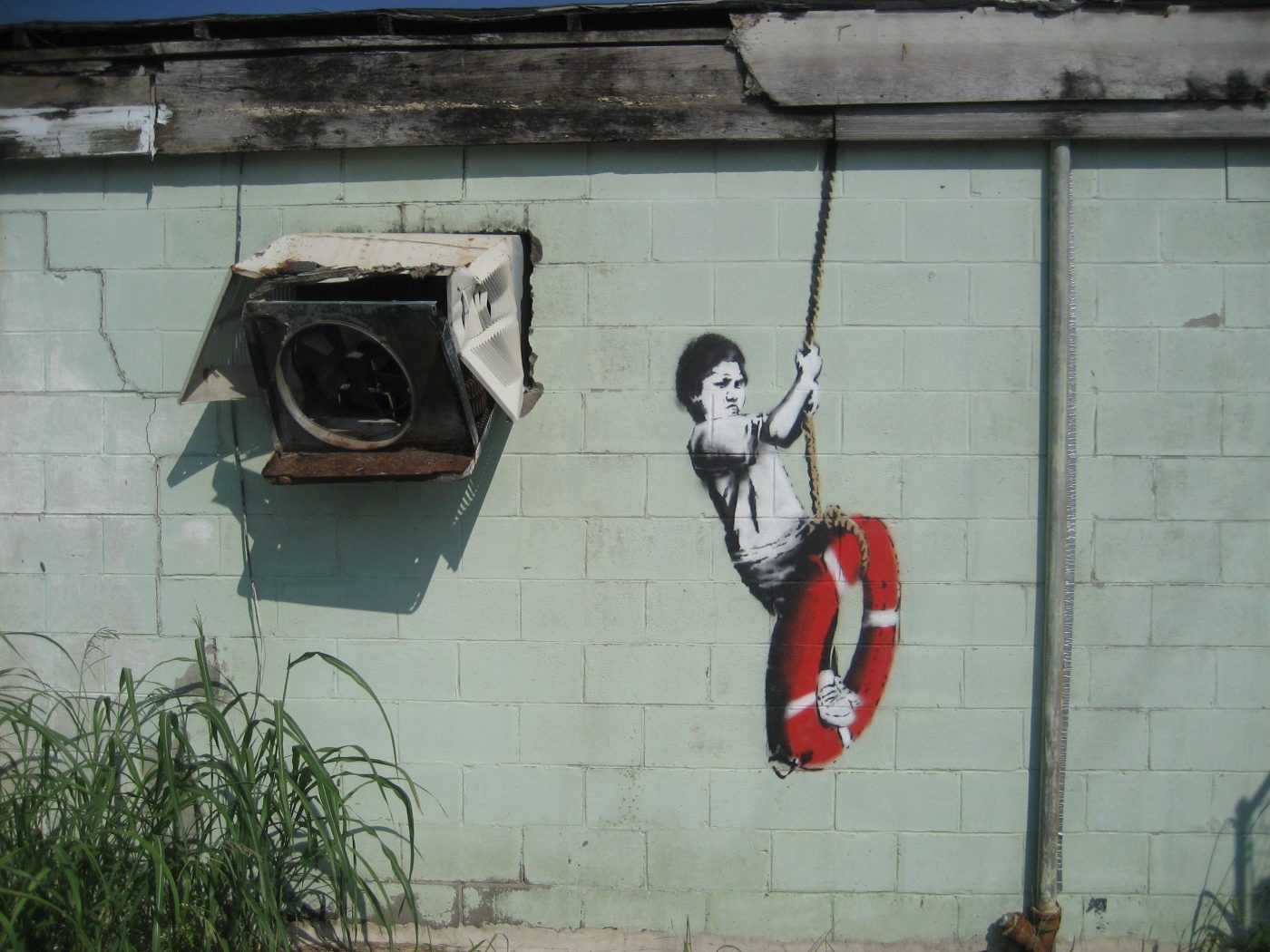
Banksy's intervention transforms an object associated with emergency and survival into a child's toy. The life preserver should protect someone from drowning; here it carries a child at play. That reversal gives the work its emotional force. Unlike some of Banksy's more overtly satirical images, there is no slogan and no obvious villain. A single object is enough to evoke the catastrophe that had transformed the surrounding neighborhood.
The composition also depends upon the wall itself. The boy appears against a largely empty surface, leaving the life preserver—and everything it represented in post-Katrina New Orleans—as the visual center of the image. Childhood resilience and vulnerability coexist: the child has turned the equipment of disaster into a game, yet the reason such an object carries such meaning in this particular place can never be forgotten.
The Lower Ninth Ward
Location is fundamental to the work. The Lower Ninth Ward became one of the defining landscapes of Katrina after failures in the city's flood-protection system allowed enormous quantities of water into the neighborhood. When Banksy arrived three years later, reconstruction remained incomplete and abandoned or damaged structures were still part of the urban landscape.
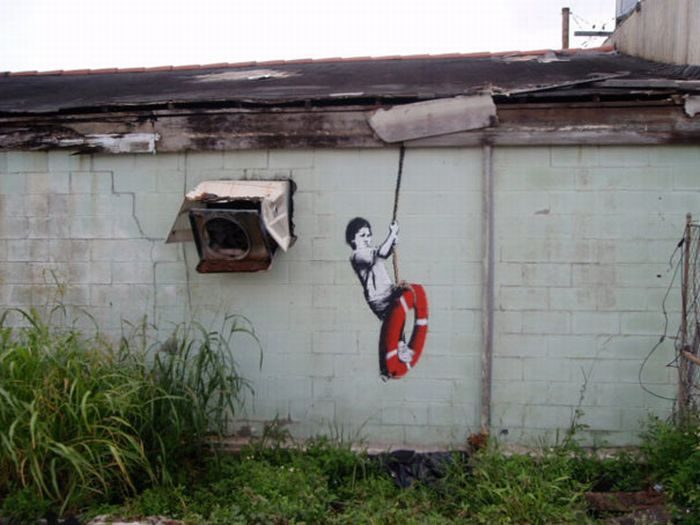
Banksy explicitly stated that his New Orleans intervention was intended to draw attention to the state of the clean-up three years after Katrina. Boy on a Life Preserver Swing expresses that criticism without depicting the hurricane itself. Instead, Banksy shows what happens afterward: disaster has become incorporated into everyday life.
There is something characteristically Banksy-like in the child's response. The boy does not appear defeated. He adapts. An object created for an emergency becomes something pleasurable; the debris and symbols of catastrophe are absorbed into childhood imagination. The image can therefore be read simultaneously as a comment on abandonment and as an image of resilience.
Destruction and an Extraordinary Recovery
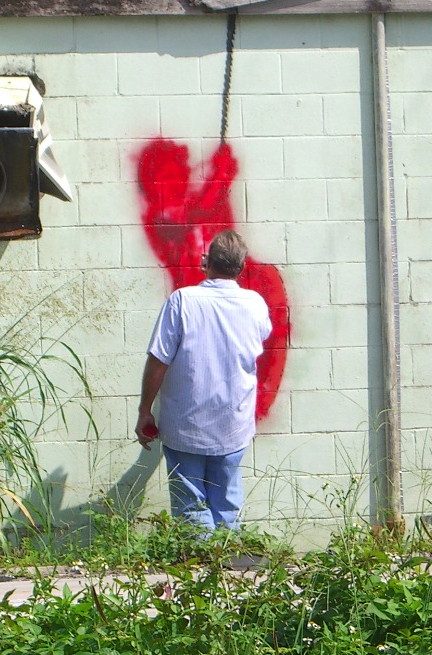
The mural's subsequent history became almost as remarkable as the work itself. It was quickly attacked with red spray paint, largely obscuring the figure, and was later covered again with mauve house paint. When the Fat Cat building was eventually demolished, the mural was widely assumed to have disappeared with it. It had not.
Dump-truck driver Ronnie Fredericks, who had known the mural before it was vandalized, recognized pieces of the painted concrete blocks among the demolition material and salvaged them. He preserved the fragments for years. In 2021, the blocks eventually reached New Orleans hotelier Sean Cummings and conservator Elise Grenier, who began the difficult process of reconstructing and recovering the image.
Removing spray paint from an underlying work that had itself been made with spray paint presented an unusual conservation problem. Grenier ultimately employed a specially developed gel that allowed the later red aerosol layer to be removed while preserving the Banksy stencil beneath it. The surviving blocks were reassembled into a freestanding wall, and the conservation was completed in 2023.
On 1 November 2024, the restored mural was unveiled at the International House Hotel at 221 Camp Street in New Orleans, where it is now on public display.
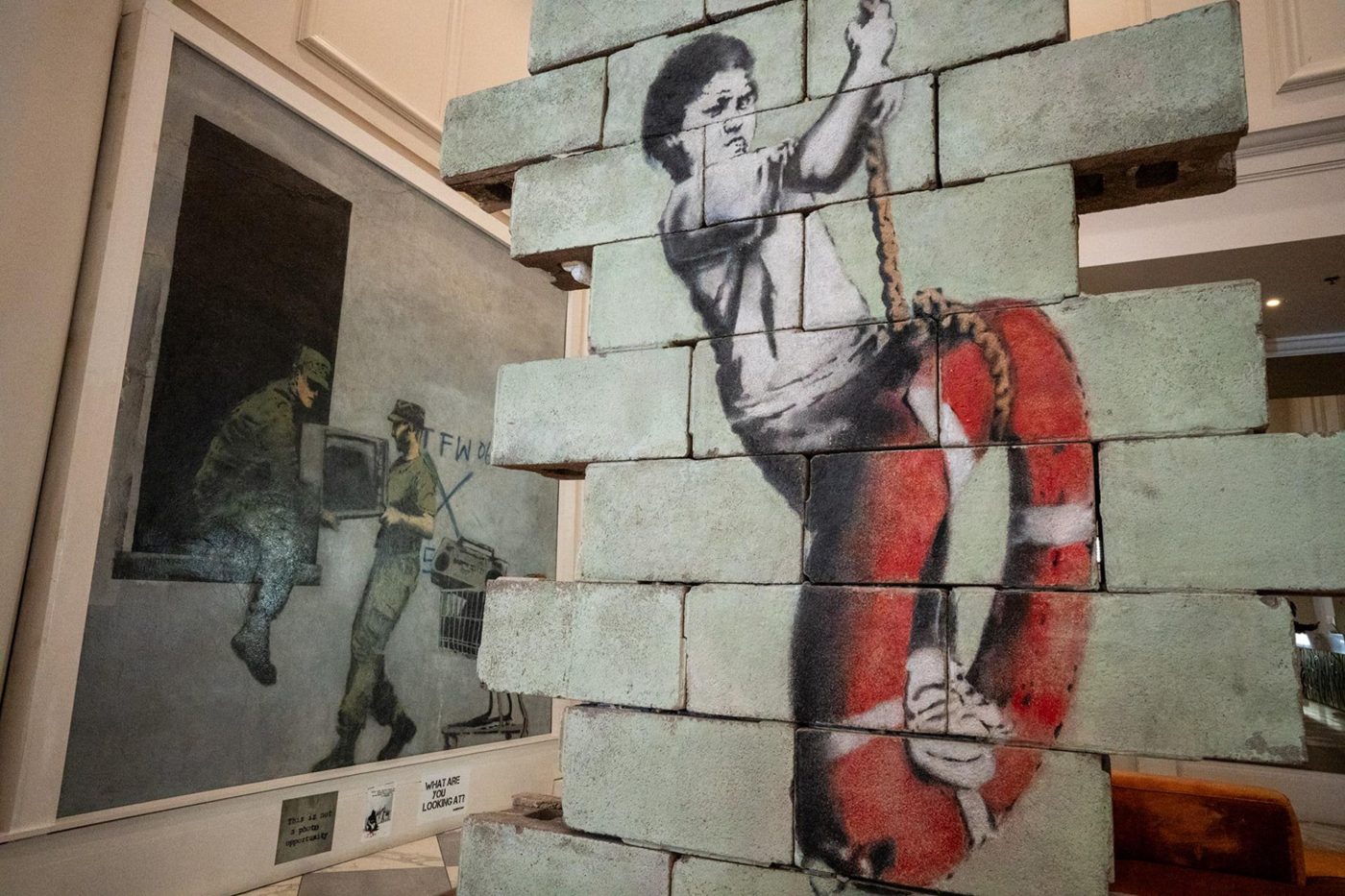
Its survival gives the work an extraordinary second chapter. A mural about a child adapting to the aftermath of destruction was itself vandalized, buried beneath paint, broken into blocks and nearly lost. Sixteen years after Banksy painted it, those fragments were put back together and the child emerged once again.
The life preserver ultimately saved more than the boy in the picture.
STAY INFORMED
Receive the latest news, exhibitions, artworks and market updates on Banksy.