BANKSY IN NEW-ORLEANS: AFTER THE FLOOD, AUGUST 2008
Three Years After Katrina
In August 2008, around the third anniversary of Hurricane Katrina, Banksy travelled to New Orleans and left approximately fourteen works across the city. Many appeared on buildings and walls that still bore the scars of the hurricane and the catastrophic flooding that followed the failure of the city's levees.
Three years after Katrina I wanted to highlight the state of the clean-up operation. Only later did it dawn on me that if you choose to do this by drawing all over their stuff, you're actually only slowing down that clean-up operation.
Banksy had not come simply to commemorate the disaster. Three years after Katrina, parts of New Orleans remained devastated, and the slow pace of reconstruction had become inseparable from broader questions of poverty, race, government responsibility and institutional failure. The city itself became both the setting and the subject of one of the most concentrated street interventions of Banksy's career.
Some of the things that are supposed to protect us, can also harm us.
Banksy later summarized the project with characteristic self-mockery: he had wanted to highlight the state of the clean-up three years after Katrina, only to realize that “drawing all over their stuff” was technically slowing the clean-up down himself.
A City Still Recovering
Rather than illustrating Hurricane Katrina directly, Banksy responded to what the disaster had left behind. Children play with objects associated with flooding and displacement; an American president is transformed into a homeless figure; symbols of authority and protection fail in their intended purpose. Elsewhere, local graffiti culture itself becomes the subject.
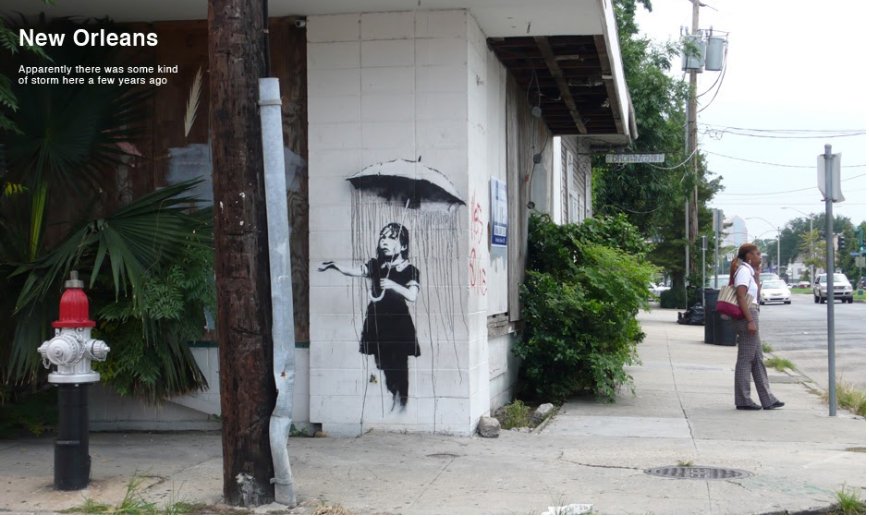
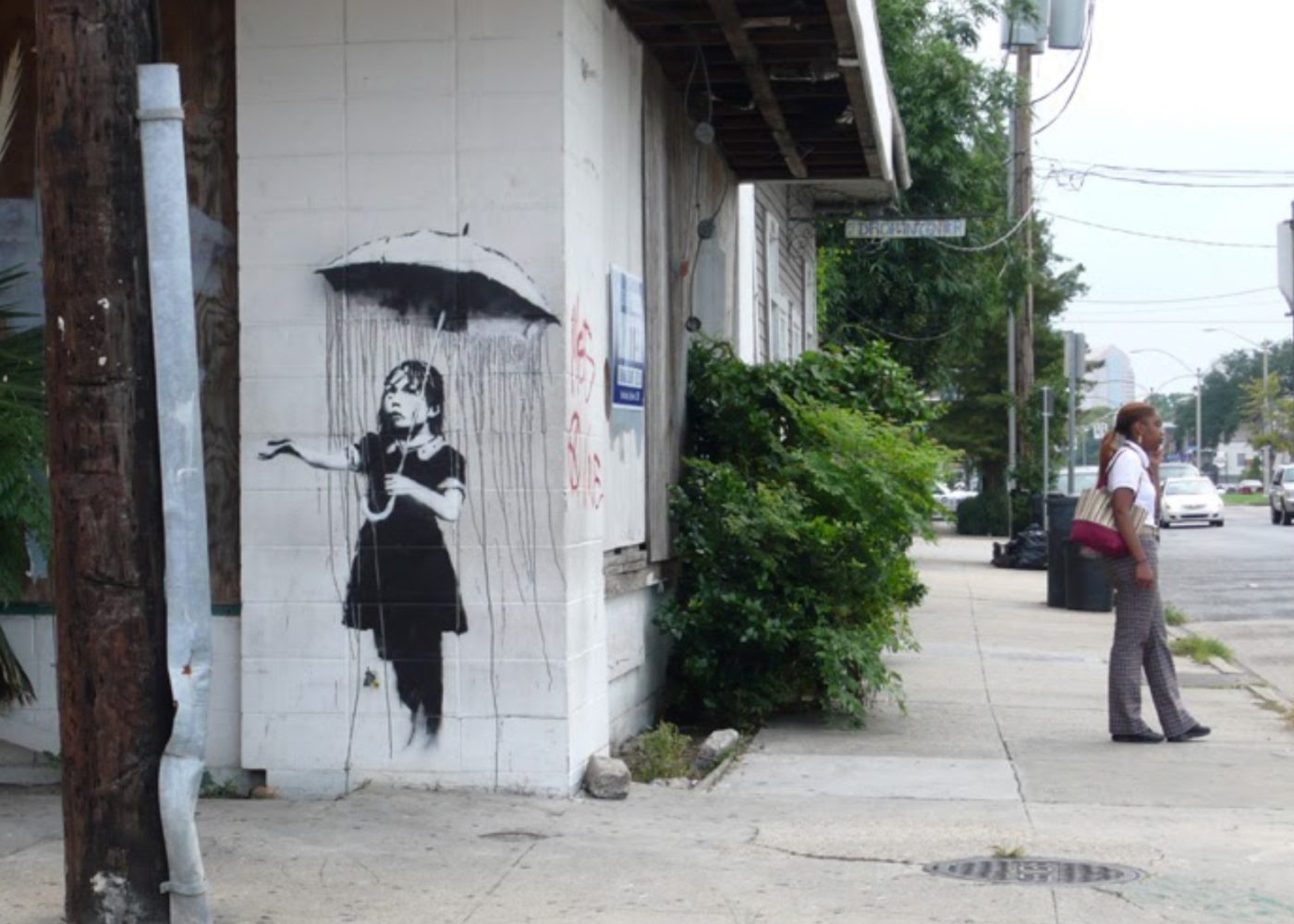
The most enduring image from the campaign was Nola, or Umbrella Girl. A young girl stands beneath an umbrella that should protect her from the rain, yet the water pours from inside it while the world outside remains dry. The reversal offered a remarkably economical metaphor for institutional failure: protection itself has become the source of danger.
Across the campaign, Banksy's characteristic humor prevents the works from becoming monuments to catastrophe. They are frequently absurd, sometimes caustic and occasionally playful. Yet beneath the jokes lies a persistent question: what happens when the institutions, infrastructure and authorities intended to protect a population fail to do so?
Banksy Versus the Gray Ghost
The New Orleans intervention also developed into another battle entirely. Banksy encountered the work of Fred Radtke, the local anti-graffiti activist known as the “Gray Ghost,” who had spent years covering graffiti with conspicuous patches of grey paint. Banksy publicly declared that he had come to New Orleans “to do battle with the Gray Ghost,” accusing him of doing enormous damage to the city's visual culture.
Banksy responded with several works in which the act of graffiti removal itself became the subject. In one, a grey-painted figure eradicates a colorful flower; in another, a painter rolls grey paint over a terrified stick figure. Existing patches of grey paint were incorporated into the compositions, transforming the marks of censorship into part of the artwork.
The confrontation introduced a second meaning to the idea of “cleaning up” New Orleans. Banksy had arrived to comment on a city whose physical reconstruction remained incomplete, only to discover another campaign dedicated to cleaning its walls. The resulting works ask one of the central questions running throughout Banksy's career: who decides what constitutes vandalism, and who has the authority to erase it?
The City as Canvas
The New Orleans campaign belongs to an important development in Banksy's practice. Individual works such as Nola can be understood independently, but the intervention becomes considerably richer when viewed as a whole. Banksy was responding not simply to Katrina but to the city three years later: its damaged architecture, its inequalities, its unfinished reconstruction, its graffiti and the people attempting to erase it.
As he would later do in Palestine, during Spraycation on the English coast and, most dramatically, in Ukraine, Banksy treated geography itself as part of the work. The murals were dispersed across New Orleans, but together they formed a single intervention in which image, location and contemporary history continually informed one another.
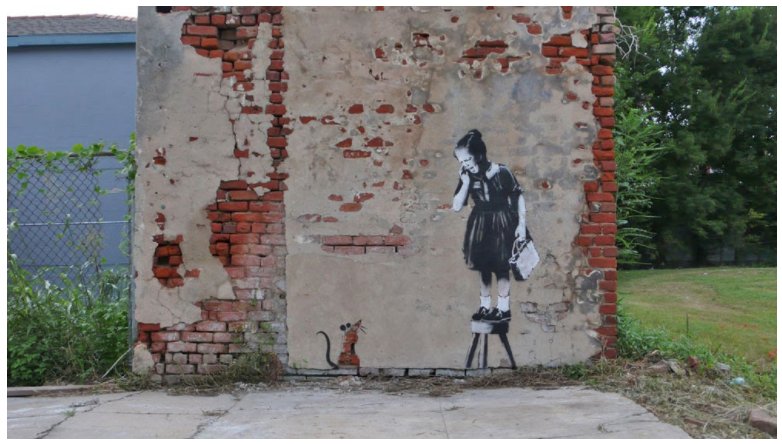
Most of the works have since disappeared, been painted over, destroyed or removed. Their impermanence is part of their history. Nola survived behind protective covering and became an internationally recognized Banksy image; Gray Ghost Attacks Stick Figure followed a very different path, eventually being removed from its wall and entering the art market. Other works survive primarily through photographs and documentation.
What remains is one of Banksy's most significant sustained engagements with an American city. New Orleans was not merely a backdrop onto which he placed a collection of stencils. Its ruins, street signs, abandoned objects, political history and existing graffiti provided the material from which the intervention was made.
The New Orleans Murals
1. Nola (Umbrella Girl)
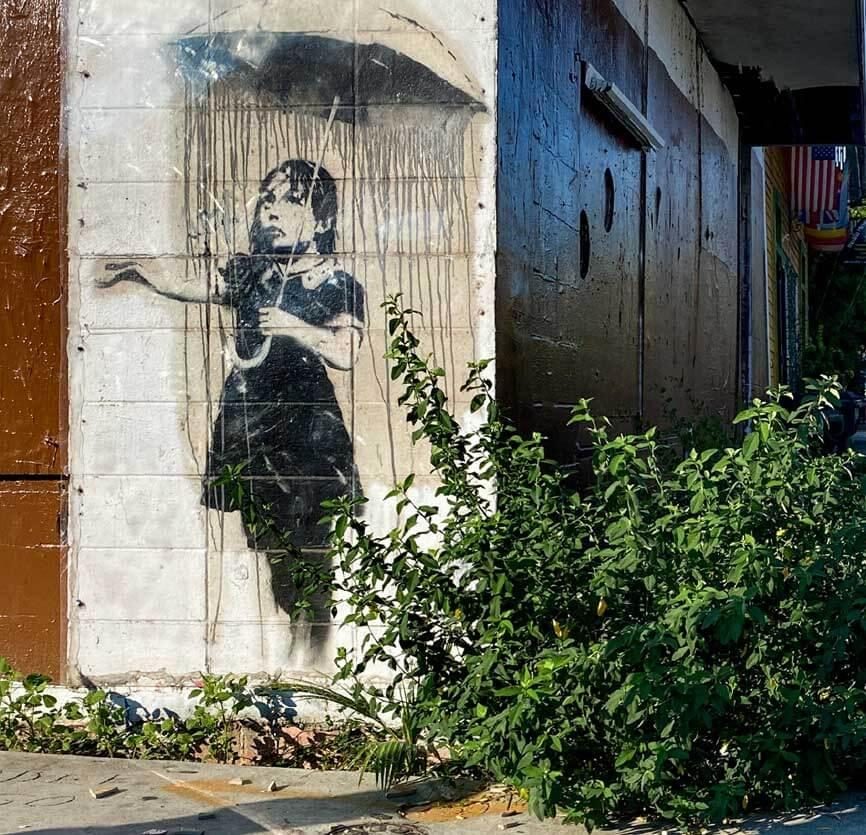
A young girl stands beneath an umbrella from which rain inexplicably falls on the inside. The best-known image of the campaign became one of Banksy's defining metaphors for the failure of systems designed to protect us.
2. Abraham Lincoln
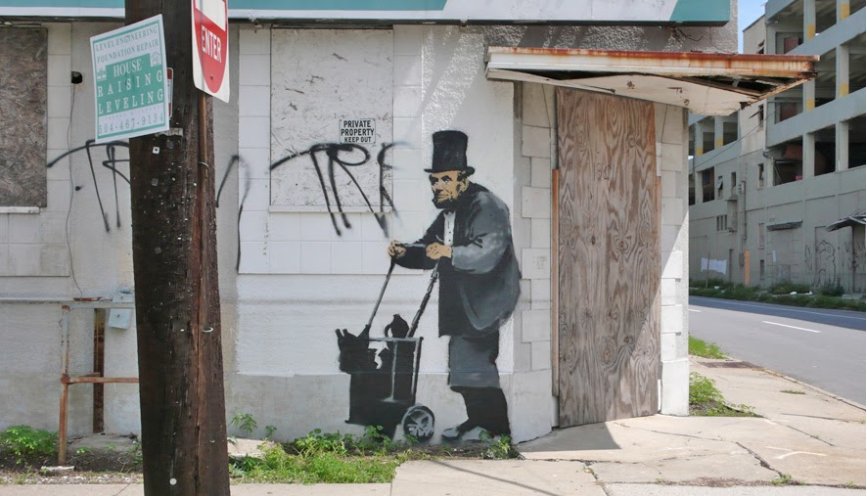
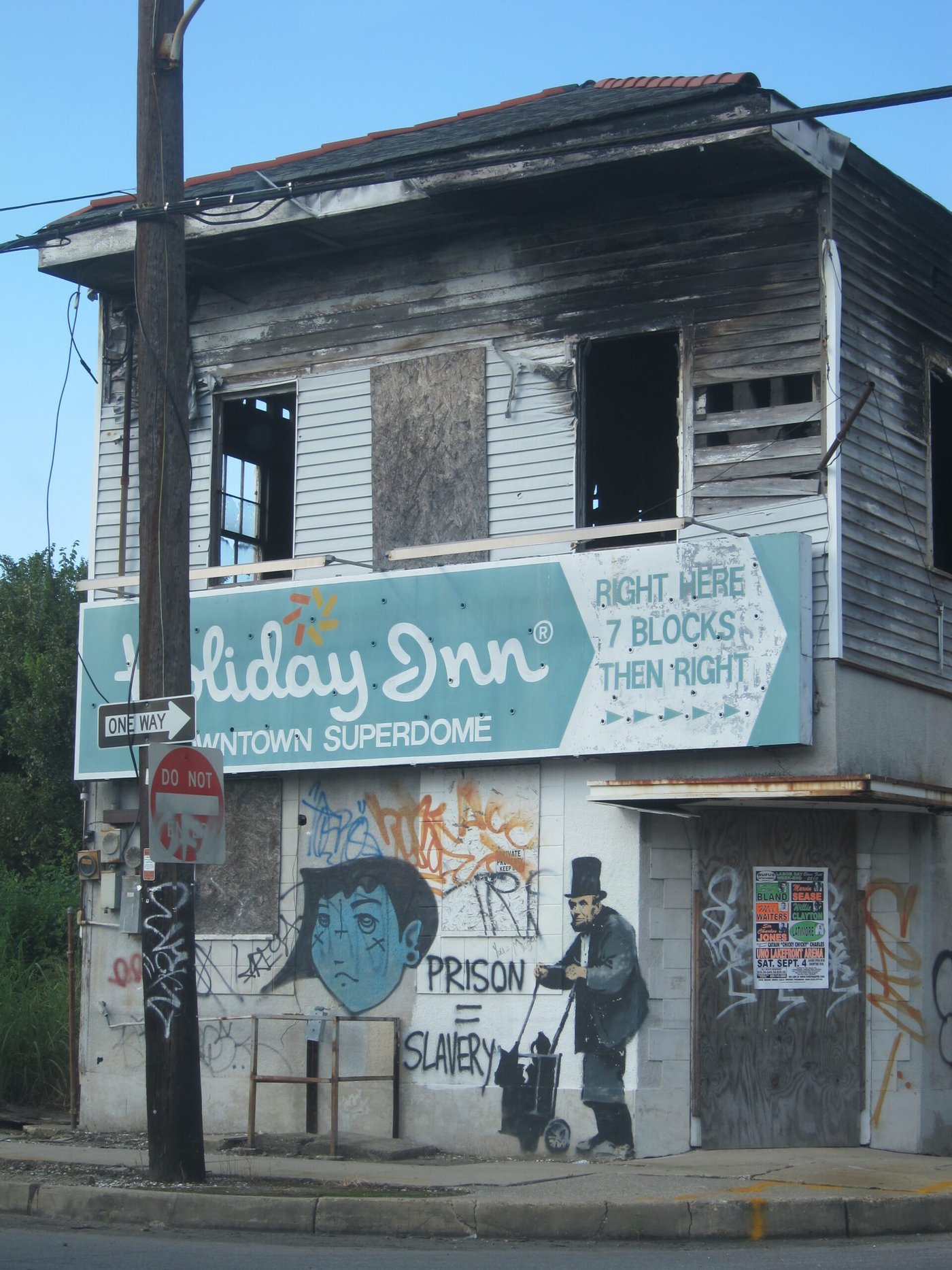
The sixteenth President of the United States appears as a homeless figure pushing a shopping cart, bringing an American icon of emancipation into confrontation with poverty, displacement and the racial inequalities exposed by Katrina. → Explore the catalogue entry
3. Gray Ghost Attacks Stick Figure
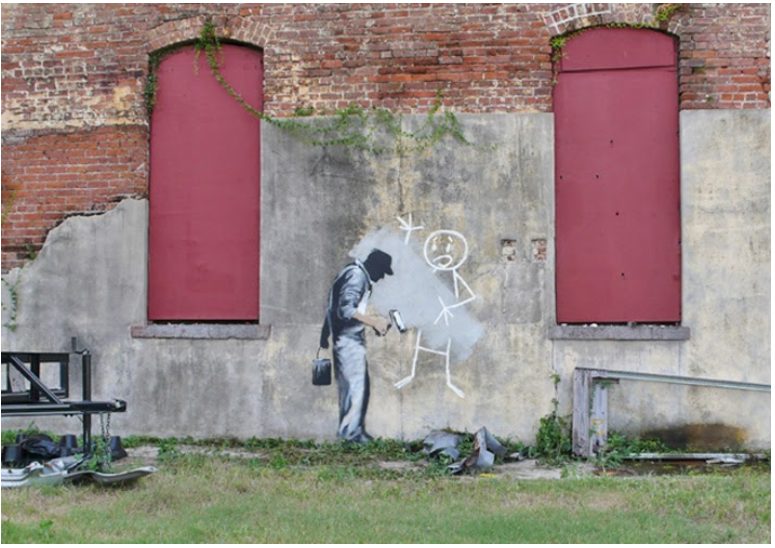
An anonymous painter rolls grey paint over a distressed stick figure, turning the methods of New Orleans' most notorious anti-graffiti campaign into the subject of Banksy's own graffiti. → Explore the catalogue entry
4. Grey Ghost Painting Over Flowers
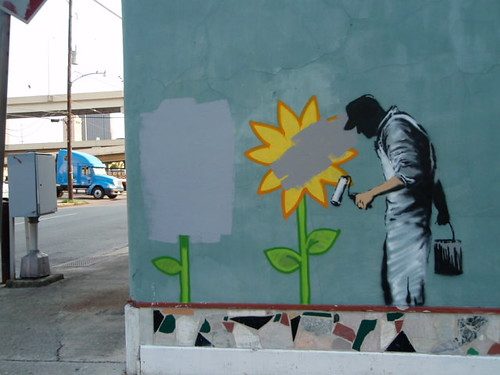
A graffiti remover methodically covers a vivid flower with grey paint, transforming an act presented as urban beautification into an image of cultural erasure.
5. I Must Not Copy What I See on The Simpsons
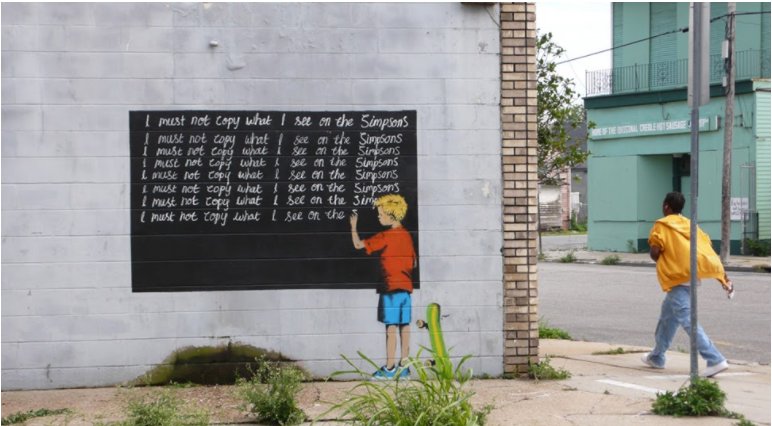
Banksy's version of Bart Simpson repeatedly writing lines on a blackboard appeared at St. Bernard Avenue and North Robertson Street—two years before Banksy would create his notorious opening sequence for The Simpsons.
6. No Loitering
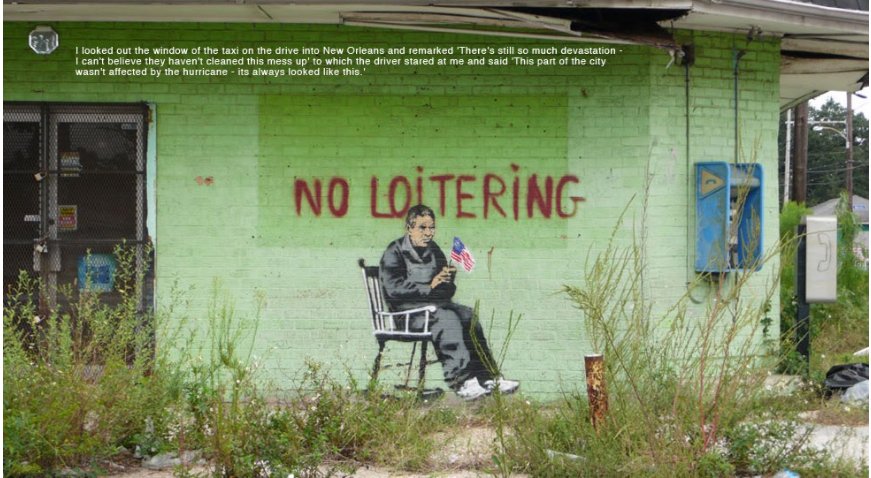
An elderly man sits quietly in a rocking chair beneath an existing “No Loitering” sign, turning municipal regulation into an understated joke about public space, belonging and authority.
7. Boy on a Life Preserver Swing
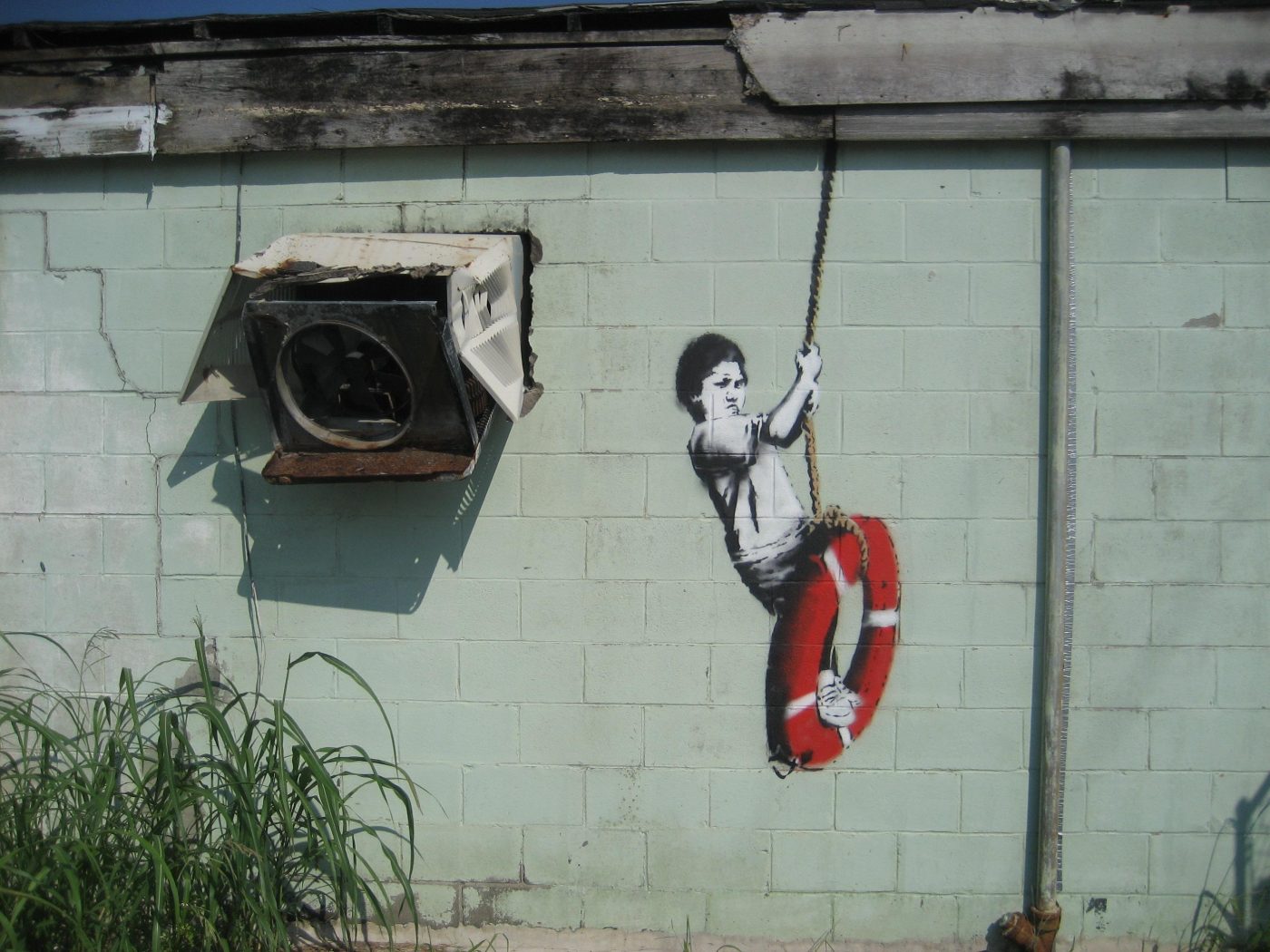
A child uses a life preserver as a swing in the Lower Ninth Ward, transforming an object associated with emergency and survival into an instrument of childhood play.
8. Child with Kite Fridge
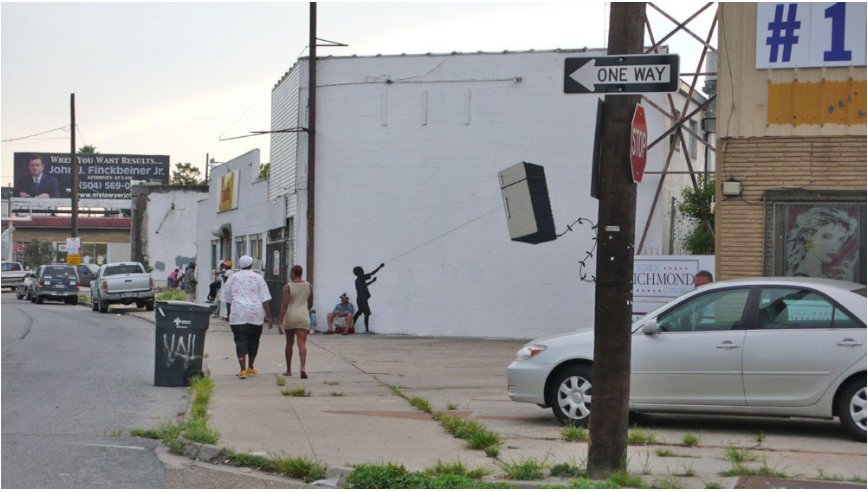
A child appears to fly a refrigerator as though it were a kite. Refrigerators became an unmistakable feature of Katrina's aftermath as flood-damaged appliances accumulated throughout the devastated city.
9. Looters
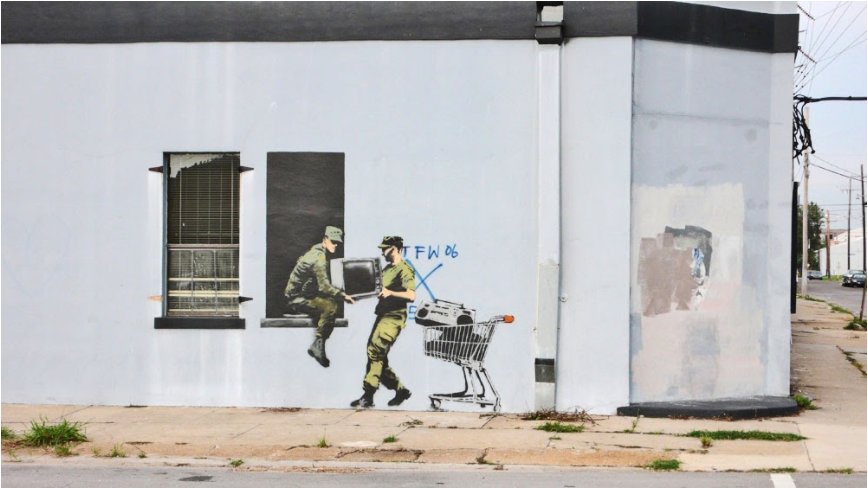
Banksy turns to one of the most politically charged images associated with Katrina's aftermath: looting, survival and the contested representation of those left behind after the disaster.
10. Jazz Players
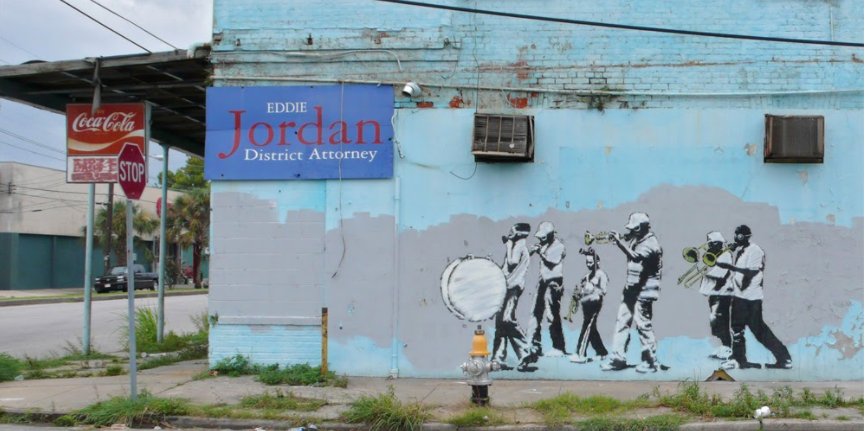
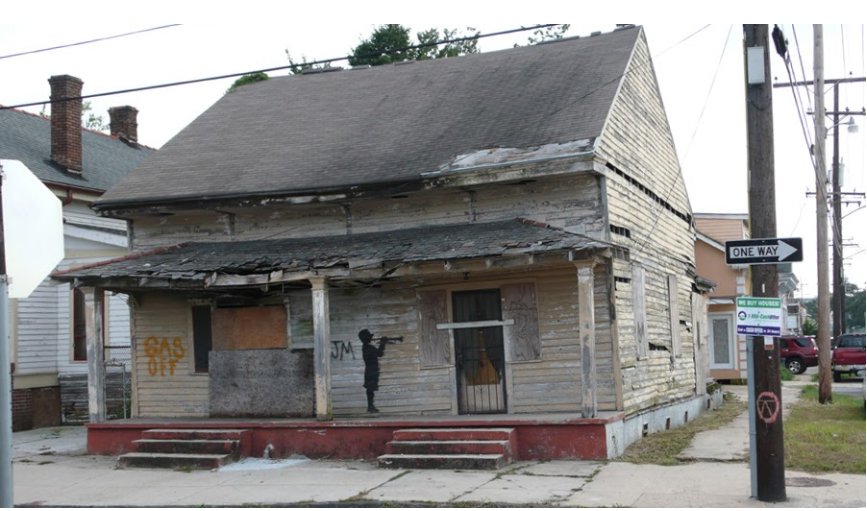
A group of musicians invokes the cultural identity of New Orleans itself, placing the city's musical tradition directly onto its battered urban fabric.
11. New Orleans Rats
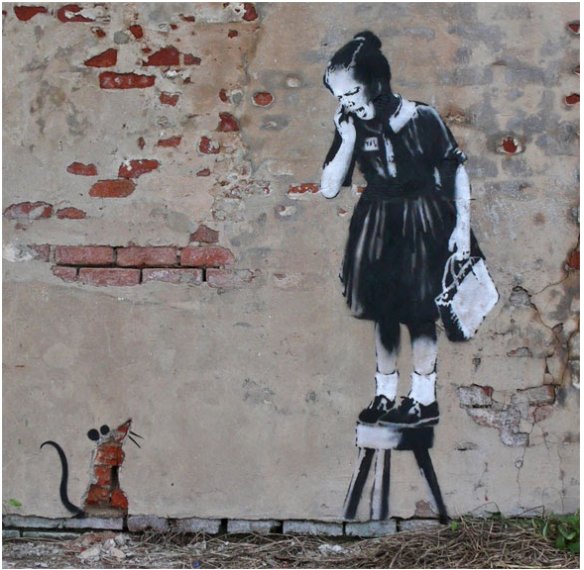
Banksy's recurring rats also appeared across the city, bringing his familiar outsiders and survivors into a landscape where questions of abandonment, endurance and urban neglect had acquired an unusually literal meaning.
STAY INFORMED
Receive the latest news, exhibitions, artworks and market updates on Banksy.