BANKSY
Banksquiat. Boy and Dog in Stop and Search, 2018
Acrylic and wax marker on birch wood, in 3 parts
243.8 x 344.5 cm (96 x 135 5/8 inches)
Signed “Banksy” lower right
Provenance
The artist
Private Collection, Hawaii
Acquired from the above by the present owner
Exhibited
Los Angeles, Beyond the Streets, May 6–August 26, 2018 (illustrated on the exhibition poster)
Auction History
| Phillips New-York 17 May 2023 Estimated: USD 8,000,000 – 12,000,000 |
Price Realized |
Catalogue Essay
When the Barbican Centre announced Basquiat: Boom for Real in 2017, London prepared to celebrate one of the most influential artists of the twentieth century. More than three decades after his untimely death, Jean-Michel Basquiat had become a museum icon, his paintings commanding tens of millions of dollars and occupying the walls of the world’s leading institutions. Banksy noticed an irony that few others acknowledged.


More than a tribute, Banksquiat is a conversation between two artists who transformed graffiti into one of the defining artistic languages of their generation. It is also a reflection on institutional hypocrisy, racial inequality and the strange journey of street art from criminal offence to museum masterpiece.
Banksy Visits the Barbican
On the morning of 17 September 2017, staff arriving at the Barbican Centre discovered that Banksy had unexpectedly become part of their exhibition. Without invitation or permission, he had installed two new works directly onto the museum’s exterior walls, creating what was perhaps the most talked-about “unofficial exhibit” of the year.
“Major new Basquiat show opens at the Barbican. A place that is normally very keen to clean any graffiti from its walls.”

The timing was carefully orchestrated. The Barbican was preparing to open Basquiat: Boom for Real, the first major retrospective of Jean-Michel Basquiat ever held in the United Kingdom. The exhibition celebrated Basquiat’s extraordinary journey from the streets of Lower Manhattan to the pinnacle of the international art world.
Rather than hanging inside the galleries, Banksy chose to exhibit exactly where both he and Basquiat had begun: on the street. In a single sentence, Banksy exposed one of the central contradictions of contemporary art. Graffiti is celebrated once it belongs to Basquiat yet routinely erased when produced by anonymous artists outside the museum walls.
From Street Intervention to Monumental Canvas
Banksquiat. Boy and Dog in Stop and Search
The following year, Banksy revisited one of the Barbican murals in the studio, expanding it into the monumental three-panel work Banksquiat. Boy and Dog in Stop and Search. Executed in acrylic and wax marker on birch wood, the composition was exhibited in Beyond the Streets in Los Angeles before achieving USD 9.7 million at Phillips New York in 2023.
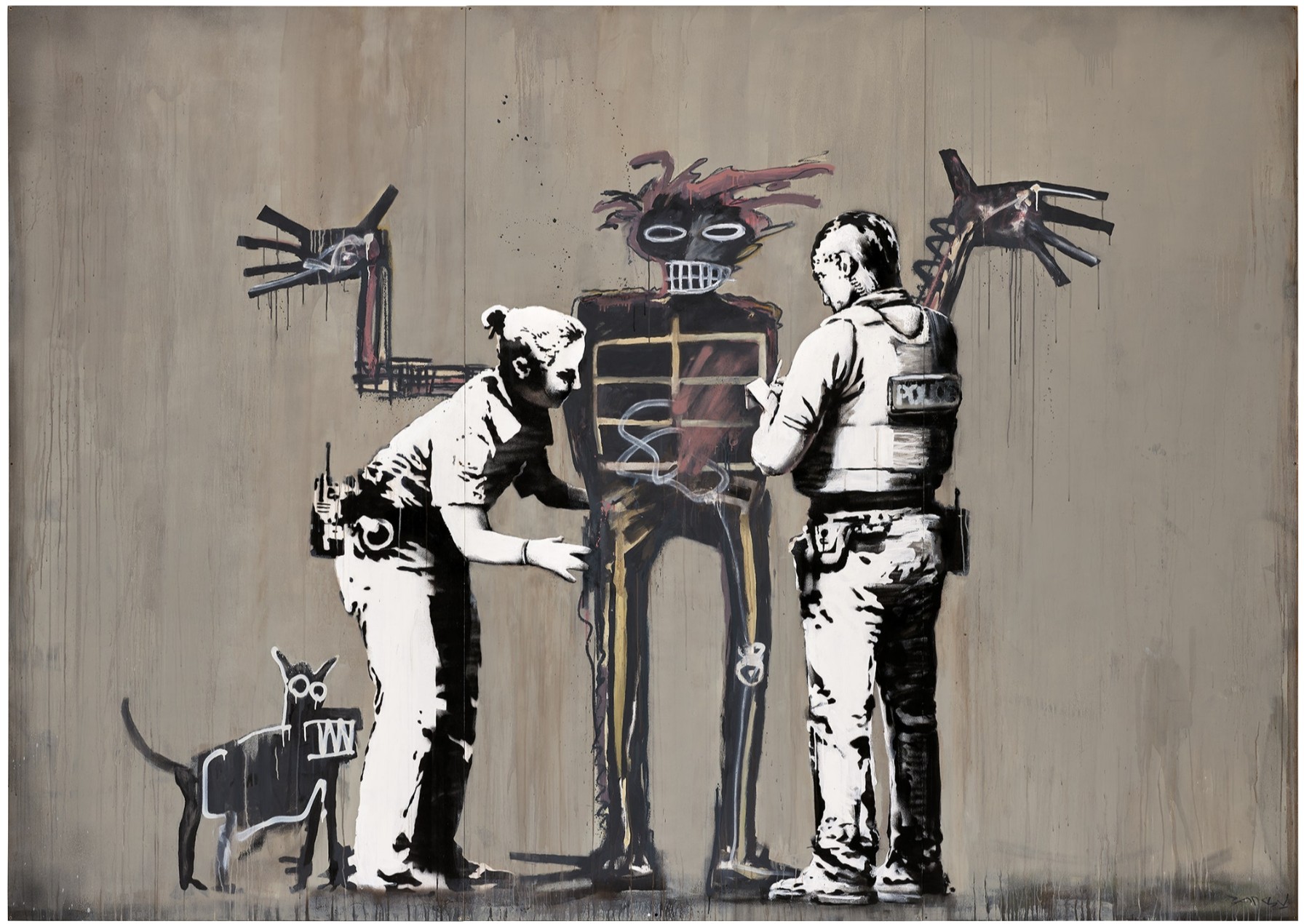
Unlike the temporary mural, the studio work allows the viewer to appreciate the remarkable dialogue between two artistic languages. Basquiat’s raw, expressive figures remain intact, while Banksy’s meticulously cut stencil policemen introduce a completely new narrative. The result is neither a copy nor a collaboration, but an artistic conversation across generations.
Boy and Dog in a Johnnypump
At the heart of the composition lies Basquiat’s celebrated Boy and Dog in a Johnnypump (1982). Painted during the artist’s meteoric rise in New York, the work captures the exuberance of urban life, with its vibrant colours and energetic brushwork celebrating the vitality of Brooklyn’s streets.

Jean-Michel Basquiat, Boy and Dog in a Johnnypump, 1982. Private Collection.
Image: akg-images, Artwork: © Estate of Jean-Michel Basquiat. Licensed by Artestar, New York
Banksy preserves Basquiat’s unmistakable visual language while radically changing its context. The expressive figures remain untouched, but their environment has become one of surveillance rather than celebration. What was once a carefree moment now unfolds under the watchful eyes of authority.
The contrast is striking. Basquiat paints with explosive spontaneity; Banksy responds with the precision of the stencil. One artist builds through gesture, the other through reduction. Yet both share the same desire to challenge established ideas about art, identity and power.
From Celebration to Suspicion
Banksy’s most significant intervention is deceptively simple. In Basquiat’s original painting, the raised arms of the central figure suggest movement, celebration and youthful energy. Banksy’s addition of two Metropolitan Police officers transforms that gesture into one of compliance during a stop-and-search. The meaning of the image changes instantly.

While Banksquiat. Boy and Dog in Stop and Search finds its visual basis in Basquiat’s Boy and Dog in a Johnnypump, Banksy reinterprets Basquiat’s imagery—and rewrites his title—to shift the meaning of the work. Basquiat’s Boy and Dog in a Johnnypump is a blistering summer scene, with the boy and dog posing in the red-hot water of a johnnypump, slang for an opened fire hydrant that turns the street into an impromptu (and technically illegal) water park. Spike Lee famously captures the raucous joy of this summertime activity in his 1989 film, Do the Right Thing, which focuses on residents of Bedford Stuyvesant, a historically Black neighborhood in Basquiat’s native Brooklyn. Basquiat paints his figures against a vibrant background of red, green, and yellow, colors which commonly feature on Caribbean and African textiles, like rastacaps, kente cloth, and the traditional Ethiopian flag. These colors, in place of the white spray of rushing water, underscore the localized connection of the visuals of Boy and Dog in a Johnnypump to the lived experience and material existence of Black Brooklynites.
If Basquiat’s painting, Boy and Dog in a Johnnypump, lives in the joyous outset of Spike Lee’s scene, as residents jump and play in the open fire hydrant, then Banksquiat lives in the aftermath, once a white man calls the police on the Black residents. Spike Lee masterfully navigates the precarious joy of the johnnypump in the narrative of the film; Banksy, too, makes careful artistic choices to adapt Basquiat’s work to the presence of his stenciled Metropolitan Police. Banksy removes the majority of Basquiat’s tricolor, Pan-African background, leaving only a thin grey-scaled outline around the figures in the present work. The male figure’s hands, raised perhaps in play or celebration in Basquiat’s original, become a clear “hands up” gesture in the presence of the police. As in Spike Lee’s film, Banksy’s artistic choices show how quickly a playful moment can become a tense encounter for Black Americans; the Johnnypump transforms into a Stop and Search.

Banksy asks an uncomfortable question: had Basquiat himself been standing outside the Barbican in 2017 rather than hanging inside its galleries, would he have been welcomed as a celebrated artist—or stopped as a suspicious young Black graffiti writer?
The Museum Paradox
Graffiti Once It Becomes Valuable
Perhaps the greatest irony of the entire project is what happened next. Rather than removing Banksy’s unauthorized murals, the Barbican and the City of London moved quickly to protect them. Security was increased, Perspex screens were installed and discussions began about their long-term preservation. The institution that normally removed graffiti had suddenly become its custodian.
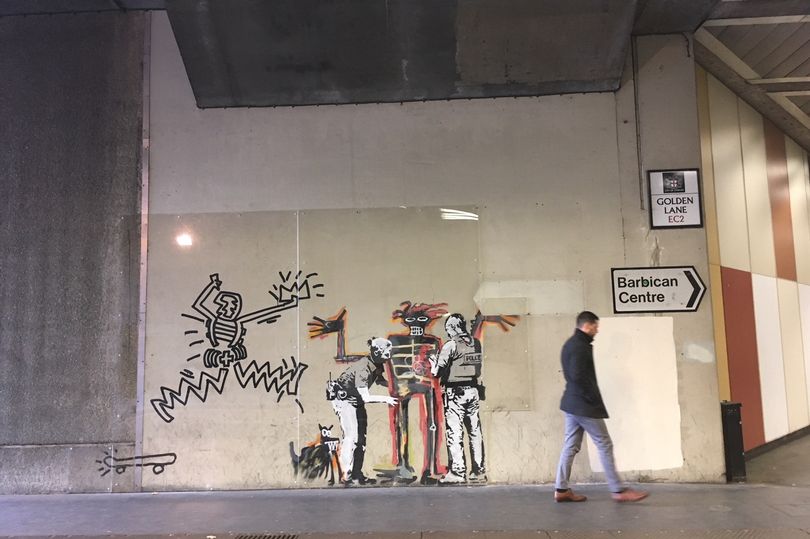
Banksy exposes a contradiction that extends far beyond the Barbican itself. Street art is often dismissed as vandalism until history, the market or a famous signature transforms it into culture. The wall has not changed. Only our perception has.
Appropriation and Institutional Critique
Banksquiat belongs to a long tradition of Banksy’s dialogue with art history. Like the Vandalized Oils, Show Me the Monet and Peckham Rock, the work appropriates an existing masterpiece not to parody it, but to reveal new meanings hidden beneath familiar images.
Unlike many of those works, however, Banksquiat is deeply respectful. Banksy is not mocking Basquiat; he is acknowledging him as one of the artists who helped make his own career possible.
The painting therefore becomes both homage and continuation. Basquiat fought to bring street culture into the museum. Banksy reminds us that the tensions Basquiat confronted—questions of race, legitimacy and institutional acceptance—have by no means disappeared.
A Conversation Across Generations
Banksquiat is far more than a tribute to Jean-Michel Basquiat. It is a meditation on who gets to make art, who gets to preserve it and who decides when an act of rebellion becomes a masterpiece.
By placing Basquiat’s expressive figures face to face with his own stenciled police officers, Banksy creates a dialogue that extends across four decades of contemporary art. One artist transformed graffiti into painting. The other transformed graffiti into global cultural commentary.
Their methods may differ, but their ambition is remarkably similar. Both understood that the street is not simply a place where art happens; it is where society reveals itself most honestly.
That is why Banksquiat remains one of Banksy’s most intellectually compelling works. It is not simply about Basquiat, nor even about graffiti. It is about the uneasy relationship between creativity and authority, between the outsider and the institution, and about the moment when yesterday’s vandalism becomes today’s cultural heritage.