Royal Courts of Justice
London
September 2025
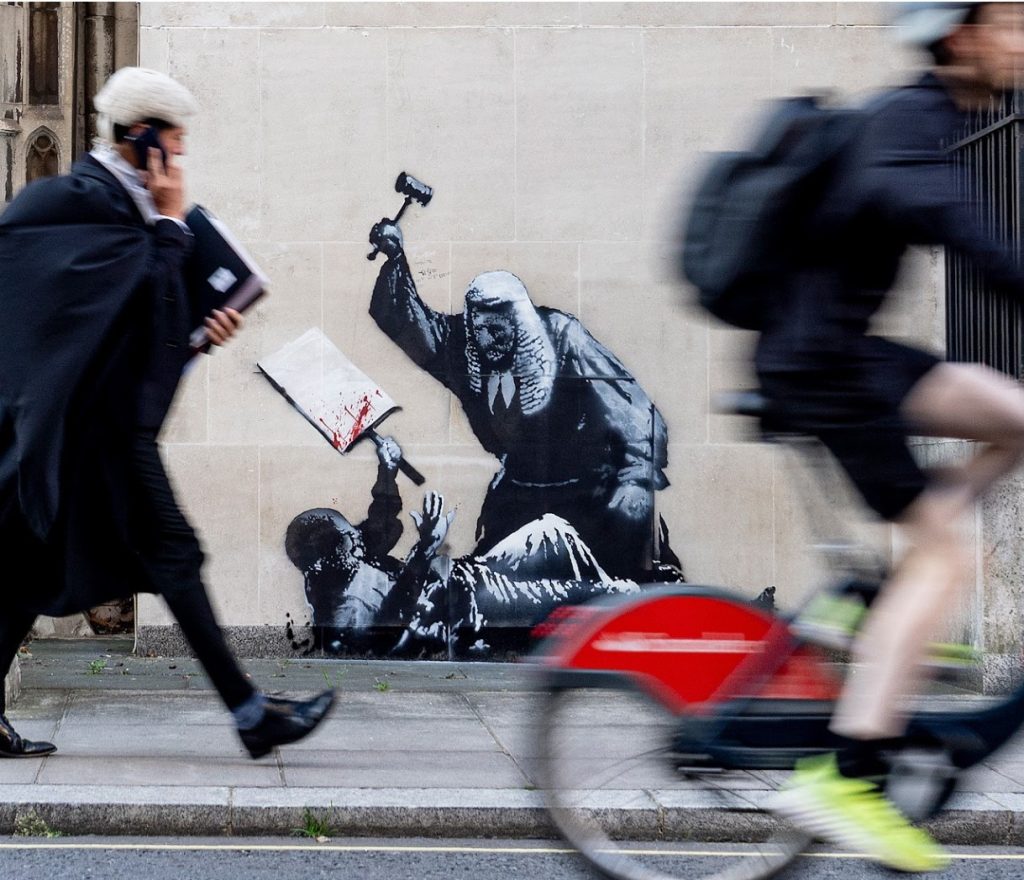
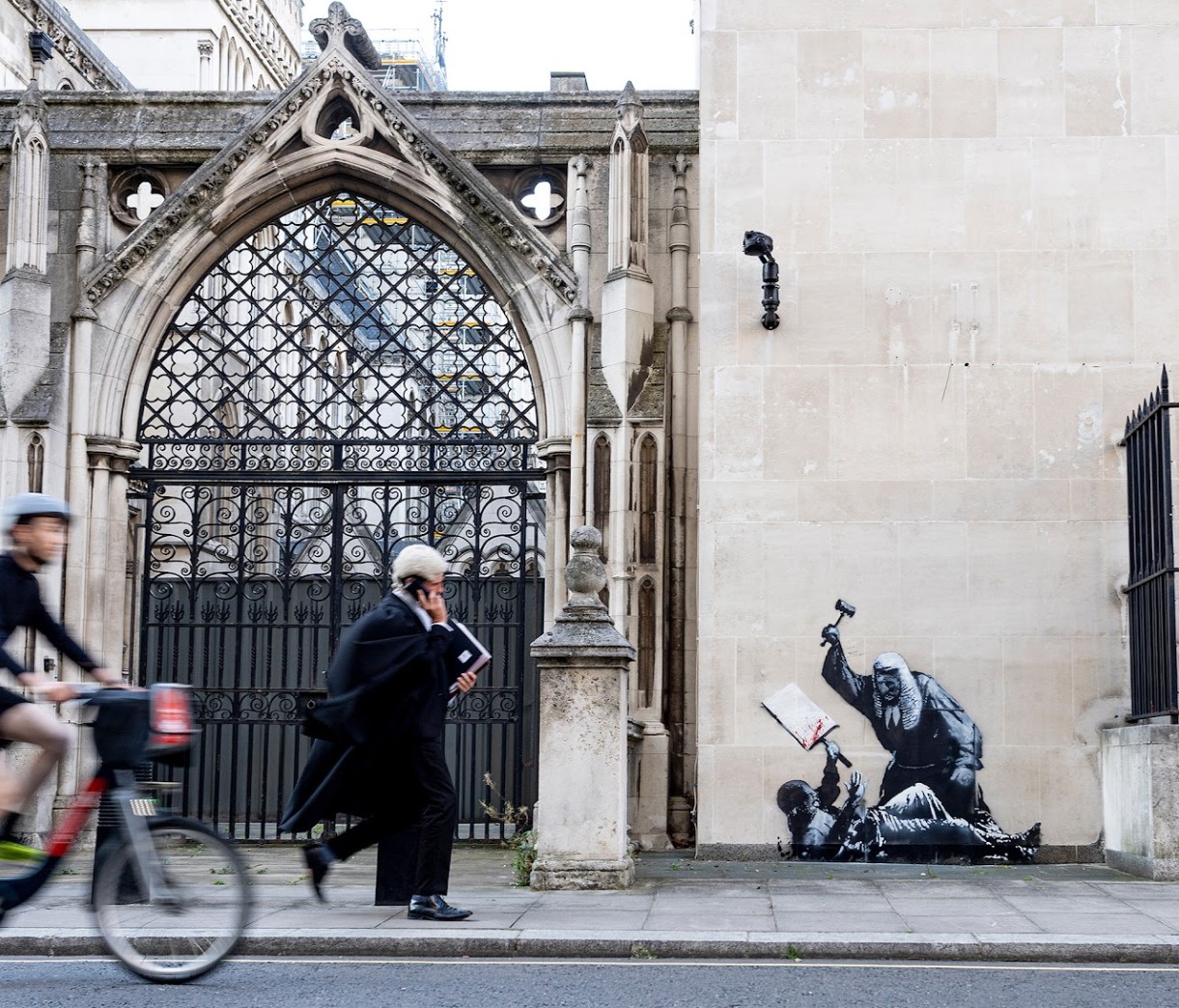
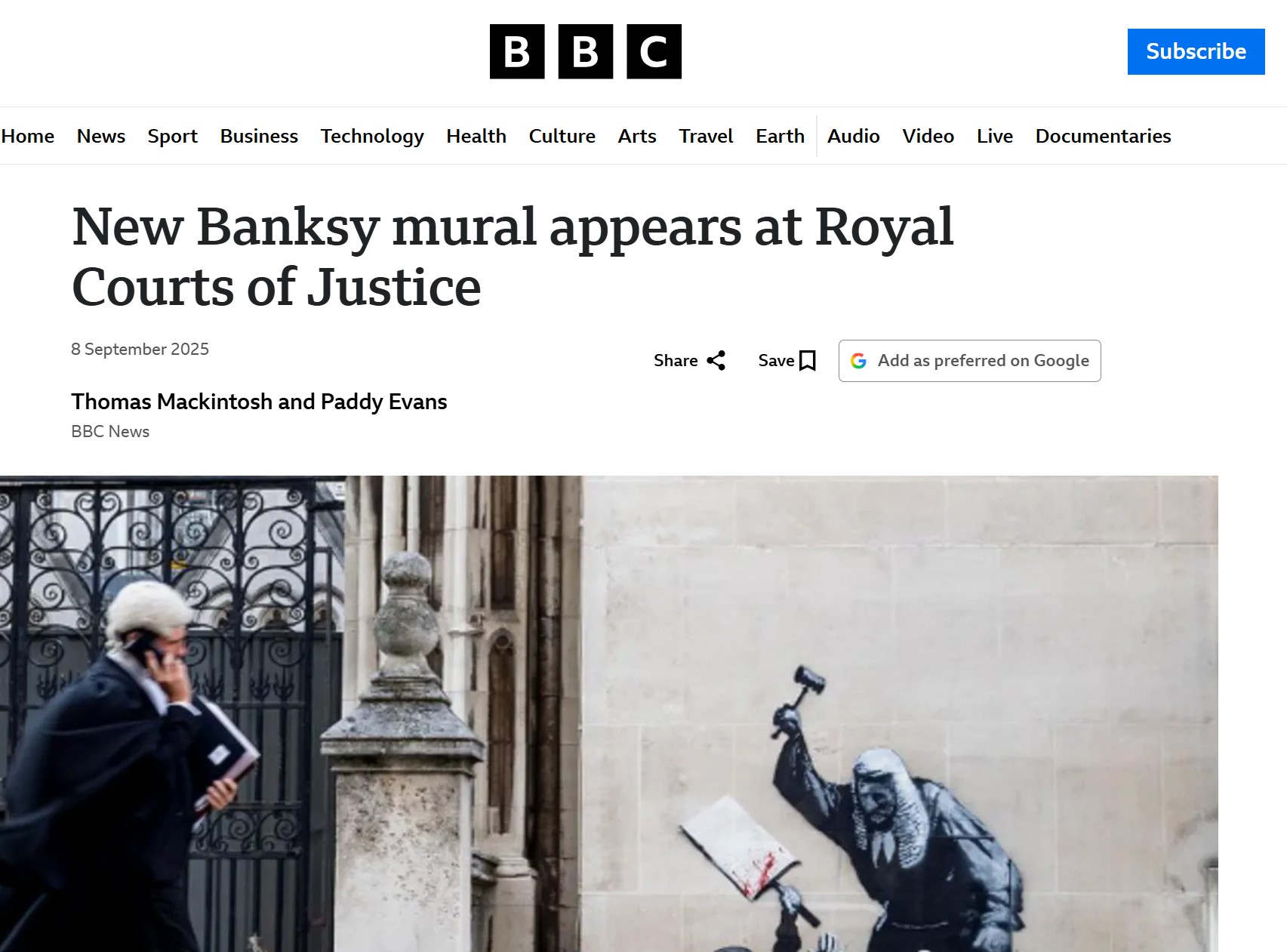
Unveiled overnight on 8 September 2025 on the exterior wall of London’s Royal Courts of Justice, Banksy’s latest mural immediately positioned itself among the artist’s most openly confrontational political interventions in recent years. Installed in one of the most symbolically charged locations in Britain—home to the High Court and Court of Appeal—the work depicts a traditional English judge, dressed in a powdered wig and judicial robes, violently beating a fallen protester with a raised gavel. The protester lies on the ground attempting to shield himself while clutching a placard stained with splashes of red paint evocative of blood. Above the scene, a CCTV camera points conspicuously away from the violence.
The mural was confirmed by Banksy through his official Instagram account with the terse caption “Royal Courts Of Justice. London.” Within hours, authorities fenced off and covered the work before beginning discussions about its removal due to the listed status of the building. The rapid censorship only amplified the piece’s resonance.
Violence in the Temple of Law
Few Banksy murals have deployed such direct iconography. The image is brutally simple: justice itself has become the aggressor. The judge, traditionally presented as the embodiment of neutrality, restraint, and institutional wisdom, is transformed into an authoritarian figure administering violence rather than law. Banksy deliberately exaggerates the symbolism by using a gavel—a tool associated more with American courts than British ones—turning the judge into a universal caricature of judicial power.
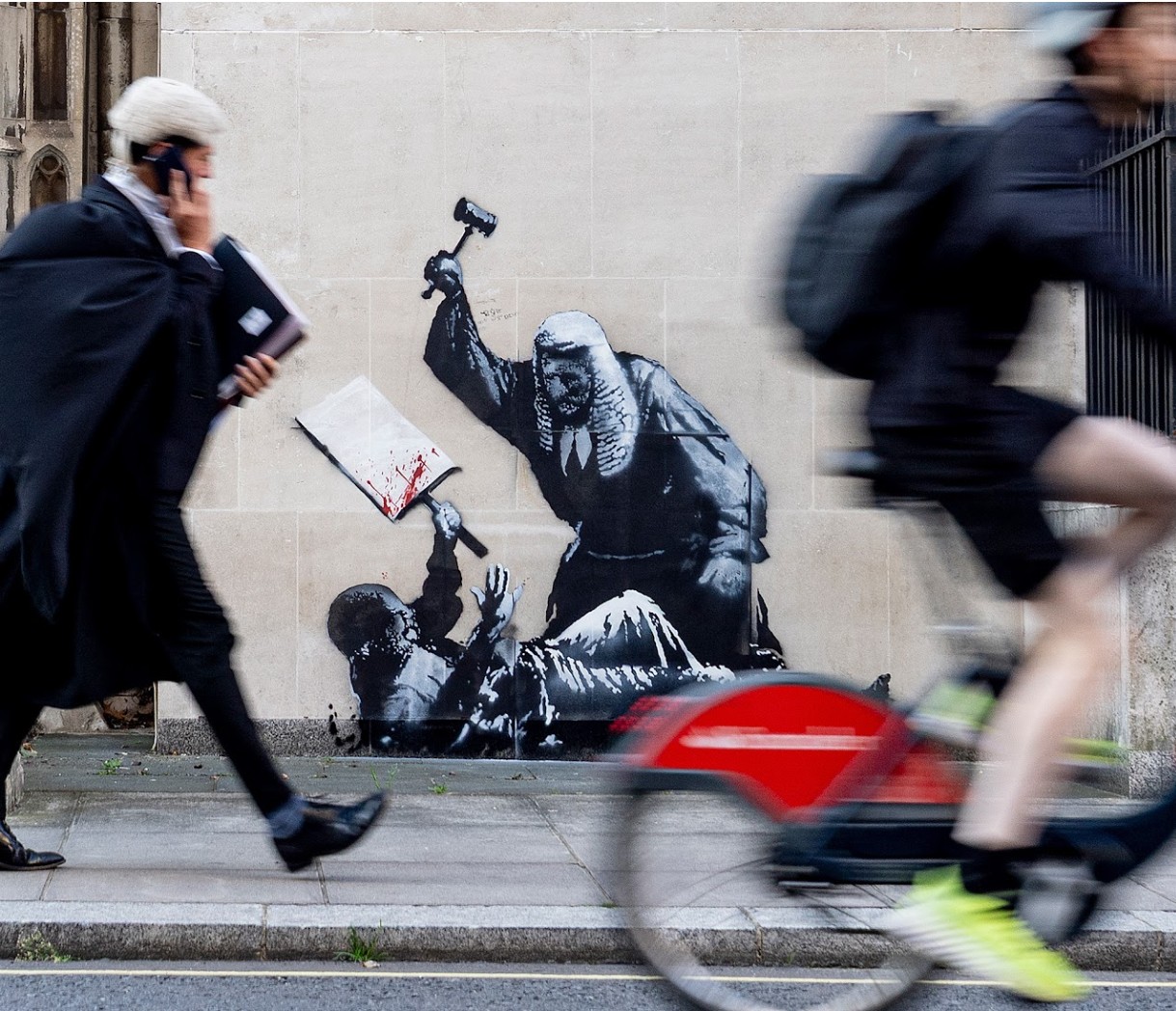
The fallen protester introduces another recurring Banksy theme: the vulnerability of ordinary citizens confronted by institutions vastly more powerful than themselves. Throughout his career, Banksy has repeatedly portrayed protesters, children, migrants, and civilians as fragile figures trapped beneath systems of authority. One immediately thinks of works such as Flower Thrower, CND Soldiers, Napalm, or Stop and Search, where innocence or dissent collides with militarized power.
Here, however, the confrontation takes place not in a war zone or on a border wall, but directly at the symbolic heart of British democracy. That shift is important. Banksy is no longer merely criticizing governments or corporations; he appears to question the moral legitimacy of institutions traditionally perceived as guardians of justice itself.
The CCTV Camera Looking Away
Perhaps the mural’s most brilliant element is not painted at all. Mounted above the scene is an existing CCTV surveillance camera that happened to face away from the violence below. Banksy incorporated it into the composition with surgical precision. The result transforms a mundane security device into part of the artwork’s narrative architecture. The symbolism is devastatingly effective. Surveillance exists everywhere, yet institutional violence somehow remains unseen. The state watches citizens constantly, but when abuses of power occur, the camera suddenly “looks away.” It is classic Banksy: a visual one-liner that feels immediate, cynical, and darkly humorous.
The juxtaposition also recalls Michel Foucault’s theories surrounding surveillance and discipline, particularly the notion of societies organized around constant observation and invisible mechanisms of control. Banksy translates these philosophical ideas into an image understandable within seconds by a passerby on the street.
The irony becomes even sharper given the location itself. The Royal Courts of Justice is among the most monitored and secured areas in London. The idea that Banksy and his team managed to execute the mural there overnight only reinforces the artist’s long-standing mythology as a ghostlike figure capable of infiltrating spaces of immense institutional control.
A Response to the Mass Arrests
The mural appeared only two days after approximately 890 protesters were arrested during demonstrations linked to opposition against the UK government’s ban of the activist group Palestine Action. Many commentators immediately interpreted the work as Banksy’s response to what critics described as an escalating crackdown on civil protest and dissent in Britain.
Banksy himself did not explicitly explain the mural, remaining faithful to his habit of allowing ambiguity to fuel public debate. Yet the timing leaves little doubt that the arrests formed part of the work’s conceptual background.
What makes the mural particularly powerful is that it avoids overt slogans or ideological specificity. The protester’s placard is blank. Banksy does not tell viewers what cause is being defended. Instead, the image operates on a broader level: the suppression of dissent itself becomes the subject. This ambiguity explains why the piece generated such polarized reactions across political and media landscapes. Some viewed it as a courageous defense of civil liberties. Others accused Banksy of unfairly attacking the judiciary rather than elected politicians or police forces. Banksy understands that ambiguity is one of the great engines of virality. By refusing to over-explain, he creates images flexible enough to circulate endlessly through contemporary political discourse.
Echoes of Historical and Religious Imagery
Visually, the composition evokes centuries of art historical depictions of martyrdom, state violence, and moral persecution. The prone protester recalls religious paintings of saints being executed, tortured, or judged by authorities claiming divine or legal legitimacy. The asymmetry of the scene—the towering aggressor above the helpless body below—belongs to a long pictorial tradition extending from Renaissance religious painting to Goya’s Disasters of War and even Picasso’s Guernica.
The mural also echoes Banksy’s own earlier imagery from Crazy Horse and Crazy Hippies, where absurdity and brutality coexist in intentionally uncomfortable ways. Yet this work is colder and more severe. There is less playfulness here than in many earlier Banksy interventions. The humor remains, but it is bitter.
Even the black-and-white stencil aesthetic contributes to the atmosphere of institutional oppression. The work resembles a newspaper photograph, a surveillance image, or archival evidence from a political conflict. Only the red splatter interrupts the monochrome palette, drawing immediate attention to violence and injury.
Removal, Erasure, and the “Ghost” of the Image
In a particularly Banksy-esque twist, the authorities’ response became part of the artwork’s meaning. Within hours, court officials covered the mural using black sheeting and barriers, citing the listed status of the building. Soon after, removal operations began. Yet as workers attempted to scrub the stencil away, a faded ghost image remained visible on the wall.
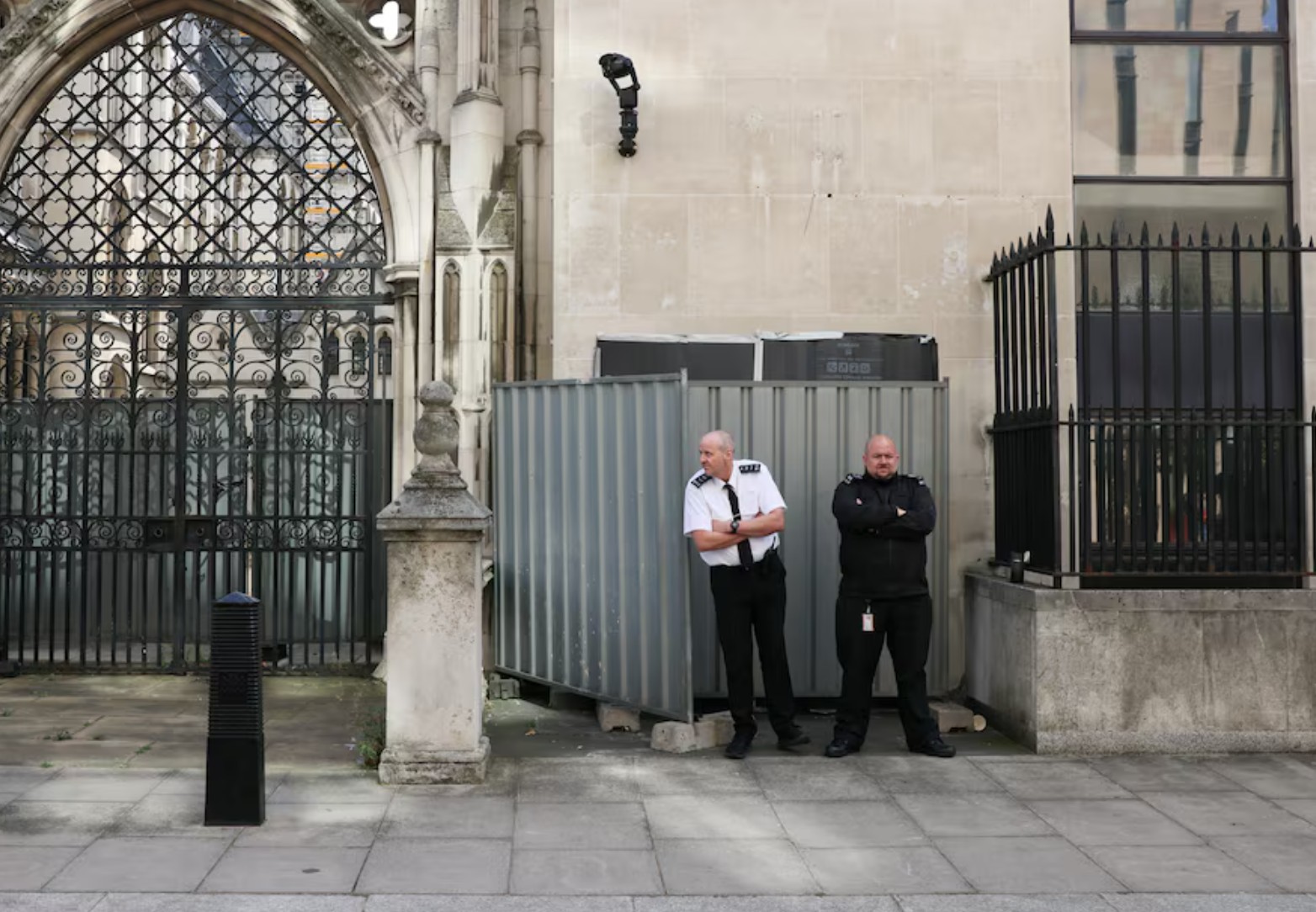
The attempted erasure paradoxically strengthened the mural’s message. A work criticizing censorship, institutional violence, and suppression of dissent was itself immediately censored by the state. Banksy could hardly have designed a more perfect performance piece.
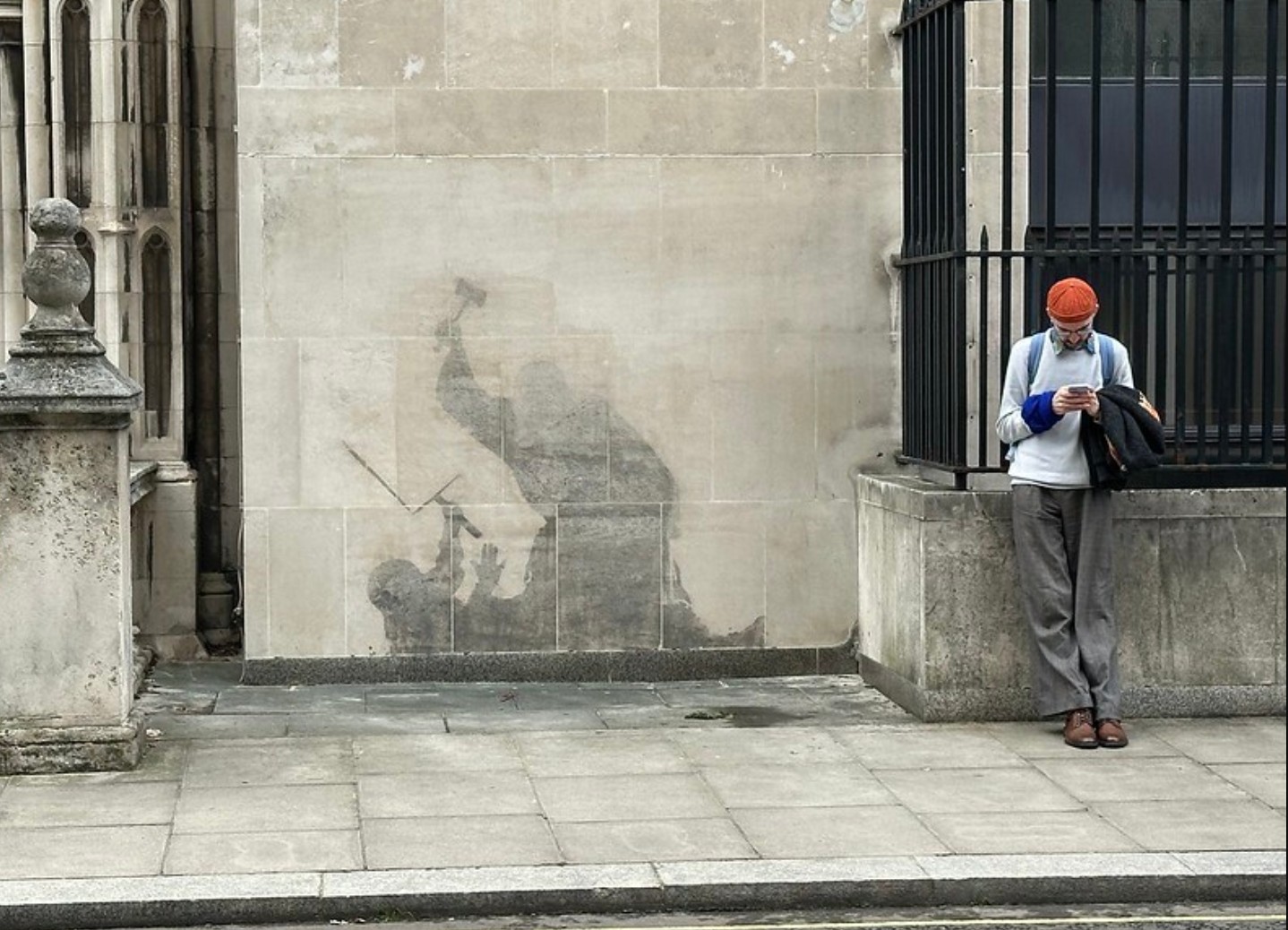
This relationship between street art and disappearance has always been central to Banksy’s practice. His murals are rarely conceived as eternal objects. They exist in a fragile state between visibility and destruction, legality and illegality, public ownership and institutional control. Their temporary nature becomes part of their conceptual force.
In this case, the removal transformed the mural into an even more haunting symbol. The fading residue left on the wall resembled a political memory the authorities could not entirely erase.
One of Banksy’s Most Important Political Murals of the Decade
The Royal Courts of Justice mural stands among Banksy’s most aggressive critiques of institutional power since works such as Slave Labour, The Son of a Migrant from Syria, or his interventions on the Israeli West Bank barrier. What distinguishes this piece is its extraordinary precision of placement. Banksy has always understood that location is inseparable from meaning. Here, the mural could only exist outside the Royal Courts of Justice. The building itself becomes part of the artwork, transforming architecture into symbolism.
The piece also reflects a broader evolution in Banksy’s recent output. While earlier works often relied heavily on irony and playful reversals, many of his newest murals feel more direct, urgent, and politically uncompromising. The tone is less prankster and more witness.
And yet, despite its gravity, the mural retains the core ingredient that has always made Banksy such a singular public artist: the ability to compress complex political anxieties into one unforgettable image. A judge beating a protester while the surveillance camera looks away. It is immediate, theatrical, darkly funny, and deeply unsettling all at once. Few contemporary artists understand visual communication with such ruthless efficiency.