Girl with Balloon:
The Graffiti Legend That Escaped the Wall
Girl with Balloon (Diptych) sold for USD 1,187,500 at Heritage Auctions on 5 June 2026, to benefit the Mathew Perry Foundation.
When an artwork, a story, and a cause unexpectedly converge, the result can feel greater than the sum of its parts. As part of its upcoming sale of works from the Estate of Matthew Perry, Heritage Auctions will present Girl with Balloon (Diptych), 2005, an exceptionally rare reinterpretation of Banksy’s most recognizable image. From an edition of only twenty-five and sold to benefit the Matthew Perry Foundation, the work arrives with a resonance extending beyond the conventional language of the art market, connecting one of contemporary art’s most enduring symbols of hope with a cause devoted to helping others find it.
PLEASE CLICK BELOW TO ACCESS HERITAGE AUCTIONS PRESS RELEASE
DISCLAIMER
This editorial is a sponsored collaboration with Heritage Auctions. While we are grateful for their support, Banksy Explained remains entirely independent in its editorial approach. All analyses, interpretations, opinions, and observations expressed in this article are solely those of Banksy Explained and reflect our own research and perspective. Sponsorship supports the continuation of our work but never directs it.
The Graffiti Legend That Escaped the Wall
Few images in contemporary art have traveled as far, both physically and culturally, as Banksy’s Girl with Balloon. It is one of those rare artworks that seems to have escaped the confines of art history and entered something larger: collective memory. Even for people who have never stepped into a gallery or opened an auction catalogue, the silhouette of a small girl extending her hand toward a drifting red heart-shaped balloon feels immediately familiar.
The image appears almost absurdly simple. A child reaches outward. The balloon escapes. Yet Banksy has always understood that the shortest visual sentence can sometimes carry the longest emotional echo. The work speaks simultaneously about hope and loss, innocence and fragility, aspiration and disappointment. It can function as a love story, a political statement, or a quiet meditation on human experience. Much like the strongest poetry, it says little and somehow says everything.

The Matthew Perry Estate Auction
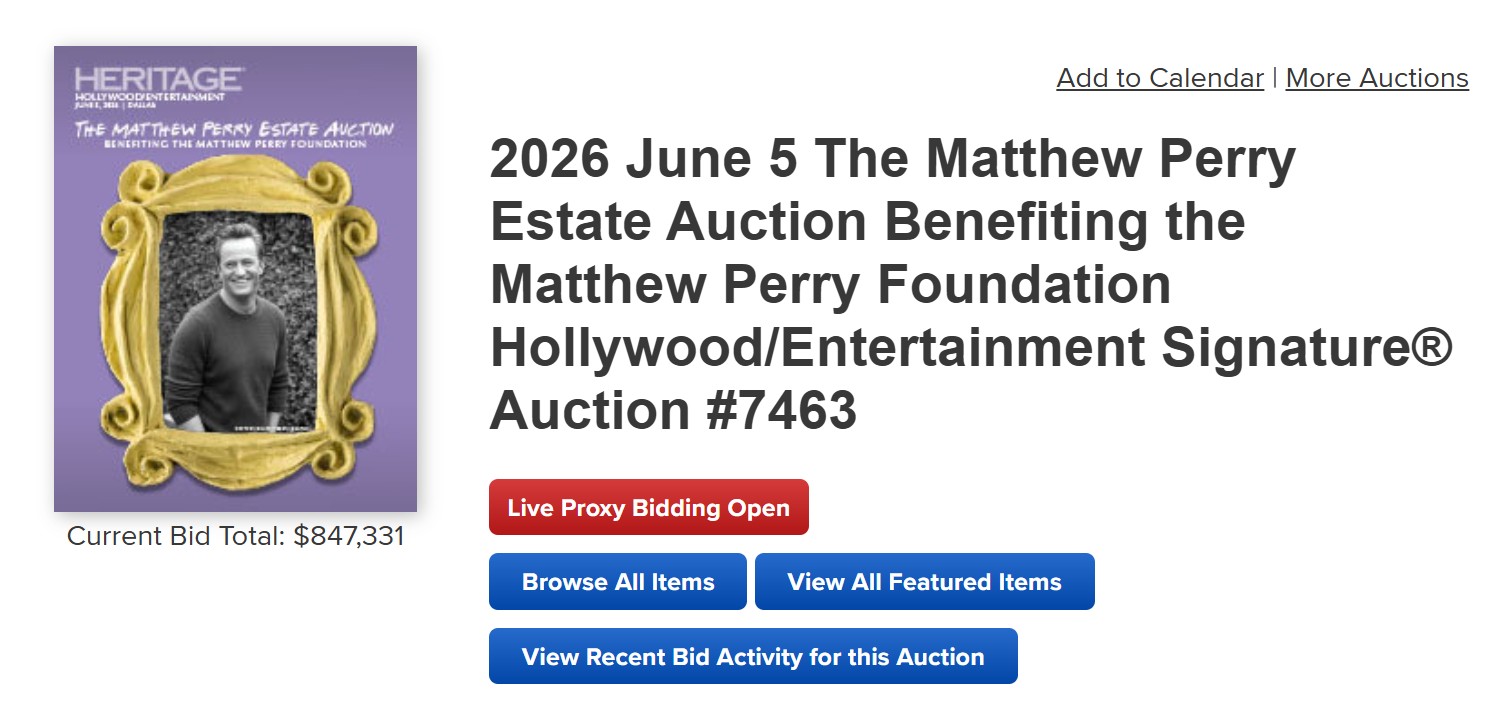
Girl with Balloon (diptych), 2005
From the Estate of Matthew Perry
With proceeds benefiting the Matthew Perry Foundation
Heritage Auctions: 5 June 2026
Estimated: USD 800,000 and up
USD 1,187,500
Banksy (b. 1974). Girl with Balloon (diptych), 2005. Spray paint on | Lot #14005 | Heritage Auctions
BANKSY (b. 1974)
Girl with Balloon (diptych), 2005
Spray paint on two canvases
Each: 30.5 x 30.5 cm (12×12 inches)
Overall: 61×61 cm (24×24 inches)
Edition: 5/25
Signed, editioned, and dated on the reverse
XXXXXXXXXX
Nola (Grey Rain), 2008
From the Estate of Matthew Perry
With proceeds benefiting the Matthew Perry Foundation
Heritage Auctions: 5 June 2026
Estimated: USD 40,000 and up
Banksy (b. 1974). Nola (Grey Rain), 2008. Screenprint in colors on | Lot #14004 | Heritage Auctions
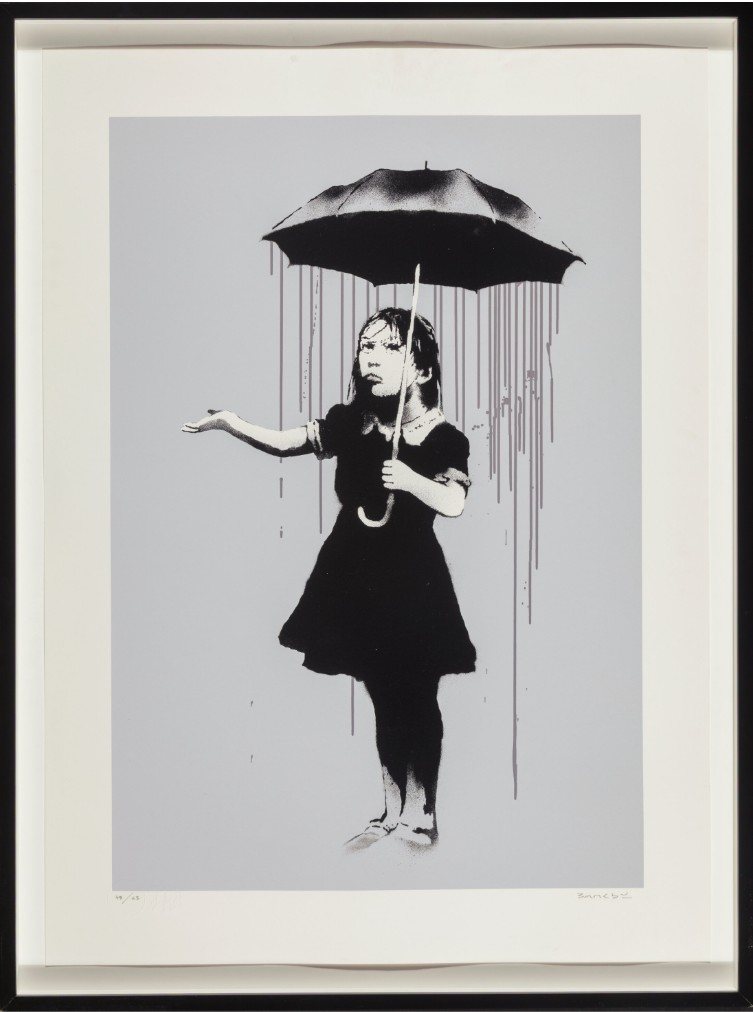
BANKSY (b. 1974)
Nola (Grey Rain), 2008
Screenprint in colors on wove paper
Edition: 48/63
Signed and editioned in pencil along lower edge
Published by Pictures on Walls, London with their blindstamp lower left
Girl with Balloon (Diptych)
Taking Apart an Icon
———-
Before discussing Girl with Balloon as a global symbol, it is worth pausing on the particular work offered here, because this is not the image most people think they know. Rather than presenting Banksy’s famous composition in its familiar form, Girl with Balloon (Diptych) from 2005 disassembles the image itself, almost as if the artist had decided to separate two inseparable elements: desire and object, hope and pursuit, the child and the dream.
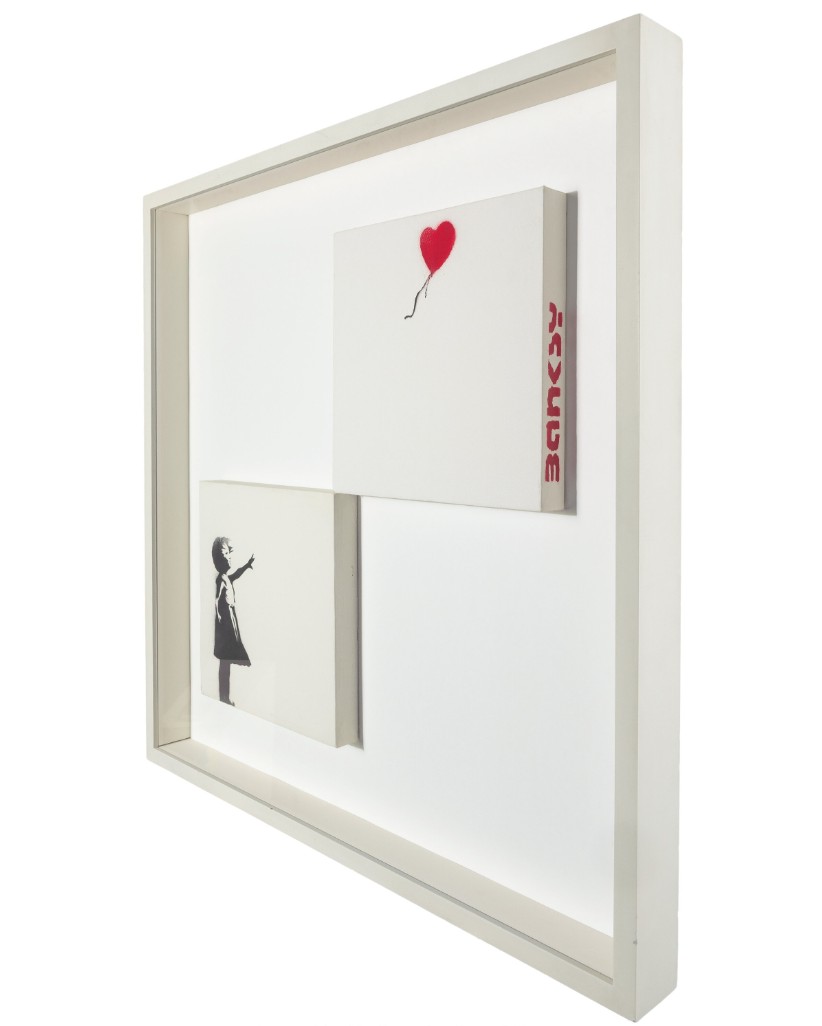
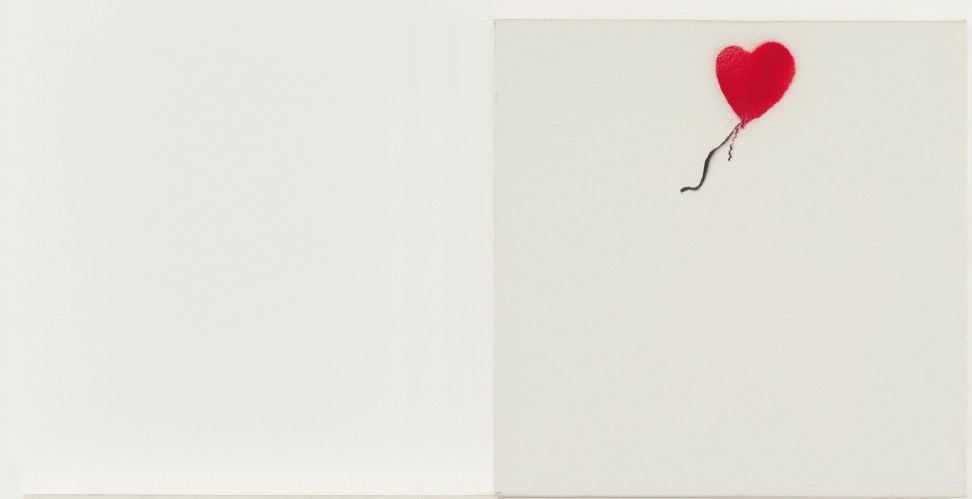
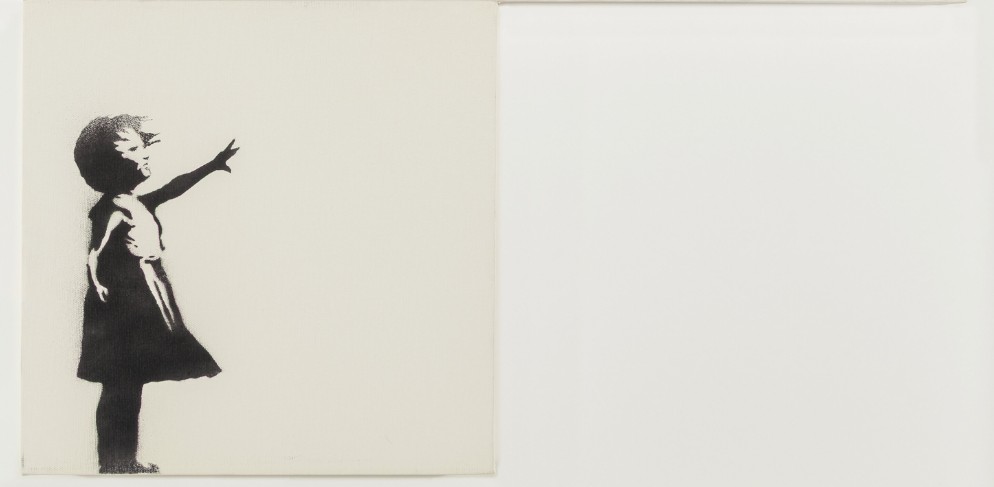
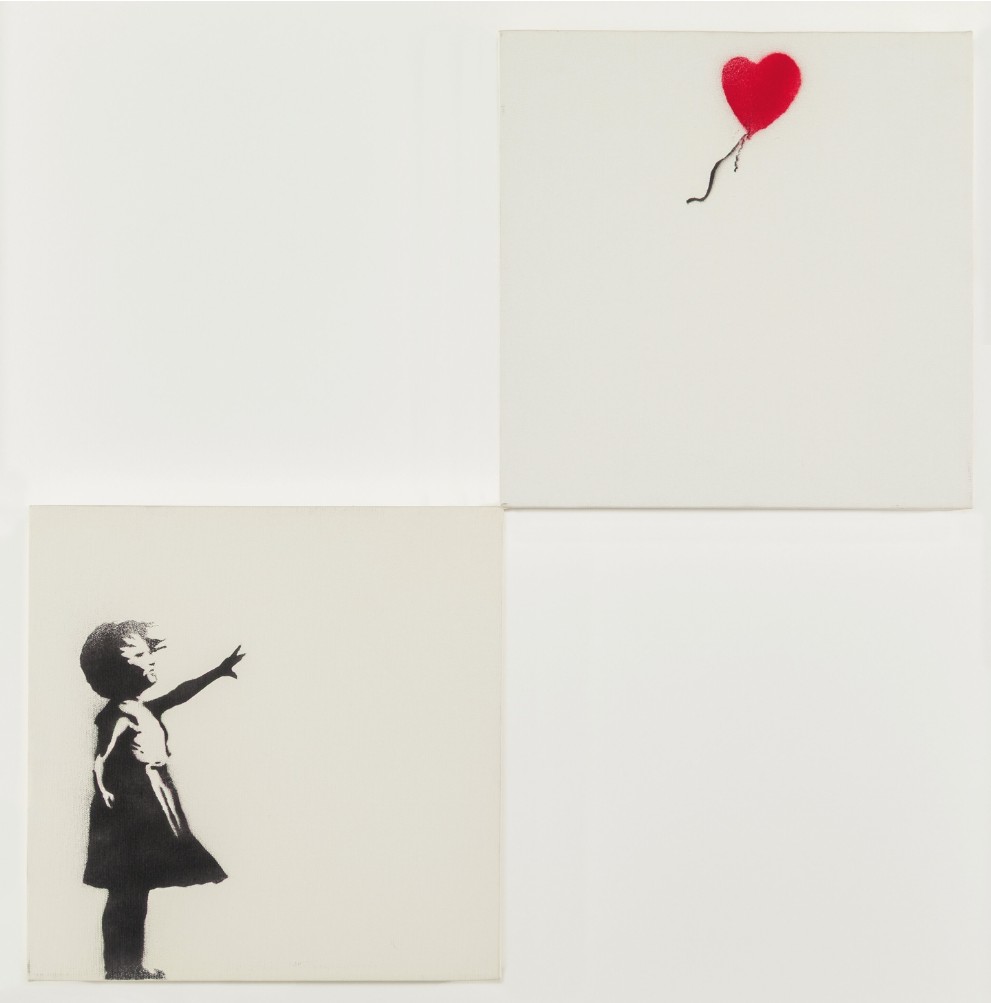
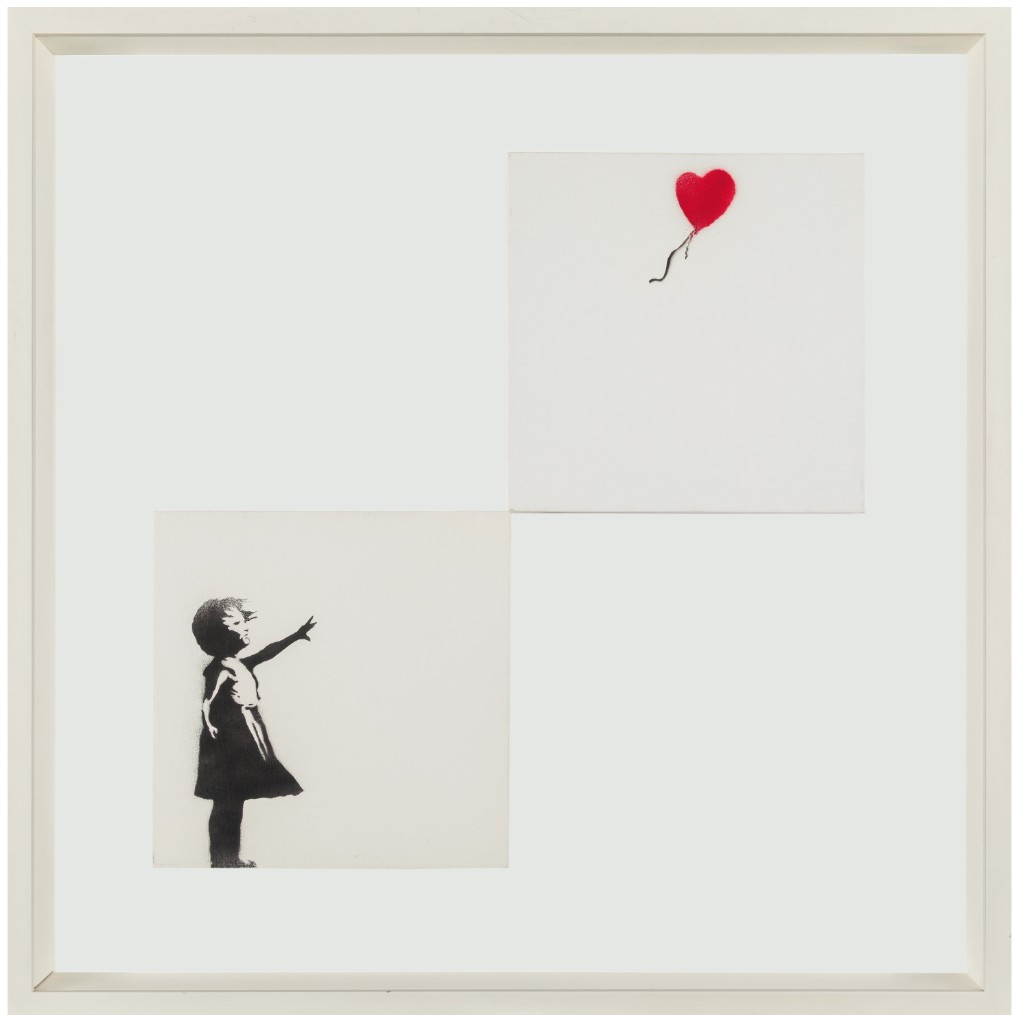
Executed in spray paint across two canvases, each measuring 12 × 12 inches and conceived as a single installation, the work fractures one of Banksy’s most recognizable compositions into two physically independent components. On the lower left canvas stands the iconic silhouette of the girl, her body rendered in Banksy’s stark monochromatic stencil language. Her arm extends upward, fingers reaching into empty space. On the upper right canvas floats the now-famous red heart-shaped balloon, isolated against a field of white.
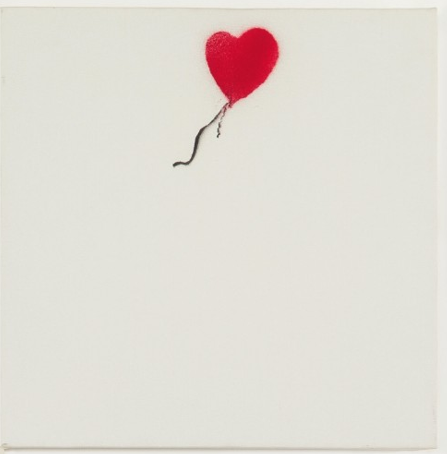
The result is subtle yet surprisingly powerful. In the original composition, the eye immediately connects the child and the balloon. Here, however, Banksy introduces literal distance. The viewer becomes responsible for mentally reconstructing the image. That small shift changes everything.
The empty space between the two canvases suddenly becomes part of the work itself. It becomes absence. It becomes time. It becomes longing. Perhaps even memory. The separation creates tension because the viewer instinctively wishes to reconnect the image, to bridge the gap that Banksy has deliberately created.
Great artists often understand that what is removed can be as important as what is shown.
The work recalls certain conceptual strategies found throughout twentieth-century art. One might think of the fragmentation of form introduced by Pablo Picasso and Georges Braque, where objects were broken apart and reassembled from multiple perspectives. One may also think of the minimalist use of emptiness found in Japanese aesthetics, where negative space becomes an active component rather than a passive background.
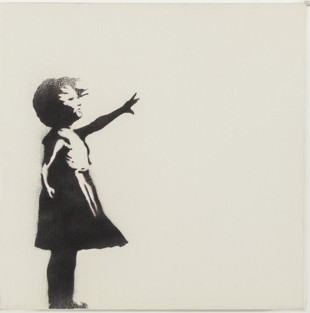
Banksy rarely receives attention for these more formal artistic decisions because his work often arrives disguised as visual jokes or social commentary. Yet Girl with Balloon (Diptych) demonstrates a surprising sophistication beneath the apparent simplicity.
The red balloon itself, the only vivid element in the composition, acquires even greater symbolic force through isolation. Floating independently from the child, it appears less like a toy and more like an autonomous presence. Hope itself seems to have escaped the frame. One cannot help but notice a certain irony as well. Banksy, whose work often criticizes systems of separation — social barriers, political divisions, walls and inequalities — here separates his own most famous image into two distinct entities. He turns viewers into participants, forcing them to complete the work psychologically.
The result feels almost cinematic: a suspended moment between possession and loss, between reaching and letting go. And perhaps that unresolved space between the girl and the balloon is precisely where the emotional power of the image has always existed.
From the Collection of Matthew Perry:
A Work About Hope Finds Another Story
———-
This particular Girl with Balloon (Diptych) carries a history extending beyond Banksy’s studio and beyond the conventional trajectory of the art market. Offered from the Estate of Matthew Perry, proceeds from the sale will benefit the Matthew Perry Foundation, adding an additional layer of meaning to an artwork already deeply associated with themes of hope and human vulnerability.

Known around the world for his role as Chandler Bing in the television series Friends, Matthew Perry was admired not only for his wit and comedic timing, but also for the openness with which he later spoke about his personal struggles with addiction and recovery. In the years preceding his passing, Perry became a powerful advocate for helping others facing similar challenges, dedicating considerable effort toward recovery initiatives and support systems.

Viewed through that lens, the image takes on an almost unexpected poignancy.
Banksy’s small girl reaching toward the drifting heart-shaped balloon has often been interpreted as a meditation on hope, longing, and the delicate distance between ourselves and the things we seek. In this diptych version, Banksy physically separates the child from the balloon, introducing a literal gap between desire and fulfillment. The empty space becomes part of the artwork itself.
Within the context of Matthew Perry’s collection, that space may resonate differently. It can evoke struggle, resilience, and the difficult pursuit of something that often seems just beyond reach. Recovery itself can sometimes feel like an act of reaching toward something fragile and elusive.
Of course, Banksy did not create this work with Matthew Perry in mind. Art history becomes dangerous when one begins forcing narratives onto objects. Yet artworks inevitably gather stories as they move through time, collecting lives and experiences along the way. This is perhaps one of the reasons provenance matters so deeply. It is not simply a record of ownership; it is a record of human connection. Here, an image long associated with hope now participates in a cause devoted to helping others find it.
From Street Art to Cultural Mythology
The Origin: A Street Art Intervention
———-
The original Girl with Balloon first appeared in London in 2002 on the South Bank, near Waterloo Bridge. Executed in Banksy’s now-iconic stencil style, the mural depicted a small monochromatic child extending her hand toward a bright red heart-shaped balloon drifting away. The accompanying phrase, “There Is Always Hope,” would sometimes appear alongside the image, although not always. Banksy deliberately left ambiguity. Was hope leaving? Was hope arriving? Had the child lost something, or was she discovering something greater?
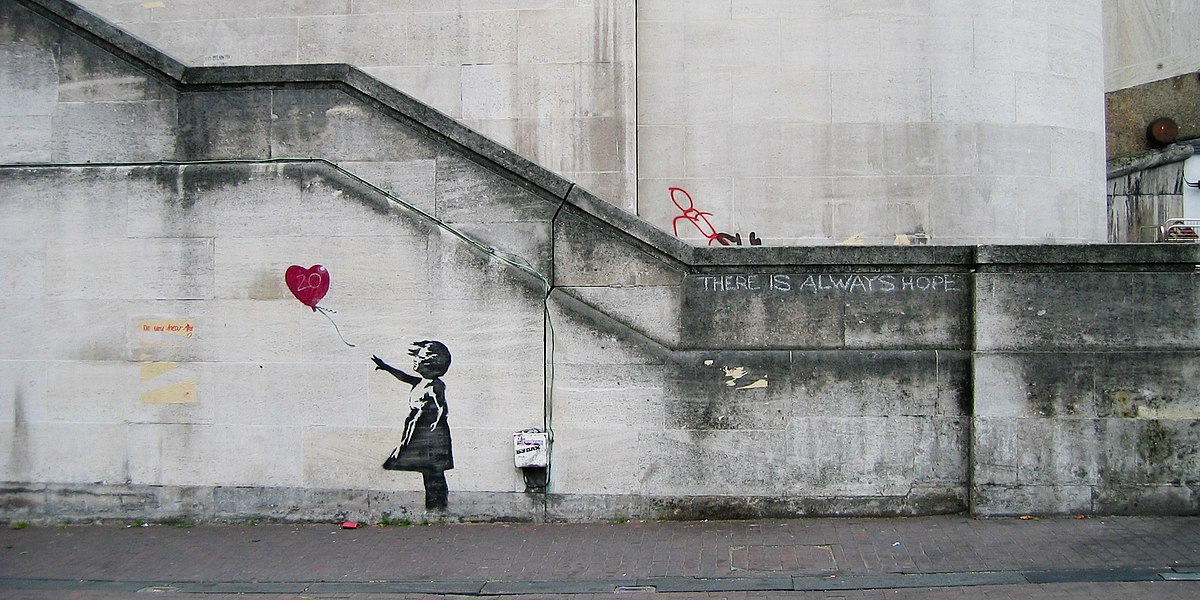
That uncertainty became central to the image’s power. Banksy often constructs visual paradoxes. Policemen embrace each other. Rioters carry flowers. Children play among symbols of conflict. In Girl with Balloon, the contradiction is emotional rather than political. The image captures a moment everyone recognizes: the instant between holding on and letting go.
Banksy’s artistic language often depends on reduction. He strips images down until only their essential elements remain. Here there are almost no distractions. The red balloon becomes especially important because it is one of the very few elements rendered in color. The heart shape transforms an ordinary object into something symbolic: love, dreams, childhood, hope, perhaps even humanity itself.
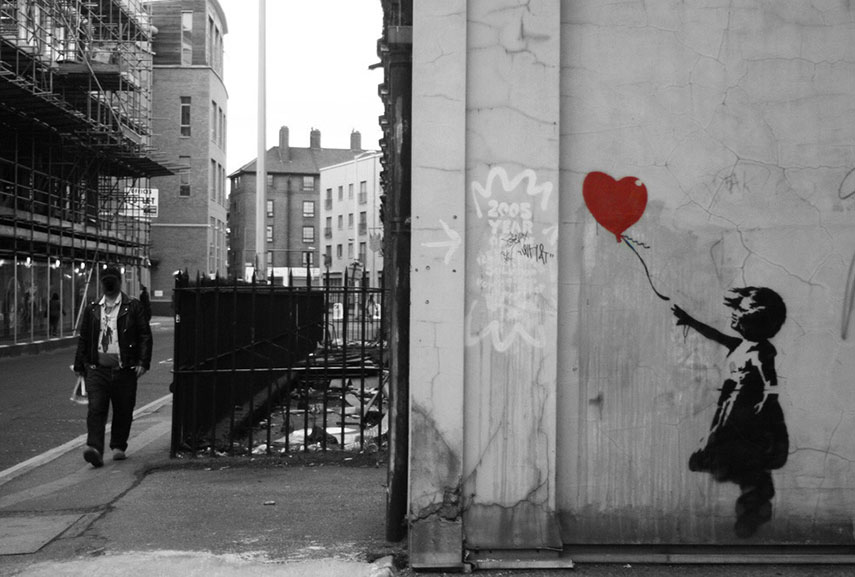
Art history repeatedly returns to similar themes. The Romantic painters transformed landscapes into emotional states. Surrealists turned everyday objects into psychological symbols. Pop artists elevated common imagery into universal icons. Banksy performs a similar operation but with the vocabulary of the street.
Very few contemporary artworks become independent of their creators. Girl with Balloon achieved something closer to mythology. The image migrated across countless media: original street murals, screenprints and editions, paintings and canvases, merchandise and posters, political campaigns, social media imagery
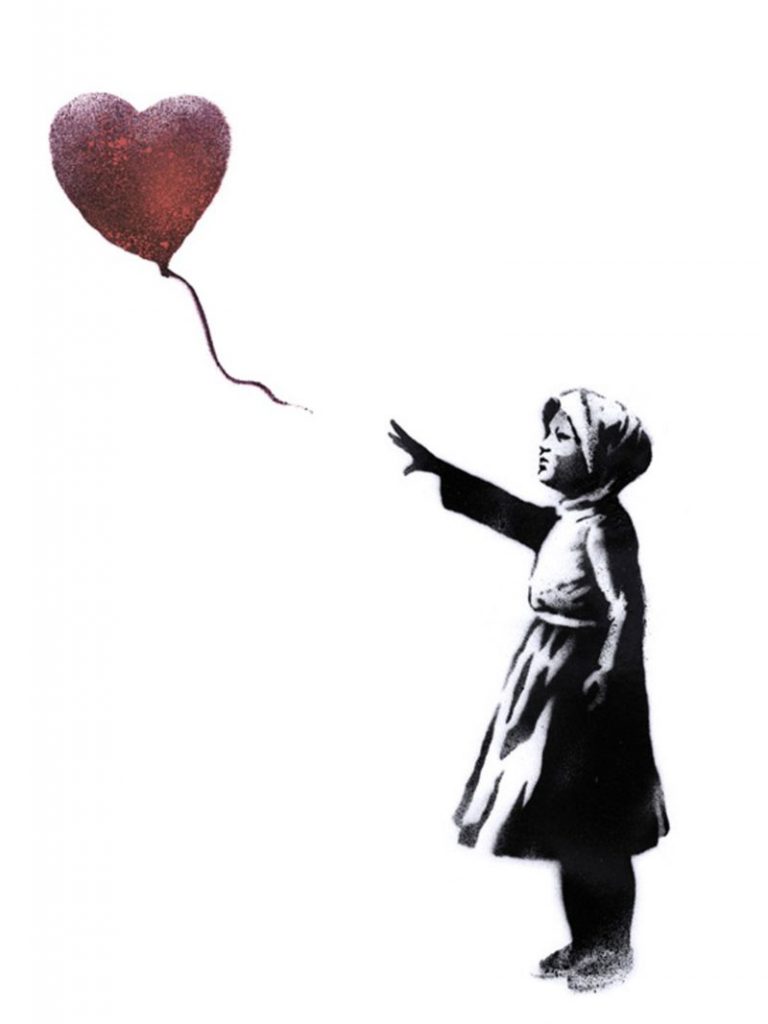
During the Syrian refugee crisis, Banksy reworked the image using the likeness of a young refugee child to draw attention to displacement and humanitarian suffering. The work transformed from a personal metaphor into a broader political statement. Banksy understood something essential: symbols survive because they can adapt.
Girl with Balloon Prints: Democratizing an Icon
———-
Like many of Banksy’s most celebrated images, Girl with Balloon did not remain confined to the street. It migrated into the world of editions and prints, allowing one of the artist’s most powerful visual statements to circulate far beyond its original location.
Released through Pictures on Walls in the early years of Banksy’s print production, Girl with Balloon entered the market in various forms and quickly established itself as one of the artist’s most sought-after subjects. Banksy released a screenprint on paper in 2004 in editions of 150 signed, and 600 unsigned prints. Furthermore, a special run of 88 signed Artist’s Proofs (in 4 different colorways) were released.

Prints initially released for a relatively modest amount would later become highly sought-after collector’s works. Images originally conceived within the anti-establishment culture of street art gradually entered auction houses, blue-chip collections and museums. Banksy has spent much of his career criticizing the machinery of the art market, yet few artists have navigated that transition more successfully.
These prints played an important role beyond their commercial success. They reflected a philosophy Banksy repeatedly defended throughout his career: the idea that art should not exist exclusively behind gallery walls or in the homes of a privileged few. Much like Andy Warhol had embraced repetition and mass production several decades earlier, Banksy understood that multiplication could become a tool rather than a compromise. The irony, naturally, is difficult to ignore.
Girl with Balloon (unsigned), 2004
Bonhams LA: 24 March 2021
Estimated: USD 140,000 – 180,000
USD 450,312 / GBP 323,965
AUCTION RECORD FOR GIRL WITH BALLOON (UNSIGNED)

Screenprint in red and black on wove paper
Numbered in pencil 201/600, with the publisher’s blindstamp
Estimated: GBP 200,000 – 300,000
AUCTION RECORD FOR GIRL WITH BALLOON (SIGNED)

Girl with Balloon (signed), 2004
Screenprint in colors on wove paper
Girl with Balloon (Dark Pink AP), 2004
Sotheby’s London, 30 June 2022
Estimated: GBP 250,000 – 450,000
GBP 403,200 / USD 495,935

BANKSY
Girl with Balloon (Dark Pink AP), 2004
Screenprint in colors on wove paper
Signed in pencil, lower right
Inscribed AP26 in pencil with the publisher’s blindstamp, lower left
One of 88 Artist’s Proofs printed in various colorways
Girl with Balloon & Morons Sepia, 2007
———-
Girl with Balloon & Morons Sepia, 2007
Phillips London: 20 October 2020
Estimated: GBP 500,000 – 700,000
GBP 1,232,500 / USD 1,609,580
Banksy – 20th Century & Contemporary … Lot 8 October 2020 | Phillips

BANKSY
Girl with Balloon & Morons Sepia, 2007
Girl with Balloon: Spray paint on paper
Morons Sepia: Screenprint on paper, double-sided
56.5 x 76 cm (22 1/4 x 29 7/8 inches)
Signed, numbered and dated ‘Banksy 07 2/8’ lower right
This work is number 2 from an edition of 8
Editions on Canvas
———-
Girl and Balloon, 2003
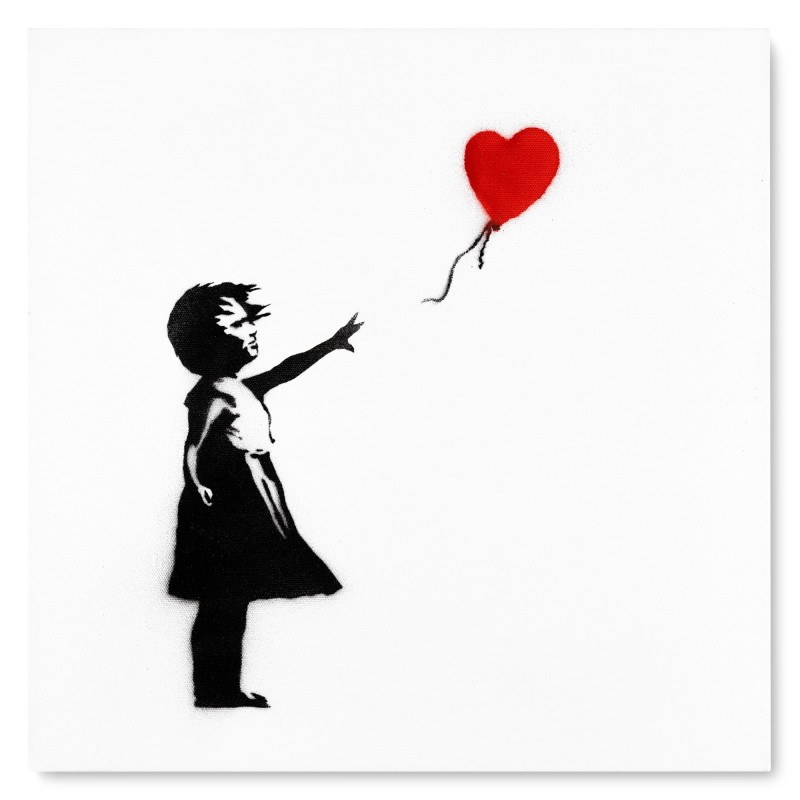
Balloon Girl (Diptych), 2005
Girl with Balloon Diptych is perhaps of the most distinctive reinterpretations. By dividing the image across two separate canvases, Banksy introduced a new sense of distance and fragmentation. The physical separation creates tension within the composition, emphasizing the emotional distance already present between the child and the drifting balloon. The diptych format transforms a fleeting moment into something more contemplative, almost cinematic.

Children in Banksy’s Universe
Innocence Confronting Reality
———-
Children occupy a central place within Banksy’s visual language. They appear repeatedly throughout his murals, prints and paintings, but rarely in the sentimental way one might expect. Banksy’s children are not decorative figures meant to evoke simple nostalgia. They are observers, participants and sometimes victims of the absurd world built around them.
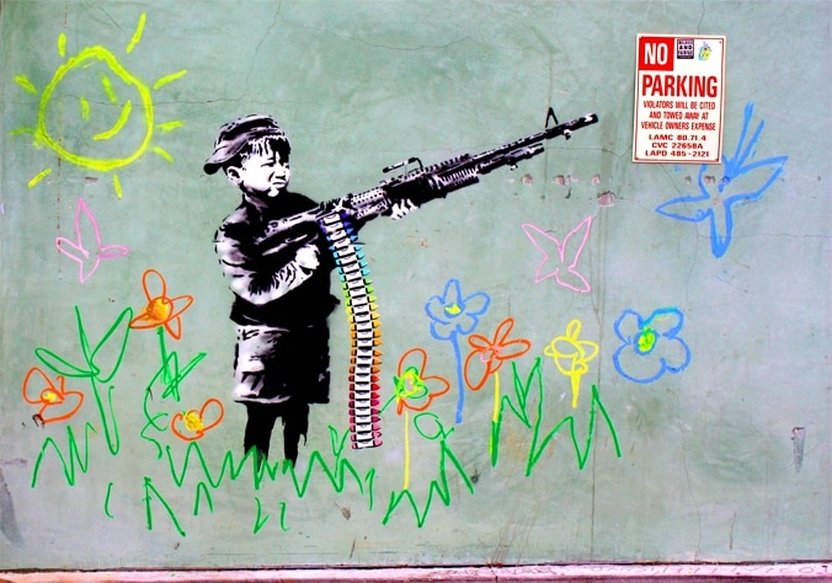
Through children, Banksy often creates one of the strongest tensions in his work: the collision between innocence and adult systems of power. A child naturally represents possibility, vulnerability and optimism. By placing children alongside weapons, political symbols, consumer objects or social conflicts, Banksy creates an immediate visual contradiction. The viewer instinctively recognizes that something feels wrong. The discomfort appears almost instantaneously.
In Girl with Balloon, the child reaches toward hope. Elsewhere, however, hope becomes more fragile. The child in Girl with Balloon becomes an almost universal figure precisely because she lacks identity. She is not a portrait; she is an emotional placeholder. Everyone becomes the child eventually.
Girl with Ice Cream on Palette: Sweetness and Melancholy
———-
Among Banksy’s less frequently discussed variations on childhood imagery is Girl with Ice Cream on Palette. At first glance the work appears playful. The visual language is immediately familiar: a child rendered through Banksy’s sharp monochromatic stencil style interacting with a universally joyful object. Yet, as frequently happens with Banksy, the image becomes more complicated upon closer examination.
Girl with Ice Cream on Palette, 2004
Bonhams London: 24 March 2021
Price realized: GBP 1,102,750 / USD 1,511,886
Bonhams : BANKSY (B. 1975) Girl With Ice Cream on Palette 2004

BANKSY
Girl with Ice Cream on Palette, 2004
Spray-paint and emulsion on wood
59.7 x 50 cm (23 1/2 x 19 11/16 inches)
Tagged, signed and dedicated on the reverse
Ice cream occupies an unusual symbolic position within childhood memory. It belongs to a world of comfort, reward and innocence. Yet Banksy often manipulates these familiar objects by introducing small disruptions or moments of instability. Happiness in his work rarely feels entirely secure. The contrast becomes important because Banksy is rarely depicting childhood itself. Rather, he often depicts our idea of childhood, and the ways adult reality gradually interrupts it.
Bomb Love: Innocence Holding Contradiction
———-
Perhaps nowhere is this tension more visible than in Bomb Love. The image depicts a young girl embracing a bomb with the tenderness one might associate with a toy or a stuffed animal. The composition immediately creates a profound visual contradiction: affection confronting destruction. The power of the work lies precisely in its simplicity. Bombs belong to the vocabulary of conflict, fear and violence. Children belong to the vocabulary of protection and innocence. Bringing the two together creates a form of visual short-circuit.
Bomb Love, 2002
Bonhams London: 15 October 2021
Estimated: GBP 450,000 – 650,000
GBP 562,750 / USD 773,865
Bonhams : Banksy (B. 1975) Bomb Love 2002
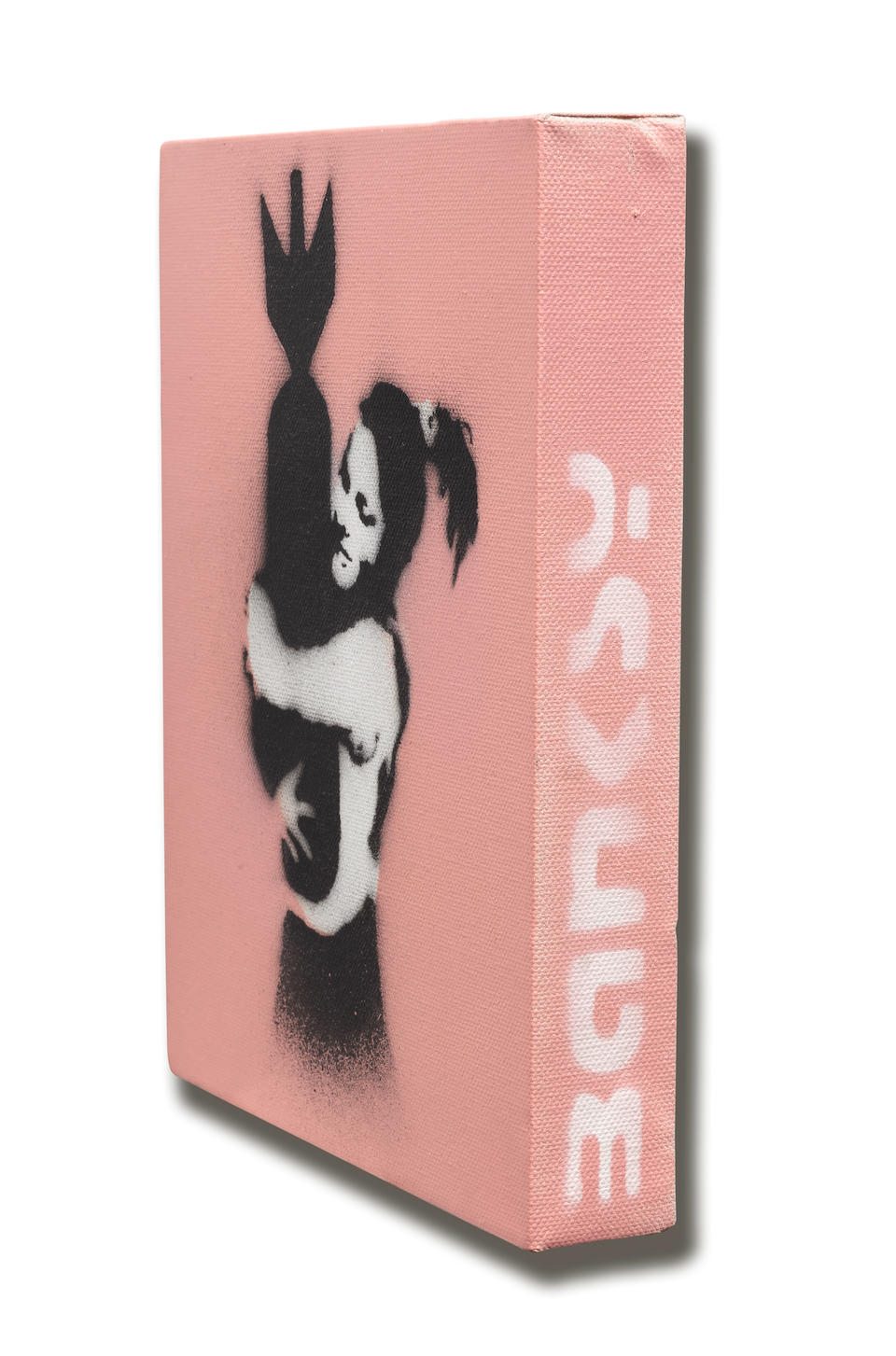
BANKSY
Bomb Love, 2002
Spray paint on canvas
25.4 x 20.3 cm (10×8 inches)
Tagged on the turnover edge
Banksy repeatedly employs this strategy throughout his career. Rather than showing violence directly, he often approaches it through innocence. The result can feel more unsettling because viewers are not confronted merely with destruction itself, but with the corruption of things that should remain untouched by it. The image also recalls a long tradition within art history of using children to expose broader social anxieties. One might think of Francisco Goya’s deeply unsettling works confronting violence and irrationality, or even Pablo Picasso’s Guernica, where innocence becomes collateral damage within adult catastrophe. The child embracing the bomb feels tragic precisely because she does not appear afraid.
Kids on Guns: Childhood in a World Built by Adults
———-
Banksy repeatedly returns to imagery involving children and weapons. In works often informally referred to as Kids on Guns or related compositions, children interact with instruments of violence with an almost disturbing sense of normality. The unease does not come from the children themselves. It comes from us. Children do not invent wars. They do not create political systems. They do not build ideologies. They inherit them. Banksy frequently positions children as witnesses to the strange logic of adulthood. By placing young figures beside guns or military imagery, he exposes the absurdity of systems that societies often accept without question.
Kids on Guns, 2004
Phillips London: 6 March 2025
Estimated: GBP 400,000 – 600,000
GBP 508,000 / USD 650,240
Banksy – Modern & Contemporary Art Eve… Lot 17 March 2025 | Phillips

BANKSY
Kids on Guns, 2004
Spray paint on canvas
50 x 49.7 cm (19 5/8 x 19 5/8 inches)
Stenciled with the artist’s name ‘BANKSY’ on the lower right turnover edge
Signed, numbered and dated ‘Banksy 23/25 2004’ on the stretcher
This work is number 23 from an edition of 25
Children in Banksy’s universe become silent judges. They rarely speak, yet their presence asks uncomfortable questions. Why do we normalize violence? Why do we teach division? Why does innocence repeatedly find itself negotiating with structures it never created?
Within that broader context, Girl with Balloon begins to appear less isolated than it first seems. The child reaching toward the balloon is not simply reaching toward a heart-shaped object. She may be reaching toward something Banksy repeatedly suggests is fragile in modern society: hope itself.
NOLA: Childhood Beneath the Storm
———-
Banksy’s use of children becomes especially poignant in NOLA (also known as Umbrella Girl), created in New Orleans in 2008 during the aftermath of Hurricane Katrina. The work depicts a young girl standing beneath an umbrella, attempting to shelter herself from rain. Yet there is a cruel irony at play: the rain is not falling outside the umbrella but from inside it. As often happens with Banksy, the image is immediately understandable and yet emotionally disorienting.
An umbrella is supposed to protect. It is a simple object associated with security and comfort. Banksy quietly transforms it into its opposite. The very thing designed to shield the child becomes the source of the problem itself.
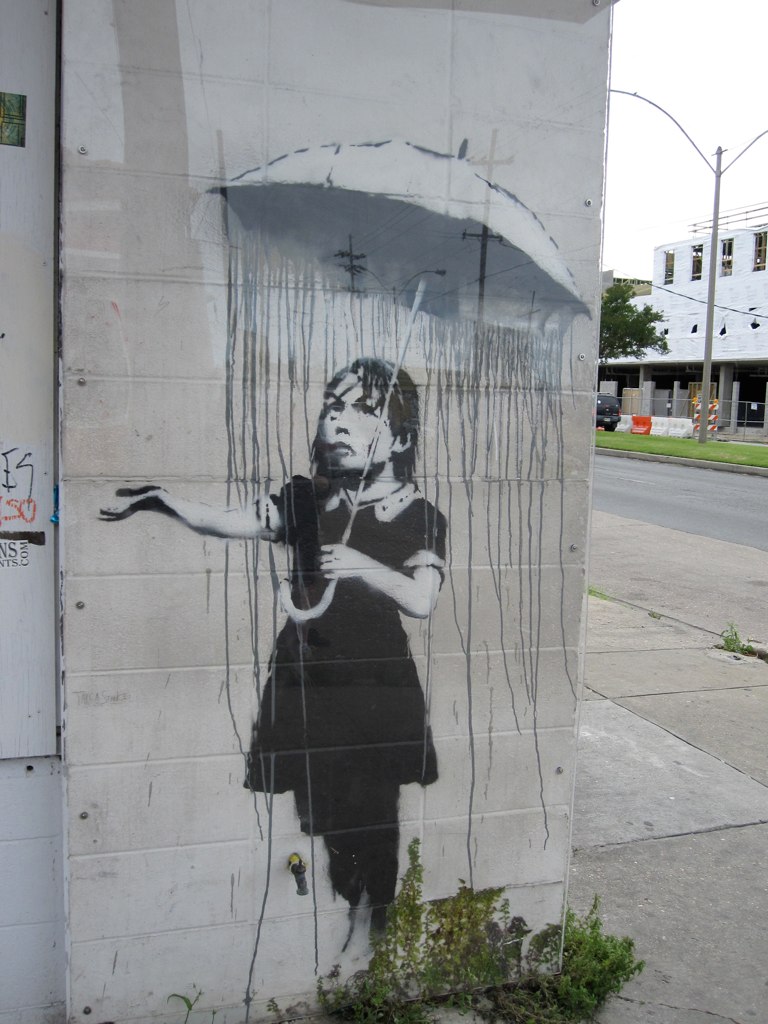
The work was created within a city still carrying the scars of Hurricane Katrina, a disaster that exposed profound social inequalities and generated criticism surrounding institutional response and failure. Banksy rarely addresses political subjects through direct slogans alone; instead, he frequently prefers visual metaphors that appear deceptively gentle. The child becomes central to that strategy.
NOLA (Yellow Rain), 2007
Christie’s online: 1 April 2025
Estimated: GBP 70,000 – 100,000
GBP 81,900 / USD 105,815

BANKSY
NOLA (Yellow Rain), 2007
Screenprint in colors on wove paper
Signed and numbered 13/31 in pencil, with the artist’s blindstamp
The tragedy of NOLA does not reside merely in environmental catastrophe or political criticism. It resides in the fact that a child appears forced to negotiate circumstances she did not create and cannot control. Like many children in Banksy’s work, she becomes a witness to failures originating entirely in the adult world.
Viewed alongside Girl with Balloon, Bomb Love, and Kids on Guns, a broader pattern begins to emerge. Banksy’s children are rarely passive figures. They often carry emotional weight far greater than their small silhouettes suggest. Children in Banksy’s universe frequently stand at the edge of systems larger than themselves — war, politics, consumerism, environmental disaster, or social inequality. And perhaps that is precisely why they remain so powerful. Adults may argue with one another. Children simply reveal what is there.
An interesting resonance appears here as well. The Estate of Matthew Perry is also offering Banksy’s NOLA as part of the charitable sale benefiting the Matthew Perry Foundation. While the selection was not assembled as a formal thematic exhibition, one cannot help noticing certain parallels emerging across the works. Both Girl with Balloon and NOLA are among Banksy’s most emotionally charged images. Both center on children confronting circumstances larger than themselves. Both quietly revolve around ideas of hope, vulnerability and resilience.
Nola (Grey Rain), 2008
From the Estate of Matthew Perry
With proceeds benefiting the Matthew Perry Foundation
Heritage Auctions: 5 June 2026
Estimated: USD 40,000 and up
Banksy (b. 1974). Nola (Grey Rain), 2008. Screenprint in colors on | Lot #14004 | Heritage Auctions
BANKSY (b. 1974)
Nola (Grey Rain), 2008
Screenprint in colors on wove paper
Edition: 48/63
Signed and editioned in pencil along lower edge
Published by Pictures on Walls, London with their blindstamp lower left
In Girl with Balloon, a child reaches toward something that appears just beyond grasp. In NOLA, a child stands beneath a shelter that no longer protects. One image speaks about pursuit; the other about disappointment. Yet both ultimately return to a similar question: how does one continue moving forward when certainty disappears?
Viewed through the lens of Matthew Perry’s story and the Foundation’s mission, the dialogue between the works becomes unexpectedly moving. Recovery itself often involves navigating fragile spaces between struggle and hope, between loss and possibility. It is perhaps fitting that works helping support the Foundation are themselves images that repeatedly remind us that resilience rarely appears as triumph. More often, it appears as reaching — and continuing to reach.
Market Momentum and Valuation
The market surrounding Girl with Balloon has evolved beyond the trajectory of a successful artwork and into something closer to an independent ecosystem. Murals, prints, paintings, unique works and conceptual reinterpretations now operate almost as individual markets within a larger Banksy universe. Very few contemporary images possess this level of recognition while simultaneously maintaining strong collector demand across nearly every category. Recent results continue to demonstrate the enduring strength of the subject.
Love is in the Bin: The Auction That Changed Art History
———-
In October 2018, one of the most extraordinary moments in auction history unfolded at Sotheby’s in London. A framed version of Girl with Balloon had just sold for over £1 million when an alarm sounded. Hidden within the frame was a shredding mechanism that suddenly activated, partially destroying the artwork in front of a stunned audience.
The event instantly became one of the defining images of the contemporary art market. Banksy later claimed responsibility through a video showing preparations for the stunt. Rather than destroying value, however, something unexpected happened.
The work increased dramatically in significance and was renamed Love Is in the Bin. The irony was almost painfully perfect. Banksy had spent decades criticizing commercialization, auction culture, and speculation. Yet by attacking the market, he had inadvertently created one of its most valuable spectacles. Art history occasionally enjoys a sense of humor.
Market Momentum
———-
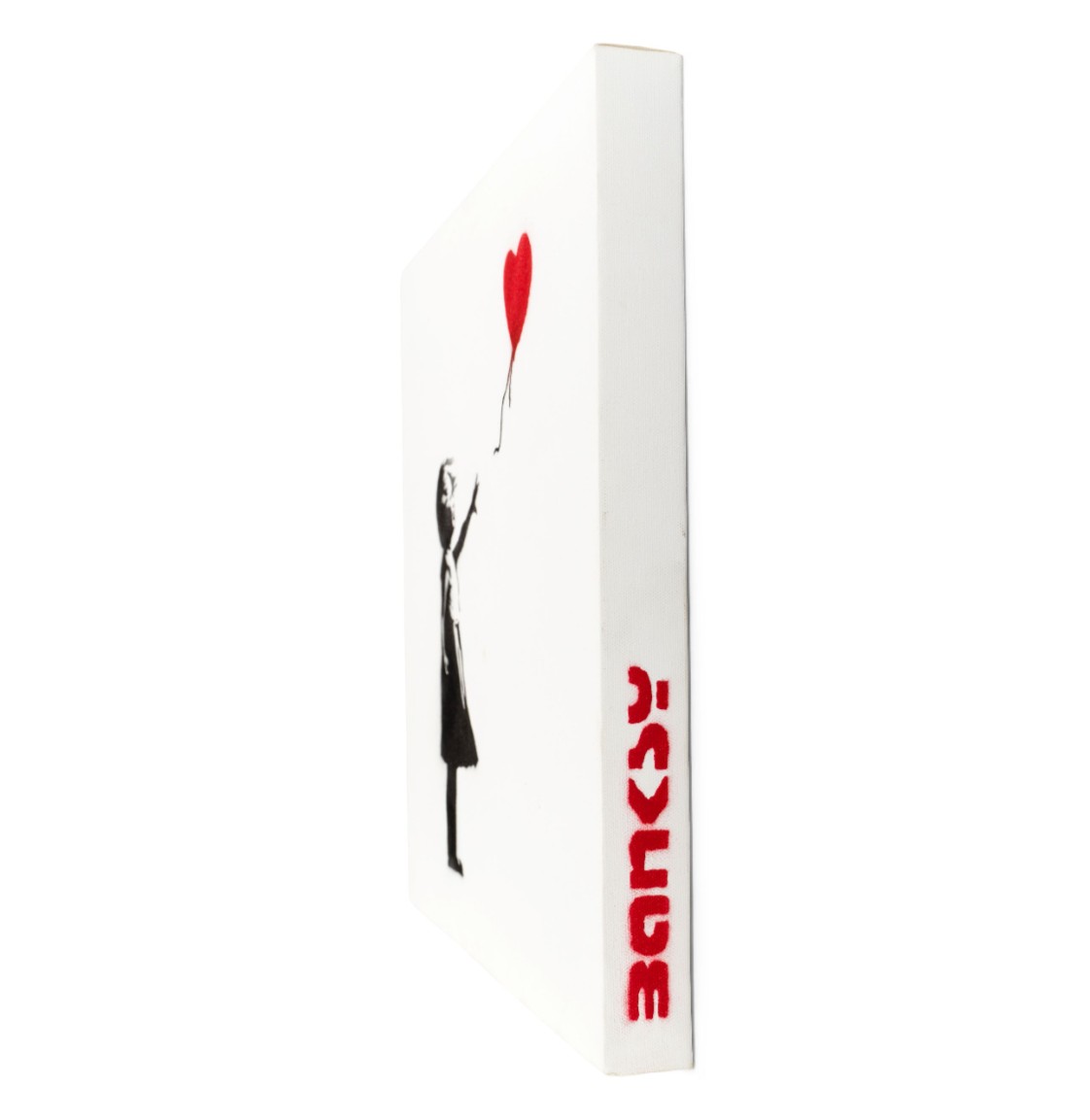
A single-panel Girl with Balloon painting from 2003, from an edition of only twenty-five, sold for USD 993,000 at Bonhams on 20 May 2026, confirming that relatively intimate interpretations of the image continue to attract serious collector demand.
Girl and Balloon, 2003
Bonhams New-York: 20 May 2026
Estimated: USD 700,000 – 1,000,000
USD 953,000
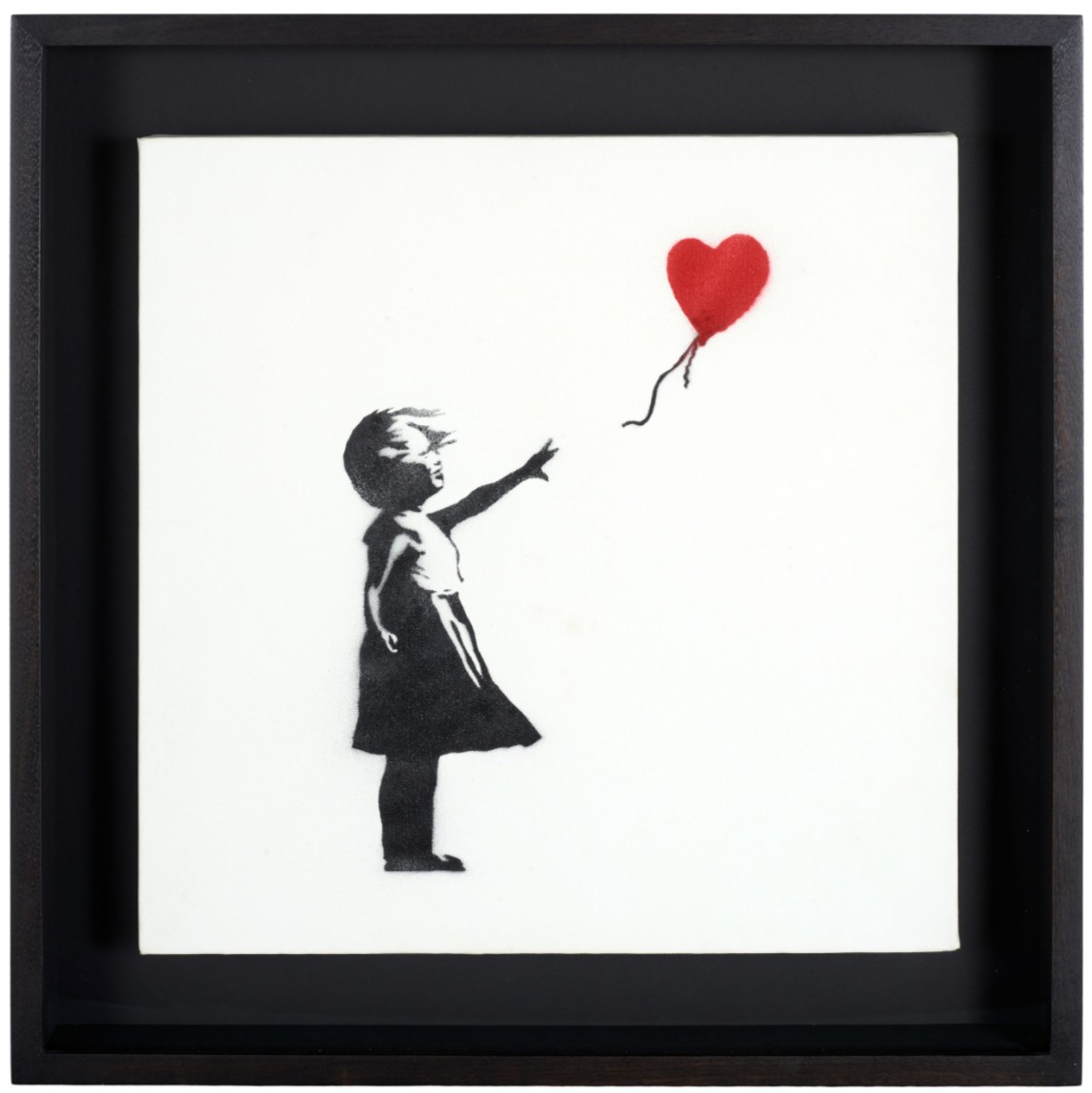
BANKSY (B. 1975)
Girl and Balloon, 2003
Spray paint on canvas
40.6 x 40.6 cm (16×16 inches)
Tagged ‘BANKSY’ (on the right turning edge)
Numbered and dated ’10/25 2003′ (on the stretcher)
This work is number 10 from an edition of 25
At the very highest end of the market, Girl with Balloon on Found Landscape achieved USD 17,940,000 through Fair Warning, becoming one of the strongest auction results ever achieved for a work built around the motif. That result is particularly interesting because it reinforced something the market increasingly appears to recognize: collectors are willing to pay substantial premiums for unusual, unique, or conceptually richer iterations of Banksy’s most recognizable imagery.
An Underappreciated Iteration?
———-
The present work occupies a particularly compelling position within that broader landscape. Girl with Balloon (Diptych) is not merely another adaptation of a successful image. It is arguably one of Banksy’s most intelligent and conceptually refined reinterpretations of his most famous subject. Rather than simply reproducing the composition, Banksy dismantles it, separating child and balloon and transforming the empty space itself into an active component of the work. It feels less like a repetition and more like an evolution. Auction history appears to support this view.
The diptych has appeared publicly only a very limited number of times and has demonstrated considerable price strength over the years. The work most recently sold at Sotheby’s in London on 14 October 2022 for GBP 882,000 (approximately USD 996,800).
Girl with Balloon Diptych, 2006
Sotheby’s London: 14 October 2022
Estimated: GBP 1,200,000 – 1,800,000
GBP 882,000 / USD 996,800
Girl with Balloon Diptych | The Now Evening Auction | 2022 | Sotheby’s (sothebys.com)

BANKSY (b. 1974)
Girl with Balloon Diptych, 2006
Spray paint on canvas, in two parts
Each: 30×30 cm (12×12 inches)
Left canvas: signed Banksy, dated 2006 and numbered Artist Proof 00/25 (on the reverse)
Right canvas: tagged (on the overturn edge)
While this represented a meaningful correction from its auction peak of GBP 3,042,500 (approximately USD 4.18 million) achieved at Christie’s in London in October 2021, the broader trajectory remains extremely compelling when viewed over a longer horizon.
Girl with Balloon (Diptych), 2005
Christie’s London: 15 October 2021
Estimated: GBP 2,600,000 – 3,500,000
GBP 3,042,500 / USD 4,183,940
AUCTION RECORD FOR GIRL WITH BALLOON (DIPTYCH)
BANKSY, Girl with Balloon (Diptych) | Christie’s (christies.com)

BANKSY
Girl with Balloon (Diptych), 2005
Spray paint on canvas, in two parts
Each: 30.2 x 30.2 cm (11 7/8 x 11 7/8 inches)
(i) numbered ‘6/25′ (on the stretcher)
(ii) tagged ‘BANKSY’ (on the overlap); signed and dated ‘BANKSY 5⁄9/05‘ (on the stretcher)
This work is number six from an edition of twenty-five
Girl with Balloon (Diptych) is not simply another adaptation of a successful composition. It is arguably among Banksy’s most intelligent reinterpretations of his most celebrated image. Rather than reproducing the familiar scene, Banksy dismantles it entirely, separating child and balloon into independent entities and transforming the empty space between them into an active component of the work itself. In our view, this matters.
One is not simply acquiring a recognizable Banksy image. One is acquiring a rare interpretation of arguably the defining visual icon of the twenty-first-century street art movement; a work from an edition of only twenty-five; a composition that many would consider among the most sophisticated treatments of the subject; and a work carrying the remarkable provenance of Matthew Perry’s collection.

There is another dimension here as well. The proceeds of this sale benefit the Matthew Perry Foundation, creating a rare convergence between market opportunity and meaningful purpose. Art history occasionally produces moments where financial logic, cultural importance and human significance intersect. This feels like one of those moments. A collector here is not simply buying a work of art. One is acquiring a small but meaningful fragment of contemporary cultural history while simultaneously supporting a foundation dedicated to helping others find hope — which, considering the image itself, feels rather fitting.
Girl with Balloon at Auction
Auction Results Rankings in Decreasing Order
PLEASE CLICK ON ANY VISUAL TO ACCESS THE CATALOGUE ENTRY
Love Is In The Bin, 2018
Sotheby’s London: 14 October 2021
Estimated: GBP 4,000,000 – 6,000,000
Price realized: GBP 18,582,000 / USD 25,457,340
Love is in the Bin | Contemporary Art Evening Auction | 2021 | Sotheby’s
NEW RECORD AT AUCTION FOR BANKSY

BANKSY
Love Is In The Bin, 2018
Spray-paint and acrylic on canvas mounted on board, framed by the artist
Decommissioned, remote controlled shredding mechanism remains in the frame
142x78x18 cm (60 x 30 7/8 x 7 inches)
Unique
Signed on the reverse
XXXXXXXXXX
Girl and Balloon on Found Landscape, 2012
Fair Warning Auction: 20 May 2026
Estimated: USD 13,000,000 – 18,000,000
USD 17,940,000
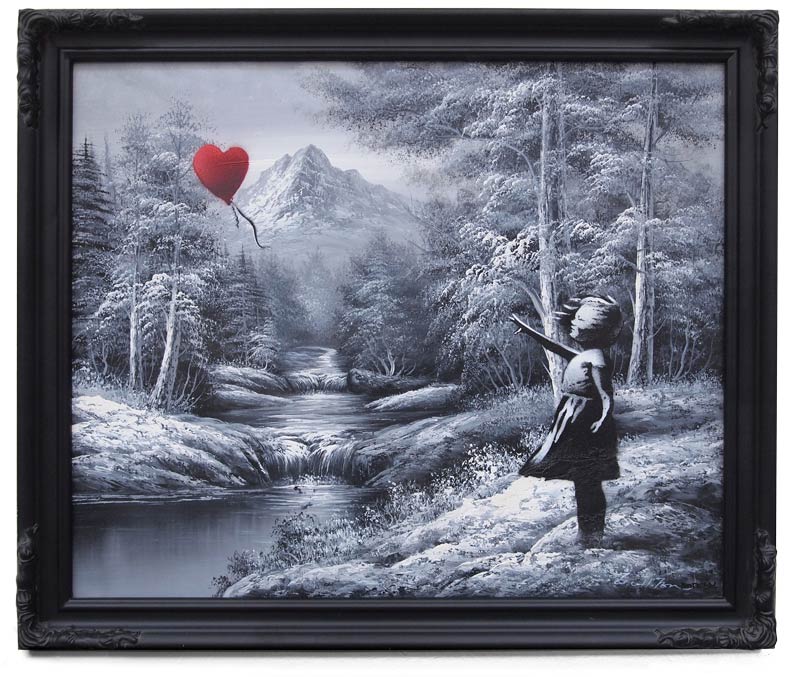
BANKSY
Girl and Balloon on Found Landscape, 2012
Spray paint on canvas
59 x 69.5 cm (23-1/4 x 27-3/8 inches)
Signed on the front and on the reverse
XXXXXXXXXX
Girl with Balloon (Diptych), 2005
Christie’s London: 15 October 2021
Estimated: GBP 2,600,000 – 3,500,000
GBP 3,042,500 / USD 4,183,940
AUCTION RECORD FOR GIRL WITH BALLOON (DIPTYCH)
BANKSY, Girl with Balloon (Diptych) | Christie’s (christies.com)
BANKSY
Girl with Balloon (Diptych), 2005
Spray paint on canvas, in two parts
Each: 30.2 x 30.2 cm (11 7/8 x 11 7/8 inches)
(i) numbered ‘6/25′ (on the stretcher)
(ii) tagged ‘BANKSY’ (on the overlap); signed and dated ‘BANKSY 5⁄9/05‘ (on the stretcher)
This work is number six from an edition of twenty-five
XXXXXXXXXX
Girl with Balloon, 2006
Sotheby’s London: 2 March 2022
Estimated: GBP 2,000,000 – 3,000,000
GBP 2,818,000 / USD 3,766,875
Girl with Balloon | The Now Evening Auction | | Sotheby’s (sothebys.com)
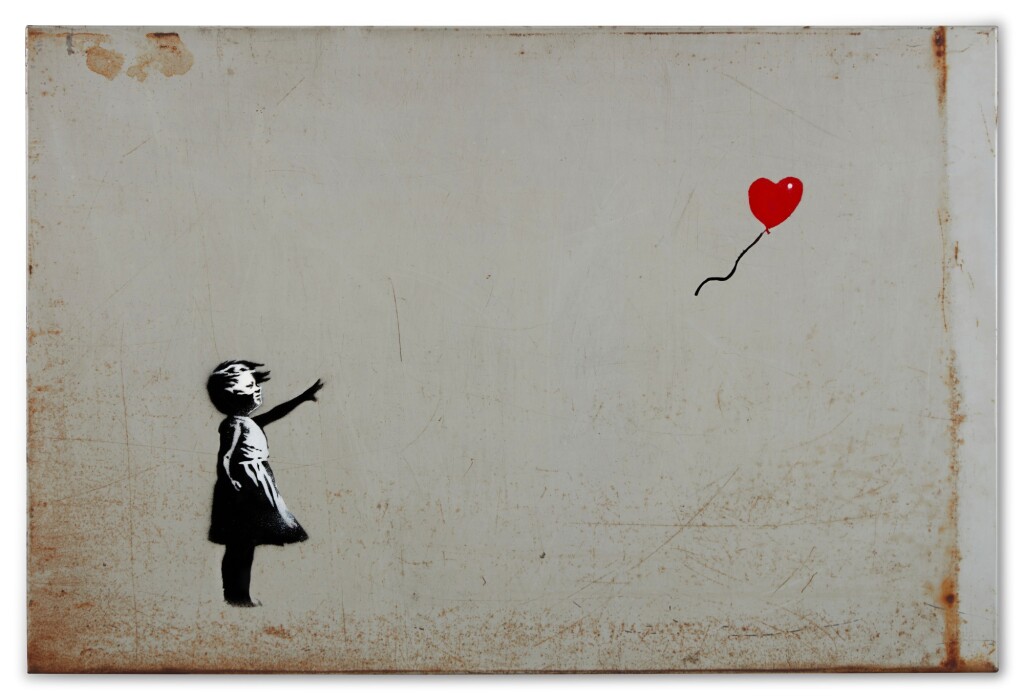
Girl with Balloon, 2006
Spray-paint on metal
60×90 cm (23.7 x 35.5 inches)
This work is from an edition of 5
Girl with Balloon, 2003
Sotheby’s London: 29 June 2021
Estimated: GBP 1,000,000 – 1,500,000
GBP 2,072,000 / USD 2,851,549
AUCTION RECORD FOR GIRL AND BALLOON
Girl with Balloon | British Art Evening Sale: Modern/Contemporary | 2021 | Sotheby’s (sothebys.com)

BANKSY (b. 1974)
Girl with Balloon, 2003
Spray paint on canvas
40.5 x 40.5 cm (16×16 inches)
Stenciled with the artist’s name on the overlap
Numbered 24/25 on the stretcher
This work is number 24 from an edition of 25
XXXXXXXXXX
Girl with Balloon & Morons Sepia, 2007
Phillips London: 20 October 2020
Estimated: GBP 500,000 – 700,000
GBP 1,232,500 / USD 1,609,580
Banksy – 20th Century & Contemporary … Lot 8 October 2020 | Phillips
BANKSY
Girl with Balloon & Morons Sepia, 2007
Girl with Balloon: Spray paint on paper
Morons Sepia: Screenprint on paper, double-sided
56.5 x 76 cm (22 1/4 x 29 7/8 inches)
Signed, numbered and dated ‘Banksy 07 2/8’ lower right
This work is number 2 from an edition of 8
Girl with Balloon (Gold AP), 2004
Estimated: GBP 400,000 – 600,000
GBP 1,104,000 / USD 1,513,885

Girl with Balloon (Gold AP), 2004
Girl with Balloon, 2006
Sotheby’s London: 5 October 2018
Estimated: GBP 200,000 – 300,000
GBP 1,042,000 / USD 1,365,480
(#67) BANKSY | Girl with Balloon
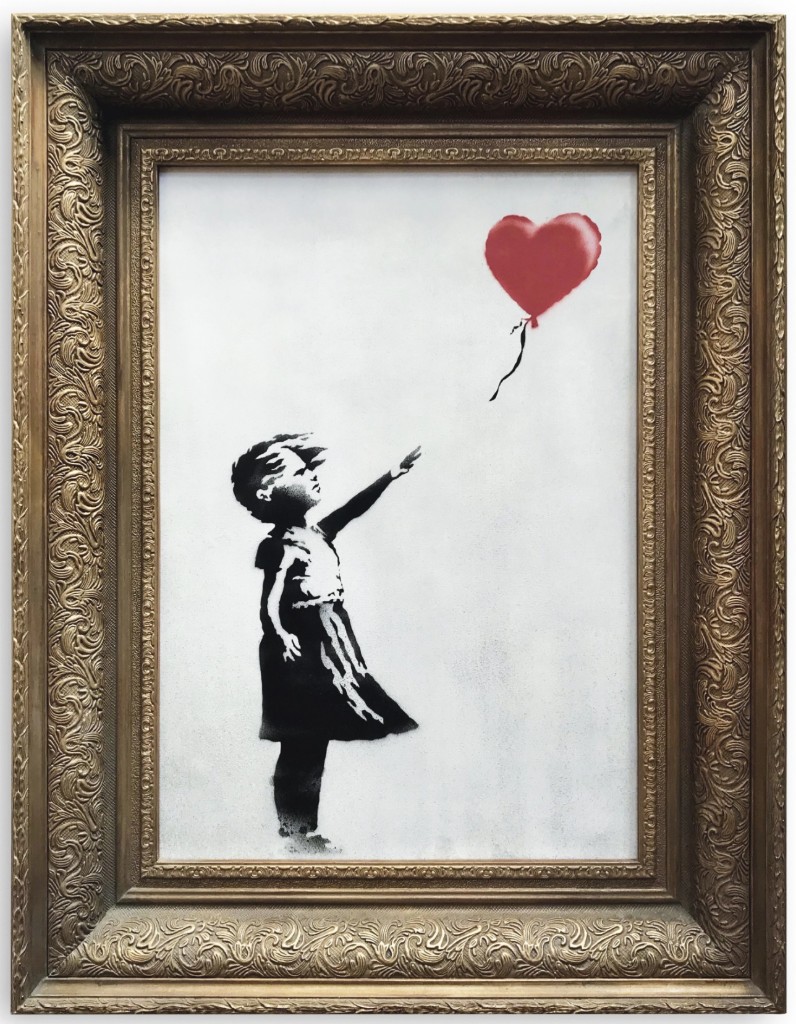
BANKSY
Girl with Balloon, 2006
Spray-paint and acrylic on canvas mounted on board, in artist’s frame
101x78x18 cm (39 3/4 x 30 3/4 x 7 inches)
Unique, signed and dedicated on the reverse
Girl with Balloon (Dark Purple AP), 2004
Estimated: GBP 250,000 – 350,000
GBP 791,250 / USD 1,044,450

Girl with Balloon (Dark Purple AP), 2004
Screenprint in colors on wove paper