BANKSY
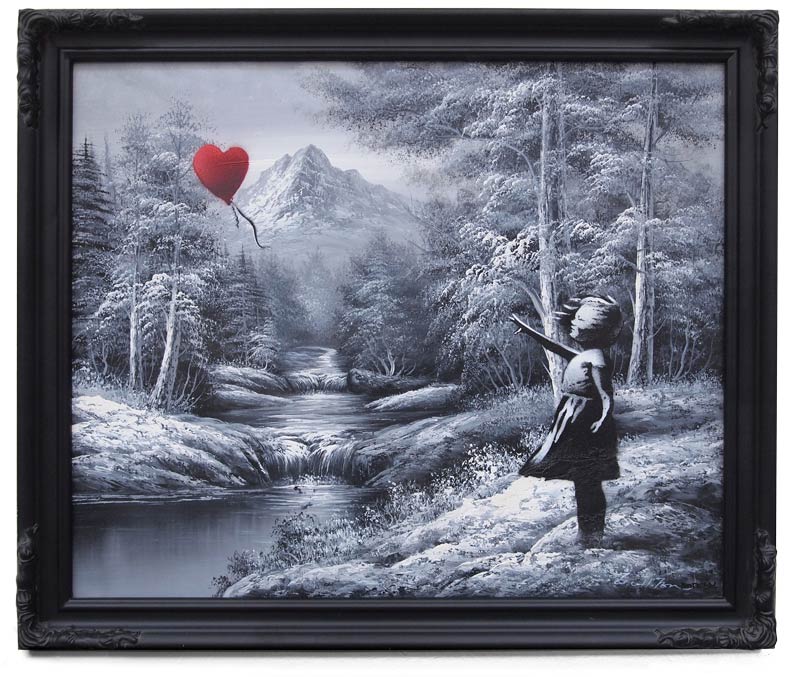
Girl and Balloon on Found Landscape, 2012
Spray paint on canvas
59 x 69.5 cm (23-1/4 x 27-3/8 inches)
Signed on the front and on the reverse
Auction History
| Fair Warning Auction 20 May 2026 Est.: USD 13,000,000 – 18,000,000 | Price Realized USD 17,940,000 Fair Warning |
Catalogue Note
Few images in contemporary art have transcended the boundaries of the art world as completely as Banksy’s Girl With Balloon. Since its first appearance on the streets of London in the early 2000s, the image of a young girl reaching toward a drifting red heart-shaped balloon has evolved into something far greater than a stencil on a wall. It has become one of the defining visual symbols of the twenty-first century, moving effortlessly between public space, museums, auction houses and popular culture. Much like Warhol’s Marilyn or Haring’s barking dog, the image has acquired a life independent of its creator, becoming instantly recognizable across cultures and generations.
In May 2026, this celebrated motif returned to the center of attention when Girl With Balloon on Found Landscape sold in New York through Fair Warning for approximately $17.9–18 million including buyer’s premium, becoming the third-highest auction result achieved for the artist. The sale represented more than another impressive market milestone. It offered collectors an exceptionally unusual work that occupies a singular position within Banksy’s production: the only known example in which his most recognizable image appears within one of his Crude Oils landscape interventions.
The work therefore occupies an unusual place in Banksy’s career, bringing together two parallel narratives that have long defined his artistic practice: the emotional universality of Girl With Balloon and his fascination with appropriating and disrupting pre-existing imagery.
More than two decades after its first appearance on a London wall, Girl With Balloon continues to evolve in ways that few could have anticipated. It began as a stencil in public space and gradually transformed into a global cultural symbol capable of moving between radically different contexts while retaining its emotional resonance. Girl With Balloon on Found Landscape represents another chapter within that evolution. By placing one of the most recognizable images of contemporary art within a romantic landscape, Banksy does not simply repeat a successful motif but reintroduces it under entirely new circumstances.
As with many of his most compelling works, the power of the image resides not in providing answers but in leaving questions unresolved. The balloon continues drifting into the distance, and viewers continue following it.
Girl With Balloon on Found Landscape
At first encounter, the composition appears almost entirely disconnected from the visual language one naturally associates with Banksy. The painting presents a tranquil grayscale landscape composed of dense trees, flowing water and distant mountains that rise softly in the background. Executed in a style reminiscent of decorative paintings frequently found in flea markets or suburban interiors, the image initially projects a sense of comfort and familiarity. The landscape is peaceful, harmonious and somewhat nostalgic, appearing as though it belongs to another era.
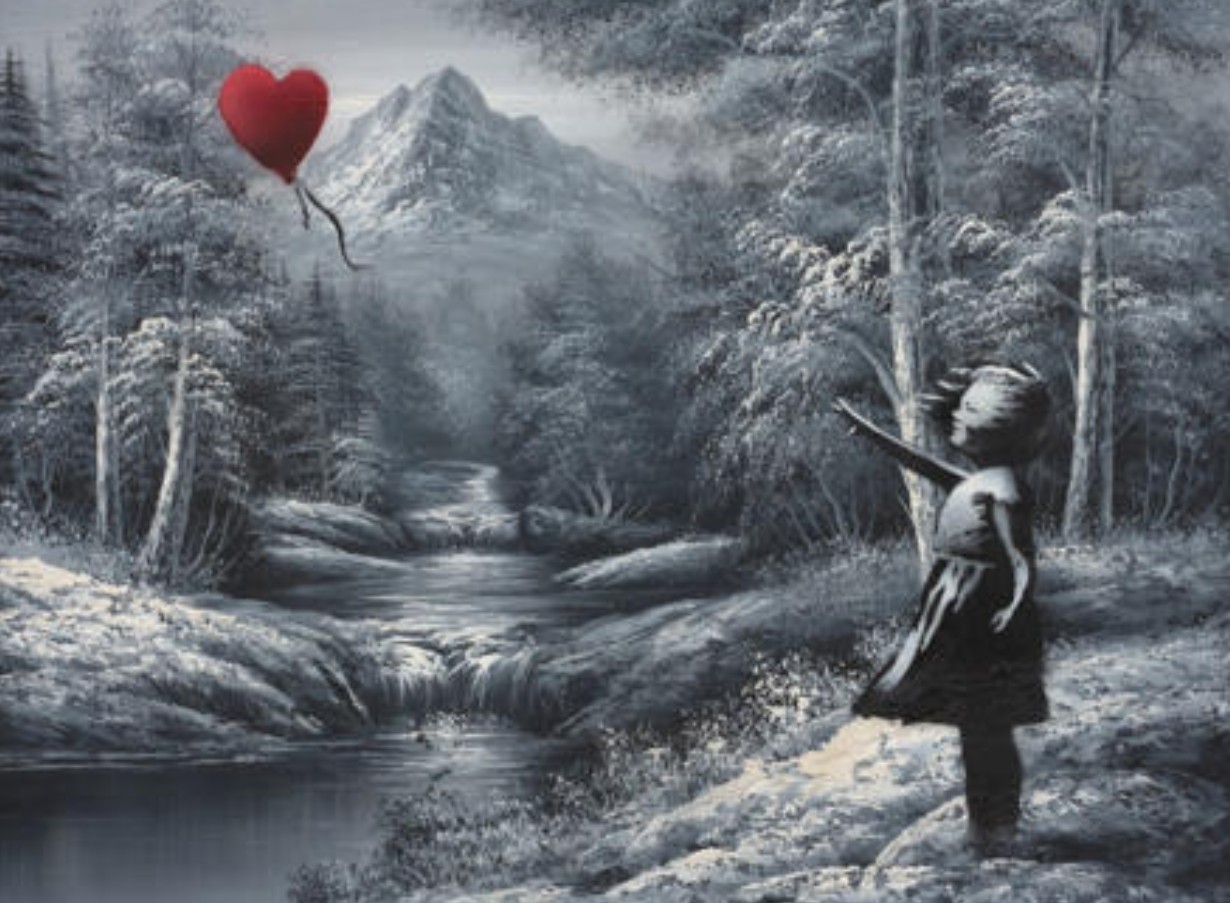
Banksy’s intervention immediately disrupts this carefully balanced calm. Standing at the lower right edge of the composition is the silhouette of a young girl rendered in the artist’s familiar stencil technique. Extending her arm toward the sky, she reaches for a red heart-shaped balloon drifting away from her and disappearing into the distance.
The contrast between the monochromatic landscape and the vivid red balloon immediately establishes a powerful visual hierarchy. The balloon becomes the emotional center of the composition, acting almost as a pulse within the otherwise muted environment. More importantly, Banksy transforms what was previously a static and decorative landscape into a scene charged with narrative and psychological tension. The viewer is no longer looking at a mountain view but at a moment suspended between hope and loss.
The Only Girl Lost in a Landscape
What makes this work particularly significant within Banksy’s oeuvre is not merely the appearance of the Girl With Balloon motif but the context in which it appears. The original image was conceived as an urban intervention. Its earliest incarnations emerged on concrete walls and neglected city spaces where the surrounding environment formed an essential part of the work itself. Public space, architecture and the rhythms of the city were inseparable from the meaning of the image.
In Girl With Balloon on Found Landscape, Banksy removes the motif entirely from its natural habitat and places it within an environment traditionally associated with escape, contemplation and romantic idealism. The result alters the emotional tone of the work in subtle but important ways.
The original street image often carried the sensation of fleeting opportunities disappearing within the speed and indifference of contemporary life. Here the emotional register becomes softer and perhaps more poetic. The drifting balloon appears less like something being lost within the chaos of the city and more like a distant dream gradually dissolving into nature itself.
Fair Warning described the work as the only example within the Crude Oils series to feature Banksy’s iconic girl and balloon motif, making it a unique hybrid between two of the artist’s most recognizable bodies of work.
Crude Oils: Rewriting the Landscape Tradition
The painting belongs to Banksy’s celebrated Crude Oils series, one of the artist’s most intelligent and mischievous bodies of work. Beginning in the early 2000s, Banksy acquired second-hand paintings and altered them with contemporary imagery ranging from shopping carts and warning signs to toxic waste containers and social commentary.
The title itself functions as a layered joke. It refers simultaneously to oil painting as a medium and to crude oil as a symbol of industrialization and environmental destruction. Through these interventions, Banksy effectively contaminates idealized visions of the world with reminders of contemporary anxieties.
Rather than creating entirely new images, Banksy behaves almost like a visual hijacker. He enters existing worlds and alters their meaning through minimal but carefully calculated interventions. The process recalls artistic appropriation strategies developed by artists such as Richard Prince and Marcel Duchamp, although Banksy approaches the idea with humor and accessibility rather than theoretical distance.
When early examples from the series were unveiled in London in 2005, Banksy transformed the exhibition itself into an event by releasing approximately two hundred live rats into the gallery space, forcing visitors to navigate around them while viewing the works. The exhibition became notorious not only because of the paintings themselves but because the environment surrounding them had become part of the artistic gesture.
Bob Ross Meets Banksy
Many viewers immediately noticed similarities between the underlying landscape and the imagery associated with Bob Ross. The comparison is difficult to avoid. Ross became famous for his idyllic mountain landscapes and his ability to transform painting into a form of televised comfort through scenes populated by rivers, forests and what he affectionately described as “happy little accidents.”
The juxtaposition becomes fascinating because Banksy’s intervention appears to operate according to almost opposite principles. Ross constructed environments of serenity and reassurance, while Banksy introduces uncertainty and emotional tension. One artist sought to soothe viewers while the other quietly unsettles them.
The result creates an unexpected conversation between two seemingly incompatible artistic personalities. Banksy does not destroy the landscape; rather, he gently infects it with narrative and emotional complexity.
Hope, Loss and the Ambiguity of the Balloon
Part of the enduring power of Girl With Balloon lies in its remarkable openness of interpretation. Banksy provides viewers with only the essential elements required to construct an emotional narrative, leaving the image intentionally unresolved.
The red balloon has frequently been interpreted as a symbol of hope, innocence, love or childhood itself. Banksy once accompanied the image with the phrase “There is Always Hope,” a statement that naturally encouraged optimistic readings. Yet the emotional complexity of the work derives precisely from its ambiguity.
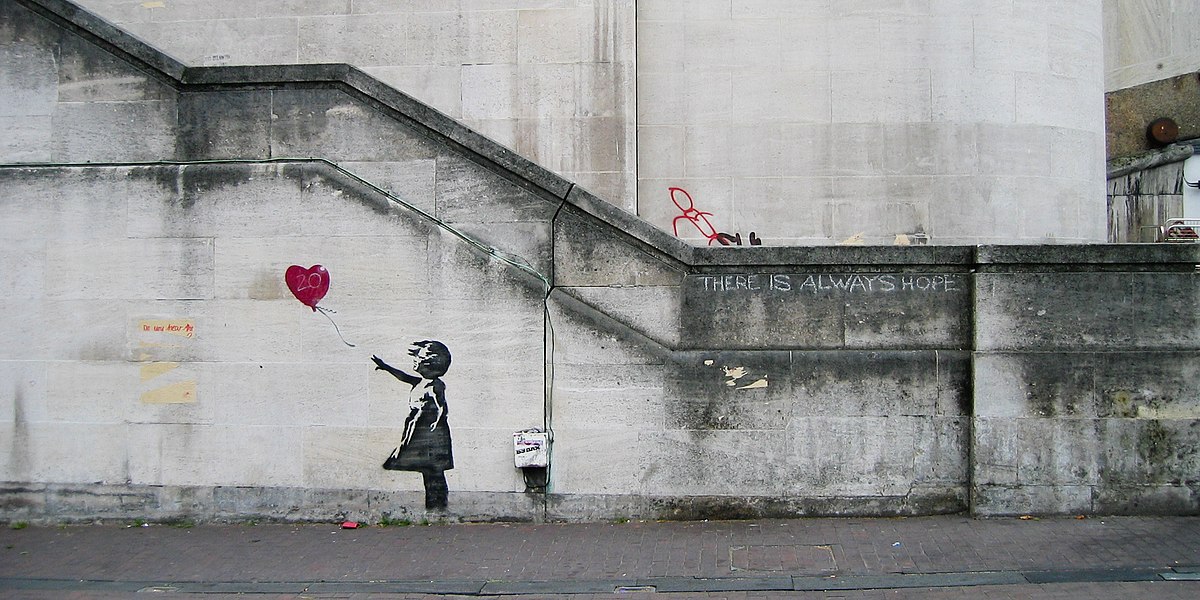
The balloon is not moving toward the child but drifting away from her. This subtle detail transforms the image from a straightforward message of optimism into something considerably more nuanced. The work simultaneously suggests hope and loss, desire and resignation. It presents viewers with a moment of uncertainty rather than a clear conclusion.
Perhaps this ambiguity explains why the image continues to resonate so profoundly. It allows viewers to project their own experiences and emotions onto the scene, making the work feel intensely personal despite its extraordinary familiarity.
Art Historical Echoes: Romanticism and the Sublime
The insertion of the girl into a mountainous landscape unexpectedly opens a broader art historical dialogue. Nineteenth-century Romantic painters frequently employed solitary figures within expansive landscapes to explore ideas of spirituality, emotion and human vulnerability in the face of nature.
Artists such as Caspar David Friedrich repeatedly positioned individuals against vast natural environments in order to evoke introspection and emotional contemplation. Banksy’s intervention can almost be understood as a contemporary inversion of this tradition.
Rather than contemplating transcendence or the grandeur of nature, the figure confronts absence itself. The sublime no longer emerges from mountains or skies but from something profoundly modern and human: the experience of losing something meaningful.
Love Is in the Bin: When the Balloon Escaped the Frame
No discussion of Girl With Balloon can avoid mentioning its most famous descendant, Love Is in the Bin. In 2018, shortly after a framed version of Girl With Balloon sold at Sotheby’s, a hidden mechanism concealed within the frame activated and partially shredded the work before a stunned audience.
The event instantly entered auction history and transformed the work into an entirely new piece. Intended as a critique of commodification and the mechanisms of value creation, the gesture ultimately produced a remarkable paradox: the destroyed artwork became more valuable than the original.
When Love Is in the Bin later sold for approximately $25.4 million, Banksy inadvertently demonstrated one of the very principles he has spent decades criticizing — that the contemporary art market possesses an extraordinary ability to absorb even its own criticism and transform it into value.
Fair Warning: Reinventing the Auction Experience
The sale itself deserves particular attention because it unfolded outside the traditional auction-house framework. Rather than appearing at Sotheby’s or Christie’s, the work was offered through Fair Warning, the auction platform founded by former Christie’s specialist Loïc Gouzer.

Since leaving Christie’s, Gouzer has attempted to rethink the auction experience by transforming sales into highly curated cultural events. The Banksy auction took place inside Tiffany & Co.’s flagship location on Fifth Avenue in Manhattan within a Peter Marino-designed apartment lounge attended by a relatively small group of invited guests.
The setting produced an almost surreal contradiction. Banksy, an artist whose career was built upon questioning authority, luxury and systems of value, found himself displayed among jewelry vitrines inside one of the world’s most recognizable luxury institutions. The irony would almost seem too obvious had Banksy himself invented it.