CLAUDE MONET
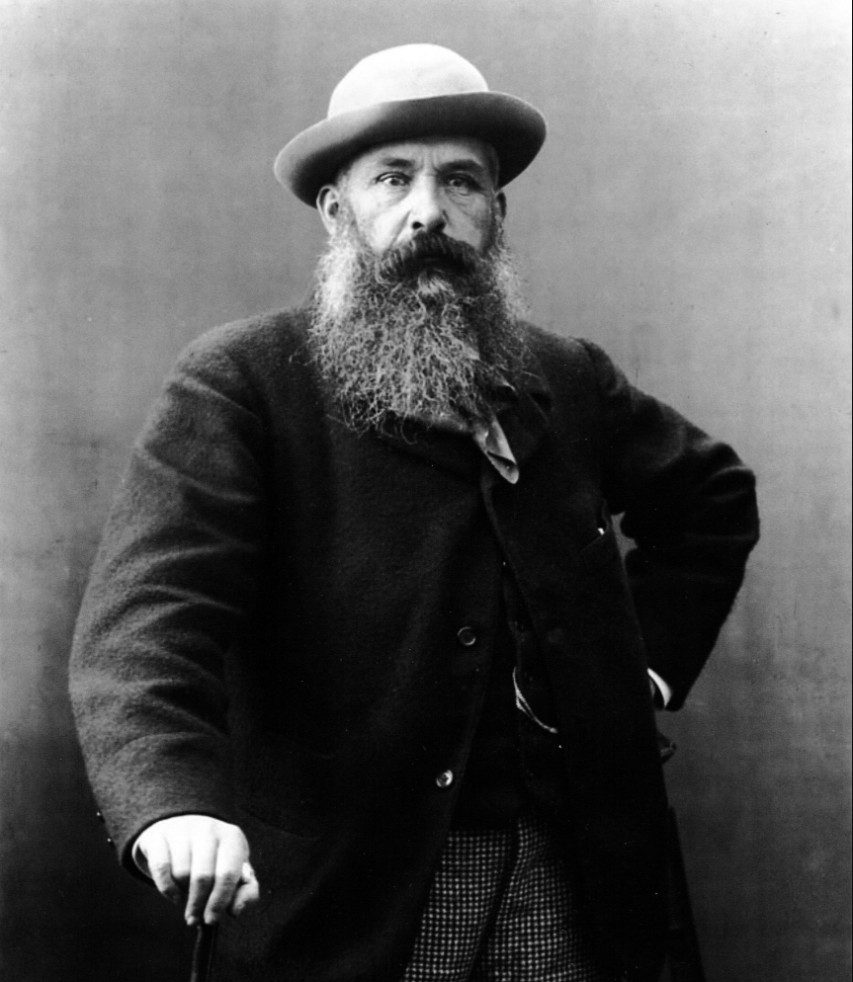
Claude Monet (1840-1926) was a French painter who is considered to be the founder of Impressionism, and the most consistent and prolific practitioner of the movement's philosophy. This art movement encouraged expressing one's perceptions before nature, especially as applied to painting outside (en plein air), which was quite innovative at the time, and a radical departure from the widely accepted practice of painting inside in their studios. In that sense, Monet could also be seen as one of the precursors to urban art, except that most of his urban landscapes were about nature. Just like Banksy, Claude Monet was quite a revolutionary character in his own time.
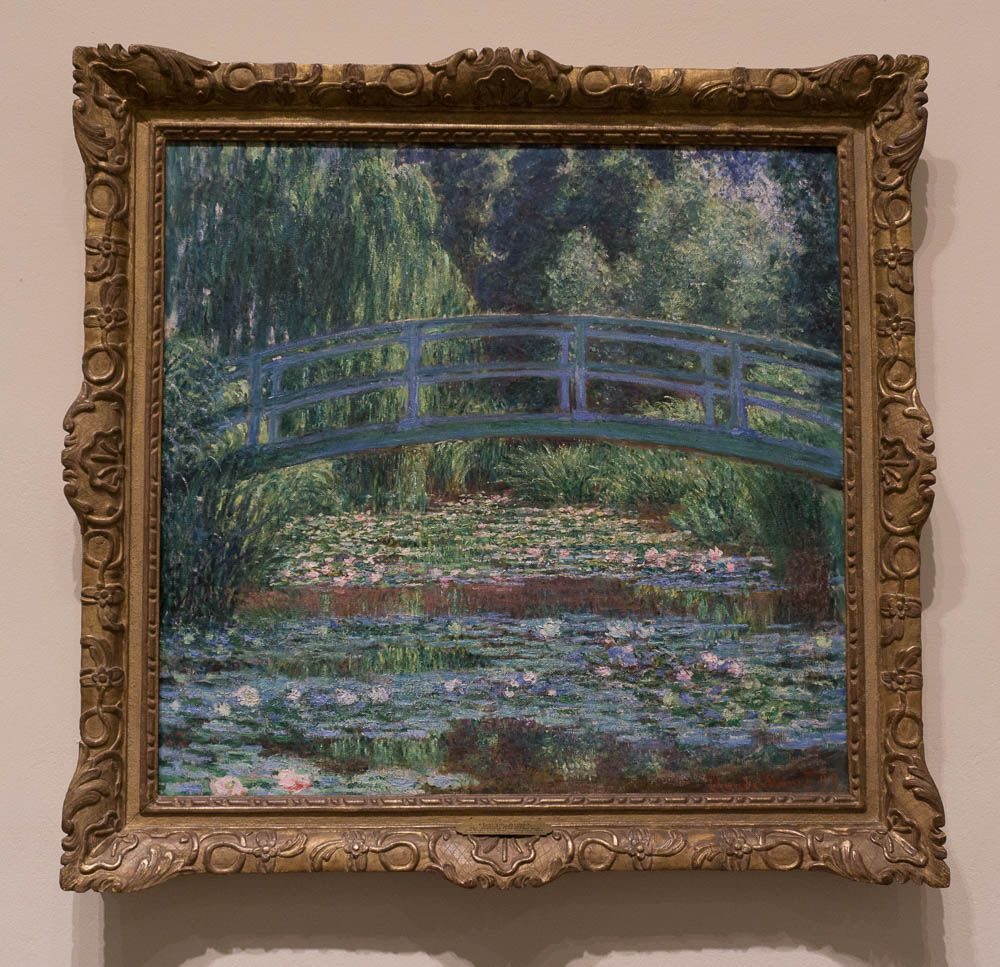
Monet’s beautiful paintings of Giverny are today considered a benchmark of established taste and crown jewels from a historical art perspective. Yet, at the time Monet was building his reputation during the 1860s and into the 1870s, he was considered a radical. By recording everything he saw and conspicuously refusing to omit ‘ugly’ scenic disturbances in his painting, his works sought to reflect the changing landscape of Modern France as the Industrial Revolution made its impact on the traditional landscape genre. This was controversial and seen as an affront to contemporary taste, a departure from the past, and this revolutionary perspective is amplified through Banksy’s reworking more than a century later. Echoing the way in which Monet translated the French landscape, complete with evidence of the encroaching Industrial Revolution, Show me the Monet presents a dialogue on the impact of the corporate world on our environment and the sacrifices made at the expense of so-called ‘human progress’.
Show Me The Monet
Show me the Monet is among the most iconic paintings of Banksy’s provocative oeuvre. It is an extremely rare, entirely hand-painted canvas that helped secure Banksy’s position as one of the most controversial and decisive social commentators of our time. Banksy repurposes a famous image in western art history: Claude Monet’s career-defining view of the Japanese footbridge in his water garden at Giverny.
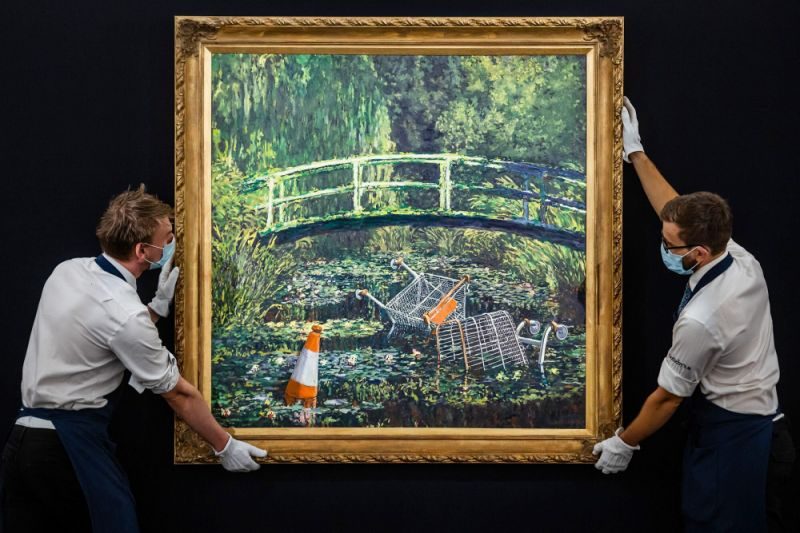
With its tongue-in-cheek pun of a title, Banksy’s painstakingly observed re-painting delivers a complex dialogue about some of the most prescient issues of our time, such as the environment and the capitalist landscape of this contemporary moment, not to mention the art establishment and its ongoing identity crisis. With a sumptuously rendered orange traffic cone and a thickly textured shopping trolley disrupting the romance of Monet’s Impressionist masterpiece, Banksy’s version becomes a twenty-first-century tipping point instead of a timelessly idyllic scene. Delivered with the ironic dead-pan immediacy of a punchline, the underlying conceptual complexity at stake here belies its humor.
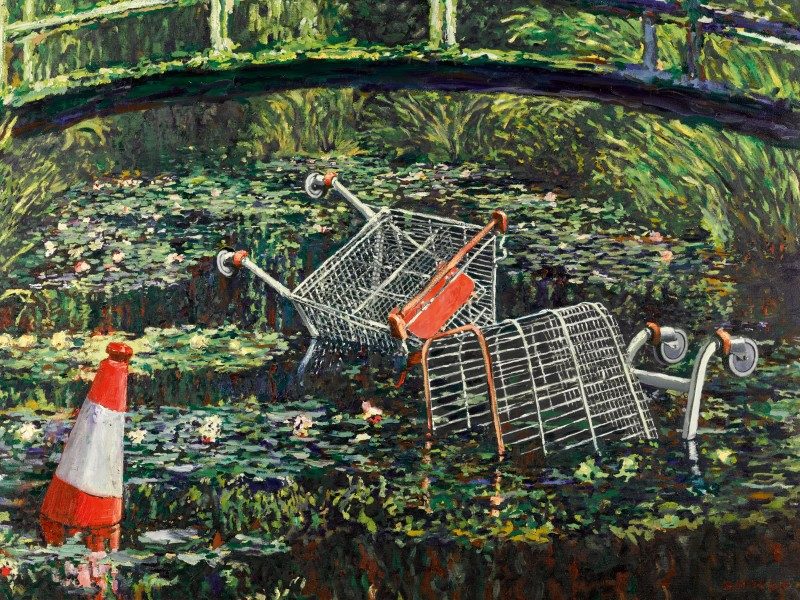
As a work of art, Monet’s waterlilies are near the apex of artistic achievement. In choosing to appropriate and rework these works, Banksy challenges modern civilization in a single image. His ironic manipulation includes half-submerged shopping trolleys and a traffic cone that present an affront to an icon of art history while also building on Monet’s radical legacy as a painter of Modernity. Banksy uses Monet's work to explicitly pass commentary on our time, an age of hyper-capitalism and waste. Using a heavy dose of irony and humor, Banksy’s work harbors a greater social agenda.
The Birth of Impressionism
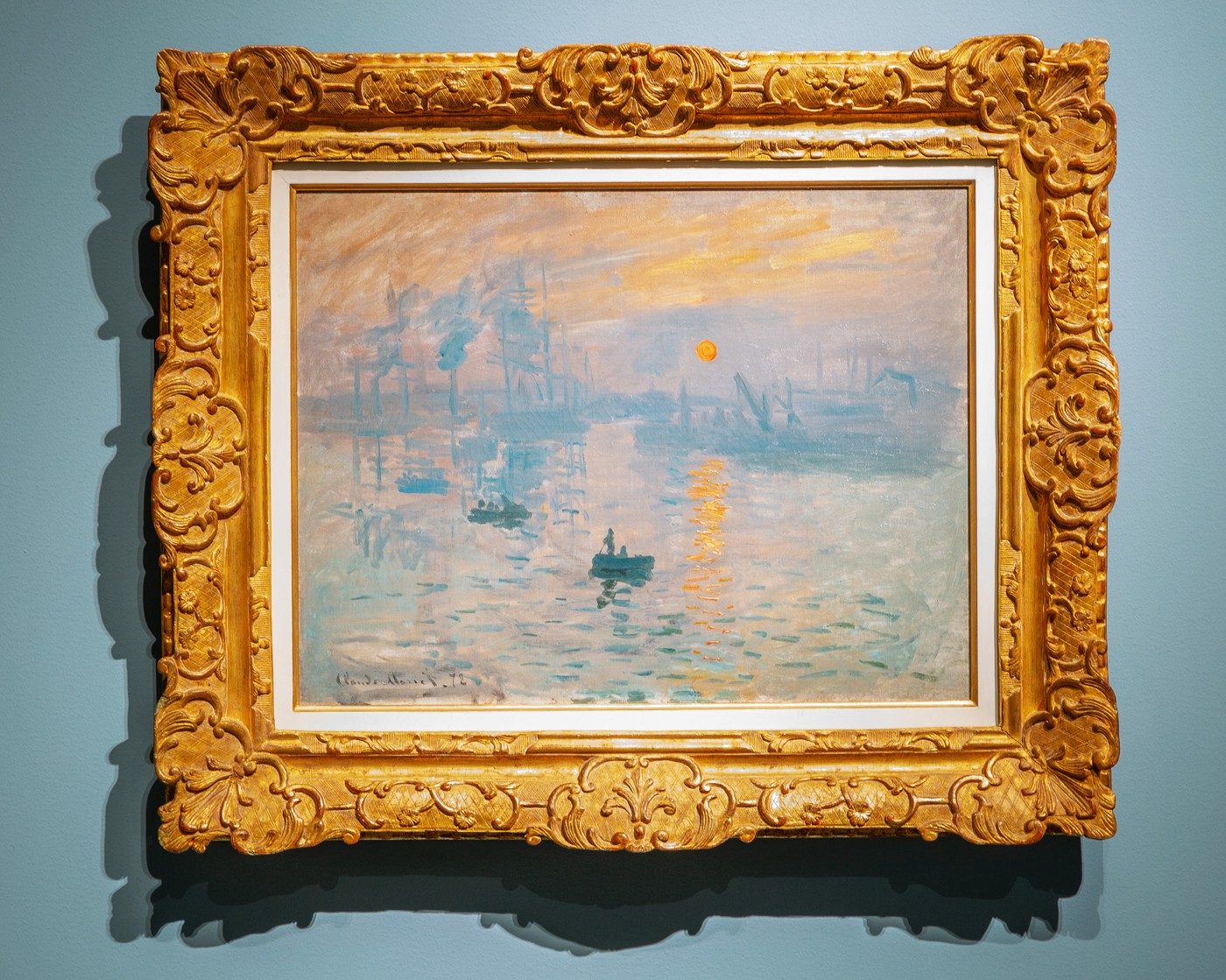
The term "Impressionism" is derived from the title of Monet's painting Impression, Soleil Levant (translated as Impressions, Sunrise), which was exhibited in 1874 in the first of the independent exhibitions mounted by a group of artists as an alternative to what was called the Salon de Paris, one of the precursors of the large art fairs familiar today.
In the early 1880s, Monet lived in Giverny, France, where he purchased a property and began a vast landscaping project which included the lily ponds that would eventually become the subjects of some of his best-known works. He began painting the water lilies, also called Nympheas in 1899, first in vertical views with a Japanese Bridge as a central feature, and later in a series of large-scale paintings that would occupy him continuously for the next 20 years of his life. Claude Monet painted no less than 250 Nympheas of all sizes. Some have sold for record prices at public auction and are now in museums all over the world.
Monet's ambition of documenting the French countryside led him to adopt a method of painting the same scene many different times in order to capture the changing of light and the passing of the seasons. As such, Monet can also be credited as the source of Andy Warhol's numerous series of repetitive subjects.
A Life Reflected in Water: The Nympheas
Few themes in the history of modern art are as universally revered as Claude Monet’s Nymphéas. More than a mere series of paintings, the water lilies became the culmination of a lifetime of observation, devotion, and artistic evolution. They stand today not only as a masterwork of Impressionism but as an enduring symbol of modernity and inner vision.
The Genesis of the Water Garden (1883–1893)
The story begins in April 1883, when Monet moved to the village of Giverny with Alice Hoschedé and their combined family of eight children. Nestled at the confluence of the Seine and the Epte, Giverny was then a quiet hamlet of 300 inhabitants. The family rented—and later, in 1890, purchased—a large pink house called Le Pressoir, set on two acres of land. “Certain of never finding a better situation or more beautiful countryside,” Monet wrote to his dealer Durand-Ruel, he resolved to turn his surroundings into a personal Eden.
“Everything I have earned has gone into these gardens, I do not deny that I am proud of them.”
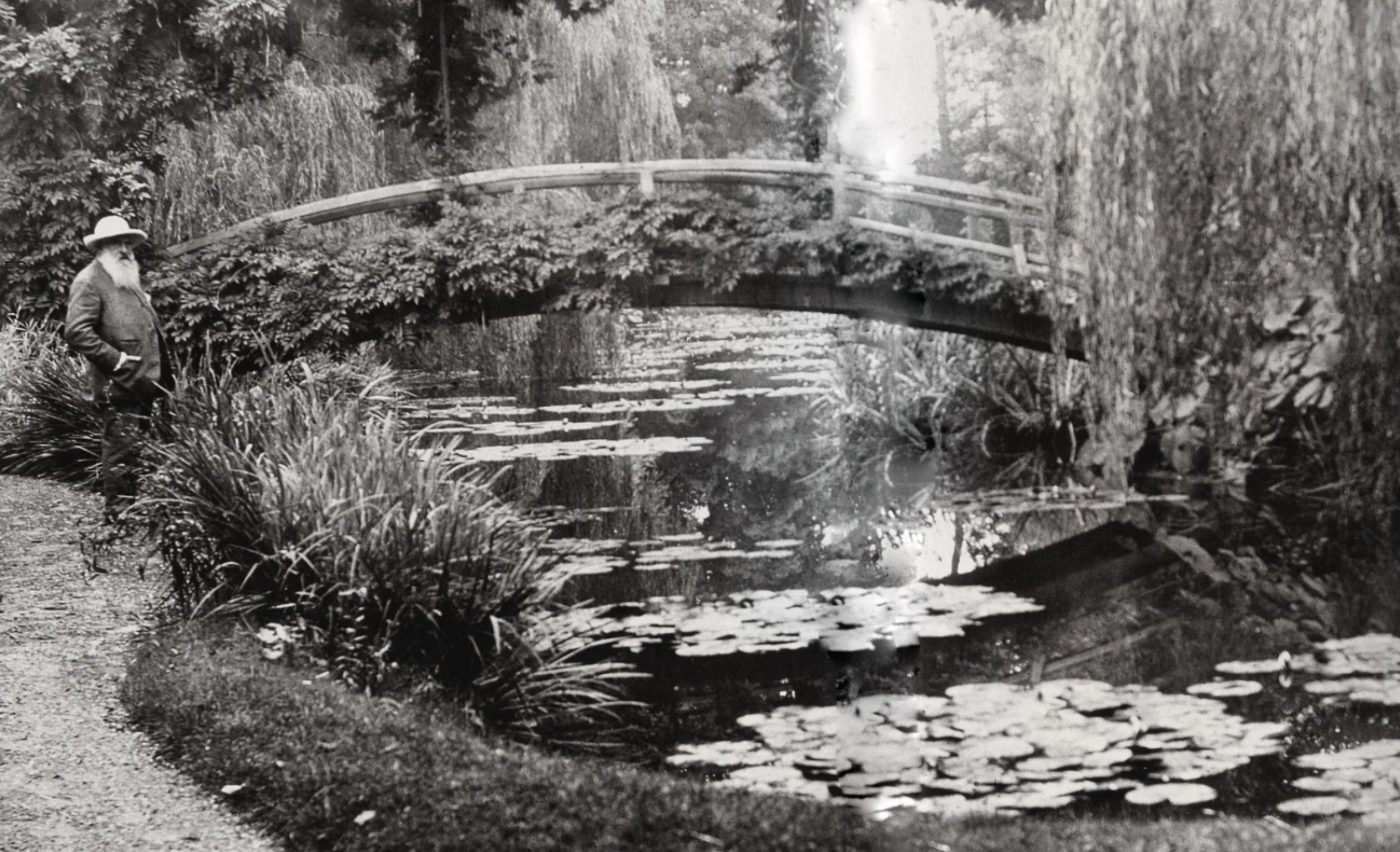
A passionate gardener since youth, Monet immediately began transforming the grounds. He replaced the vegetable plots with flowerbeds in what would become the Clos Normand. In 1893, emboldened by commercial success, Monet acquired an adjacent parcel of land and applied for permission to dig a pond “for the pleasure of the eyes and also for the purpose of having subjects to paint.” Despite protests from local farmers, who feared foreign plants would poison their cattle, the request was granted.
That same year, he created his now-iconic lily pond—a thousand square meters of aquatic paradise graced by irises, agapanthus, cherry trees, bamboo, and the Japanese bridge that would become a recurrent motif.
Planting Before Painting (1893–1897)
Despite the garden’s grandeur, Monet did not immediately begin painting the lilies. Between 1893 and 1897, he painted only three views of the pond—hesitant beginnings that suggest he was still observing, allowing the landscape to mature before attempting to translate its elusive beauty onto canvas.
“It took me a long time to understand my water lilies. A landscape takes more than a day to get under your skin. And then all at once, I had the revelation—how wonderful my pond was—and reached for my palette.”
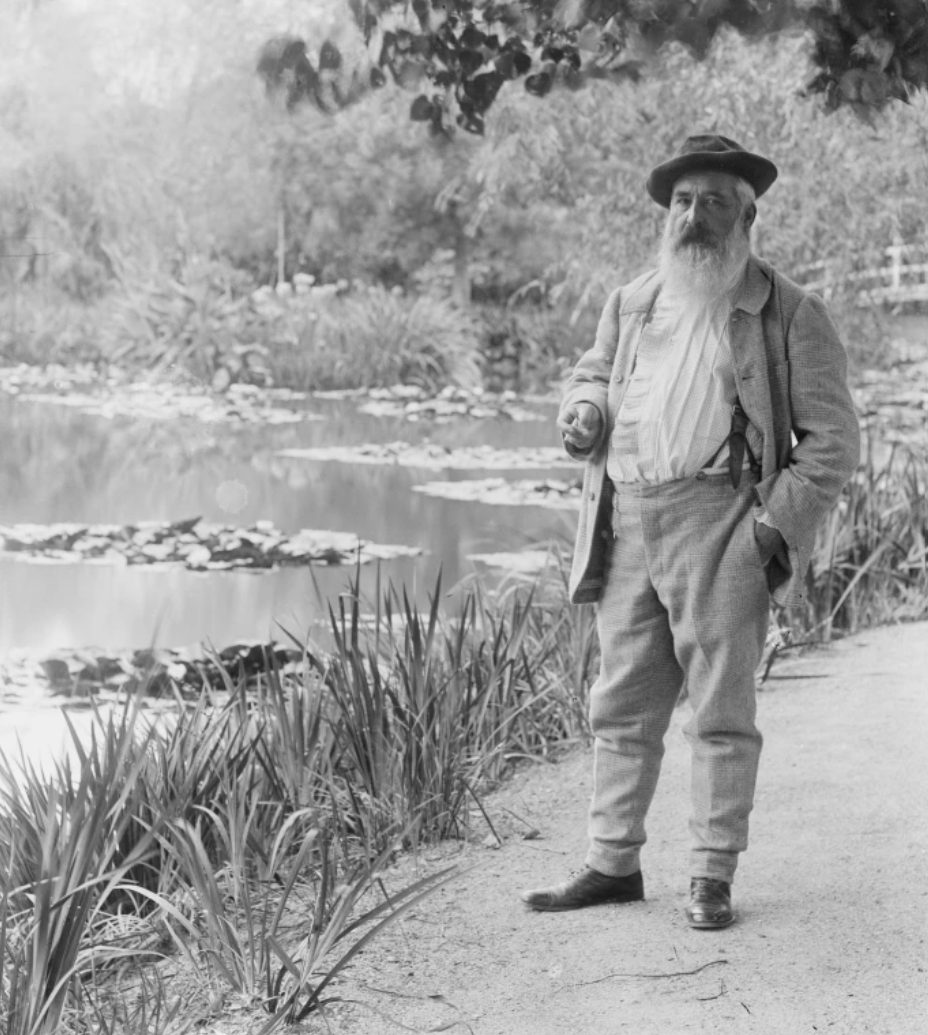
By 1897, this moment of epiphany arrived. That same year, Monet completed Matinée sur la Seine, a contemplative series of dawn views along the river. These explorations of light, reflection, and atmosphere unlocked a new way of seeing, and soon, his gaze turned inward—downward—onto the surface of his own pond.
The First Nymphéas Series (1897–1909)
Between 1904 and 1909, the artist worked with almost unbroken intensity, producing more than sixty paintings of the water garden. Eschewing traditional perspective, he lowered his gaze to the surface of the pond, yielding a dazzling and radically destabilized vision of shifting, disintegrating forms; the world beyond the plane of the water exists only as the most ephemeral reflections.
“The water-flowers themselves are far from being the whole scene. Really, they are just the accompaniment. The essence of the motif is the mirror of water, whose appearance alters at every moment.”
When these works were exhibited in May 1909, they were met with critical astonishment. Jean Morgan, writing for Gil Blas, declared, “His vision increasingly is simplifying itself… to amplify, to magnify the impression of the imponderable.” Monet could not have hoped for a warmer response. And yet, the years that followed were marked by personal tragedy: the deaths of his wife Alice and son Jean, the onset of cataracts, and flooding that damaged his gardens. “I am going to pack up my colors for good,” he lamented to his stepdaughter Blanche in 1911.
The Great Project: Les Grandes Décorations (1914–1926)
Monet’s creative spirit rekindled in 1914. “I have thrown myself back into work,” he wrote, “so much so that I am getting up at four a.m. and am grinding away all day long.” Inspired by a vision he had shared as early as 1897—a circular space enveloped in panoramic views of the pond—he now committed fully to the monumental project that would become Les Grandes Décorations.
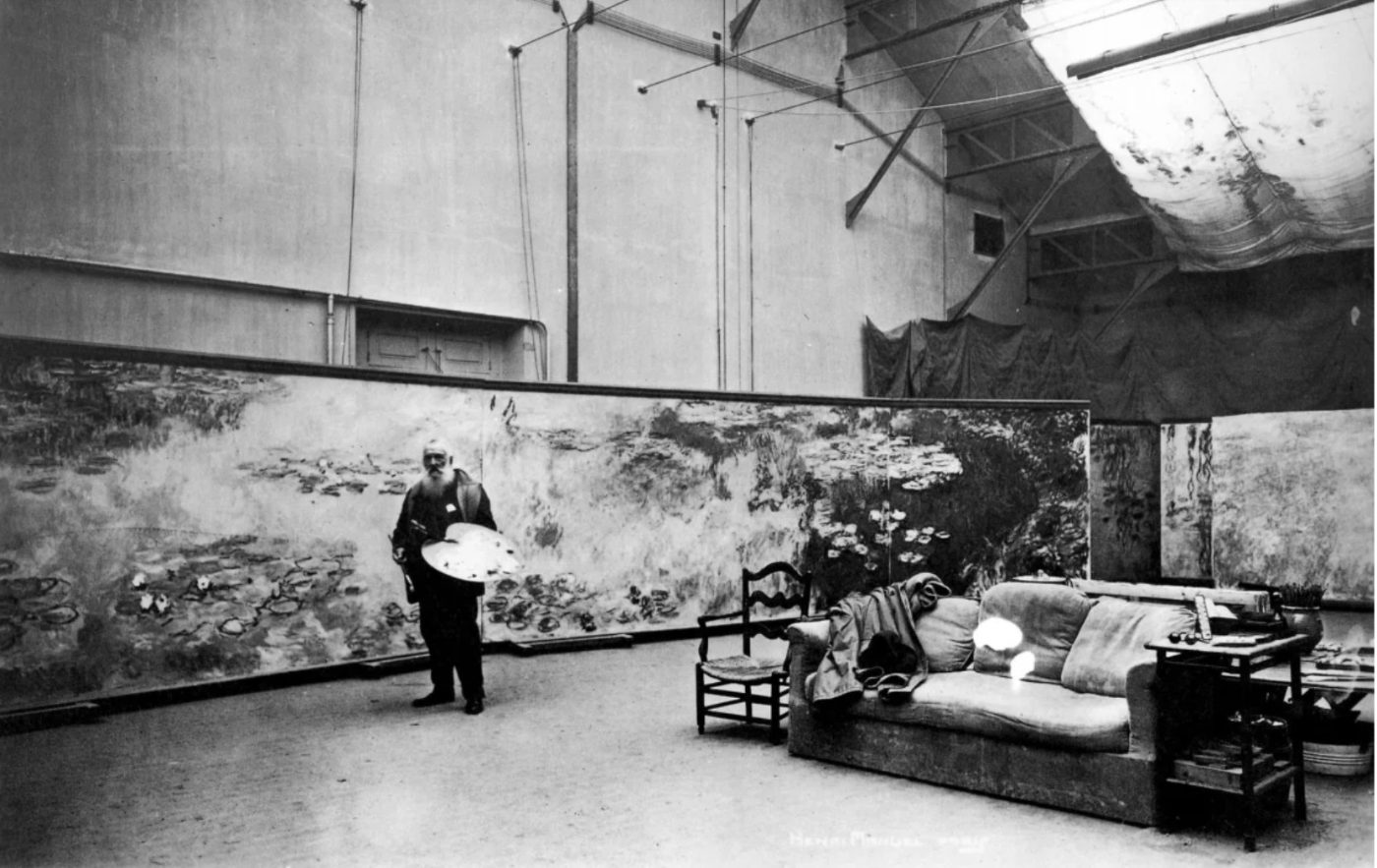
In painting his larger panels for the Grandes décorations, Monet worked in his newly-built studio, specially designed and constructed in 1915 despite the ravages and privations of the First World War, a mark of his passion for the project. While Monet could work on the largest canvases indoors in the studio all year long, come rain or shine, the ‘smaller,’ more manageable pictures like Le bassin aux nymphéas would often be propped up with an arrangement of ropes and weights so that he could paint them before the pond itself. An insight into this process was provided by René Gimpel, who wrote of a visit he made to Monet’s studio in 1918, mentioning a group of pictures that Daniel Wildenstein stated almost certainly included Le bassin aux nymphéas:
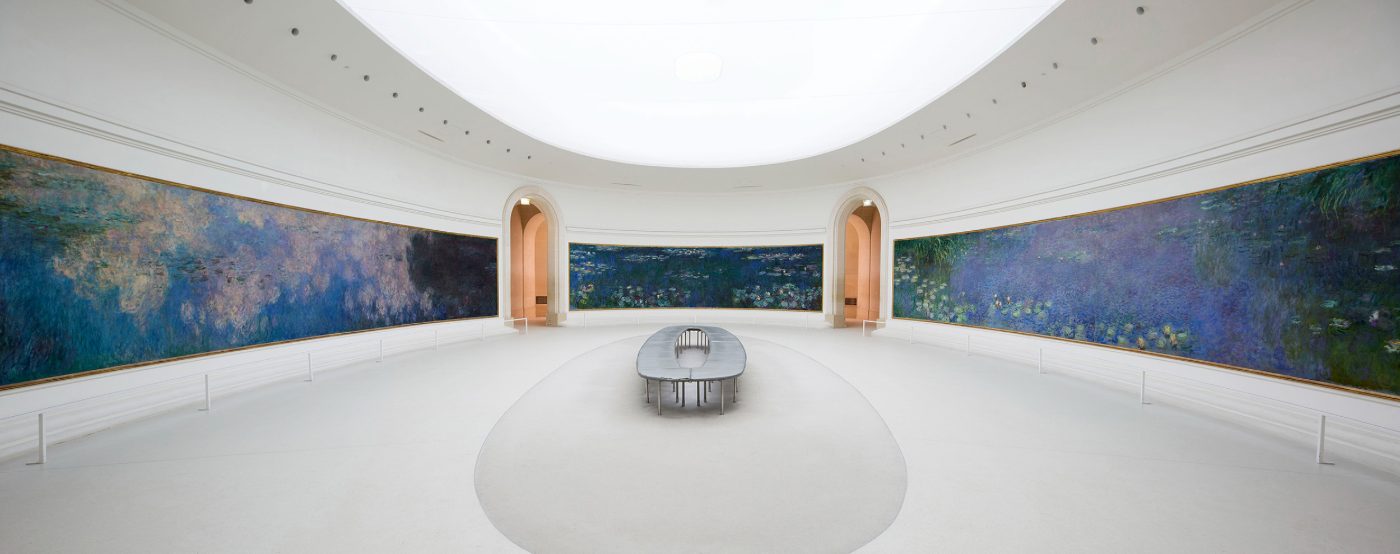
Working with mural-sized canvases, many over two meters in width, Monet embraced a new scale and boldness. Gone was the compositional restraint of the earlier Nymphéas; in its place came sweeping, expressionistic brushwork, daring color, and emotional immediacy. “Monet often made these paintings sites of contention,” wrote Paul Tucker, “pitting order against balance, and forcing forms and reflections into spaces that might otherwise be lulling and seductive.”
At the height of World War I, Monet painted furiously while his stepson fought at the front. Refusing to abandon Giverny, he vowed: “I shall die in front of my canvases, in front of my life’s work.” The paintings became both personal refuge and patriotic offering. “It occupies me enough so that I don’t have to think too much about this terrible, hideous war,” he confided.
In 1918, the day after the Armistice, Monet wrote to Prime Minister Georges Clemenceau offering the completed panels as a gift to the nation. “It’s little enough, but it’s the only way I have of taking part in the victory.” Installed in the Musée de l’Orangerie in 1927, shortly after his death, Les Grandes Décorations represent the crowning achievement of his career.
Legacy
Monet’s late water lily paintings remained largely unseen until after World War II. When Alfred H. Barr, Jr., acquired one for MoMA in 1955, it marked a turning point. American Abstract Expressionists such as Jackson Pollock and Mark Rothko saw in Monet’s late work a kindred freedom—a liberation of form and sensation. “Monet taught me to understand what a revolution in painting can be,” declared André Masson. “Only with Monet does painting take a turn. He bestows absolute poetry on color.”
Monet’s Nymphéas are more than depictions of a pond—they are symphonies of vision, meditations on light, color, and time. In their presence, we are invited to see not only the world as Monet saw it, but as we might perceive it ourselves: fluid, fleeting, and infinitely luminous.
STAY INFORMED
Receive the latest news, exhibitions, artworks and market updates on Banksy.