SHOW ME THE MONET, 2005
Provenance
- Steve Lazarides, London (acquired directly from the artist)
- Acquired directly from the above by the present owner in 2005
EXhibited
- London, 100 Westbourne Grove, Crude Oils: A Gallery of Re-mixed Masterpieces, Vandalism and Vermin, October 2005
- London, Lazinc Sackville, Banksy, Greatest Hits: 2002-2008, July - September 2018 (unofficial exhibition)
- Denmark, Silkeborg, Museum Jorn, Art Strikes Back: From Jorn to Banksy, September - December 2019, p. 13, illustrated, p. 40, illustrated in colour (installation view, Crude Oils, 100 Westbourne Grove, 2005) and p. 41, no. 7, illustrated in color
Auction History
Prices are inclusive of buyer’s premium unless stated otherwise, as reported by the auction houses.
A Masterpiece of the Crude Oils
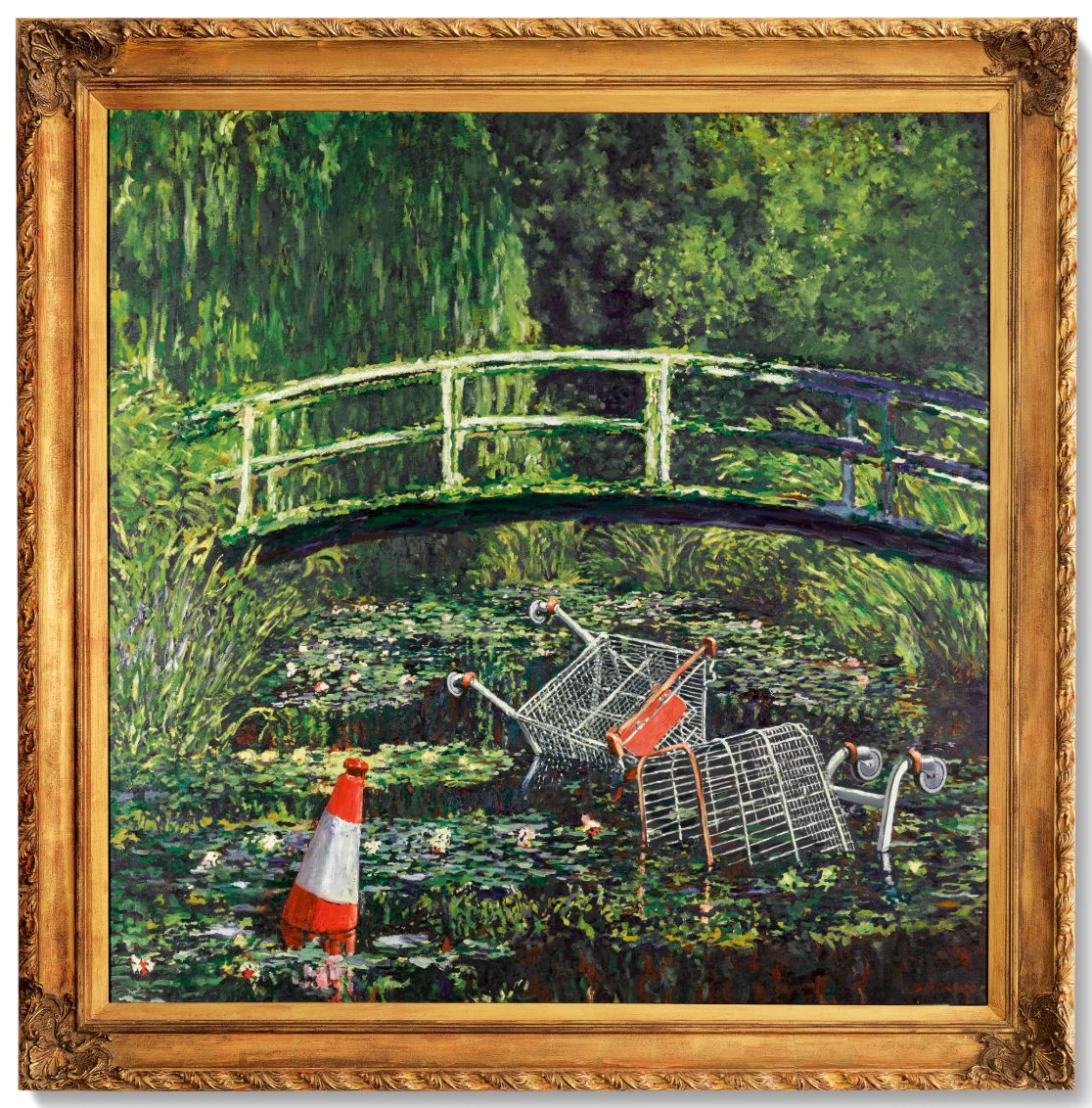
Show Me the Monet is one of the defining paintings of Banksy’s career and arguably the masterpiece of his celebrated Crude Oils series. Created in 2005 and entirely painted by hand, it brings together several themes central to Banksy’s practice: the collision between high and low culture, the environmental consequences of consumerism, the instability of artistic value, and the question of who has the authority to alter images that society has decided are masterpieces.
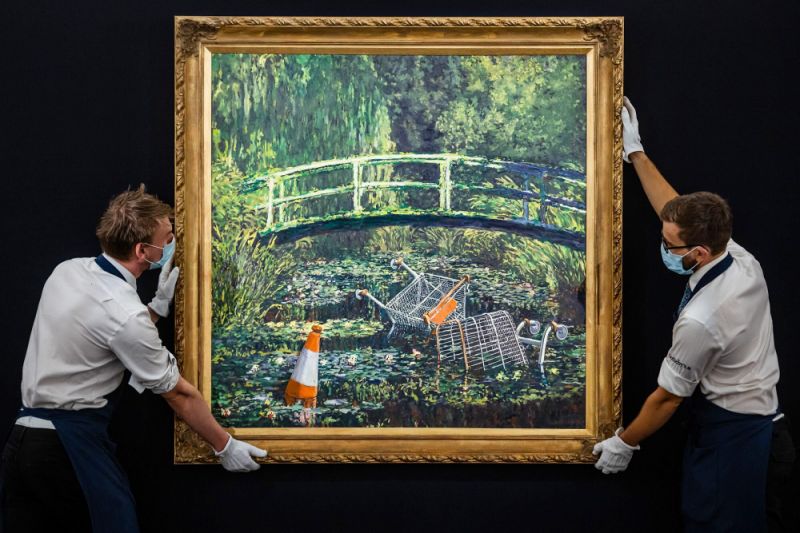
The painting was unveiled in October 2005 at Crude Oils: A Gallery of Re-mixed Masterpieces, Vandalism and Vermin, Banksy’s landmark exhibition staged in a disused shop at 100 Westbourne Grove in Notting Hill. The show brought together twenty-two hand-painted canvases and was famously populated by 164 live rats. Within this deliberately irreverent setting, Banksy turned his attention to some of the most recognizable images in Western art, treating art history much as he treated the urban environment: as material available for intervention.
When Sotheby’s offered Show Me the Monet in 2020, it described the painting as one of Banksy’s most iconic works and emphasized its exceptional position within his practice as a fully hand-painted canvas. It is a work in which Banksy the painter, vandal, social commentator and art-historical provocateur converge with unusual clarity.
Paradise, Interrupted
Banksy’s starting point is one of the most recognizable landscapes in Western art: Claude Monet’s celebrated paintings of the Japanese bridge and water-lily pond at Giverny. The arched bridge, dense vegetation, reflective water and enveloping atmosphere are immediately familiar. Banksy painstakingly reconstructs this idyllic landscape in oil before introducing three objects that emphatically do not belong there.
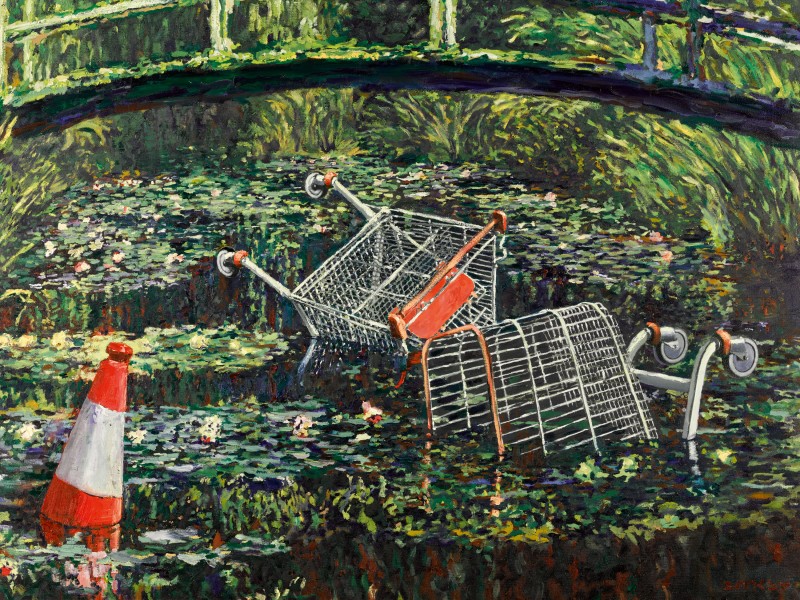
Two abandoned shopping trolleys lie partially submerged among the water lilies. Nearby, a fluorescent orange traffic cone emerges from the pond. Sotheby’s aptly described the transformation as turning Monet’s celebrated garden into a modern-day fly-tipping site: one of art history’s great visions of cultivated nature has become something closer to a neglected urban canal.
The violence of Banksy’s intervention is remarkably understated. There is no explosion, soldier or policeman. Monet’s bridge remains standing; the water lilies continue to bloom. Instead, Banksy contaminates the image with objects so ordinary that they have become almost invisible within contemporary life. Their presence in Giverny makes them suddenly absurd.
The joke is immediate, but the disturbance it creates is not. Banksy has introduced the debris of the present into an image of paradise.
The Shopping Trolley
Few objects could have been better chosen than the shopping trolley. Designed entirely around consumption, it is useful only while moving goods between supermarket shelves and the consumer. Once abandoned outside that system, it becomes waste: an awkward metal skeleton whose original purpose has disappeared.
Banksy places not one but two of them in Monet’s pond. Consumer culture has literally entered the landscape and left its equipment behind.
The traffic cone performs a related function. Like the trolley, it is an ubiquitous object of contemporary urban life—functional, standardized and generally ignored. Its fluorescent orange surface is particularly jarring against the greens and blues of the painted garden. Banksy has inserted the visual vocabulary of the street into the language of Impressionism.
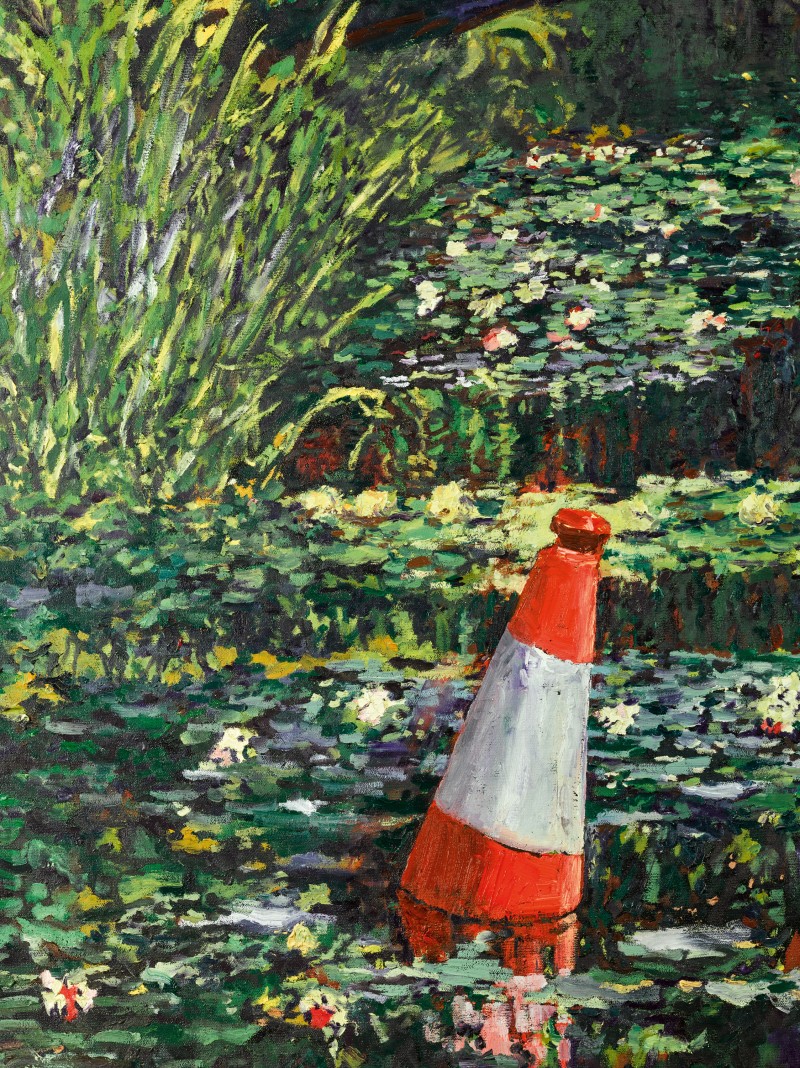
The environmental reading is unavoidable. As Sotheby’s emphasized when presenting the work in 2020, Show Me the Monet confronts society’s willingness to sacrifice the natural environment to the excesses of consumption. Yet the painting goes beyond a straightforward ecological warning. The discarded objects suggest an entire economic cycle: production, consumption, abandonment and waste.
Monet’s paradise has not been destroyed by some spectacular catastrophe. It has simply become somewhere to leave our rubbish.
Painting Modern Life
Banksy’s choice of Monet is more sophisticated than simple parody. The Impressionists themselves were once radicals, and Monet repeatedly painted a world being transformed by modernity. Railways, stations, bridges, factories, crowds and industrial smoke entered Impressionist painting because they had entered the landscape of nineteenth-century life.
Even Giverny complicates the idea of untouched nature. Monet’s famous garden was itself carefully constructed: planted, cultivated and continually modified before being transformed once again through painting. The apparently timeless paradise was, in reality, a deliberately created environment.
Banksy effectively asks what the equivalent signs of modernity might be a century later.
His answer is less optimistic. Where Monet’s modern world produced railways, bridges and new forms of visual experience, Banksy’s leaves behind shopping trolleys, traffic cones and waste. The objects floating among the water lilies become archaeological remains of contemporary consumer society.
In this sense, Banksy does not simply vandalize Monet’s image. He updates it.
Crude Oils: Painting as Vandalism
Show Me the Monet belongs to Banksy’s most sustained engagement with the history of painting. Throughout Crude Oils, familiar images and traditional paintings were invaded by the visual language of his contemporary world. Van Gogh’s Sunflowers appeared dead and withered; Edward Hopper’s Nighthawks was disrupted by an enraged man in Union Jack boxer shorts; pastoral landscapes acquired police cordons, military helicopters and other signs of modern disturbance. The exhibition’s subtitle—A Gallery of Re-mixed Masterpieces, Vandalism and Vermin—made the underlying question explicit: what separates an artistic intervention from an act of vandalism?
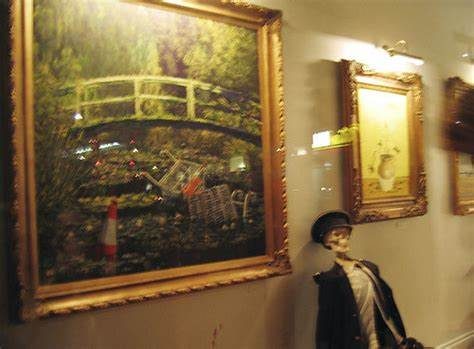
Banksy had already begun exploring that contradiction by modifying paintings acquired from flea markets and charity shops. In 2003, he carried the idea directly into the museum when he secretly installed Crimewatch UK Has Ruined the Countryside for All of Us at Tate Britain. A conventional pastoral landscape had been interrupted by blue-and-white police incident tape. The strategy reproduced indoors what Banksy routinely did on the street: take an existing visual environment and alter its meaning without permission.
Show Me the Monet pushes the idea considerably further. Banksy is not actually vandalizing a Monet. He paints his own Monet in order to vandalize it. Creation and destruction, homage and irreverence become inseparable. Indeed, the effectiveness of the intervention depends upon the recognizability and conviction of the underlying painting: Banksy must first reconstruct Monet’s paradise before the shopping trolleys and traffic cone can violate it.
This tension runs throughout Crude Oils. Banksy enters the history of painting not by rejecting it, but by appropriating it in much the same way that he appropriates a wall, a road sign or a piece of urban architecture. The inherited image becomes another surface upon which the present can intrude.
In Show Me the Monet, that intrusion is particularly powerful because beauty and pollution remain visible at the same time.
Show Me the Money
The title introduces another layer. Show Me the Monet converts the familiar demand “show me the money” into an art-historical pun, collapsing the name of one of the world’s most celebrated painters into the language of financial value.
The joke is light, but its implications are not.
Monet represents not only artistic achievement but extraordinary cultural and monetary value. His paintings occupy the world’s great museums and command enormous prices when they appear on the market. By appropriating Monet, Banksy therefore intervenes simultaneously in art history and the economics of art.
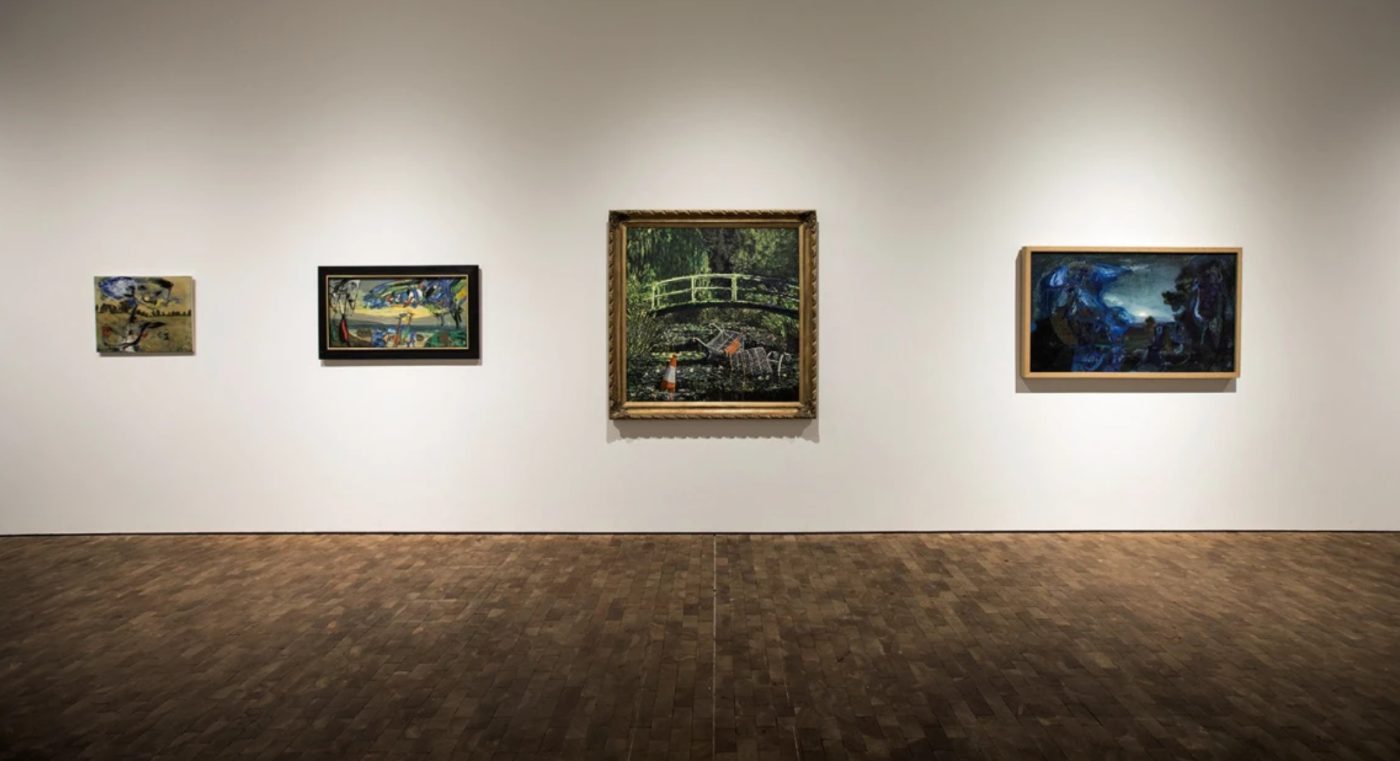
This was particularly appropriate within Crude Oils. Banksy—the anonymous graffiti artist whose work had been painted over, removed from walls and prosecuted as vandalism—was entering precisely the commercial and institutional art world that determines which objects should be preserved and assigned value.
When presenting the painting in 2020, Sotheby’s allowed several interpretations to coexist: a critique of consumer culture, environmental degradation and the commercialization of art. They are not competing explanations. The strength of Show Me the Monet is that the same abandoned shopping trolley can operate across all of them.
Consumption produces waste. Art becomes commodity. Cultural masterpieces acquire financial value. And Banksy’s vandalism itself eventually becomes an extraordinarily valuable object.
From Vandalism to Blue-Chip Masterpiece
The subsequent history of Show Me the Monet adds an almost perfect final chapter to Banksy’s argument.
The painting was acquired directly from Banksy by Steve Lazarides and subsequently purchased from Lazarides by a private collector in 2005. It remained in that collection for fifteen years. The work was later exhibited in Banksy, Greatest Hits: 2002–2008 at Lazinc Sackville, London, in 2018 and Art Strikes Back: From Jorn to Banksy at Museum Jorn, Silkeborg, in 2019. It is accompanied by a certificate of authenticity issued by Pest Control.
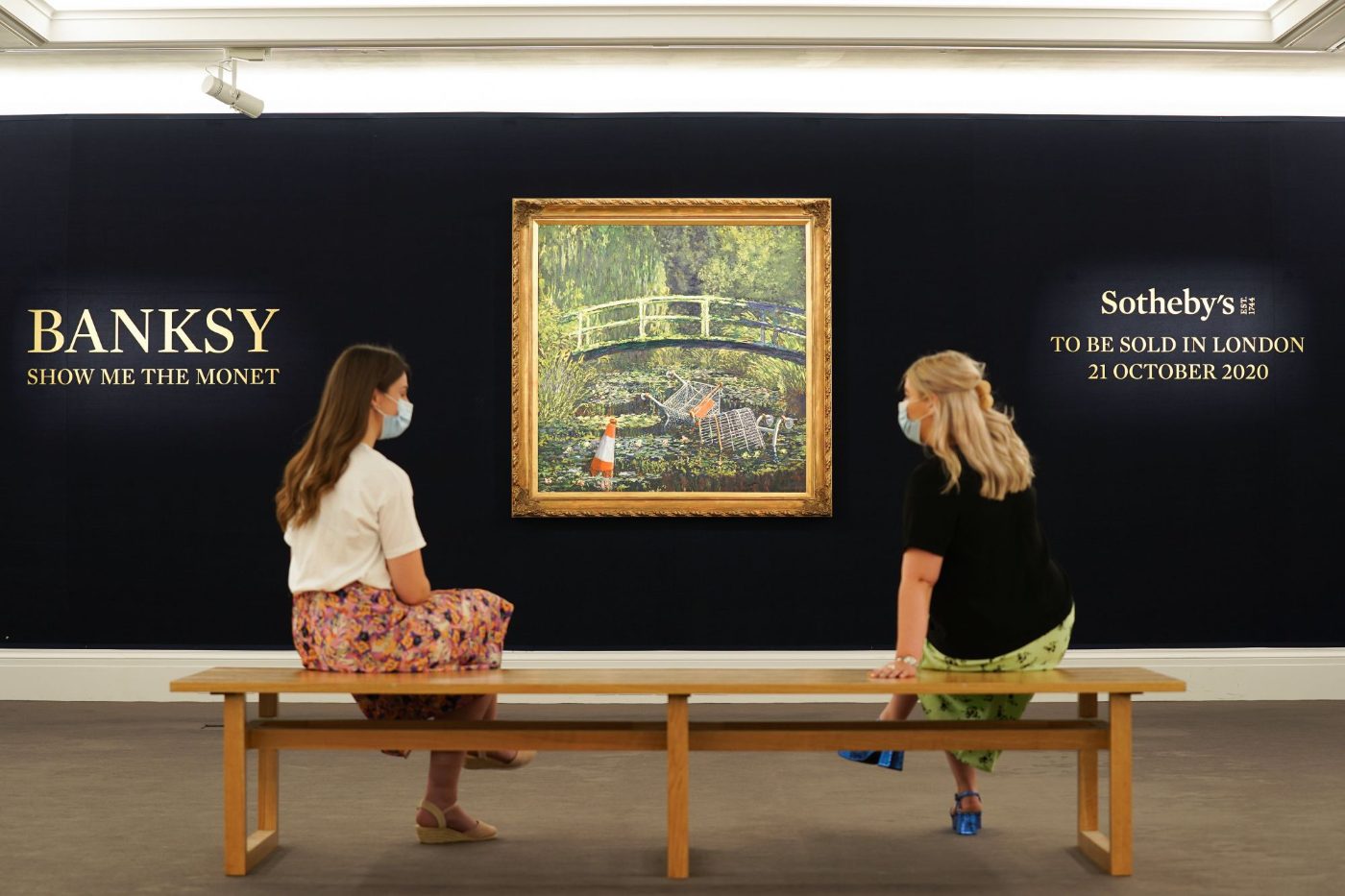
On 21 October 2020, Show Me the Monet was offered at Sotheby’s London with an estimate of £3–5 million. Following an extended bidding contest, it sold for £7,551,600, approximately $10 million, becoming at the time the second-highest auction price ever achieved for Banksy.
The result completed a transformation already implicit in Crude Oils. An artist who had built his reputation by placing unauthorized images on other people’s property had appropriated one of the most revered images in Western painting, transformed it into a critique of consumerism, pollution and commercialization, and watched that critique become a multimillion-pound commodity.
Yet the contradiction does not diminish Show Me the Monet. It is part of what makes the painting so important. Banksy begins with one of art history’s great visions of paradise and introduces the evidence of the society that came after it: consumption, waste, pollution and money. But Monet’s garden remains visible underneath it all.
Banksy does not destroy paradise. He asks what we have done to it.
About Claude Monet
Claude Monet’s iconic images of the Japanese bridge spanning the lily pond of his lush garden at Giverny are some of the most recognizable images in art history. Executed between 1897 and 1899 on canvases measuring approximately 90 by 90 cm, Monet painted twelve variations on this same composition depicting the same view at different times of the day, during different weather conditions and seasons of the year. Representing the apogee of Monet’s oeuvre, these are the holy grail of Impressionist paintings.
Monet’s beautiful paintings of Giverny are today considered a benchmark of established taste and art historical achievement. Yet as an artist building his reputation during the 1860s and into the 1870s Monet was considered a radical. By recording everything he saw and conspicuously refusing to omit ‘ugly’ scenic disturbances in his painting, his works sought to reflect the changing landscape of Modern France as the industrial revolution made its impact on the traditional landscape genre. This was controversial and seen as an affront to contemporary taste, and this revolutionary value has been amplified through Banksy’s reworking over a century later. Echoing the way in which Monet translated the French landscape, complete with evidence of the encroaching industrial revolution, Show me the Monet presents a dialogue on the impact of the corporate world on our environment and the sacrifices made at the expense of so-called ‘human progress’.
STAY INFORMED
Receive the latest news, exhibitions, artworks and market updates on Banksy.