DONKEY DOCUMENTS, 2007
A Checkpoint Reduced to the Absurd
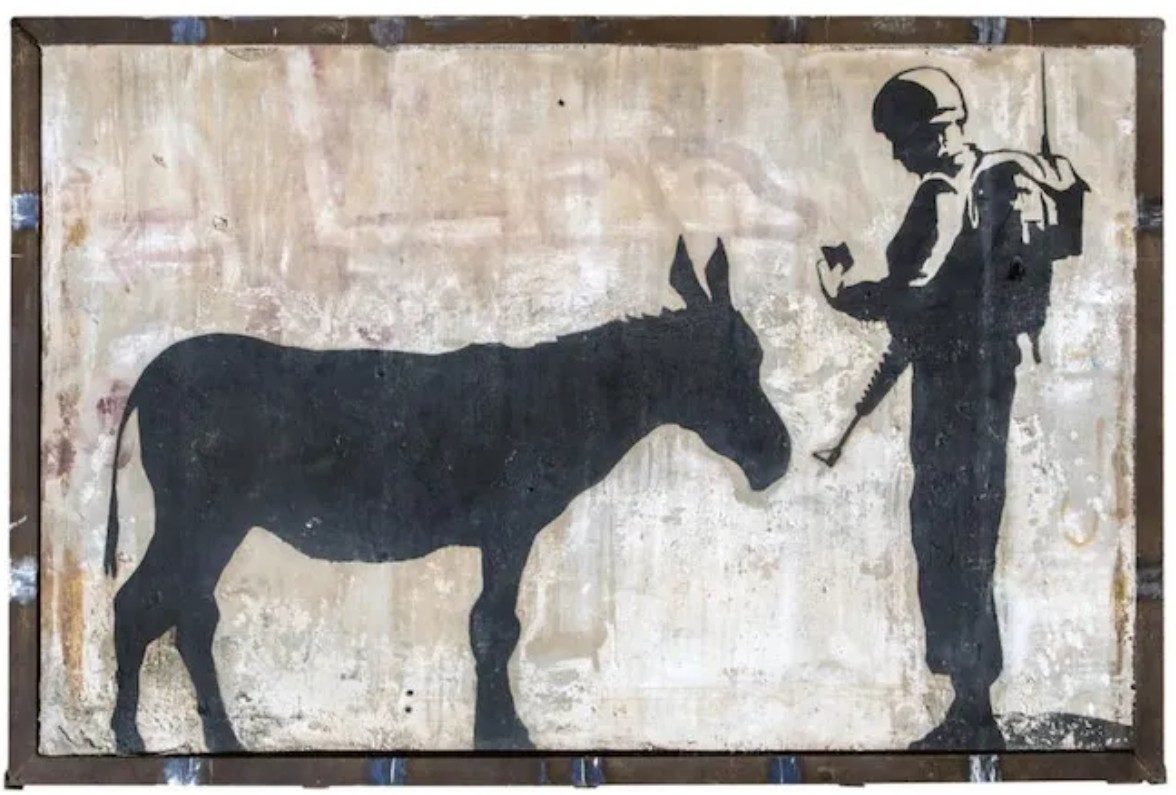
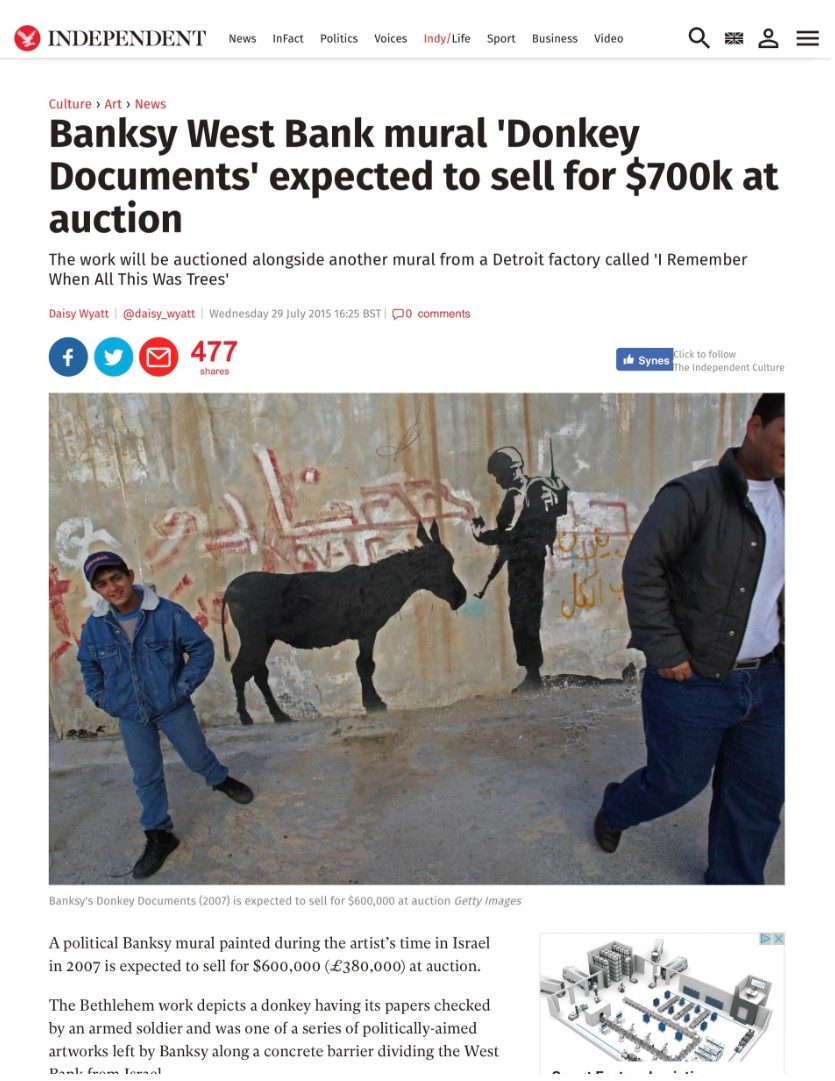
Created in Bethlehem in 2007, Donkey Documents is among Banksy’s most substantial interventions in the Palestinian territories and one of the most immediately legible political images of his career. A heavily armed soldier confronts a donkey and appears to inspect the animal’s identification papers. Nothing more is required. With the economy of a political cartoon and the physical authority of a monumental mural, Banksy reduces the machinery of borders, permits, checkpoints and surveillance to an encounter so absurd that its logic becomes impossible to ignore.
The composition is exceptionally spare. The donkey occupies almost the entire left half of the wall while the soldier stands rigidly opposite it. Their silhouettes are nearly equal in scale, creating a peculiar face-to-face confrontation: animal and representative of the state, innocence and authority, stubbornness and bureaucracy. The soldier carries a rifle and military equipment; the donkey carries nothing. Yet it is the donkey that apparently requires documentation.
The joke is funny for perhaps half a second. Then it becomes considerably less funny.
Bethlehem, 2007
The work belongs to Banksy’s important 2007 return to Bethlehem, associated with the Palestinian edition of Santa’s Ghetto, the Christmas exhibition and fundraising initiative through which Banksy and other artists sought to draw international attention to conditions in the West Bank and encourage visitors to travel to Bethlehem. Contemporary auction documentation specifically identifies Donkey Documents with this campaign and records that Banksy posted the work on his own website shortly after its creation.
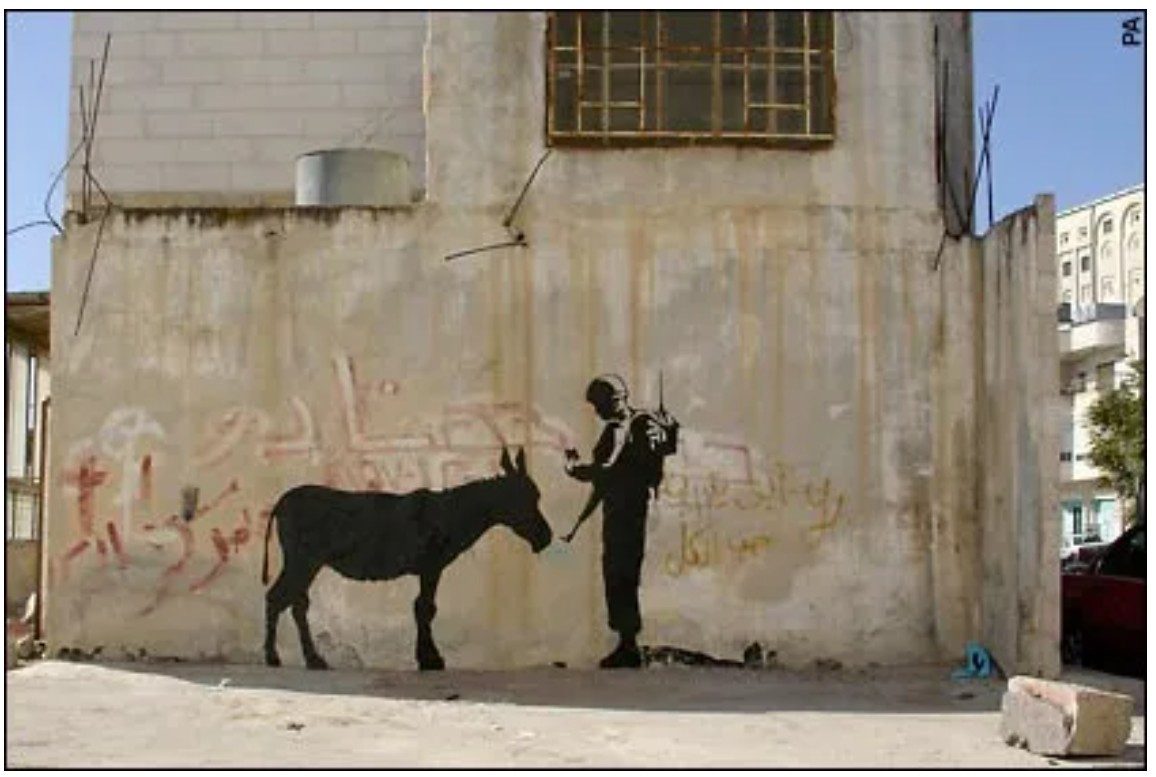
It continued a dialogue Banksy had begun with the Israeli West Bank barrier several years earlier. Rather than treating the wall simply as a surface upon which to place images, Banksy repeatedly made the physical and political meaning of the barrier part of the artwork itself. Openings reveal imaginary beaches and landscapes; children attempt impossible escapes; figures confront soldiers; and the architecture of confinement is momentarily punctured by fantasy, satire or inversion.
Donkey Documents uses a different strategy. There is no imaginary escape. Instead, Banksy accepts the checkpoint's bureaucratic logic and pushes it one step beyond reason.
The Donkey
The choice of animal is anything but accidental.
In Western culture the donkey has long carried associations with humility, labour, patience and stubbornness. In Bethlehem, however, the animal inevitably acquires an additional biblical resonance. Auction documentation for the work explicitly noted the parallel with the donkey traditionally associated with Mary and Joseph's journey to Bethlehem before the birth of Christ.
Banksy therefore places one of the most ancient symbols associated with Bethlehem before one of the defining structures of its contemporary political geography. Two thousand years of imagery collapse into a single checkpoint.
There is also a characteristically Banksian reversal of hierarchy. Human systems supposedly exist because humans are rational; animals supposedly operate without our sophisticated institutions. Yet here the human being has constructed a system so elaborate that he finds himself demanding papers from a donkey. The animal begins to look perfectly reasonable. The bureaucracy does not.
A More Difficult Image Than It First Appears
The work should nevertheless not be reduced to a simple visual gag. Its reception reveals the dangers inherent in political satire, particularly when an outsider enters a landscape defined by a conflict that is lived rather than observed.
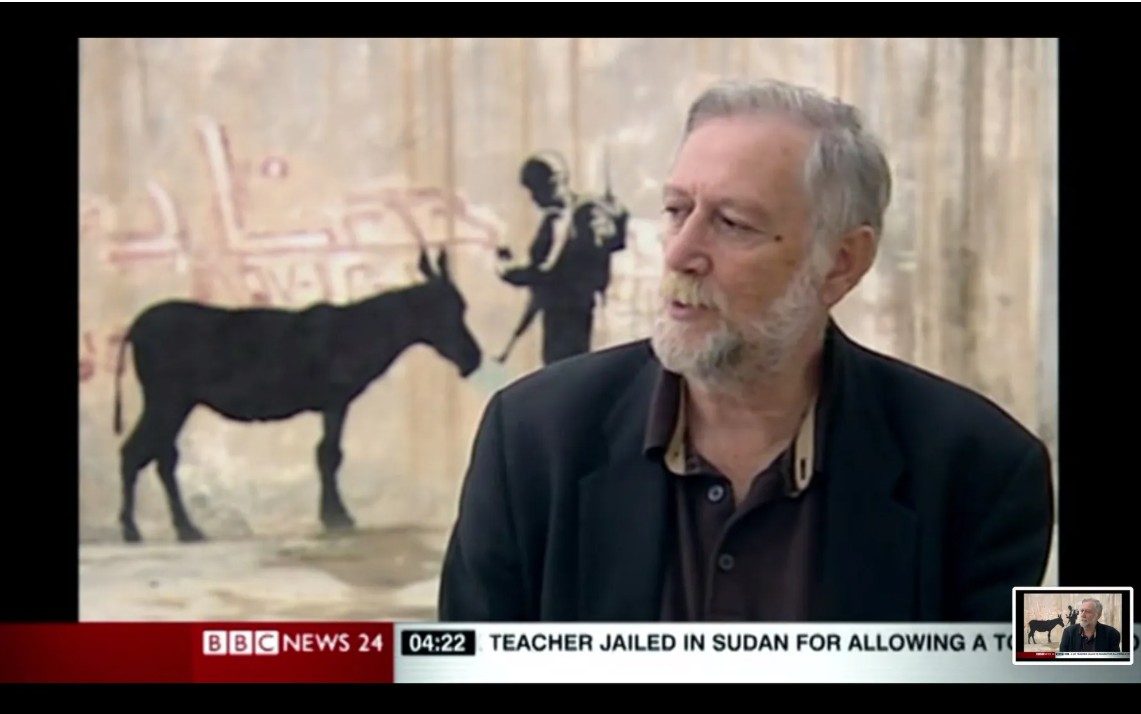
The image was controversial locally. Some Palestinians reportedly interpreted the donkey as representing Palestinians themselves and consequently regarded the comparison as insulting rather than liberating. That reaction is important because it complicates the comfortable assumption that politically engaged street art necessarily speaks for the people whose circumstances it addresses. Accounts surrounding the mural became part of a broader debate about Banksy’s interventions in Palestine: admiration for their international visibility existed alongside criticism of an internationally famous Western artist using the landscape of occupation as his canvas.
That ambiguity makes Donkey Documents more interesting, not less. Banksy is strongest when the joke refuses to remain completely under his control.
From Wall to Artwork
The subsequent history of Donkey Documents raises another question central to Banksy’s work: what happens when street art stops being part of the street?
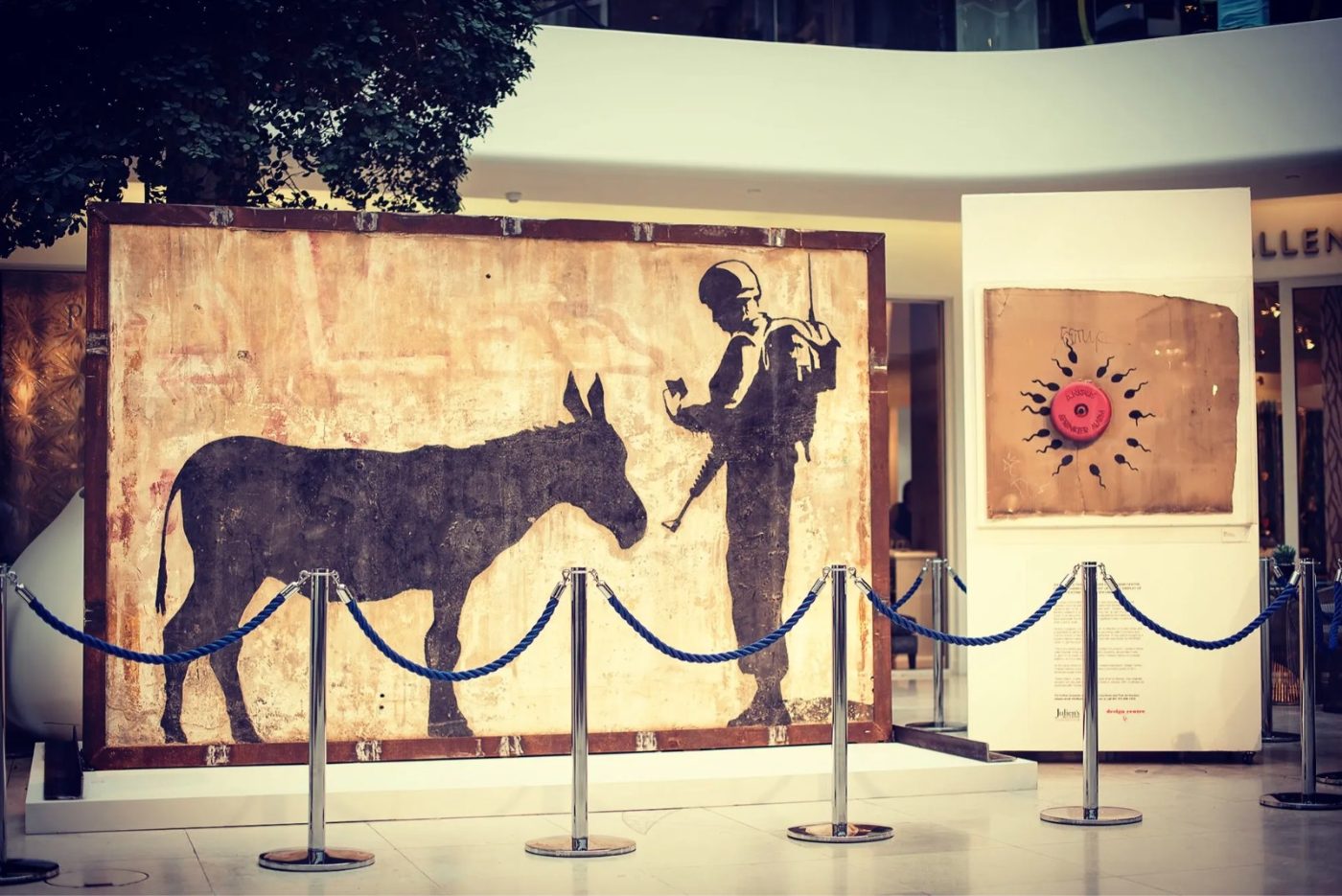
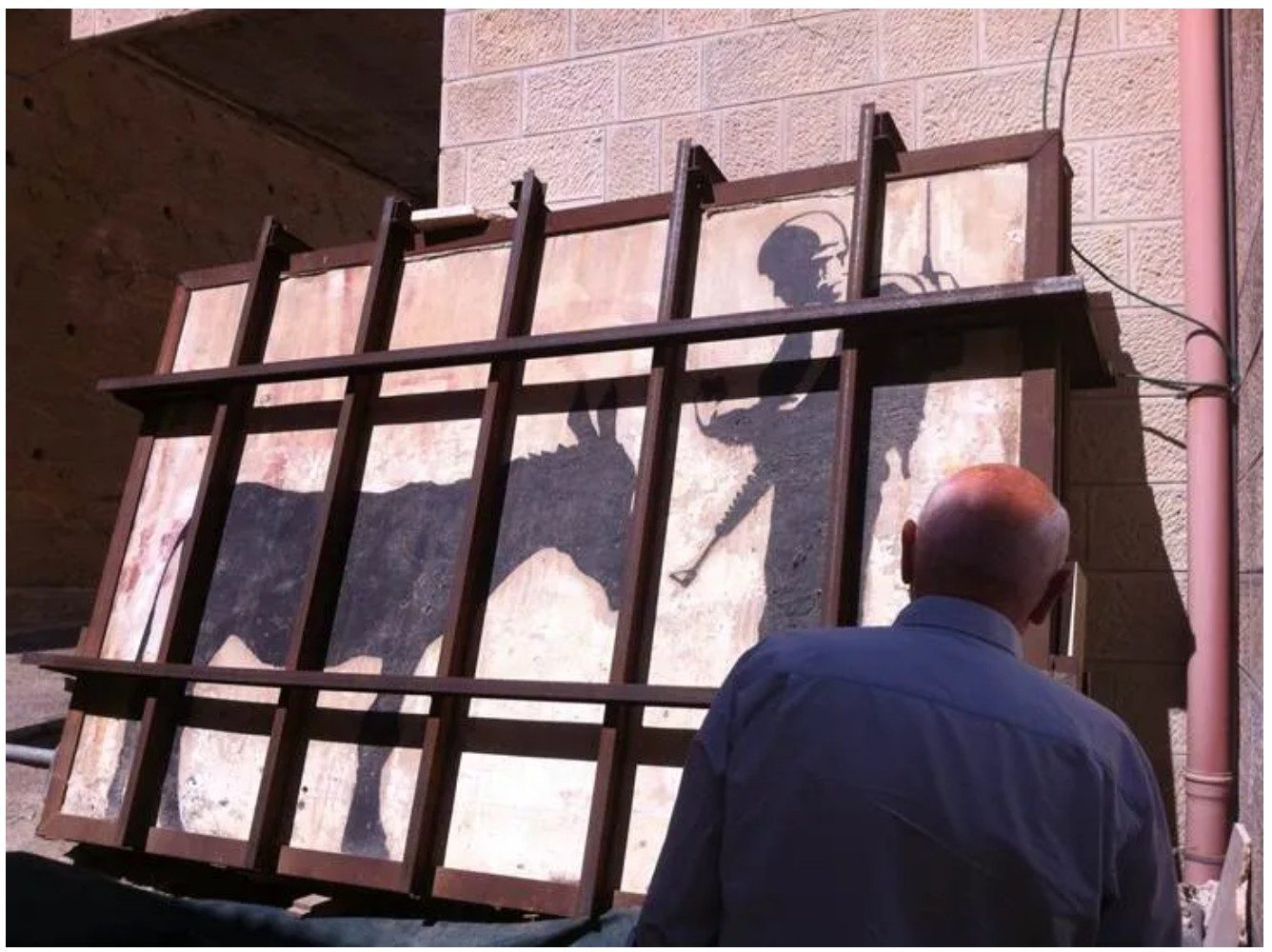
The mural was cut from the building on which it had been painted. Contemporary reporting stated that the removal was undertaken with the consent of the building's owner, and when the work was later offered at auction the documentation reportedly included an agreement between the Bethlehem property owners and the subsequent owner.
According to its present custodial history, approximately six hours of footage document the mural before, during and after its removal. The cutting process itself left physical traces on the object, including residue associated with coolant used during sawing. Unlike a canvas carefully transported from an artist's studio, therefore, the surviving object retains the scars of its conversion from architecture into movable property.
This distinction matters. The weathering, underlying marks and irregular surface are not incidental imperfections. They are evidence of the wall's previous existence as a functioning architectural surface in Bethlehem. The object is simultaneously image, fragment and document.
The Paradox of the Banksy Street Work
Its removal also creates a particularly Banksian contradiction. A work criticizing borders, control and systems of ownership was literally cut out of Bethlehem, transported internationally, exhibited behind barriers and offered for sale.
In September 2015, Donkey Documents was presented publicly at London's Design Centre, Chelsea Harbour before travelling to Beverly Hills for Julien's Auctions. Julien's described it at the time as the largest and most significant intact mural surviving from Banksy's 2007 visit and placed an estimate of $400,000–600,000 on the work.
The market, however, supplied one final piece of Banksian irony: it failed to sell.
The episode neatly encapsulates the unresolved problem surrounding detached street works. Their physical removal can preserve an image that might otherwise disappear, but preservation simultaneously transforms public intervention into private commodity. The wall becomes an artwork precisely by ceasing to function as a wall.
An Important Work from the Palestinian Chapter
Within Banksy’s oeuvre, Donkey Documents belongs to the remarkable group of works through which the artist confronted borders, occupation and the absurdities produced when political systems regulate ordinary human movement.
It also anticipates Banksy's continuing engagement with Bethlehem, culminating a decade later in the opening of the The Walled Off Hotel in 2017. The donkey-and-soldier composition itself subsequently entered the visual vocabulary surrounding that project: miniature Donkey Documents wall sections were later produced among the hotel's hand-painted souvenir works.
What makes the original mural particularly compelling, however, is its simplicity. There is no slogan telling the viewer what to think. No punchline is written underneath. Banksy simply presents a donkey, a soldier, a piece of paper and a gun. The rest of the argument takes place in our heads.
STAY INFORMED
Receive the latest news, exhibitions, artworks and market updates on Banksy.