FLYING INFLATABLE BOAT, 2021
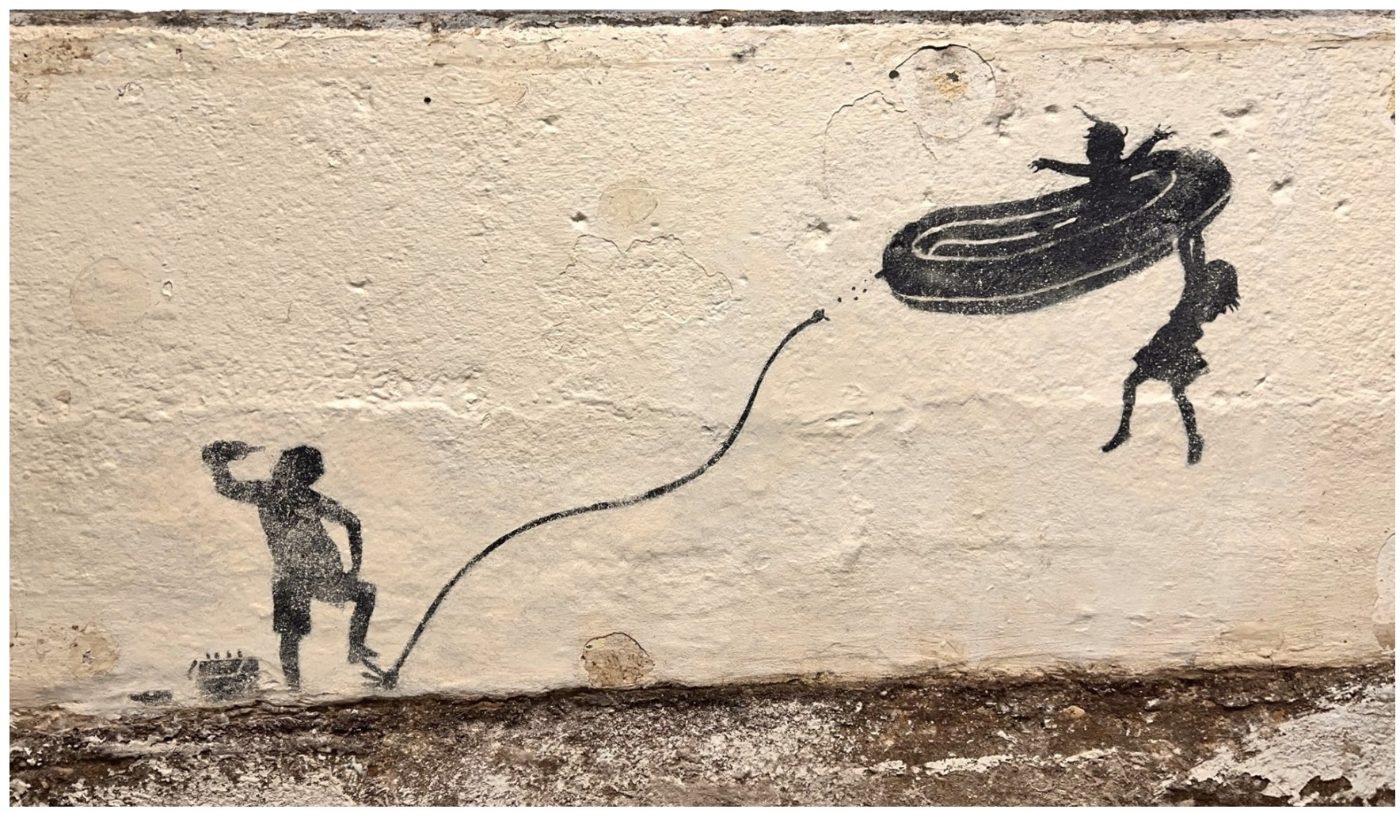
Catalogue Note
Flying Inflatable Boat was created in August 2021 at Gorleston-on-Sea, Norfolk, as part of Banksy's A Great British Spraycation, the artist's mischievous summer journey through the seaside towns of Norfolk and Suffolk.
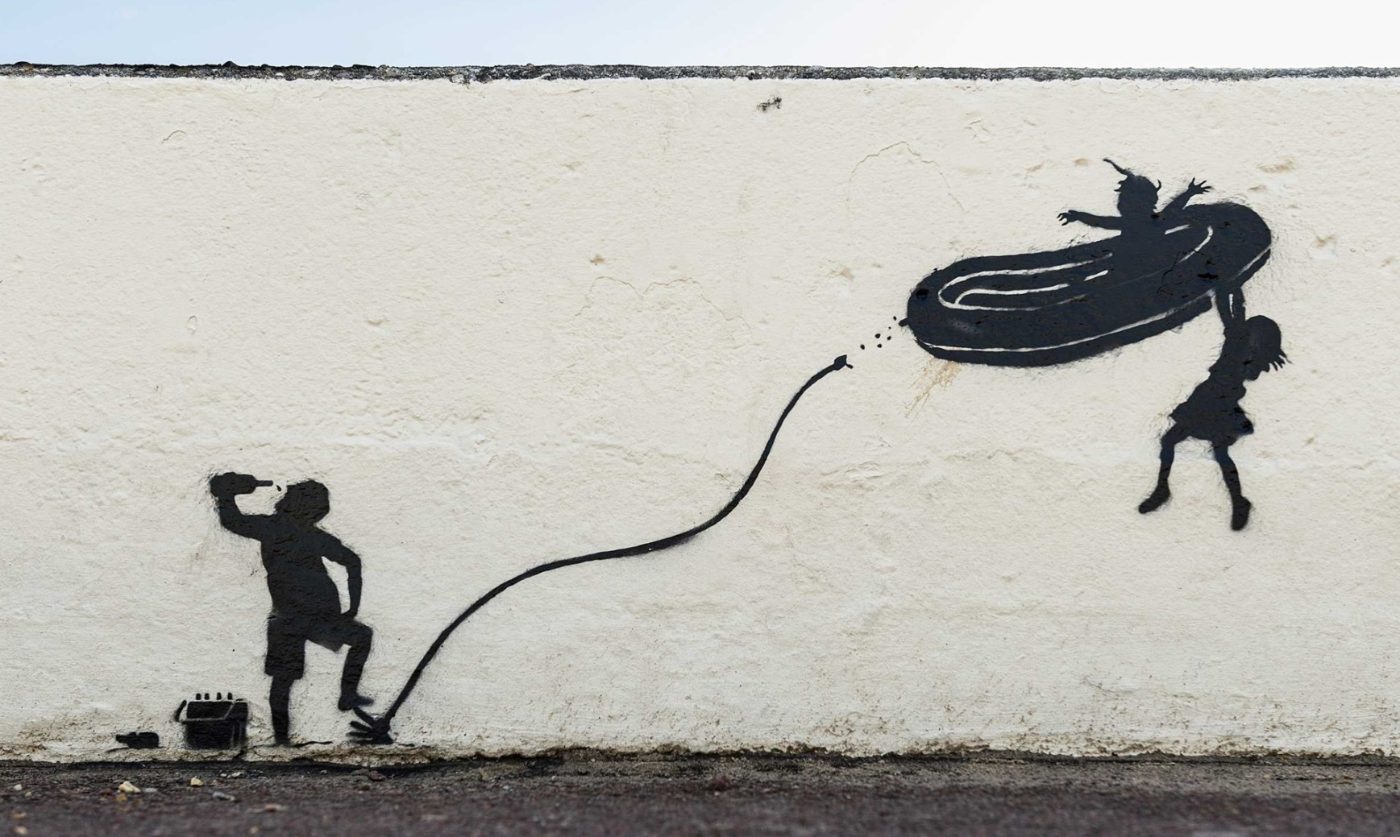
Executed directly onto the low concrete wall surrounding the Gorleston yacht pond, the composition is characteristically economical. At left, an adult operates a foot pump while casually drinking from a bottle. The hose snakes across the wall towards an inflatable dinghy that has quite literally taken flight. Two children cling precariously to it: one sits inside while another hangs beneath, suspended in mid-air.
The joke works immediately. The adult is so preoccupied with his drink that he has failed to notice the consequences of his actions. He keeps pumping; the boat keeps rising; the children are left hanging on.
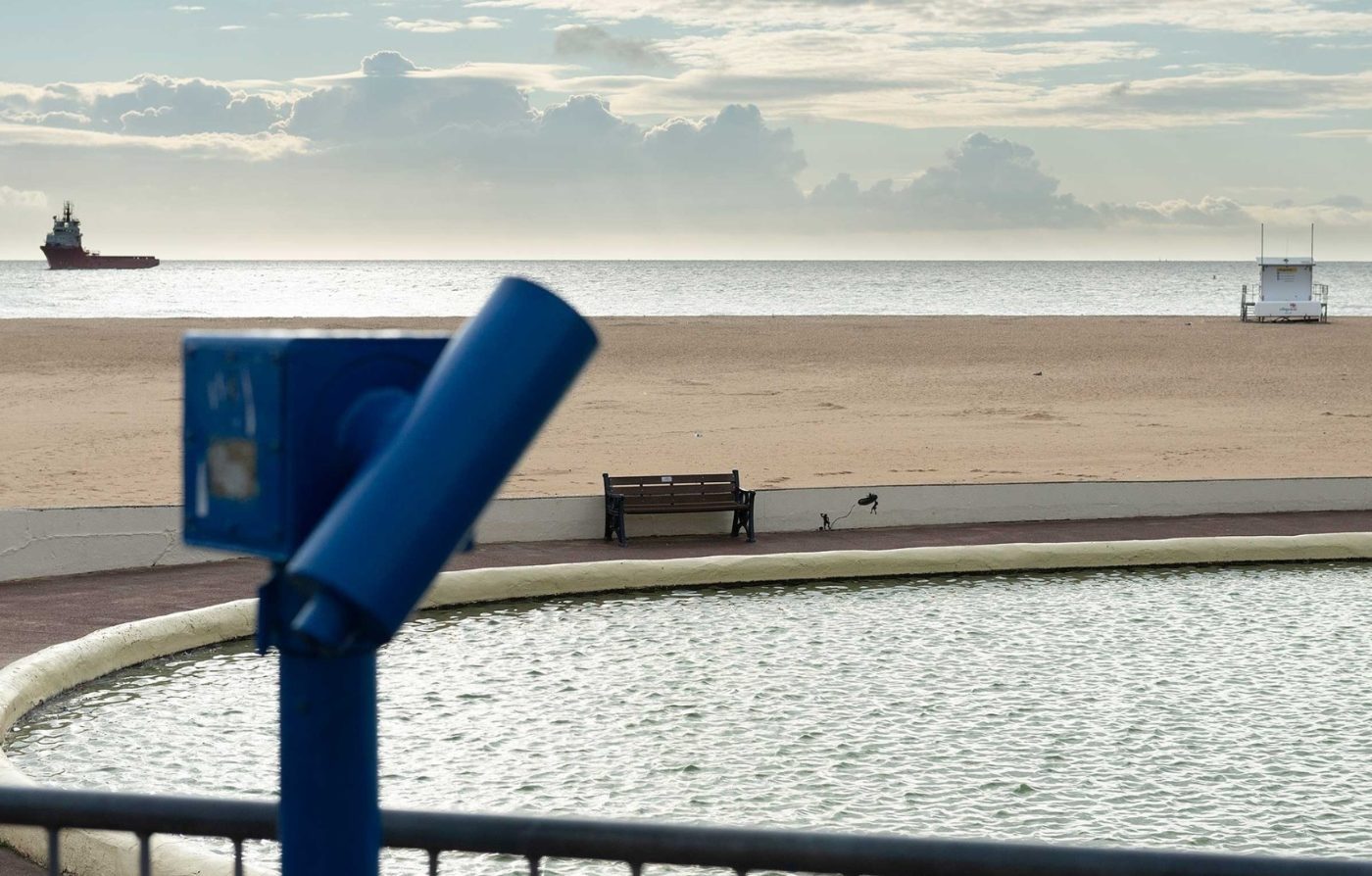
Like many works from Spraycation, however, the image gains considerably from its original location. Banksy placed the scene directly beside the sea, transforming the surrounding promenade, yacht pond and horizon into an extension of the composition. Seen from a distance, the tiny black figures occupy an almost absurd position beneath the enormous expanse of the real North Sea. The mural was not simply painted at the seaside; the seaside completed the work.
A Great British Spraycation
During the summer of 2021, Banksy travelled through East Anglia in a battered camper van, leaving a sequence of interventions across Great Yarmouth, Gorleston, Cromer, Lowestoft, Oulton Broad and King's Lynn. He eventually confirmed the project through a video entitled A Great British Spraycation, showing himself travelling between and working at the various locations.
There is something almost cartoonish about the composition, but its structure is unmistakably Banksian: the children understand the danger while the adult responsible for them does not. Innocence is again placed at the mercy of an apparently oblivious grown-up world.
The series played affectionately—and sometimes rather darkly—with the visual language of the traditional British seaside holiday: sandcastles, deckchairs, seagulls, amusement arcades, boats and holidaymakers. Yet beneath the nostalgia ran familiar Banksy themes of poverty, environmental degradation and social instability.
Boats carried particular weight within the series. Elsewhere in Lowestoft, Banksy depicted children aboard a precarious makeshift vessel accompanied by the phrase "We're all in the same boat"—an image widely understood in relation to migration and displacement. In Flying Inflatable Boat, the vessel becomes more surreal. It should offer safety on water, yet instead becomes the source of danger itself.
An unforeseen tragedy
Shortly after the work appeared, however, its meaning changed dramatically because of circumstances Banksy could almost certainly not have anticipated.
The mural stood close to the location where three-year-old Ava-May Littleboy had died in July 2018 after being thrown from an inflatable trampoline that burst on Gorleston beach. The visual coincidence between Banksy's airborne inflatable and the circumstances of the tragedy caused understandable concern locally.
Great Yarmouth Borough Council therefore covered the mural shortly after Banksy confirmed the Spraycation works, explaining that the decision had been taken out of respect for local sensitivities and acknowledging that Banksy would not have known the circumstances surrounding the child's death. Ava-May's father similarly stated that he believed the artist could only have acted with good intentions.
It is an extraordinary example of context completely transforming an artwork after its creation. What appears in isolation as a darkly comic scene of parental distraction became, because of where Banksy unknowingly placed it, painfully close to the memory of a real local tragedy.
From street wall to movable artwork
The story did not end when the image disappeared beneath paint.
Rather than destroying it, the council eventually elected to preserve the work. In 2022 it announced that the section of wall bearing the Banksy would be cut out, removed and treated by specialist conservators, with plans at the time to relocate it away from the sensitive original site.
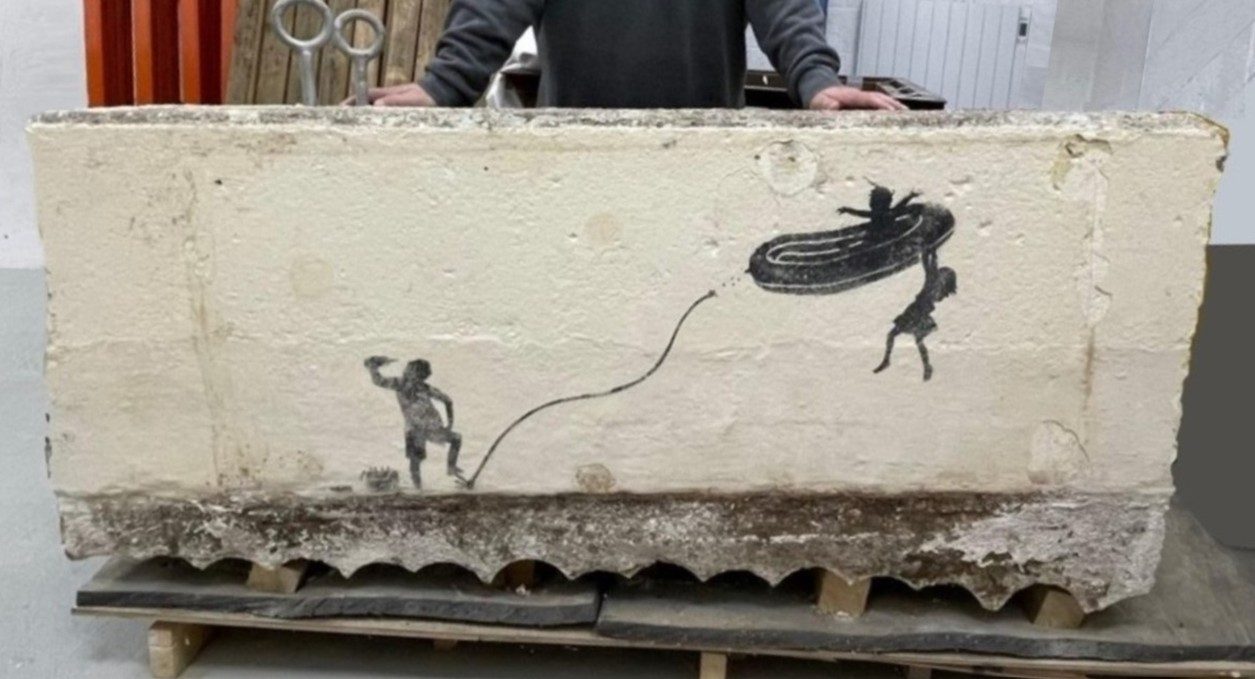
The surviving object therefore presents precisely the fascinating problem at the heart of the Banksy Explained Street Works category. What began as an intervention inseparable from a particular wall, promenade and seascape has subsequently become a substantial autonomous section of concrete capable of being transported, conserved, exhibited—and potentially sold.
The physical scars visible around the detached section are consequently part of its history. This is not a studio work made to resemble street art. It is literally a piece of the street.
And its unusual biography gives Flying Inflatable Boat an additional poignancy within A Great British Spraycation. Banksy arrived at the British seaside intending to play with its rituals, absurdities and faded pleasures. Here, entirely inadvertently, his joke collided with something far more serious.
Few episodes demonstrate more clearly one of the peculiar qualities of street art: once an image is placed into public space, the artist no longer controls everything that surrounds it—or everything it may come to mean.
STAY INFORMED
Receive the latest news, exhibitions, artworks and market updates on Banksy.