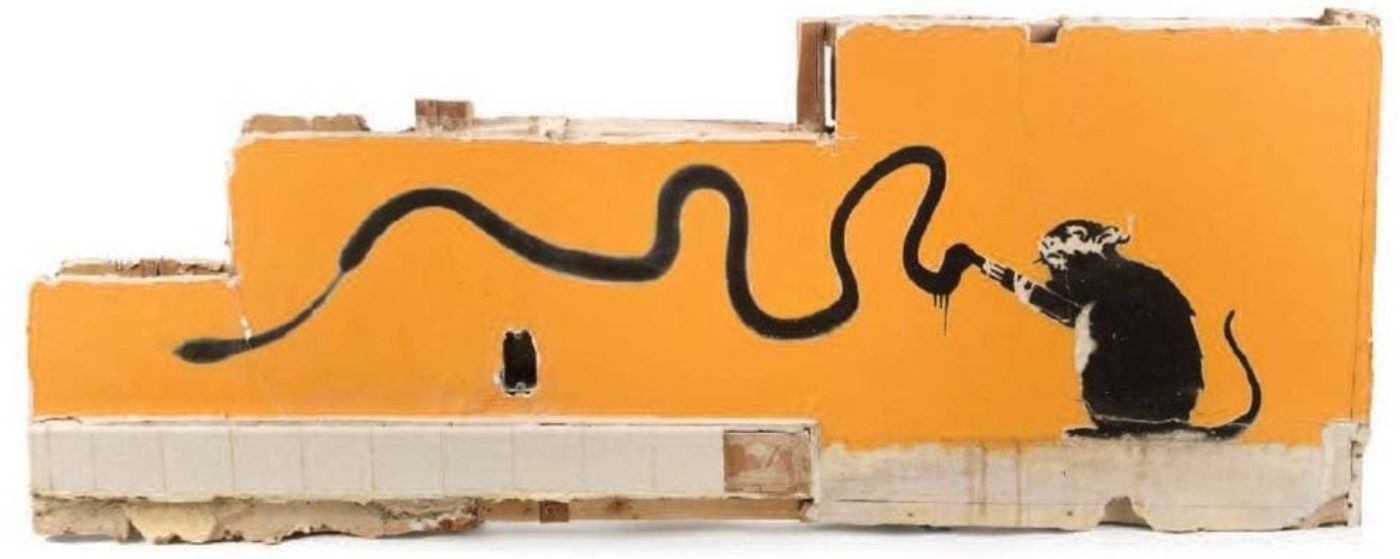
GRAFFITI RAT, CIRCA 2002
Literature
- Banksy, Cut It Out, Weapons of Mass Distraction, 2004
- Banksy, Wall and Piece, Century, London, 2005
Auction History
Prices are inclusive of buyer’s premium unless stated otherwise, as reported by the auction houses.
Catalogue Note
Graffiti Rat belongs to the formative period in which Banksy’s rat emerged as one of the defining protagonists of his visual language. Here, the animal is not merely a spectator or urban pest: it has become an artist. Holding a paintbrush in its paw, the rat draws an enormous, wandering black line across the wall, transforming an otherwise ordinary domestic surface into its own improvised canvas.
The work was executed under particularly remarkable circumstances. In 2002, Banksy travelled to Los Angeles for Existencilism: An Exhibition of Graffiti, Lies and Deviousness, his first exhibition in the city, held at the 33⅓ Books & Gallery Collective in the Silver Lake/Echo Park area. The exhibition marked an important early stage in Banksy’s expansion beyond Britain, several years before the international phenomenon that would follow.
During his stay, Banksy was reportedly crashing in a Hollywood apartment. Rather than confining his work to the gallery or the streets, he turned the apartment itself into another working surface. Several rat stencils appeared across its interior walls, including Graffiti Rat, Action Rat and Menace Rat.
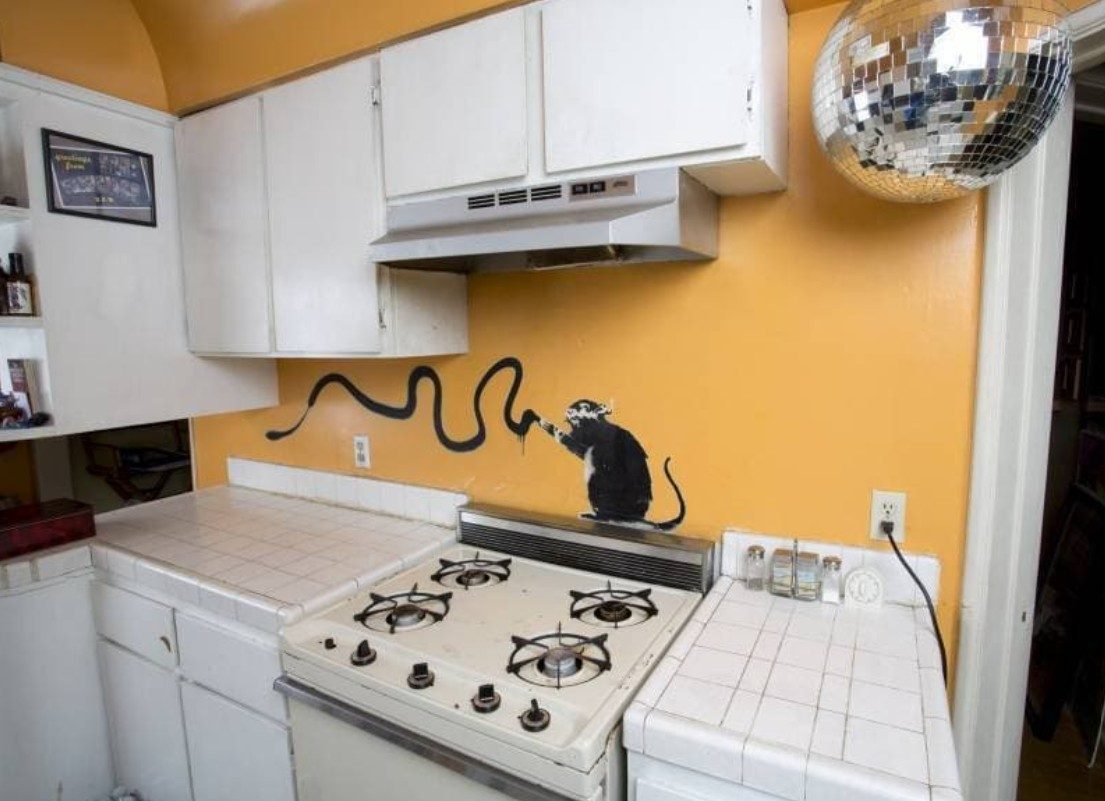
The surviving photograph of Graffiti Rat in situ is particularly evocative. The rat sits directly above the kitchen stove, surrounded not by the architecture of the street but by cabinets, electrical outlets, tiled countertops and the paraphernalia of everyday life. The setting gives the image much of its charm. Banksy’s pest has quite literally invaded the house. The anonymous graffiti artist who normally paints walls without permission appears to have sent his alter ego indoors to do exactly the same thing.
More importantly, the work was subsequently reproduced by Banksy himself in both Cut It Out (2004) and Wall and Piece (2005), providing unusually compelling contemporary documentation of the work in its original environment. The published photograph records the composition before its removal from the apartment and places it firmly within the visual history Banksy constructed around his own early practice.
The Rat as Artist
The imagery is wonderfully economical. The rat holds a brush from which an absurdly long black stroke escapes, twisting across the wall with almost calligraphic freedom. It is simultaneously painting, graffiti and evidence of mischief.
By 2002, the rat had already become central to Banksy’s vocabulary. Its importance derives partly from the natural affinity between the animal and the graffiti artist: both inhabit overlooked corners of the city, operate largely at night, appear where they have not been invited and are relentlessly pursued by authorities attempting to eradicate them. Banksy turns precisely those undesirable qualities into virtues. The pest becomes survivor, dissident and creative agent.
In Graffiti Rat, the metaphor becomes unusually explicit. The rat is effectively Banksy’s surrogate. It does what Banksy does: takes possession of somebody else’s wall and leaves behind a mark. The joke becomes even better when one remembers that this particular wall was not in an alleyway at all, but in somebody’s kitchen.
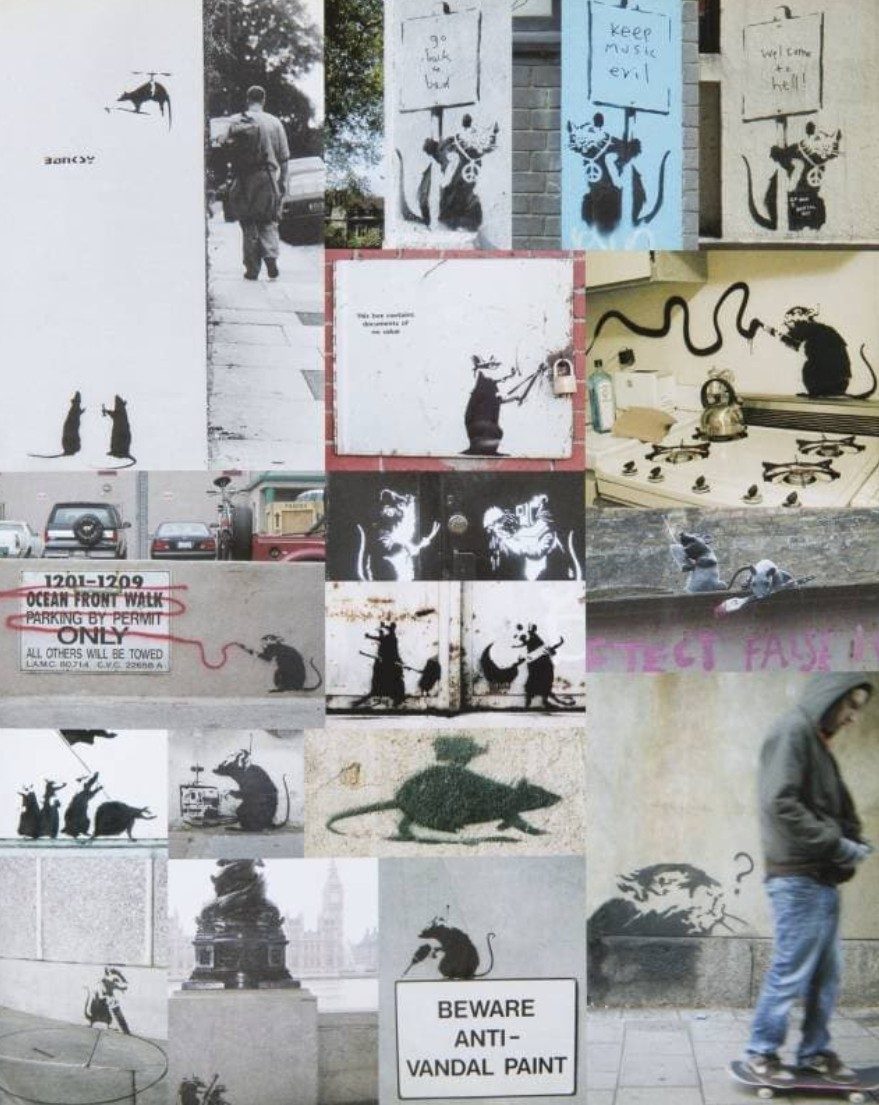
The work therefore belongs to a broader family of Banksy images in which rats assume human roles—protesters, musicians, photographers, saboteurs and painters. Rather than depicting society from above, Banksy repeatedly gives agency to the creature occupying its lowest rung. The rat may be small, unwanted and anonymous, but it nevertheless insists upon participating in the culture around it.
This idea became so fundamental to Banksy’s work that the rat can reasonably be understood as one of his closest forms of indirect self-portraiture. Your broader Rat Business and Pest Modernism essay develops precisely this relationship: if the monkey often functions as Banksy’s portrait of society, the rat increasingly becomes his portrait of the artist.
From Kitchen Wall to Artwork
Its subsequent removal gives Graffiti Rat another layer of significance. What began as an intervention painted directly onto the architecture of a private apartment was eventually extracted with the section of drywall on which it had been executed. The irregular perimeter visible today is therefore not incidental damage or an aesthetic decision by Banksy; it is evidence of the object's former existence as architecture.
That transformation is fundamental to the Street Works category. The work was never conceived as a conventional portable painting. Its support was simply the wall that happened to be available. Only later did preservation and the art market convert the wall itself into an object.
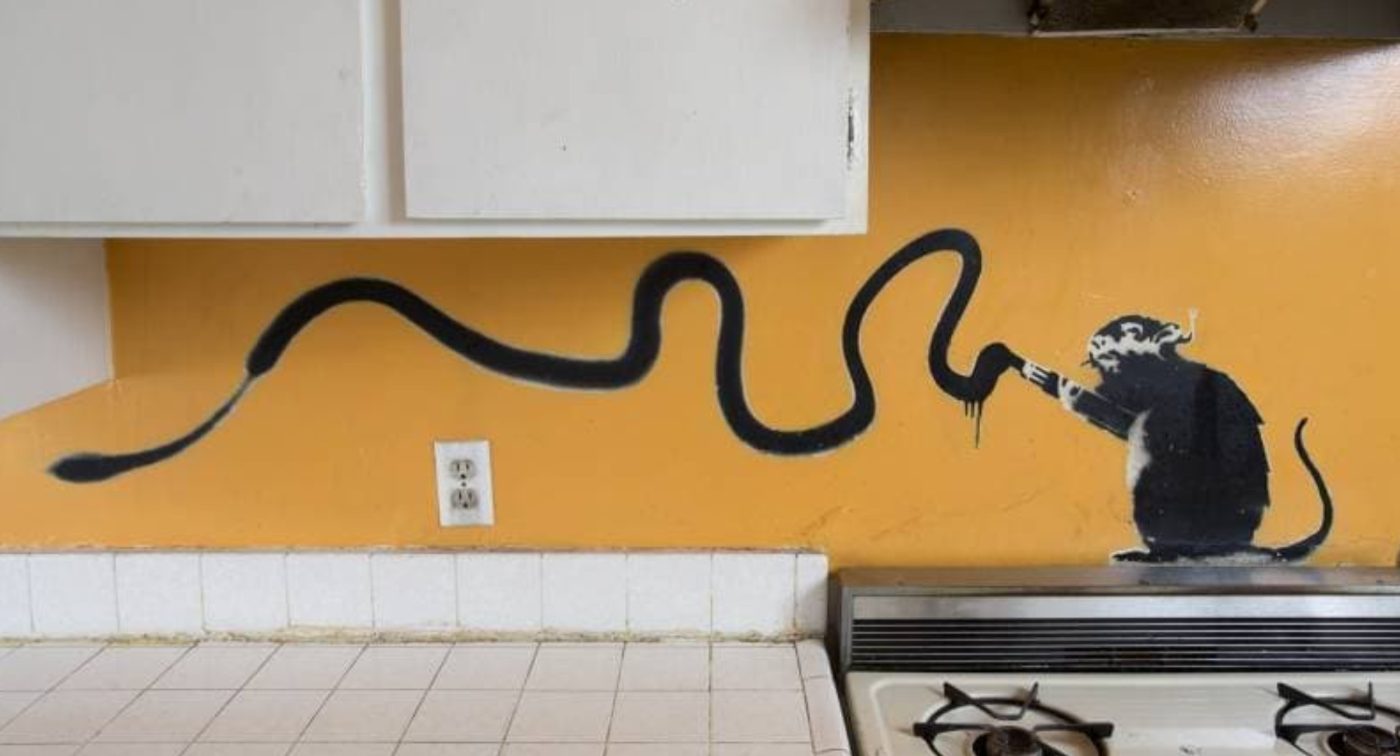
The resulting fragment retains something a conventional canvas cannot reproduce. Its exposed edges, missing sections, traces of fittings and irregular geometry preserve the archaeology of its original location. The mundane orange kitchen wall has effectively become part of the composition—and part of the work's history.
There is an appealing Banksian paradox in the journey. A rat painted casually above a stove in an apartment where a young street artist was staying during his first Los Angeles exhibition eventually became a collectible artwork precisely because somebody decided that the wall itself was worth keeping.
STAY INFORMED
Receive the latest news, exhibitions, artworks and market updates on Banksy.