GRAY GHOST ATTACKS STICK FIGURE
Banksy versus the Gray Ghost
When Banksy arrived in New Orleans in 2008, three years after Hurricane Katrina, he was responding not only to the physical and social scars left by the disaster but also to an unusually intense local debate about graffiti, public space and who had the authority to decide what should remain on the city's walls. At the center of that debate was Fred Radtke, a former Marine who had founded the anti-graffiti organization Operation Clean Sweep in 1997. Radtke became known locally as the “Gray Ghost” for covering graffiti with conspicuous rectangles and patches of grey paint, sometimes without the permission of property owners. Contemporary New Orleans reporting shows that his activities were already highly controversial before Banksy's arrival.
"I came to New Orleans to do battle with the Gray Ghost, a notorious vigilante who's been systematically painting over any graffiti he can find with the same shade of grey paint since 1997. Consequently he's done more damage to the culture of the city than any section five hurricane could ever hope to achieve."
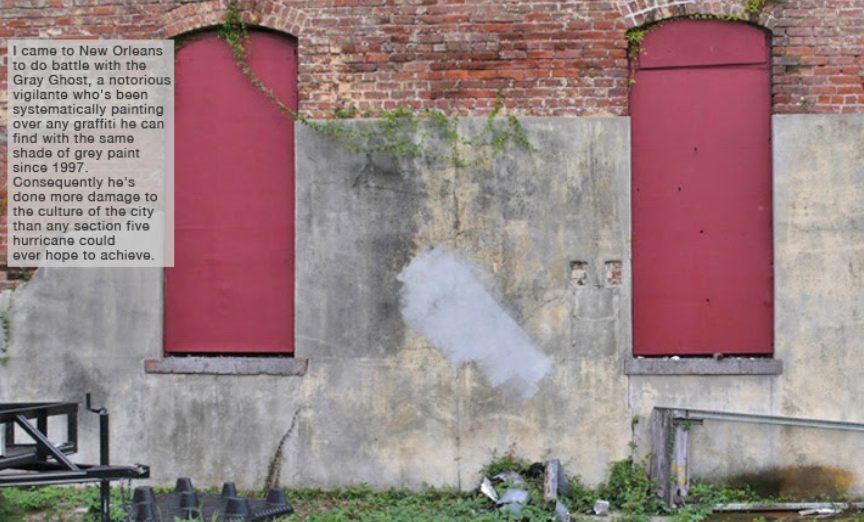
Banksy made the confrontation explicit. Describing his New Orleans intervention, he wrote that he had come to the city “to do battle with the Gray Ghost,” accusing Radtke of systematically erasing its graffiti culture. The conflict fitted perfectly within the broader New Orleans project. Banksy had ostensibly come to draw attention to the incomplete recovery from Katrina, yet he also became fascinated by another kind of clean-up: the attempt to cleanse the city of unauthorized images.
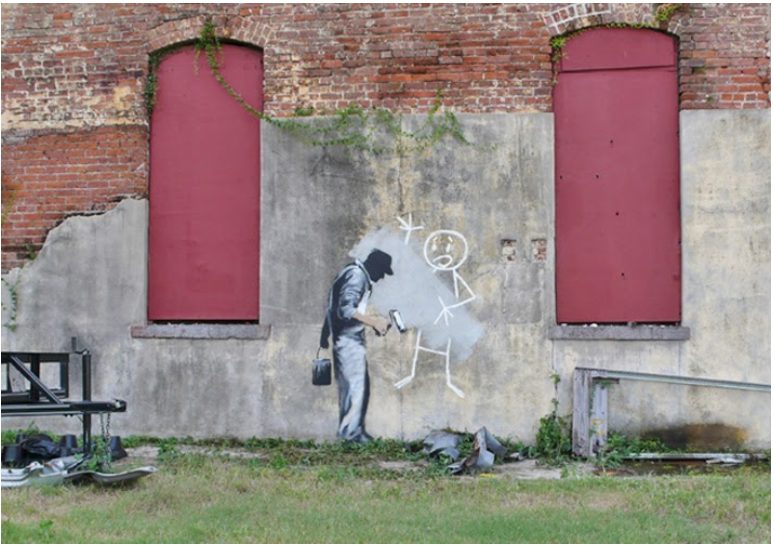
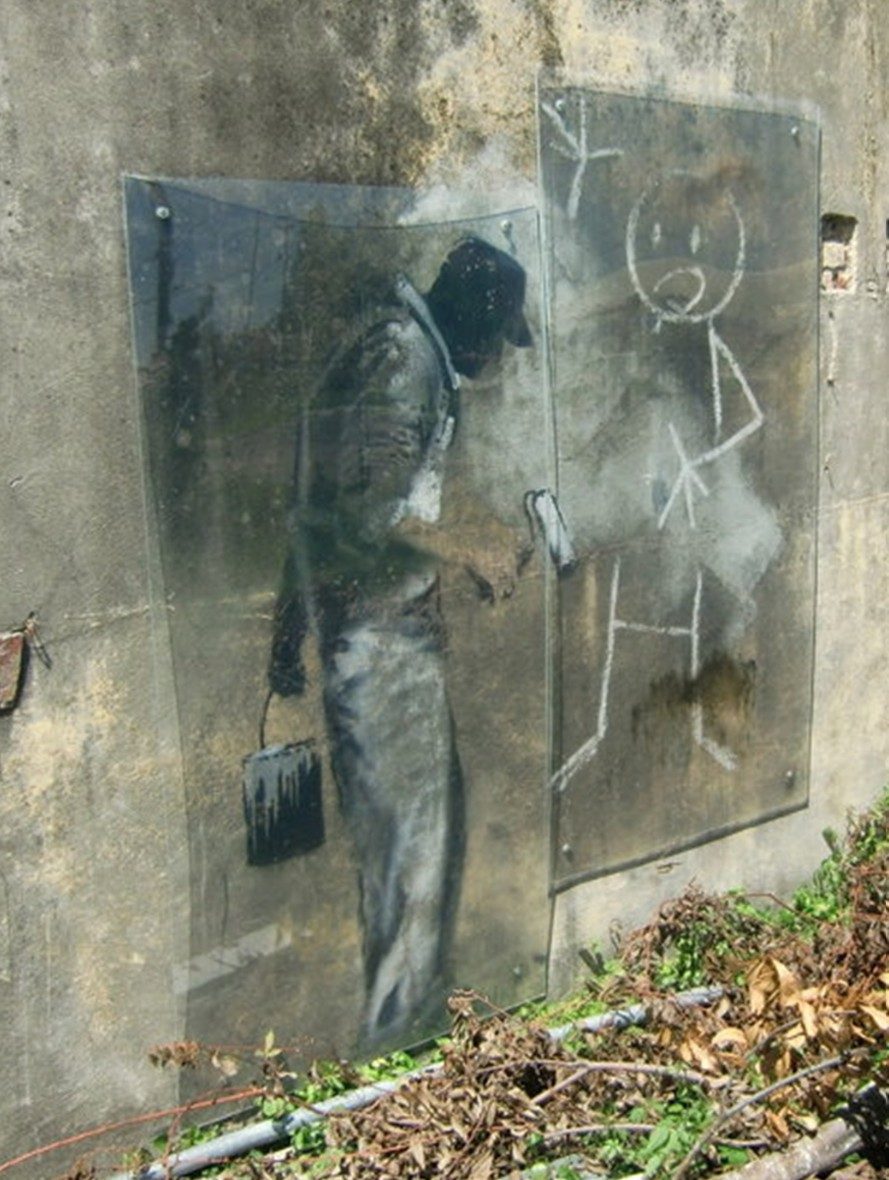
Gray Ghost Attacks Stick Figure was one of several works in which Banksy transformed this local dispute into a visual argument.
Turning Erasure into Art
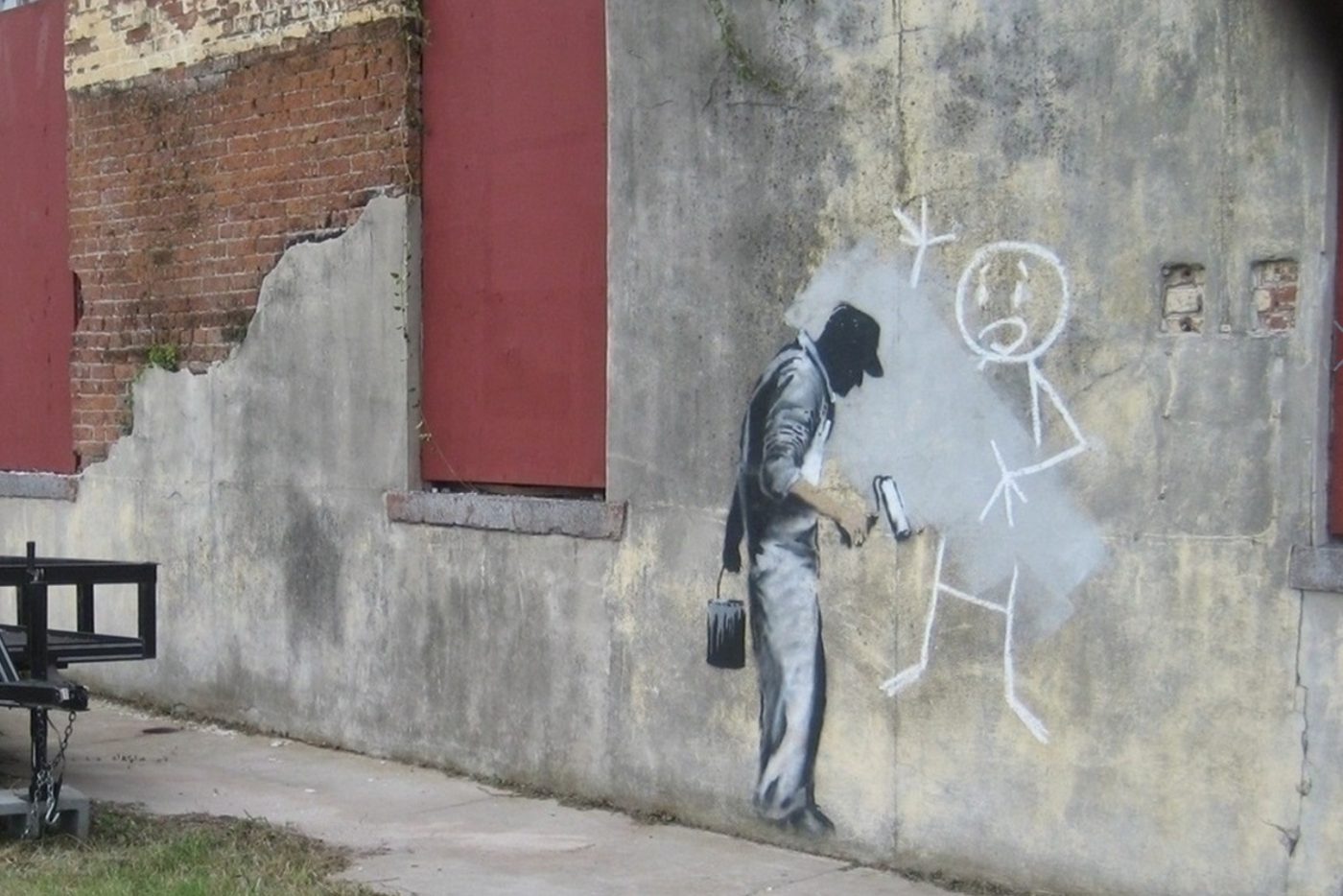
Painted on the side of a former firehouse at 514 Jackson Avenue, the composition depicts an anonymous workman calmly applying grey paint with a roller while a crude stick figure recoils before the advancing field of colour. Crucially, Banksy did not paint the entire composition himself. The diagonal patch of grey already existed: it had previously been applied by Radtke. Banksy incorporated it directly into the mural, converting an act of graffiti removal into one of the principal elements of his own work.
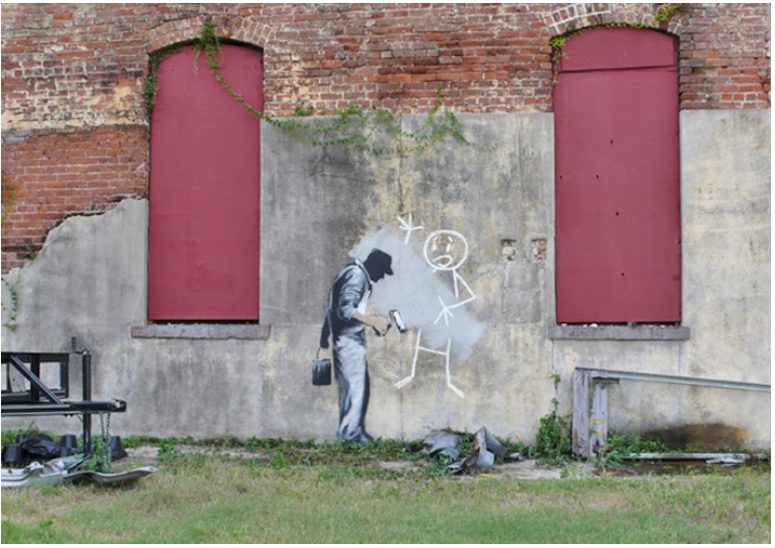
The intervention is exceptionally economical. On one side stands the grey painter, rendered with the relatively naturalistic stencil technique familiar from Banksy's work. On the other is an almost primitive stick figure, reduced to the simplest possible expression of human presence. Between them lies the grey paint itself, spreading across the wall like an engulfing force.
Banksy's joke is therefore more complicated than a simple attack on an anti-graffiti campaigner. Radtke had attempted to erase graffiti; Banksy made the erasure visible. The Gray Ghost's paint ceased to be the absence of an artwork and became part of one. Without knowing it, Radtke had effectively supplied Banksy with both his subject and part of his composition.
The reversal goes to the heart of Banksy's practice. If both men apply paint to a wall without necessarily having permission, where precisely does vandalism end and civic improvement begin? Is the unauthorized image the act of vandalism, or can its unauthorized destruction be vandalism too? The question was particularly pointed in New Orleans: only weeks after Banksy's intervention, Radtke was issued a summons after allegedly painting over a mural on private property whose owners specifically wanted it preserved.
Cleaning Up New Orleans
The Gray Ghost works also give Banksy's New Orleans intervention a deeper coherence. Katrina had left the city confronting destruction, abandonment and the enormous task of rebuilding. Banksy stated that he wanted to highlight the condition of the clean-up three years after the hurricane, before wryly acknowledging the contradiction of drawing on people's property while complaining that the clean-up was taking too long.
Against this background, the word “clean-up” acquires two very different meanings. One refers to rebuilding homes, infrastructure and communities after a catastrophe; the other to removing marks from walls. Banksy juxtaposed the two and implicitly asked what a city should prioritize preserving, repairing or erasing.
The Gray Ghost became the perfect antagonist because his grey rectangles embodied this ambiguity. They removed graffiti but left their own highly visible marks behind. Banksy did not need to defeat those marks. He simply changed the way they were seen.
From Street Wall to Auction
Unlike many of Banksy's New Orleans murals, Gray Ghost Attacks Stick Figure survived beyond its original life on the street, although no longer as part of the building for which it was conceived. The masonry section was eventually removed from the former firehouse, turning an immovable piece of New Orleans street art into an independent object weighing approximately 2,500 kilograms. It was subsequently exhibited at the Louisiana State Museum.
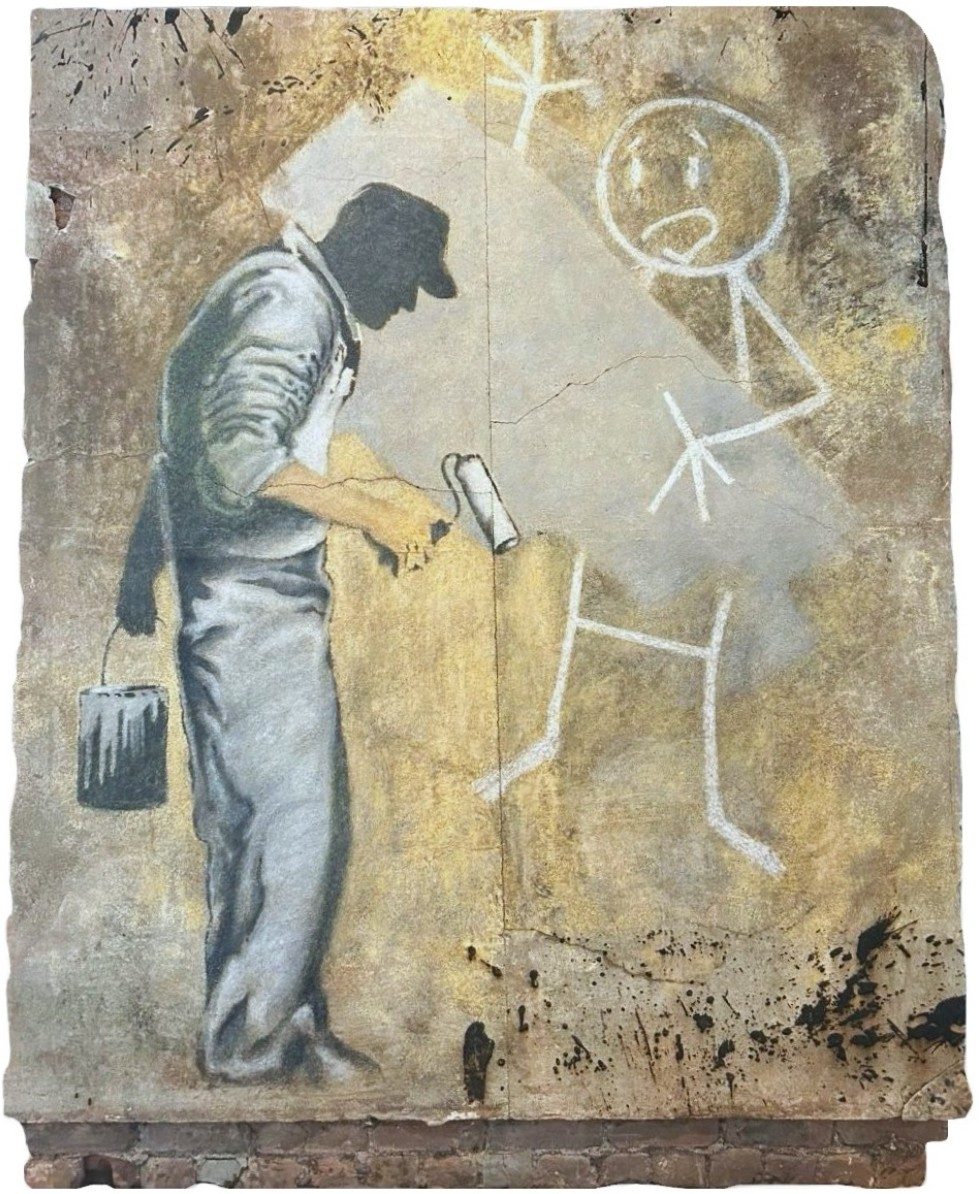
Its transformation culminated at auction on 28 March 2026, when Hessink's offered the complete wall section with an estimate of €600,000. It realized €812,500 including buyer's premium (approximately $937,440).
There is a final irony in this afterlife. Radtke's grey paint was intended to make street art disappear. Banksy transformed that paint into art; the wall was then physically extracted, preserved, exhibited and ultimately sold for more than €800,000.
What began as an act of erasure became something people went to extraordinary lengths to preserve.
STAY INFORMED
Receive the latest news, exhibitions, artworks and market updates on Banksy.